Anyone who has spent more than two hours behind the wheel knows the familiar ache — lower back tightening, tailbone pressure building, shoulders rounding forward. The seat looked fine at the dealership. So what went wrong?
Car seats feel uncomfortable for several interconnected reasons: the foam degrades and flattens over time, the seat shape rarely matches every body type, lumbar support is often poorly positioned, seat cushion angles put pressure on the wrong points, and many modern seats prioritize aesthetics or cost-cutting over genuine ergonomic design. Add heat retention from synthetic materials and restricted airflow, and prolonged discomfort is almost unavoidable in most stock vehicle seats.
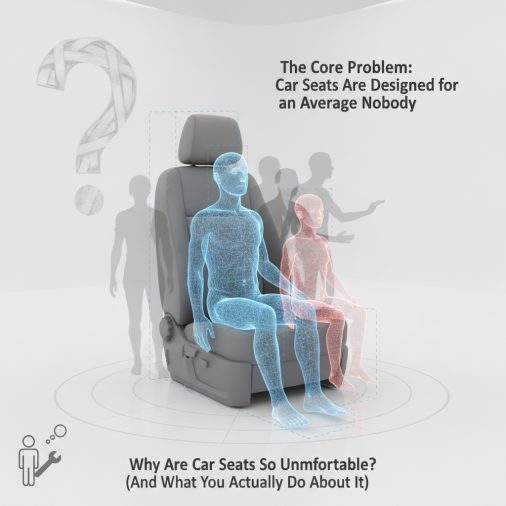
The Core Problem: Car Seats Are Designed for an Average Nobody
Automotive seat engineers work from a standardized human model — typically based on average height, weight, and proportions. That average rarely matches any single driver perfectly. Taller drivers find the headrest pushes their neck forward. Shorter drivers lose lumbar support entirely because the curve hits them in the wrong vertebral region. Wider-hip drivers experience pressure on the lateral bolsters meant for cornering support.
The seat that felt acceptable for a 20-minute test drive reveals its weaknesses on a 3-hour highway run. Static pressure on the ischial tuberosities — the bony points at the base of your pelvis — builds steadily, cutting circulation and triggering pain that radiates into the hips, lower back, and thighs.
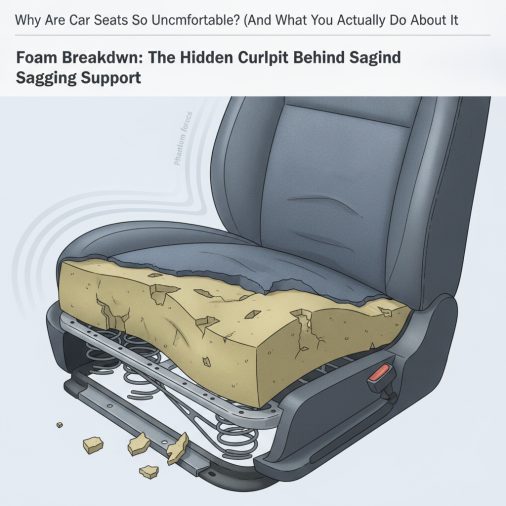
Foam Breakdown: The Hidden Culprit Behind Sagging Support
New seats feel noticeably better than seats with 50,000 miles on them, and that difference comes almost entirely from foam deterioration. Factory seat foam is a layered system — typically a firmer base foam with softer comfort foam on top. Over time, repeated compression cycles break down the cell structure of the foam, particularly in the primary contact zones: the seat base directly under the thighs and the lumbar region.
A seat that has lost its foam integrity no longer distributes weight across the intended surface area. Instead, pressure concentrates on the points making direct contact with the seat pan or frame beneath. Many owners notice this as a “bottoming out” sensation — sitting into the seat rather than on it.
If your vehicle has high mileage and the seat discomfort has gradually worsened, foam degradation is likely a major factor. Replacing or augmenting the seat foam can meaningfully restore support. Options like high-quality replacement foams for car seats can restore the layered support structure that original equipment loses with age, which is worth investigating before spending money on more complex interventions.
Poor Lumbar Support: Positioned for the Manual, Not for Your Back
Factory lumbar support systems — both fixed and adjustable — are a major source of driver complaints. Most OEM adjustable lumbar systems move on a single axis, pushing a small bladder or curved support outward. The problem is that natural lumbar curvature varies significantly between individuals in both location and degree.
An inflatable lumbar set too high creates sharp pressure between the shoulder blades. Set too low, it pushes into the sacrum and offers no actual lumbar support. Many drivers abandon the lumbar adjustment entirely rather than spend 30 minutes experimenting, which leaves them sitting in a position that encourages posterior pelvic tilt — the lower back rounds out, flattening the natural curve and loading the lumbar discs.
Premium vehicle seats from brands like Recaro, Volvo, and Mercedes-Benz invest significantly more engineering into multi-axis, multi-zone lumbar systems, which is one reason long-distance driving in a well-equipped luxury vehicle feels fundamentally different from the same journey in a budget sedan.
Heat and Sweat: Why Synthetic Seat Materials Make Everything Worse
Most base-trim and mid-trim seats use polyester fabric, vinyl, or bonded leather — all of which trap heat aggressively. After 20–30 minutes, the seat surface temperature rises noticeably, moisture builds at contact points, and the combination of heat and dampness intensifies pressure discomfort. This is a physical feedback loop: heat increases tissue sensitivity, which makes the same pressure feel more painful.
Vehicles with heated seats and no ventilated seat option frequently suffer this problem in warmer climates. Even in temperate conditions, a black vinyl seat on a summer day can become genuinely difficult to tolerate on long drives.
Genuine leather breathes slightly better than bonded leather or vinyl but still requires perforations and airflow to manage heat meaningfully. That is why breathable car seats designed for cooler rides have become a genuine market category — airflow through the seating surface makes a measurable difference in sustained comfort, especially for drivers spending several hours daily behind the wheel.
Bolster Pressure: Sport Seats That Grip Instead of Support
Many vehicles — particularly sporty trims and performance-oriented models — use seats with pronounced lateral bolsters. These tall, firm side bolsters keep the driver planted during cornering, which is genuinely useful at track speeds. In daily stop-and-go commuting, those same bolsters dig into the outer thighs and hips on every entry and exit.
Drivers with wider hip measurements frequently find that sport bucket seats apply continuous lateral pressure across the thigh and hip area, restricting blood flow and creating pain that gets misattributed to the seat cushion itself. The fix for this is rarely obvious — the bolster shape is structural, not adjustable, and aftermarket seat replacement becomes the only real solution.
Seat Angle and Thigh Support: The Geometry Problem
The cushion tilt and thigh support length directly affect how evenly weight is distributed across the seat. A seat cushion angled too far upward at the front edge compresses the underside of the thighs, reducing circulation to the lower legs. A cushion too flat allows the pelvis to slide forward, creating a slumped posture that loads the lower lumbar region.
Thigh support extension — adjustable on some higher-trim seats — addresses this for taller drivers. Without it, the thigh contact zone ends too close to the knee, concentrating pressure at the back of the thigh rather than distributing it evenly from hip to knee. Many owners don’t recognize this as a seat geometry issue and assume the cushion is simply too firm.
What You Can Actually Do About It
The practical fixes depend on which specific problem is affecting you most.
For general cushion comfort and foam degradation:
– A quality seat cushion wedge or memory foam topper can redistribute pressure in the short term
– Foam replacement is a longer-term solution when the seat structure itself has degraded
For lumbar problems:
– Experiment with all available lumbar and seat back angle adjustments before buying accessories
– An aftermarket lumbar cushion placed at the correct vertebral location often outperforms built-in systems — the LoveHome Foldable High Resilience Foam Lumbar Support Cushion is a commonly cited option for repositionable lumbar support without modifying the seat
For heat and moisture:
– Aftermarket seat covers with mesh or perforated materials improve airflow substantially
– Ventilated seat kits exist for some vehicles but require significant installation work
For bolster discomfort:
– Seat covers can add a small amount of padding to lateral bolster contact zones
– In severe cases, seat replacement or a quality aftermarket seat is the most effective correction
For seat height and thigh support:
– Adjust the seat as far back as safely comfortable while still reaching all controls
– A small seat wedge raising the rear of the cushion slightly can tilt the pelvis forward into a more neutral position
Long Drives vs. Short Commutes: Why Distance Changes Everything
A seat that feels perfectly acceptable during a 15-minute commute often reveals serious ergonomic shortcomings on a 4-hour drive. Short trips don’t give discomfort enough time to accumulate. Sustained static posture, even in a reasonably designed seat, allows soft tissue compression and reduced circulation to build into genuine pain.
Long-haul drivers — truck drivers, road-trip regulars, daily highway commuters — are far more likely to modify their seat setup than urban drivers. A simple strategy that consistently helps is breaking static posture every 60–90 minutes by briefly adjusting the seat position. Moving the seat forward or backward slightly changes which tissues bear load, giving compressed areas a chance to recover.
Why Some Cars Are Simply Built With Better Seats
Not all uncomfortable seats are the result of age or foam breakdown. Some vehicles are engineered with seat comfort as a clear priority; others treat seating as a cost center.
Volvo consistently earns recognition for ergonomic seat design, particularly for long-distance driving. BMW seats are well-regarded for support even in the base configuration. Honda’s CR-V and Toyota’s Camry receive generally positive long-term seat comfort reviews from owners. Budget compact sedans and economy SUVs frequently use thinner, cheaper foam and simpler seat structures that prioritize production cost over sustained comfort.
Trim level matters significantly within the same model. A base-trim seat with cloth fabric and no lumbar adjustment can feel noticeably worse than the same vehicle’s upper trim using leather, adjustable lumbar, and thicker seat padding. Before assuming a vehicle’s seats are simply poor, check whether upper trim versions offer meaningfully different seat specifications.
Frequently Asked Questions
Why does my lower back hurt after driving even short distances?
Short-distance lower back pain during driving is usually related to poor lumbar support positioning, seat-back angle, or a collapsed seat cushion that forces the pelvis into a posterior tilt. Check whether your lumbar adjustment is positioned at the natural curve of your lower back — roughly at the belt line — rather than higher up. A forward-tilted pelvis with a neutral lumbar curve dramatically reduces lower back strain during driving.
Can a seat cushion actually fix car seat discomfort, or is it just a temporary band-aid?
A seat cushion addresses cushion-level problems — pressure distribution, heat, and surface firmness — but cannot fix structural issues like a broken seat frame, collapsed seat springs, or a permanently flattened seat pan. For foam degradation or pressure point issues, a quality memory foam or gel-infused cushion genuinely helps. For lumbar, bolster, or seat angle problems, the cushion alone is insufficient.
Why are sports car seats more uncomfortable for daily driving?
Sport seats prioritize lateral support and a low-profile design that positions the driver close to the floor. The firm foam, pronounced bolsters, and reduced padding make them excellent for spirited driving but fatiguing in stop-and-go traffic. Many performance seats also lack meaningful lumbar adjustment. The trade-off is intentional — track-oriented support versus daily-drive comfort.
Does seat material really affect how uncomfortable a seat feels?
Yes, meaningfully. Vinyl and bonded leather trap heat and moisture, which intensifies pressure discomfort. Cloth breathes better but often provides less surface structure. Genuine perforated leather with ventilation offers the best comfort balance in warm conditions. If your vehicle lacks ventilated seats and you drive frequently in heat, a breathable seat cover can reduce thermal discomfort substantially.
Is it worth replacing OEM seats with aftermarket seats for comfort?
Aftermarket seat replacement is a significant investment — quality ergonomic aftermarket seats from brands like Recaro or Sparco range from several hundred to over a thousand dollars, plus installation. It makes sense for drivers with genuine long-term discomfort who have already exhausted simpler fixes. Ensure the seat is compatible with your vehicle’s side-curtain airbag system before purchasing; some aftermarket seats do not have integrated airbag provisions, which creates a meaningful safety concern.
Why do new car seats feel comfortable but then become painful over months of ownership?
New foam has full structural integrity and distributes pressure correctly. Over the first 12–24 months of regular use, foam compression cycles gradually reduce its recovery capacity, particularly in the primary contact zones. The seat doesn’t become worse suddenly — it degrades progressively, which is why many drivers don’t notice the change until the discomfort becomes significant.
Are luxury car seats significantly better than mainstream car seats?
Generally yes, but not universally. Premium vehicles typically use higher-density, multi-layer foam, more extensive lumbar adjustment systems, wider adjustment ranges, and better ventilation options. However, seat comfort is also subjective — a seat calibrated for a specific posture or body proportion may feel worse to someone outside that range regardless of price. Always test-drive for at least 30 minutes before assuming a luxury seat will work for your specific body type and driving position.
Final Thoughts
Car seat discomfort is rarely a single problem with a single fix. Foam degradation, poor lumbar positioning, heat retention, bolster pressure, and seat geometry all contribute — often simultaneously. Start by identifying which specific symptom is most severe, then address that root cause directly rather than layering generic solutions. If the discomfort developed gradually over time, foam breakdown is the most likely culprit. If it was present from the start, seat geometry or lumbar positioning mismatch is the more probable explanation. When simple adjustments and cushion upgrades don’t resolve the issue, confirming whether upper-trim seat options or aftermarket ergonomic solutions are compatible with your specific vehicle is the logical next step.