Running only two speakers but wondering if a four channel amp can squeeze more power into them — it’s a common question, and the answer matters for both sound quality and equipment safety.
Yes, you can connect a four channel amp to two speakers. The most effective method is bridging the amp, which combines two channels into one to nearly double the power output to each speaker. A typical four channel amp bridged down to two channels can deliver significantly more wattage per speaker than any single channel alone. However, bridging requires compatible speakers with a minimum impedance of 4 ohms — most bridged configurations require speakers rated at 4 ohms or higher to avoid overheating or damage.
How a Four Channel Amp Delivers Power to Speakers
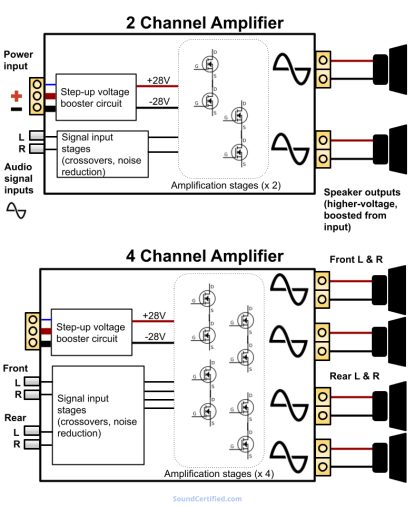
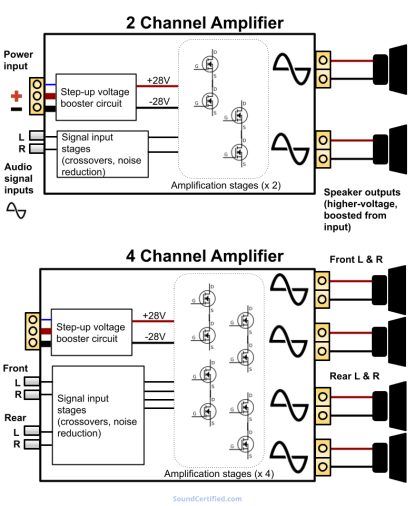
A four channel amplifier has four independent output channels, each rated at a specific wattage into a specific impedance. For example, an amp might be rated at 75 watts RMS per channel into 4 ohms. Run it at two channels and you’re only using half its capacity.
Bridging combines the output of two channels to drive a single speaker, effectively doubling the voltage swing and delivering roughly three to four times the power of one channel. That same 75-watt-per-channel amp might deliver 200–250 watts RMS when bridged into one speaker.
This is why bridging appeals to enthusiasts who want more output without buying a dedicated mono amp.
Bridging: The Primary Method for More Power
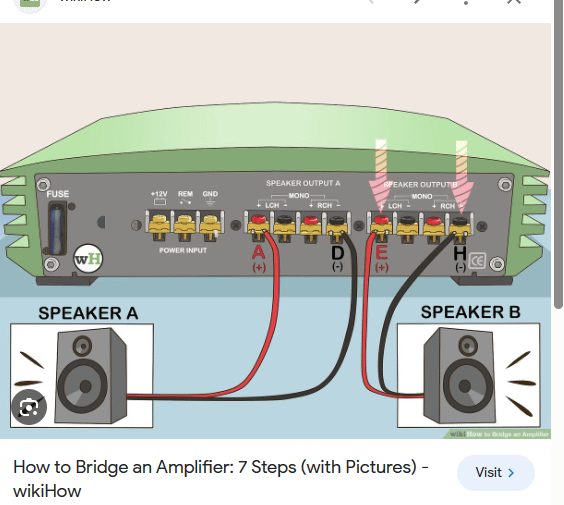
Bridging a four channel amp to two speakers uses channels 1+2 for the left speaker and channels 3+4 for the right speaker. Most amplifiers label bridge terminals on the speaker output panel, and many include a bridge mode switch or require a specific wiring sequence described in the owner’s manual.
How to bridge a four channel amp to two speakers:
- Locate the bridge terminals on the amp — typically labeled “+” on channel 1 and “–” on channel 2, and similarly for channels 3 and 4.
- Connect the left speaker’s positive wire to channel 1’s positive terminal and the negative wire to channel 2’s negative terminal.
- Connect the right speaker’s same way using channels 3 and 4.
- Check your amp’s manual — some require setting a bridge mode switch, which changes internal signal routing.
- Verify the speaker impedance is at or above the amp’s minimum bridged impedance (usually 4 ohms).
Never connect both speakers to the same bridged output. Each bridged pair drives one speaker only.
The Impedance Rule You Cannot Ignore
This is where most DIY installs go wrong. When an amp bridges two channels, the internal circuit sees the speaker’s impedance differently than in standard mode. Most amps that handle 2-ohm loads in stereo mode can only handle 4-ohm loads in bridged mode.
Connecting a 2-ohm speaker to a bridged output designed for 4-ohm minimum will cause:
- The amp to overheat rapidly
- Thermal protection shutdowns (the amp cutting out repeatedly)
- Permanent internal damage over time
- Potentially blown output transistors
Always check the amplifier’s specifications for its minimum bridged impedance. This is listed in the owner’s manual or on the manufacturer’s spec sheet. Do not guess.
Parallel Wiring: An Alternative When Bridging Isn’t Supported
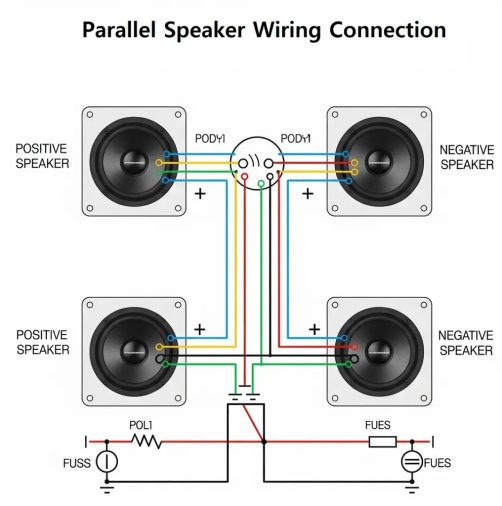
Some older or budget amplifiers don’t support bridging. In that case, you can still route all four channels to two speakers by wiring two channels in parallel to each speaker — but this approach has real limitations.
Wiring two channels in parallel to one speaker isn’t the same as bridging. The signal from both channels reaches the same speaker simultaneously, which can work but requires the channels to be fed identical signals and the impedance load to stay within limits.
In practice, this method is less common and less effective than bridging. Many technicians advise against it unless the amp specifically supports this configuration, because the channels can work against each other and create distortion or damage.
If bridging isn’t supported on your amp, a better solution is often replacing the amp with a two channel or mono amp that’s properly spec’d for your speakers.
Matching Amp Power to Speaker RMS Ratings
Getting more power to your speakers only helps if the speakers can handle it. Every speaker has a continuous RMS power rating and a peak power rating. The RMS rating is the one that matters for everyday listening.
A speaker rated at 150 watts RMS can handle up to 150 watts continuous. Running a bridged amp pushing 300 watts into that speaker will eventually blow the voice coil — not from a single burst, but from sustained overpowering during loud listening sessions.
The goal is to match amp output to speaker ratings, not to maximize raw power. A bridged four channel amp pushing 200 watts into a pair of 150-watt RMS speakers is a reasonable and safe match. Bridging to 400 watts into those same speakers is a risk.
When a Four Channel Amp Makes Sense for Two Speakers
There are legitimate reasons to run a four channel amp on only two speakers:
- Future expansion: You plan to add rear speakers or a subwoofer later and want amp headroom ready.
- Bi-amping: Some speaker systems use separate amplification for tweeter and woofer sections, allowing the four channels to drive two two-way speakers independently.
- Budget: You already own a four channel amp and don’t want to buy a separate two channel unit.
- Space: A single multi-channel amp takes less mounting space than two separate units.
Bi-amping is a more advanced configuration that requires a crossover network or active crossover processor. It’s worth researching separately if your speakers support it, because it can improve clarity and reduce distortion in each driver.
Gains, Crossovers, and Settings After Bridging
Once you’ve bridged the amp, a few settings matter significantly. Setting the gain (sensitivity) correctly prevents distortion and protects the speakers. The gain control on an amplifier doesn’t set the volume — it matches the amp’s input sensitivity to the head unit’s output voltage.
Set the gain too high and you’ll clip the signal, which introduces harsh square-wave distortion that damages tweeters faster than excessive clean power ever would.
If the amp has a built-in crossover, configure it appropriately for the speakers connected. Full-range speakers in a bridged setup typically don’t need a high-pass filter applied aggressively, but rolling off frequencies below 60–80 Hz protects the woofer cone from low-frequency stress it wasn’t designed to handle at high power.
Safety Considerations for Electrical Wiring
Amplifier installs involve your vehicle’s electrical system, and a few precautions are worth following:
- Disconnect the negative battery terminal before starting any wiring work.
- Use the correct gauge power cable for the amp’s current draw. An amplifier drawing 30–40 amps needs at minimum 8-gauge wire; higher-power amps may need 4-gauge.
- Always install an inline fuse within 18 inches (46 cm) of the battery on the power cable. This protects against a short circuit causing a fire.
- Route power cable away from signal cables. Running power and RCA cables side by side causes alternator whine and ground loop noise.
- Secure all connections and protect exposed terminals from contact with metal surfaces.
These aren’t optional steps. A poorly fused power wire in a vehicle is a genuine fire risk.
Comparison: Bridged vs. Stereo Two-Channel Operation
| Configuration | Channels Used | Power Per Speaker | Minimum Speaker Impedance | Best For |
|---|---|---|---|---|
| Stereo (2 of 4 channels) | 2 | Rated channel power | 2–4 ohms (amp-dependent) | Normal listening, future expansion |
| Bridged (all 4 channels) | 4 | ~3–4x single channel | Usually 4 ohms minimum | Maximum power from existing amp |
| Bi-amped (all 4 channels) | 4 | Divided between drivers | 4–8 ohms (speaker-dependent) | Two-way speakers, improved clarity |
FAQ
Can bridging a four channel amp to two speakers damage the amp?
Bridging is safe when the speakers meet the amp’s minimum bridged impedance requirement, typically 4 ohms. Connecting lower-impedance speakers in bridged mode causes excessive current draw, overheating, and can permanently damage the output stage. Always verify the bridged impedance specification in the amp’s owner’s manual before wiring.
What happens if my amp doesn’t have a bridge mode switch?
Many amplifiers support bridging through terminal wiring alone without a dedicated bridge switch. You connect speaker wires to the correct positive and negative terminals across two channels. Check the owner’s manual for your specific amp’s bridging wiring diagram. Some budget amps don’t support bridging at all — attempting it can damage the internal circuitry.
Will bridging a four channel amp to two speakers make the music noticeably louder?
Yes, in most cases. More clean RMS power to the speakers increases dynamic range and headroom, which translates to louder, cleaner output before distortion sets in. The improvement is most noticeable at higher volume levels. However, the gain must be set correctly — distorted power from an improperly set gain sounds worse than less power from a correctly tuned amp.
Can I bridge only two channels of a four channel amp and leave the other two unused?
Yes. Bridging channels 1 and 2 to drive one speaker while leaving channels 3 and 4 unconnected is generally safe and won’t harm the amp. Some installers do exactly this when temporarily running a single subwoofer from a four channel amp. The unused channels draw no meaningful power and generate no heat when no load is attached.
Is it better to buy a two channel amp or bridge a four channel amp for two speakers?
A dedicated two channel or mono amplifier designed for your speaker impedance and power requirement is usually the cleaner solution. A four channel amp bridged to two speakers works well but may run warmer and draws more current than a purpose-built unit. If you already own a compatible four channel amp, bridging it is a cost-effective option. If you’re buying new, match the amp to your specific setup.
What gauge speaker wire should I use between a bridged amp and my speakers?
For bridged amplifier setups delivering higher wattage, 16-gauge speaker wire is a minimum for short runs. For runs longer than 10 feet (3 meters), 14-gauge is more appropriate to minimize resistance-related power loss. Higher-power setups pushing 200+ watts benefit from 12-gauge wire. Thicker wire maintains signal integrity and reduces heat buildup at the connections.
Can I use a four channel amp bridged to two speakers in a factory stereo system without an aftermarket head unit?
You can, but it requires a line output converter (LOC) to step the factory speaker-level signal down to RCA-level input for the amplifier. The signal quality from a factory head unit is usually adequate for this application. Some LOCs include signal sensing for automatic amp turn-on, which simplifies the install when a dedicated remote wire isn’t accessible on the factory radio.
Bridging a four channel amp to two speakers is a legitimate and effective way to extract more power from existing equipment — provided the speakers meet the amp’s minimum bridged impedance requirement and the gain is set correctly. Match amplifier output to speaker RMS ratings, wire it properly with appropriate fusing, and the result is a cleaner, more powerful system without adding another component to the install.