Running a single subwoofer off two separate amplifiers sounds like a power upgrade, but it’s one of the most frequently misunderstood wiring scenarios in car audio. Get it wrong and you’ll damage both amps, the sub, or both.
Bridging a subwoofer to two amps simultaneously isn’t electrically safe or recommended — two amplifiers cannot share the same subwoofer outputs without risking ground loops, output conflicts, and component damage. Instead, the correct approach is to bridge each amplifier independently, wire one sub per bridged amp, or use a single bridged amp with dual voice coil wiring. The right configuration depends on your subwoofer’s impedance, voice coil setup, and each amplifier’s minimum stable load.
What “Bridging” Actually Means in Car Audio
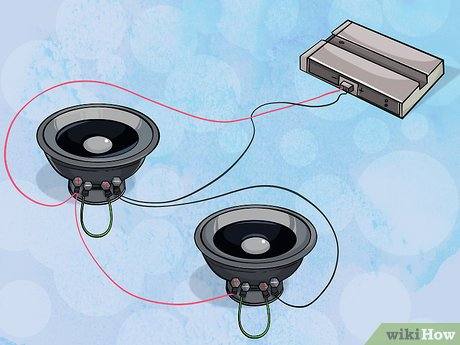
Bridging an amplifier combines two stereo channels into a single mono output, effectively doubling the available voltage and increasing wattage output. A stereo amp rated at 100W x 2 channels might produce 300–400W bridged mono — though actual output depends on the amp’s design and the load impedance.
Most modern car amplifiers include a dedicated bridge mode switch or require a specific speaker wire connection pattern to engage bridge mode. The minimum impedance the amp can safely drive usually doubles when bridged. An amp stable at 2 ohms in stereo mode is typically only stable at 4 ohms bridged.
This matters enormously when you’re planning a subwoofer system around two amplifiers.
Why You Can’t Connect One Subwoofer to Two Amps at Once
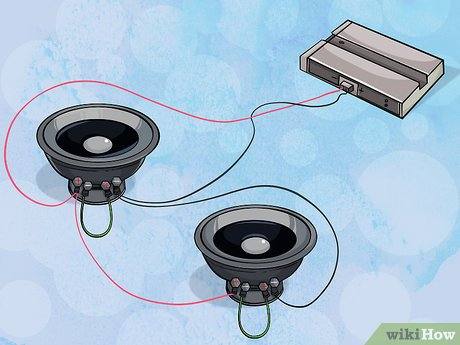
This is the core misconception. When two amplifier outputs are connected to the same speaker terminals simultaneously, both amps are trying to control the same driver at the same time. The output signals interfere with each other, creating voltage conflicts between the positive terminals of each amp.
In practice, this situation often results in:
- Overheating and thermal shutdown on one or both amps
- Blown output transistors inside one or both amplifiers
- Distorted or completely wrecked audio
- Potential damage to the subwoofer’s voice coil
There is no safe wiring method that connects two separate amplifier outputs directly to one sub’s terminals. Even if they’re playing the same signal, slight timing and voltage differences between the two amps will create problems.
The Correct Ways to Use Two Amps with a Subwoofer System
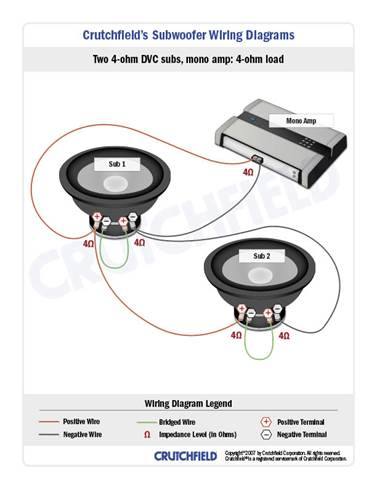
Rather than sharing one sub between two amps, here are the legitimate configurations that actually work:
Option 1: One Bridged Amp Per Subwoofer
If you’re running two subwoofers, bridge each amplifier independently and dedicate one bridged amp to each sub. This is the cleanest, most stable setup for dual-sub systems. Both amps receive the same mono signal from the head unit’s subwoofer output, but each controls its own driver.
- This configuration is ideal when:
- You have two separate single voice coil (SVC) subs
- Each amp is matched to the impedance its bridged output can handle
- You want maximum headroom and clean power delivery
Option 2: One Amp, Dual Voice Coil Subwoofer
A dual voice coil (DVC) subwoofer has two independent sets of winding terminals. This allows you to wire one voice coil to each amplifier — but only if the two amplifiers are identical and phase-locked together. In practice, this is extremely difficult to achieve reliably without professional-grade gear and a crossover network between them. Most car audio installers avoid this entirely.
Option 3: Bi-Amping with Passive or Active Crossovers
In some advanced setups, two amps handle different frequency ranges. One amp might run a subwoofer while the other handles midbass drivers. Each amplifier operates independently on separate speakers — they are never sharing the same driver simultaneously.
Option 4: Single Bridged Amp with the Right DVC Wiring
A single amp bridged to mono, paired with a DVC subwoofer wired to the correct final impedance, is often the simplest and most powerful single-sub solution. A DVC 4-ohm sub wired in parallel produces a 2-ohm load. Wired in series, it’s 8 ohms. Match the final impedance to the amp’s bridged minimum load.
How to Bridge a Single Amplifier for Your Subwoofer
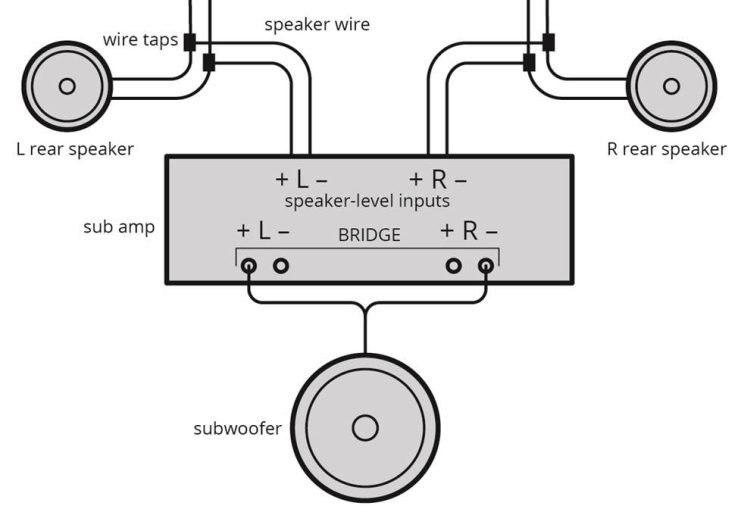
Here’s the practical step-by-step process for bridging one amplifier to a subwoofer correctly.
- What you’ll need:
- Your amplifier’s owner manual (check the bridging diagram specific to your model)
- Quality 12 or 14-gauge speaker wire
- Wire crimps or a soldering iron
- Multimeter (to verify impedance and polarity)
- RCA mono signal from the head unit or a line output converter
Steps:
- Confirm your amp supports bridge mode. Most 2-channel and 4-channel amplifiers support bridging. Check the owner’s manual — some entry-level amps do not.
- Determine the bridged minimum impedance. If your amp states 2 ohms stereo minimum, it can typically handle 4 ohms bridged. Running below that minimum will trigger thermal protection or cause failure.
- Calculate your subwoofer’s impedance at the final wiring configuration. For a DVC sub, decide series or parallel. For a SVC sub, the impedance is fixed.
- Set the amp’s bridge mode switch to MONO or BRIDGE, depending on how your unit labels it.
- Connect the positive speaker wire to Channel 1’s positive (+) terminal.
- Connect the negative speaker wire to Channel 2’s positive (+) terminal. This is the correct bridged wiring — do not use the negative terminals for the negative wire in bridge mode.
- Run a single RCA from the head unit’s subwoofer output to Channel 1’s RCA input. Some amps automatically sum both channels when bridged; consult the manual.
- Set the amp’s low-pass crossover — typically 80 Hz is a common starting point, though tuning to your subwoofer’s specs and cabin acoustics will improve results.
- Set the gain using a multimeter or by ear, starting low to avoid clipping. A well-known reference tool for this process is the Dayton Audio iMM-6 Calibrated Measurement Microphone, which can help you tune your system more accurately using a smartphone app.
- Test at low volume first, checking for heat, distortion, or amp protection triggers before pushing power.
Impedance Matching: The Most Common Mistake
Mismatched impedance is the most frequent cause of amp failure in bridged setups. Many owners see a 1000W rated subwoofer and assume more amp power is always better — but the load the amp sees matters more than peak watt ratings.
Here’s a quick reference for common configurations:
| Sub Type | Wiring | Final Impedance |
|---|---|---|
| SVC 4-ohm | Single | 4 ohms |
| DVC 4-ohm | Parallel | 2 ohms |
| DVC 4-ohm | Series | 8 ohms |
| DVC 2-ohm | Parallel | 1 ohm |
| DVC 2-ohm | Series | 4 ohms |
| Two SVC 4-ohm subs | Parallel | 2 ohms |
| Two SVC 4-ohm subs | Series | 8 ohms |
Always verify the bridged minimum impedance in your amplifier’s manual before finalizing the wiring.
Signal Distribution When Using Two Amps
If you’re running two separate amplifiers — one for the subwoofer and one for full-range speakers — signal distribution becomes important. Use a quality RCA Y-adapter or a head unit with multiple preamp outputs to split the signal cleanly.
Avoid long, unshielded RCA runs near power cables. Ground loops are a common source of alternator whine in dual-amp systems. Keep RCA cables on the opposite side of the vehicle from power wires, and make sure both amps share the same chassis ground point to prevent voltage differences between them.
A well-made RCA splitter cable like the Scosche RCA to Dual RCA Y-Adapter can help cleanly distribute signal to two separate amps without significant signal loss.
When to Reconsider the Two-Amp Setup
Two amps draw more current, generate more heat, and require more complex wiring than a single-amp system. Before committing, consider whether a single high-output monoblock amplifier might serve your goals better. Monoblocks are specifically designed for subwoofer duty, are typically stable at low impedances, and simplify installation significantly.
For most daily-driven vehicles where the goal is quality bass rather than competition-level output, one properly matched monoblock amplifier and one DVC subwoofer will outperform a poorly planned dual-amp system.
FAQ
Can I run one subwoofer off two amps at the same time?
No. Connecting two amplifier outputs to the same subwoofer terminals simultaneously causes voltage conflicts between the two outputs. This typically results in overheating, distorted audio, blown output transistors in one or both amplifiers, and potential voice coil damage in the subwoofer. There is no safe wiring method for this configuration.
What is the minimum impedance I should run on a bridged amp?
Most amplifiers double their minimum impedance in bridge mode. An amp stable at 2 ohms stereo will typically only handle 4 ohms bridged. Running below the minimum stable impedance in bridge mode causes the amp to overheat, enter protection mode, or sustain permanent damage. Always confirm the bridged impedance rating in your amplifier’s documentation.
How do I know if my amp is correctly in bridge mode?
Check your amplifier’s manual for the bridge mode switch location and correct speaker terminal connections. In bridge mode, the positive speaker wire connects to Channel 1’s positive terminal, and the negative wire connects to Channel 2’s positive terminal — not a negative terminal. Many amps also have an indicator light or label confirming bridge mode is active.
Can two amps share the same ground point in a dual-amp system?
Yes — in fact, grounding both amps to the same chassis location is strongly recommended. Separate ground points with slight voltage differences between them are a leading cause of ground loops and alternator whine. Use a ground distribution block or bolt both amp grounds to the same clean, bare-metal chassis location.
What’s the difference between bridging an amp and running it in stereo for a subwoofer?
Bridging combines two channels into one mono output, roughly doubling the available power to a single subwoofer. Running a sub in stereo (using one channel) delivers lower power but is a more stable configuration at low impedances. Bridging gives more output but requires a higher minimum load. The right choice depends on your sub’s impedance and the amp’s bridged capability.
Is it better to run two amps or one monoblock for a subwoofer system?
For dedicated subwoofer applications, a monoblock amplifier is usually the cleaner, simpler choice. Monoblocks are designed specifically for mono, low-frequency duty and are often stable at 1 ohm. Two general-purpose amps bridged to sub duty adds wiring complexity, increased current draw, and heat without always delivering better sound quality than a well-matched monoblock.
What happens if I bridge a non-bridgeable amplifier?
Bridging an amplifier that doesn’t support bridge mode can permanently destroy it. The internal output stage is not designed to handle the load conditions created by non-bridged operation in that configuration. Always verify bridge mode support in the amp’s manual or on the manufacturer’s website before attempting any bridged wiring.
The key takeaway: two amps cannot safely share one subwoofer’s output terminals. Bridge each amplifier independently, assign each to its own driver, and match impedance carefully before powering the system. A correctly bridged single amp with a well-matched DVC subwoofer often delivers more reliable, higher-quality bass than a complicated dual-amp arrangement.