Car seat laws in the Australian Capital Territory exist to protect children during some of the most vulnerable moments of road travel. Getting them wrong isn’t just a legal risk — it’s a safety one.
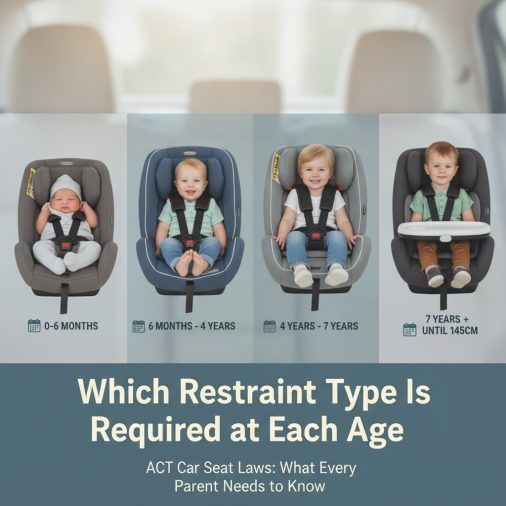
In the ACT, children must use an approved child restraint appropriate for their age and size. Infants under six months must use a rearward-facing restraint. Children aged six months to under four years must use a rearward-facing or forward-facing restraint with a harness. Children aged four to under seven years must use a forward-facing seat with a harness or an approved booster seat. From seven years, children may use a booster seat or adult seatbelt when the seatbelt fits correctly. These rules align with Australian Standard AS/NZS 1754 and are enforced under ACT Road Transport legislation.
Which Restraint Type Is Required at Each Age
ACT law follows a stage-based system. Each stage is tied to a child’s age and, importantly, their physical size and developmental needs. Moving a child to the next stage too early — simply because they seem big enough — is a common mistake that can compromise crash protection.
Here is a clear breakdown of the legal requirements:
| Age Group | Required Restraint |
|—|—|
| Birth to under 6 months | Rearward-facing restraint only |
| 6 months to under 4 years | Rearward-facing or forward-facing with harness |
| 4 years to under 7 years | Forward-facing with harness or approved booster |
| 7 years and older | Approved booster or adult seatbelt (if fit is correct) |
The law sets minimum age thresholds. In practice, many child safety experts and organisations like Kidsafe recommend keeping children rearward-facing and in harnessed seats for as long as the restraint allows, well beyond the legal minimum age for transition.
What “Approved” Actually Means for a Car Seat in the ACT
A child restraint used in the ACT must comply with Australian Standard AS/NZS 1754. This standard applies to all restraints sold in Australia and covers structural integrity, harness strength, and installation requirements.
Restraints must display an approved label confirming AS/NZS 1754 compliance. Second-hand seats that are expired, involved in a crash, or missing their compliance label should not be used. A seat without a verifiable compliance label cannot be confirmed as legally acceptable or structurally sound.
Imported seats purchased overseas, including those meeting US FMVSS 213 or European ECE R44 standards, do not meet Australian compliance requirements and are not legally permissible in the ACT.
Installation Requirements and Who Can Install the Seat
In the ACT, the driver of the vehicle is legally responsible for ensuring that a child under the age of 16 is properly restrained. This includes correct installation of the child restraint itself.
Incorrect installation is one of the most frequently cited problems with child seat use across Australia. Common errors include:
– Harness straps that are too loose or routed incorrectly
– The seat installed at the wrong recline angle
– The seatbelt or ISOFIX anchors not fully engaged
– Top tether strap not connected or not tensioned properly
Every new vehicle sold in Australia since 2004 is required to have top tether anchor points in the rear seating positions. ISOFIX anchorage points became mandatory for new vehicles from 2009 onward. Older vehicles may have neither, requiring lap-sash belt installation instead.
If you are unsure about installation, accredited child restraint fitting stations operate across the ACT. Kidsafe ACT and NRMA offer fitting checks where trained technicians can inspect the installation at no charge or a modest fee. Using a purpose-designed car seat protector for child seats underneath the restraint is also worth considering, as it prevents the base from damaging your vehicle’s upholstery without affecting the seat’s stability when installed correctly.
Seating Position Rules: Where Can a Child Sit?
ACT law requires that children under four years of age must not travel in the front seat of a vehicle that has two or more rows. In practical terms, this means infants and toddlers must be placed in the rear.
Children aged four to seven years should also travel in the rear seat where possible. If the rear seats are already occupied by younger children, a child in this age group may use the front seat, provided a correctly fitted child restraint is used.
Children seven years and older may sit in the front seat with an appropriate restraint.
For vehicles with only one row of seating — such as some utes, vans, or older two-seater vehicles — different rules apply. A child may be seated in the front if it is the only seating available and a suitable restraint is used. Where an active front airbag is present, rearward-facing seats must not be positioned in front of it. This is a critical safety consideration specific to certain cabin configurations.
Penalties for Non-Compliance in the ACT
Failing to correctly restrain a child in the ACT carries financial penalties and demerit points. Exact penalty amounts are set by ACT Road Transport legislation and are subject to periodic revision, so checking the current ACT government road rules website or Transport Canberra for updated figures is advisable.
Generally, penalties apply per unrestrained child, meaning a vehicle carrying two improperly restrained children may attract separate infringements for each.
Beyond the legal consequences, the crash safety implications are significant. An unrestrained or improperly restrained child is far more likely to sustain serious or fatal injuries in a collision, even at relatively low speeds.
Taxis, Rideshare, and Borrowed Vehicles
Parents sometimes assume that taxis and rideshare vehicles are exempt from child restraint requirements. In the ACT, children travelling in taxis or rideshare vehicles are generally still required to be restrained in an appropriate child seat.
Some limited exemptions may apply in specific circumstances, but these are narrow. The safest and most practical approach is to carry a portable or travel-specific restraint when using rideshare services with young children. Compact, lightweight options designed for travel exist specifically for this scenario.
For families who frequently travel by air and then use rental cars or rideshare at the destination, a car seat dolly for airport travel can make transporting a bulky restraint through terminals significantly more manageable.
When a Child Can Transition to an Adult Seatbelt
Children seven years and older may legally use an adult seatbelt in the ACT, but the fit of that seatbelt matters. A seatbelt that does not fit a child correctly provides reduced protection and can itself cause injury in a crash.
A seatbelt generally fits correctly when:
– The lap portion sits flat across the upper thighs, not the soft abdomen
– The shoulder portion crosses the chest and collarbone, not the neck or face
– The child can maintain this position comfortably throughout the journey without slouching
If the belt does not fit this way, the child should continue using a booster seat until the fit is correct. Children who fall asleep and slump forward, pulling the shoulder belt away from the chest, are also at increased risk. Many road safety specialists suggest children remain in a booster until they reach approximately 145 cm in height, though this is guidance rather than law.
ACT Car Seat Rules That Catch Parents Off Guard
A few specific scenarios trip up even careful parents:
Expired seats: Car seats carry an expiry date stamped on the base or frame, typically between six and ten years from manufacture. Using an expired seat may be non-compliant and certainly compromises structural integrity in a crash.
Crash-involved seats: A seat involved in any moderate or severe crash must be replaced, even if no visible damage is apparent. The internal structure can be compromised without obvious external signs.
Harness routing after a transition: When a child moves to a forward-facing seat, harness slots must be at or above the child’s shoulders. Using slots below shoulder height in a forward-facing position is incorrect and reduces crash protection.
Recline angle: Infant seats require a specific recline angle to prevent a newborn’s head from falling forward and restricting breathing. Most modern seats include a built-in angle indicator. Checking this after every installation is a simple step many parents skip.
Frequently Asked Questions About ACT Car Seat Laws
At what age can my child stop using a car seat in the ACT?
There is no single age at which a car seat becomes optional — the law is based on age thresholds combined with correct restraint fit. Children must use an appropriate restraint until they are at least seven years old. After that, they may use an adult seatbelt, but only when it fits correctly across the chest and thighs. Many children are not physically ready for an adult belt until they are between ten and twelve years old or reach approximately 145 cm in height.
Is my child allowed to sit in the front seat in the ACT?
Children under four must not travel in the front seat of a vehicle with two or more rows. Children aged four to seven may use the front seat only when the rear seats are occupied by younger children in restraints. Children seven and older may sit in the front with an appropriate restraint. A rearward-facing seat must never be placed in front of an active airbag.
Can I use a second-hand car seat purchased privately?
You can, but with significant caution. The seat must comply with AS/NZS 1754, carry a valid compliance label, not be expired, and must not have been involved in a crash. Without a complete history, it is difficult to confirm crash involvement. Many child safety specialists recommend against using second-hand seats unless the full history is known and verifiable.
Do car seat laws apply in rideshare vehicles like Uber in the ACT?
Generally yes. ACT road rules require appropriate child restraints in most vehicle types, including rideshare vehicles. While some narrow exemptions may exist in specific circumstances, parents should not assume rideshare trips are automatically exempt. Carrying a portable restraint is the safest approach when using these services with young children.
What happens if my child outgrows their forward-facing harness seat but isn’t ready for a booster?
A child should remain in a harnessed forward-facing seat until they reach the maximum weight or height limit specified by the manufacturer — not simply when they turn four. Once they genuinely outgrow the harness seat’s limits, an approved booster with a lap-sash seatbelt is the next appropriate step. Moving too early removes important crash protection.
How do I know if a car seat is installed correctly in my specific vehicle?
The best approach is to visit an accredited child restraint fitting station. Kidsafe ACT and various NRMA fitting service locations operate in and around Canberra. Technicians can assess whether the restraint is compatible with your vehicle’s anchor points, belt routing, and seat geometry — differences that matter between vehicle models and even individual seat positions within the same vehicle.
Does a child restraint fitted to the centre rear seat need a top tether?
Where a top tether anchor point is available for the centre rear seat position, the top tether must be used. Not all vehicles provide a centre tether point. In that case, the restraint must be installed using the available belt path and following the manufacturer’s instructions. Installing a forward-facing seat without the top tether, when an anchor is present, is non-compliant and significantly reduces crash protection.
Final Thoughts
ACT car seat laws are straightforward once you understand the age-based stages, but the details — correct installation, restraint compliance, expiry dates, and seat positioning — are where most errors occur. Keeping your child in each stage for as long as the restraint allows, rather than rushing to the next one at the earliest legal opportunity, consistently provides better crash protection. When in doubt about installation or seat fit, a professional fitting check is a practical and often free resource that takes the guesswork out of one of the most important safety decisions you make as a driver.