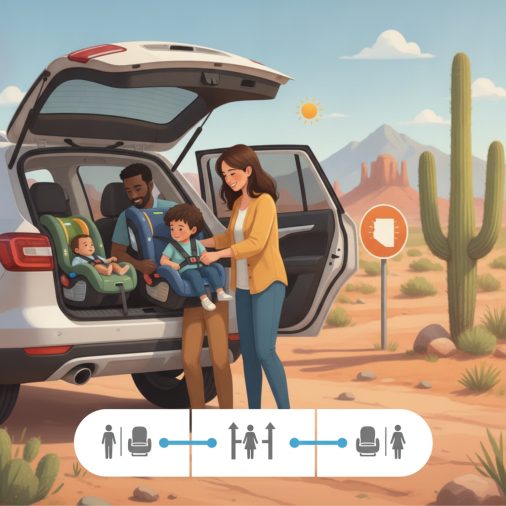
If you’re driving with a child in Arizona, getting the car seat right isn’t optional — it’s the law, and more importantly, it’s the most effective way to protect a young passenger in a crash.
Arizona car seat laws require children to use a rear-facing car seat from birth until they outgrow the seat’s manufacturer height and weight limits, then a forward-facing seat with a harness, then a booster seat until age 8 or until the child is 4 feet 9 inches tall. After that, children must use a properly fitting seat belt. All children under 8 must ride in a federally approved child restraint system. Violations can result in a fine and points on your driving record.
Arizona’s Car Seat Requirements by Age and Stage
Arizona law doesn’t strictly mandate transitions based on birthdays alone. The law is structured around developmental stages and seat manufacturer guidelines, which means your child may stay in one stage longer than a neighbor’s child of the same age.
Here’s how the stages break down under Arizona Revised Statutes § 28-907:
Stage 1 — Rear-Facing Infant or Convertible Seat
Infants and toddlers must ride rear-facing from birth. Arizona law aligns with the American Academy of Pediatrics (AAP) guidance: keep children rear-facing until they reach the maximum height or weight limit set by the car seat manufacturer. Most convertible seats allow rear-facing up to 40–50 pounds, meaning many children can remain rear-facing well past age 2.
Stage 2 — Forward-Facing Seat with Harness
Once a child outgrows the rear-facing limits, they move to a forward-facing seat with an internal harness. The harness should remain in use until the child reaches the seat’s forward-facing height and weight limits — typically between 40 and 65 pounds depending on the seat model.
Stage 3 — Booster Seat
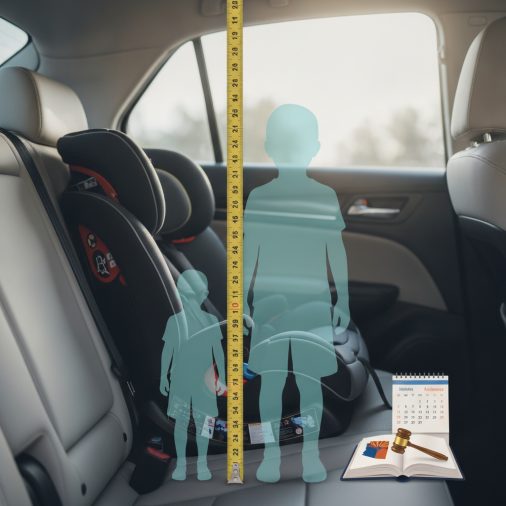
Children who have outgrown the harness seat move to a belt-positioning booster. Arizona law requires booster seat use until the child is either 8 years old or at least 4 feet 9 inches tall. The booster raises the child so the vehicle’s seat belt crosses the shoulder and chest correctly, not the neck.
Stage 4 — Seat Belt Only
Once a child meets the height threshold (4’9″) or turns 8, they may legally use the vehicle’s built-in seat belt. However, safety experts recommend children continue in a booster until the seat belt fits properly regardless of age — meaning the lap belt lies flat across the upper thighs and the shoulder belt crosses the chest and shoulder without touching the neck.
The 4’9″ Rule and Why Age Alone Isn’t Enough
Arizona’s 4-foot-9-inch height requirement exists because vehicle seat belts are designed for adult body proportions. A child who is too short will have the shoulder belt crossing their neck or face rather than the chest, turning a safety device into a potential hazard.
Many children don’t reach 4’9″ until age 10, 11, or even 12. Turning 8 does not automatically mean a child is ready for a seat belt alone. Parents should use the 5-step seat belt fit test to confirm readiness:
1. Can the child sit with their back flat against the seat back?
2. Do their knees bend naturally at the edge of the seat?
3. Does the lap belt sit across the upper thighs, not the stomach?
4. Does the shoulder belt cross the chest and shoulder, not the neck?
5. Can the child maintain this position for the entire trip without slumping?
If the answer to any of these is no, the child should remain in a booster.
Rear Seat Requirement and Front Seat Exceptions
Arizona law does not specify a mandatory age for riding in the front seat, but the National Highway Traffic Safety Administration (NHTSA) recommends children under 13 ride in the rear seat whenever possible. Front passenger airbags deploy with significant force and are calibrated for adult bodies — a rear-facing seat placed in the front seat with an active airbag is extremely dangerous and should never occur.
If a vehicle has no rear seat — such as a pickup truck with a single cab — a rear-facing or forward-facing seat may be used in the front, but the passenger-side airbag should be disabled if the vehicle allows it and the seat manufacturer permits front placement.
Installation: Where Most Parents Get It Wrong
Correct installation matters as much as selecting the right seat stage. Studies cited by NHTSA have found that a significant percentage of car seats are installed with critical errors. The most common problems include:
– Too much harness slack — The harness should pass the pinch test: no fabric should remain between your fingers when you pinch the strap at the child’s shoulder.
– Incorrect recline angle — Rear-facing seats must recline at the angle specified by the seat manufacturer. Most seats include a built-in level indicator. Without the correct angle, a newborn’s head can fall forward, restricting the airway.
– Loose installation — The seat should not move more than 1 inch at the belt path when tested side-to-side and front-to-back.
– Chest clip position — The chest clip should sit at armpit level, not at the stomach.
– Using LATCH and seat belt simultaneously — Unless the seat’s manual explicitly permits it, do not use both LATCH anchors and the seat belt to install the seat. Most manufacturers specify one method.
If you’re unsure about installation, Arizona has certified child passenger safety technicians (CPSTs) available at inspection stations statewide. NHTSA’s website allows you to search for a certified inspection location by ZIP code at no charge.
If you use a child seat protector mat beneath the car seat, verify that the mat is approved for use with your specific seat. Some manufacturers warn that certain aftermarket mats can affect seat stability during a crash. Parents interested in protecting their upholstery should look for options specifically designed for this use — car seat protectors designed for child seats are built to maintain seat stability while guarding against dents, spills, and indentations.
Penalties for Non-Compliance in Arizona
Under ARS § 28-907, failure to properly restrain a child under 8 in an approved child restraint system is a civil traffic violation. Fines can reach $50 or more per violation, and the offense adds points to the driver’s license record. More importantly, a crash at even moderate speed with an improperly restrained child can result in serious injury or death that a correctly used seat would have largely prevented.
Choosing the Right Seat for Your Vehicle
Not every car seat fits equally well in every vehicle. Before purchasing, check whether the seat fits your vehicle’s seating geometry — some rear-facing convertible seats are very long and may not fit behind the driver’s seat in smaller sedans without significant adjustment.
Key compatibility factors to verify:
– LATCH anchor location and weight limits — Many vehicles cap LATCH system use at 65 pounds combined child-plus-seat weight. Beyond that, use the seat belt for installation even if the child is under 8.
– Seat belt routing path — Confirm the belt threads through the correct path on the seat (rear-facing vs. forward-facing paths are different on convertible seats).
– Rear seat depth and incline — Vehicles with steeply angled rear seats may require a seat with more adjustable recline options.
– Third-row compatibility — Some seats are not approved for installation in third-row seating. Check the manual before placing a seat there.
Special Situations: Taxis, Rideshares, and Rentals
Arizona law applies to the driver of the vehicle transporting the child. In a taxi or rideshare, the law places responsibility on the driver, but in practice parents traveling with children should bring their own car seat or use a travel-system solution when possible.
Some lightweight car seat and stroller combinations are specifically designed with travel convenience in mind, making them practical for rideshare and airport situations where carrying a full-size seat is impractical. For airport travel specifically, a car seat dolly designed for airport terminals can reduce the physical burden of transporting a seat through large terminals.
When to Replace a Car Seat
Arizona law doesn’t address seat replacement schedules, but manufacturers and safety organizations provide clear guidance:
– After any moderate to severe crash — Replace the seat even if it appears undamaged. Internal structural integrity may be compromised in ways that are not visible.
– After the expiration date — Car seats have printed expiration dates (typically 6–10 years from manufacture). Plastic degrades over time, and older seats may not meet current federal safety standards.
– If the seat is damaged, cracked, or missing parts — A compromised seat should not be used.
– If the child has outgrown the height or weight limits — Using a seat beyond its rated limits reduces its effectiveness in a crash.
FAQ
Does Arizona require rear-facing until age 2?
Arizona law does not specify a minimum age for transitioning from rear-facing. The requirement is that children remain rear-facing until they reach the maximum height or weight limits set by the car seat manufacturer. Many seats allow rear-facing well past age 2, and safety organizations recommend keeping children rear-facing as long as those limits permit.
What happens if my child is over 8 but still small for their age?
If your child is over 8 but has not yet reached 4 feet 9 inches, Arizona law no longer mandates a booster seat. However, safety experts strongly recommend continuing booster use until the seat belt fits correctly across the chest and upper thighs — not the neck or abdomen. Legal compliance and optimal safety are two different thresholds.
Can I use a secondhand car seat in Arizona?
Arizona does not prohibit secondhand seats, but safety organizations recommend against using one unless you can verify its full history. A seat involved in a crash, missing its manual, past its expiration date, or with unknown storage conditions may not perform as designed. When in doubt, purchase a new seat.
Is it legal to put a rear-facing seat in the front seat of a truck in Arizona?
If the vehicle has no rear seating — such as a single-cab truck — a child restraint may be used in the front seat. However, the passenger airbag must be disabled if possible and the seat manufacturer must approve front-seat installation. A rear-facing seat should never be placed in front of an active airbag.
What is the fine for not using a car seat in Arizona?
Failing to properly restrain a child under 8 in an approved child restraint system is a civil traffic violation under ARS § 28-907. Fines can reach $50 per offense, and the violation adds points to the driver’s license record. Repeat violations or cases involving injury may carry additional consequences.
Do Arizona car seat laws apply to rental cars?
Yes. Arizona law applies to any vehicle being driven in the state, including rental cars. The driver is responsible for ensuring children are properly restrained. Rental companies typically offer car seat rentals, though their condition and installation quality vary — bringing your own seat remains the most reliable option.
At what age can a child sit in the front seat in Arizona?
Arizona law does not specify a minimum front-seat age. NHTSA recommends children under 13 ride in the rear seat whenever possible due to airbag deployment risk. Children using rear-facing seats should never be placed in front of an active passenger airbag regardless of Arizona’s age guidelines.
Final Thoughts
Arizona’s car seat law is built around developmental stages rather than fixed ages for good reason — children grow at different rates, and a seat that fits correctly is far more protective than one chosen by birthday alone. The four-stage progression from rear-facing through booster and into a seat belt follows real crash-protection science. Verifying correct installation with a certified technician is one of the most valuable steps any Arizona parent can take, since even the right seat provides limited protection if it isn’t secured and adjusted properly.