Choosing the right 8 inch midrange speaker can transform your car audio system, delivering clear vocals and rich instrumentals across the frequencies where music lives most vividly. Unlike full-range speakers or subwoofers, dedicated midrange drivers handle the critical 200Hz to 5kHz band where voices, guitars, and most melodic content sit. The challenge lies in matching power handling, impedance, and sensitivity to your amplifier and existing setup while staying within your installation space. This guide examines five current 8 inch midrange models, comparing their voice coil construction, power ratings, and practical trade-offs to help you pick the speaker that fits your system’s needs and your listening preferences.
At a Glance
High Power Handling
PRV AUDIO 8MR600X-4
- 600 watts continuous program power with 2″ CCAW voice coil for serious output
- Ventilated voice coil gap reduces thermal compression during extended listening
- Requires verification of mounting depth and amplifier 4-ohm compatibility
For 8-Ohm Systems
Skar Audio FSX8-8
- 350 watts max power with 8-ohm impedance suits specific amplifier configurations
- 93.1 dB sensitivity rating delivers efficient output from moderate power
- Lower power rating may limit headroom in high-SPL competition builds
Vocal Clarity Focus
DS18 PRO-GM8.4B
- 1.5″ Kapton voice coil handles high temperatures for consistent daily performance
- Aluminum bullet dust cover protects internals while shaping midrange response
- 190W RMS requires matching with appropriately powered amplifier for best results
Higher RMS Output
DS18 PRO-X8.4BM
- 275 watts RMS provides higher continuous power than other DS18 midrange options
- 97dB sensitivity rating works efficiently with a wide range of amplifiers
- Red aluminum bullet design may not suit every interior aesthetic preference
Alternative 8-Ohm Option
DS18 PRO-GM8B
- 8-ohm impedance pairs with specific wiring configurations and amplifier loads
- Same 1.5″ Kapton voice coil construction as the 4-ohm PRO-GM8.4B model
- Lower 190W RMS limits maximum volume in demanding audio competition setups
Quick Product Comparison
| Speaker | Impedance | Standout Feature | Key Consideration |
|---|---|---|---|
| PRV 8MR600X-4 | 4 Ohm | 2″ CCAW voice coil, ventilated gap | 600W program power needs strong amp |
| Skar FSX8-8 | 8 Ohm | 93.1 dB sensitivity | 175W RMS moderate power |
| DS18 PRO-GM8.4B | 4 Ohm | Kapton voice coil, bullet cover | 190W RMS, vocal-focused range |
| DS18 PRO-X8.4BM | 4 Ohm | 275W RMS, 97dB sensitivity | Higher output than PRO-GM line |
| DS18 PRO-GM8B | 8 Ohm | Same construction as PRO-GM8.4B | 8-ohm wiring compatibility |
PRV AUDIO 8 Inch Midrange Speaker 8MR600X-4

The PRV AUDIO 8MR600X-4 targets serious car audio builders who need reliable midrange output at high power levels. Its 2-inch dual-layer voice coil and 600-watt continuous program rating make it suitable for competition systems or multi-way setups where vocal clarity and midbass punch matter. PRV positions this as a professional-grade component designed to work in compact enclosures without sacrificing thermal performance.
Verified Specifications
| Voice Coil | 2″ dual layer CCAW on polyimide former |
| Impedance | 4 ohms |
| Power Rating | 600 watts continuous program |
Key Features and Practical Benefits
The 2-inch voice coil is larger than typical 8-inch midrange speakers, which usually use 1.5-inch coils. This extra diameter increases heat dissipation and power handling, important when running high-output amplifiers for extended periods. The dual-layer CCAW winding on a polyimide former balances light weight with thermal stability.
Ventilated voice coil gaps help manage heat buildup during sustained high-power operation. This design reduces power compression, the phenomenon where speaker output drops as the voice coil heats up. For installers running competitive SPL systems or multi-hour events, this feature helps maintain consistent output levels.
PRV advertises high Xmax for increased midbass output, meaning the cone can move farther before distortion sets in. The double-roll dimple suspension design supports this extended excursion while maintaining control. The manufacturer claims excellent performance in compact enclosures, which matters in vehicles with limited door-panel depth or custom installations where space is tight.
Documented Advantages and Trade-Offs
The 600-watt continuous program rating is the highest among the supplied products, giving installers significant headroom for demanding audio content. The oversized voice coil and ventilated design address thermal management directly, which is a genuine engineering consideration in professional car audio.
The 4-ohm impedance is standard for car audio but requires proper amplifier matching. The product data does not specify sensitivity, frequency response range, or mounting depth, so installers will need to verify fitment and acoustic performance requirements before committing. The double-roll suspension is advertised as unique, but the data does not provide comparative excursion numbers or distortion figures to quantify the benefit.
Who Should Consider It
This speaker suits experienced installers building high-output three-way or four-way systems where dedicated midrange drivers handle vocals and upper-bass frequencies. Competition SPL builders and mobile audio professionals who need reliable thermal performance at sustained high power should evaluate this model. Buyers working in compact door installations or custom enclosures may benefit from the advertised compact-enclosure optimization, but should verify mounting dimensions and acoustic requirements with PRV directly before purchase.
Setup and Everyday Use
Professional installation is strongly recommended. The 4-ohm impedance requires an amplifier capable of stable output at that load, and the 600-watt rating means proper gain structure and impedance matching are critical to avoid damaging the speaker or amplifier. The speaker should be crossed over appropriately to avoid sending subwoofer-range frequencies to the midrange driver. Consult PRV’s published specifications for recommended crossover points, enclosure volume, and mounting hardware. Secure mounting is essential for excursion-capable speakers to prevent rattles and to protect the suspension during high-output operation.
Skar Audio FSX8-8 8" 350 Watt 8 Ohm Pro Audio Midrange

The Skar Audio FSX8-8 is an 8-ohm midrange speaker rated for 350 watts maximum and 175 watts RMS. Its higher impedance makes it suitable for series wiring in professional audio arrays or car audio systems where multiple speakers share an amplifier channel. The 93.1 dB sensitivity rating suggests efficient output with moderate amplifier power, which can be useful in budget builds or installations where amplifier wattage is limited.
Verified Specifications
| Impedance | 8 ohms |
| Power Rating | 350 watts max, 175 watts RMS |
| Voice Coil | 1.5″ |
| Magnet | Ferrite |
| Sensitivity | 93.1 dB 1w/1m |
Key Features and Practical Benefits
The 8-ohm impedance is less common in car audio, where 4-ohm speakers dominate, but it offers flexibility for multi-speaker wiring. Two FSX8-8 speakers wired in parallel present a 4-ohm load to the amplifier, while series wiring creates a 16-ohm load. This flexibility helps installers match speaker arrays to amplifier output stages without impedance-matching transformers.
The 93.1 dB sensitivity means the speaker produces 93.1 decibels of sound pressure when driven with 1 watt of power at 1 meter distance. This efficiency rating is competitive for an 8-inch midrange and suggests the speaker will produce reasonable volume levels without requiring hundreds of watts. For installers working with lower-power amplifiers or building efficient systems, this specification is a practical advantage.
The 1.5-inch voice coil is standard for this speaker size and is wound on a ferrite magnet structure. Ferrite magnets are heavier than neodymium but offer stable magnetic flux at a lower cost. The 175-watt RMS rating is modest compared to the PRV model but aligns with typical midrange duty in three-way systems where tweeters and subwoofers handle the frequency extremes.
Documented Advantages and Trade-Offs
The 8-ohm impedance and 93.1 dB sensitivity give this speaker clear wiring and efficiency advantages for certain system designs. Installers building multi-speaker arrays or working with amplifiers that deliver more power into higher impedances will find the FSX8-8 easier to integrate than typical 4-ohm models.
The 175-watt RMS power handling is the lowest among the supplied products, which limits headroom in high-output systems. The product data does not specify frequency response, excursion limits, mounting depth, or thermal management features, so installers must contact Skar Audio or consult published specifications to confirm suitability for specific enclosures and crossover designs. The ferrite magnet adds weight compared to neodymium alternatives, which may matter in weight-sensitive installations.
Who Should Consider It
This speaker is a practical choice for installers building efficient pro audio arrays, line arrays, or car audio systems where multiple 8-inch midranges share amplifier channels. Budget-conscious buyers who prioritize flexibility in wiring configuration and efficient output over maximum power handling should evaluate this model. It suits three-way systems with adequate subwoofer and tweeter support, where the midrange driver does not need to reproduce extreme bass or handle peak power above 175 watts RMS. Buyers planning single-speaker door installations or high-SPL competition systems should verify that the power rating and impedance match their amplifier and performance goals.
Setup and Everyday Use
Plan your wiring configuration before installation. The 8-ohm impedance requires attention to total system impedance, especially when combining multiple speakers. Use series wiring for higher-impedance loads or parallel wiring to drop to 4 ohms per pair. Match the amplifier’s rated output to the speaker’s 175-watt RMS handling and set crossover points to keep low-bass content out of the midrange driver. Secure mounting and proper enclosure volume are essential for predictable acoustic performance. Refer to Skar Audio’s published specifications for recommended crossover frequencies, enclosure dimensions, and mounting hardware. Avoid overdriving the speaker beyond its RMS rating to prevent voice coil damage.
DS18 PRO-GM8.4B Loudspeaker

The DS18 PRO-GM8.4B targets car and truck audio builders who want vocal clarity and instrumental presence across the critical midrange spectrum. With its 4-ohm impedance and 1.5-inch Kapton voice coil, this speaker is designed to integrate into systems where heat management and power handling matter. The aluminum bullet dust cover adds visual appeal while protecting internal components from dust and debris.
Verified Specifications
| Specification | Value |
|---|---|
| Maximum Power | 580 Watts |
| RMS Power | 190 Watts |
| Impedance | 4 Ohms |
| Voice Coil Size | 1.5 inches |
| Voice Coil Material | Kapton (high-temperature) |
| Dust Cover | Red Aluminum Bullet |
Key Features and Practical Benefits
The 1.5-inch Kapton voice coil is engineered to withstand high temperatures without warping or losing structural integrity, a practical concern when running speakers at higher volumes for extended periods. This material choice aims to extend operational life in demanding automotive environments where heat buildup is common.
At 190 watts RMS and 580 watts maximum power, the PRO-GM8.4B provides headroom for dynamic music passages and vocal-heavy tracks. The 4-ohm impedance matches many aftermarket amplifiers and head units, simplifying system design for installers working with standard car audio configurations.
The aluminum bullet dust cover serves dual purposes: it protects the voice coil from contaminants while adding a distinctive red accent visible through speaker grilles. This design element appeals to builders who want functional protection with a performance-oriented aesthetic.
Documented Advantages and Trade-Offs
The high-temperature voice coil construction addresses thermal stress, a documented advantage in continuous-use scenarios. The power rating gives flexibility when pairing with amplifiers, and the 4-ohm load is widely compatible with consumer-grade car audio electronics.
The supplied product information does not specify sensitivity ratings, frequency response range, or mounting depth, details that matter when planning enclosure dimensions or crossover points. Buyers working with space-constrained door panels or custom enclosures will need to verify physical fitment with the manufacturer directly before purchase.
Like all single-speaker listings, this is sold individually, so budget accordingly if building a multi-speaker system. The bullet dust cover adds visual interest but may not suit every installation aesthetic.
Who Should Consider It
This speaker suits car and truck audio enthusiasts upgrading from factory door speakers who want better vocal definition and midrange punch without building a complex multi-way component set. It works well for installers comfortable matching impedance and power specs to their existing amplifier.
Buyers planning a complete system overhaul should verify enclosure volume requirements, crossover frequencies, and mounting depth compatibility before committing. Those unfamiliar with impedance matching or power calculations may benefit from consulting an experienced installer.
Setup and Everyday Use
Proper installation requires secure mounting to prevent rattling and careful attention to polarity when wiring. Most aftermarket car audio systems benefit from an active or passive crossover to limit low-frequency content sent to midrange drivers, protecting the voice coil and improving overall clarity.
When integrating this speaker into a door panel, check that the mounting depth clears window mechanisms and that the magnet structure fits within available space. The manufacturer’s installation manual or technical support can provide specific dimensions and enclosure recommendations not included in the supplied listing data.
During use, avoid prolonged operation at maximum volume without adequate amplifier headroom, as clipping and distortion generate additional heat. The Kapton voice coil offers thermal protection, but sensible gain staging and crossover settings extend component life and maintain sound quality.
DS18 PRO-X8.4BM Loudspeaker

The DS18 PRO-X8.4BM delivers higher continuous power than the PRO-GM8.4B, with 275 watts RMS compared to 190, making it a choice for systems driven by more capable amplifiers. Its 4-ohm impedance and ferrite magnet construction provide compatibility with common car audio setups, while the 97 dB sensitivity specification offers insight into efficiency. The red aluminum bullet dust cover matches the PRO-GM series aesthetic.
Verified Specifications
| Specification | Value |
|---|---|
| Maximum Power | 550 Watts |
| RMS Power | 275 Watts |
| Impedance | 4 Ohms |
| Magnet Type | Ferrite |
| Sensitivity | 97 dB |
| Dust Cover | Red Aluminum Bullet |
Key Features and Practical Benefits
The 275-watt RMS rating positions this speaker for use with amplifiers capable of delivering sustained higher output, useful when filling larger cabin spaces or competing with road noise in trucks and SUVs. The increased power handling compared to the PRO-GM8.4B gives installers more flexibility when designing louder systems.
The 97 dB sensitivity specification indicates how efficiently the speaker converts amplifier power into sound pressure. Higher sensitivity generally means more output per watt, which can reduce amplifier demands and improve dynamic range when working within a given power budget.
The ferrite magnet structure provides the magnetic field necessary for voice coil movement. Ferrite magnets are common in professional audio applications due to their durability and stable performance across temperature ranges encountered in vehicle environments.
Documented Advantages and Trade-Offs
The higher RMS power rating is a clear advantage for builders planning high-output systems, and the documented 97 dB sensitivity helps with amplifier matching calculations. The 4-ohm impedance works with most aftermarket car audio amplifiers without requiring special configuration.
The supplied listing provides limited detail beyond power, impedance, magnet type, and sensitivity. Voice coil diameter, mounting depth, frequency response, and recommended crossover points are not specified in the provided data, information that matters when designing enclosures and tuning system response.
As with the PRO-GM8.4B, this speaker is sold individually. Budget and plan accordingly if outfitting multiple doors or building a multi-channel system.
Who Should Consider It
This speaker makes sense for car and truck audio builders who already own or plan to purchase amplifiers capable of delivering 275 watts RMS per channel at 4 ohms and want midrange drivers that can handle that power without compression. The sensitivity specification appeals to installers who calculate system efficiency as part of their design process.
Buyers should verify physical dimensions, enclosure requirements, and crossover specifications with DS18 directly before purchasing, especially when retrofitting into factory door locations or building custom enclosures with specific acoustic goals.
Setup and Everyday Use
Successful installation depends on confirming that mounting depth, magnet clearance, and basket diameter fit within the intended location. Door panel installations require careful routing of speaker wire and secure mounting to minimize vibration and rattling.
Pair this speaker with an appropriate crossover to limit low-frequency content that can overdrive the voice coil and cause distortion. Active crossovers offer precise control, while passive designs provide a simpler solution when amplifier flexibility is limited. Consult the manufacturer’s recommendations for optimal crossover frequencies based on your specific system design.
The 97 dB sensitivity means this speaker produces healthy output levels without requiring maximum amplifier power, leaving headroom for dynamic peaks and reducing the risk of clipping distortion. Set amplifier gain conservatively and adjust based on listening tests to balance volume, clarity, and component longevity.
DS18 PRO-GM8B Loudspeaker
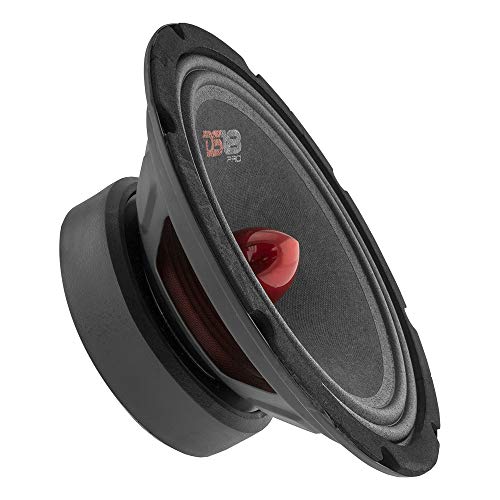
The DS18 PRO-GM8B is an 8-ohm midrange driver designed for car and truck audio systems that need vocal and instrumental clarity across the main audible spectrum. With an advertised 580W maximum power handling and 190W RMS, this speaker is built for system builders who want dedicated midrange performance and have amplifiers or crossovers configured for higher impedance loads. The red aluminum bullet dust cover is both a protective feature and a visual element that signals its pro-audio orientation.
Verified Specifications
| Impedance | 8 Ohms |
| Maximum Power | 580W |
| RMS Power | 190W |
| Voice Coil Size | 1.5″ |
| Voice Coil Material | Kapton (high-temperature) |
| Speaker Diameter | 8″ |
Key Features and Practical Benefits
The 1.5-inch Kapton voice coil is designed to handle sustained high temperatures, which matters during extended high-volume use or in hot vehicle cabins where heat dissipation is limited. Kapton’s thermal stability helps maintain the voice coil’s structural integrity, reducing the risk of distortion or failure under thermal stress compared to materials with lower heat tolerance.
The 8-ohm impedance is less common in car audio than 4-ohm configurations, but it offers specific advantages when wiring multiple speakers in series or parallel to match amplifier output impedances. This higher impedance can simplify multi-speaker installations and reduce amplifier strain in certain configurations, though it may deliver lower overall volume than a 4-ohm equivalent at the same amplifier power.
The red aluminum bullet dust cover protects the voice coil from debris and moisture while contributing to sound dispersion characteristics. Bullet-style covers are a common pro-audio design feature, though their acoustic impact varies by implementation and listening environment.
DS18 markets this speaker for both vocal and instrumental content, reflecting the midrange driver’s role in reproducing frequencies where most vocal fundamentals and many instrumental overtones live. This frequency range is critical for clarity and intelligibility in music and spoken content.
Documented Advantages and Trade-Offs
The primary advantage is the 8-ohm impedance, which provides flexibility for complex wiring configurations and can reduce heat buildup in amplifiers when driving multiple speakers. The Kapton voice coil material is a genuine durability feature in high-temperature environments, addressing a common failure mode in car audio installations.
The advertised 580W maximum power handling is a peak rating, not continuous power; the 190W RMS figure is the more realistic working specification for sustained listening. Buyers should match amplifier output to the RMS rating for safe, distortion-free performance. The product data does not specify sensitivity (dB @ 1W/1m), frequency response range, or mounting depth, all of which are important for determining acoustic output, tonal balance, and physical fit in door panels or enclosures.
Because this is an 8-ohm speaker, it will produce less volume than a 4-ohm version when driven by the same amplifier power, a trade-off that benefits heat management and multi-speaker wiring but may require more amplifier power to achieve the same sound pressure level.
Who Should Consider It
This speaker suits car and truck audio builders who are designing systems with crossovers or amplifiers that benefit from 8-ohm loads, or who are wiring multiple midrange drivers in configurations where higher impedance simplifies the electrical design. It’s also appropriate for installers prioritizing thermal durability in hot climates or applications with limited airflow.
Buyers should verify mounting depth, frequency response, and crossover points before purchase, as these details are not specified in the supplied product information. Those unfamiliar with impedance matching or crossover design should consult installation guides or professionals to ensure compatibility with their amplifier and overall system architecture.
Setup and Everyday Use
Installing this midrange speaker requires determining the correct crossover frequencies to protect the driver from low-bass content it cannot reproduce safely and to integrate it with subwoofers and tweeters. Active or passive crossovers should be configured to feed this driver the midrange frequencies it is designed to handle, typically in the range where vocals and melodic instruments are most prominent.
Because the speaker is 8 ohms, confirm that your amplifier is stable at this impedance and adjust gain settings accordingly; an 8-ohm load will draw less current and produce lower output than a 4-ohm load at the same voltage. If wiring multiple PRO-GM8B speakers, calculate the total impedance to ensure it remains within your amplifier’s rated range.
Mounting depth, magnet clearance, and trim-ring compatibility are not specified in the product data, so measure your installation location and consult the manufacturer’s documentation or technical support before cutting or modifying door panels or enclosures. Secure mounting and proper sealing will improve midbass response and reduce rattles, especially in door installations where the panel itself acts as part of the enclosure.
Detailed Buying Guide for Best 8 Inch Midrange Speakers
Choosing the right 8 inch midrange speaker requires matching several technical factors to your audio system and listening goals. Power handling, impedance, sensitivity, and voice coil construction all affect how a speaker performs in your specific setup.
Power Handling and RMS Ratings
RMS power ratings tell you how much continuous power a speaker can handle safely. The models in this guide range from 175 watts RMS (Skar Audio FSX8-8) to 275 watts RMS (DS18 PRO-X8.4BM). Match the speaker’s RMS rating to your amplifier's output at the speaker's impedance. Running a speaker significantly below its RMS capability wastes potential output, while exceeding it risks thermal damage to the voice coil.
Max or peak power ratings describe short-burst tolerance, not sustained performance. Base your amplifier pairing decisions on RMS ratings and leave headroom for dynamic peaks in music.
Impedance Matching
Impedance affects how your amplifier delivers power and how speakers can be wired together. The products here include 4-ohm and 8-ohm options. A 4-ohm speaker draws more current and typically receives more power from the same amplifier than an 8-ohm speaker, but it also generates more heat.
If you plan to wire multiple speakers in series or parallel, calculate the total impedance your amplifier will see. Most car audio amplifiers are stable down to 2 ohms per channel, but check your amp’s specifications before finalizing your impedance choice. Mismatched impedance can cause overheating, distortion, or amplifier protection mode activation.
Voice Coil Size and Material
Voice coil diameter and material determine how efficiently a speaker converts electrical energy into sound and how well it dissipates heat. The PRV 8MR600X-4 uses a 2-inch dual-layer CCAW (copper-clad aluminum wire) voice coil, while the DS18 and Skar models feature 1.5-inch coils. Larger voice coils generally handle more power and provide better heat management, which matters during extended high-volume sessions.
Kapton formers, used in the DS18 models, offer excellent thermal stability and structural integrity under heat. Polyimide and Kapton are chemically similar and both resist deformation at high temperatures. Ventilated voice coil gaps, like the PRV’s design, improve cooling and reduce power compression as the speaker heats up.
Sensitivity and Efficiency
Sensitivity ratings, measured in dB at 1 watt and 1 meter, indicate how loud a speaker plays with a given amount of power. The Skar FSX8-8 lists 93.1 dB sensitivity, and the DS18 PRO-X8.4BM states 97 dB. A speaker with 96 dB sensitivity requires half the amplifier power to match the output of a 93 dB speaker.
Higher sensitivity speakers work well in systems with modest amplifier power or where you want maximum output without upgrading your amp. Lower sensitivity speakers often provide more controlled bass response and finer detail at moderate volumes, but they demand more power to reach the same loudness.
Enclosure Requirements and Mounting Depth
Midrange speakers perform best in sealed or ported enclosures tuned to their parameters, though some applications use them in vehicle door panels or free-air installations. Check the mounting depth and cutout diameter before purchasing to confirm physical fit in your intended location. The PRV 8MR600X-4 specifies excellent performance in compact enclosures, which matters if space is limited.
Measure your available depth and compare it to the speaker’s specifications before ordering. An 8-inch midrange typically requires 3 to 4 inches of mounting depth behind the mounting surface, but verify this with the manufacturer’s datasheet.
System Integration and Crossover Points
Midrange speakers handle the critical vocal and instrumental range, typically from around 200 Hz to 5 kHz. Pair them with a subwoofer to cover low bass and a tweeter or super tweeter for extended highs. Use an active crossover or passive network to prevent the midrange from receiving frequencies it cannot reproduce efficiently.
Set high-pass filters to protect the midrange from excessive low-frequency excursion, and low-pass filters to keep harsh upper frequencies out of the speaker’s output. The exact crossover points depend on the midrange’s frequency response and the capabilities of your other drivers. If you’re dealing with intermittent audio issues in your existing setup, verify wiring and connections before upgrading speakers.
Installation, Assembly and First-Time Setup
Installing an 8 inch midrange speaker requires careful attention to wiring polarity, secure mounting, and proper sealing to prevent acoustic leaks. Before starting, disconnect the vehicle battery or turn off the amplifier to avoid accidental shorts or speaker damage.
Verify that the mounting location provides adequate depth and that the cutout diameter matches the speaker’s specifications. Use the supplied mounting hardware or purchase appropriate screws and gaskets if none are included. Mount the speaker to a rigid baffle or enclosure wall using evenly spaced screws, tightening them in a star pattern to avoid warping the speaker frame.
Connect the positive terminal on the speaker to the positive output of your amplifier or crossover, and the negative to the negative. Reversed polarity causes phase cancellation and weak, unfocused sound. If you’re integrating the midrange into a multi-way system, route the signal through an active or passive crossover set to the appropriate frequency range.
Seal any gaps around the speaker with foam gaskets or weather stripping to prevent sound from the rear of the cone from canceling the front wave. This is especially important in door-mounted installations where the speaker operates in a semi-open environment.
After installation, play a familiar track at moderate volume and listen for rattles, distortion, or phase issues. Adjust crossover points and amplifier gain settings to match the midrange to your subwoofer and tweeters. Refer to the speaker manufacturer’s manual and your amplifier’s documentation for model-specific instructions and safe operating limits. Trying to maximize power from a multi-channel amp requires careful attention to impedance and channel bridging options.
Maintenance and Common Troubleshooting
Midrange speakers require minimal maintenance but benefit from periodic inspection and cleaning. Dust and debris can accumulate on the cone and around the voice coil gap, reducing performance and increasing the risk of rubbing or distortion. Use a soft brush or compressed air to remove surface dust, taking care not to press on the cone or damage the surround.
If you hear distortion at higher volumes, check that the amplifier gain is set correctly and that the speaker is not being driven beyond its RMS power rating. Overdriving a speaker causes voice coil overheating and mechanical damage. If distortion appears suddenly, inspect speaker wiring for loose connections, frayed insulation, or corrosion at the terminals.
Rattling or buzzing sounds often indicate a loose mounting screw, a foreign object near the cone, or a failing surround. Tighten all mounting hardware and inspect the speaker for visible damage. If the voice coil rubs against the magnet structure, the speaker may have been physically damaged or overdriven, and replacement is usually necessary.
Reduced output or weak sound can result from reversed polarity, a blown crossover component, or a partially failed voice coil. Swap speaker connections to verify polarity, and test the speaker with a known-good amplifier and source to isolate the problem. Persistent issues often point to internal damage that cannot be repaired in the field.
Frequently Asked Questions
What impedance should I choose for my 8 inch midrange speaker?
Choose 4 ohms if your amplifier is stable at lower impedances and you want more power output, or 8 ohms if you plan to wire multiple speakers in parallel or prefer a cooler-running, more efficient system. Check your amplifier’s minimum stable impedance and power output at both 4 and 8 ohms before deciding. Most car audio amplifiers deliver significantly more power into 4-ohm loads.
Can I use an 8 inch midrange speaker without a subwoofer?
An 8 inch midrange can reproduce some lower midrange frequencies, but it is not designed to handle deep bass below roughly 80 to 100 Hz. Running a midrange without a subwoofer and without a high-pass filter risks overexcursion and voice coil damage. For a complete system, pair the midrange with a dedicated subwoofer and use crossovers to divide the frequency spectrum appropriately.
How much amplifier power do I need for a 275-watt RMS midrange speaker?
Match your amplifier’s RMS output per channel, at the speaker’s impedance, to the speaker’s RMS rating. An amplifier rated for 250 to 300 watts RMS at the speaker’s impedance provides a safe match with headroom for dynamic peaks. Avoid amplifiers that significantly exceed the speaker’s RMS rating unless you can reliably control gain and avoid clipping.
What is the difference between a 1.5 inch and a 2 inch voice coil?
A 2 inch voice coil typically handles more power and dissipates heat more effectively than a 1.5 inch coil, which matters during sustained high-volume use. Larger voice coils also generally provide more control and lower distortion under heavy excursion. However, a well-designed 1.5 inch coil in a properly matched enclosure can still deliver excellent performance for most applications.
Do I need an enclosure for an 8 inch midrange speaker?
An enclosure or sealed baffle improves midrange performance by preventing acoustic cancellation and controlling excursion. Door-mounted installations can work if the door is properly sealed and deadened, but dedicated enclosures provide more consistent and predictable results. Check the speaker’s specifications for recommended enclosure volume and tuning if applicable.
Can I mix different brands of midrange speakers in the same system?
Mixing brands is possible but requires careful attention to sensitivity, impedance, and frequency response to avoid tonal imbalance. Speakers with similar sensitivity ratings and overlapping frequency ranges integrate more easily. Use crossovers and equalization to match output levels and voicing, but identical speakers in symmetrical positions generally provide the most cohesive sound.
How do I prevent my midrange speaker from overheating?
Set amplifier gain correctly to avoid clipping, use a high-pass crossover to filter out low frequencies the speaker cannot handle, and ensure adequate airflow around the speaker if it is enclosed. Ventilated voice coil designs and high-temperature materials like Kapton improve thermal performance. Avoid sustained operation at maximum volume, which generates excessive heat and accelerates wear.
What crossover frequency should I use for an 8 inch midrange?
A typical high-pass crossover point for an 8 inch midrange is 200 to 300 Hz, and a low-pass point is 3 to 5 kHz, depending on the speaker’s response and the capabilities of your tweeter and subwoofer. Use active crossovers for more precise control and easier adjustments. Consult the speaker’s frequency response curve and experiment with crossover settings to find the smoothest transition between drivers.
Final Verdict
Each of these 8 inch midrange speakers serves a distinct purpose depending on your power requirements, impedance needs, and system design. The PRV 8MR600X-4 stands out for high power handling and advanced thermal management with its 2-inch voice coil and ventilated design, making it a strong choice for high-output systems. The DS18 PRO-X8.4BM offers the highest RMS power rating and sensitivity in this group, delivering maximum loudness with efficient amplifier use. The Skar Audio FSX8-8 provides a balanced option for 8-ohm systems where moderate power and proven reliability matter. Choose based on verified specifications, amplifier compatibility, and the acoustic demands of your installation.