Finding a subwoofer that can handle 2000 watts RMS requires matching serious power handling with durable construction and the right enclosure design for your install. Whether you’re building a competition SPL system or need extreme low-frequency output for daily listening, these subwoofers deliver professional-grade performance across different sizes and configurations. This guide compares five verified 2000W RMS models to help you choose the right match for your amplifier, available space, and bass preferences.
At a Glance
Compact 8-inch design with 2000W RMS handling, 30mm Xmax, and triple-stack magnet structure. Best for high-output systems where space is limited, optimized for 1.0 cu. ft. ported enclosures tuned to 32Hz.
- Dual 2-ohm voice coil configuration
- 3-inch 8-layer aluminum voice coil
- Mega-Roll v.2 surround for linear excursion
- Mounting depth: 9.5 inches
Competition-grade 10-inch subwoofer with 2000W RMS and 8000W peak power handling. Features custom cast aluminum frame, triple-stack magnet, and dual 2-ohm configuration for sealed or ported enclosures.
- 3-inch high-temperature aluminum voice coil
- Enhanced vented coil cooling system
- NBR foam surround with dual spider suspension
- Moisture and UV-resistant cone
Large 15-inch SPL subwoofer built for competition-level bass with 2000W RMS handling, 30mm Xmax, and triple-stacked magnet. Die-cast aluminum basket with X-braced structure provides maximum stability under heavy loads.
- Dual 2-ohm voice coil with 3-inch diameter
- 4-layer linear roll spider with integrated tinsel leads
- Vent cooling spacer and high-velocity pole vent
- Custom high-roll foam surround
Value-focused 12-inch subwoofer with 1000W RMS and 2000W peak handling. Dual 1-ohm configuration suits low-impedance wiring, with 2.5-inch copper voice coil and aluminum frame for daily and high-output use.
- High-temperature copper voice coil
- Ferrite magnet motor structure
- Reinforced paper cone
- Optimized suspension for clean low-frequency response
Professional 10-inch subwoofer engineered for low-distortion bass extension with 2000W RMS handling and 35mm Xmax. Patented Mega-Roll surround and advanced thermal management suit small ported, sealed, and infinite-baffle enclosures.
- Dual 2-ohm with 3-inch aluminum voice coil
- Proprietary high-velocity frame-base venting
- Recommended 1.5 cu. ft. ported (32Hz) or 0.75 cu. ft. sealed
- Patented frame design (US D691596, D691597, D691598, D741841)
Quick Product Comparison
| Product | Size | RMS Power | Voice Coil | Xmax | Impedance |
|---|---|---|---|---|---|
| Sundown Audio Z8 V.2 | 8 inch | 2000W | 3″ aluminum, 8-layer | 30mm | Dual 2-ohm |
| ORION HCCA102 | 10 inch | 2000W | 3″ aluminum | Not specified | Dual 2-ohm |
| NVX 15″ X-Series SPL | 15 inch | 2000W | 3″ diameter | 30mm | Dual 2-ohm |
| Deaf Bonce Apocalypse DB-SA252 D1 | 12 inch | 1000W | 2.5″ copper | Not specified | Dual 1-ohm |
| Sundown Audio M-10 D2 | 10 inch | 2000W | 3″ aluminum, 4-layer | 35mm | Dual 2-ohm |
Sundown Audio Z8 V.2 8" Subwoofer
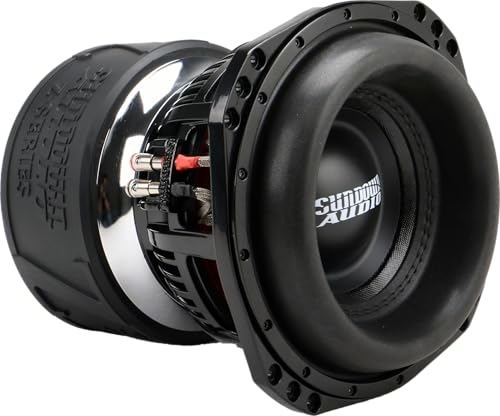
The Sundown Audio Z8 V.2 represents an aggressive approach to maximizing output from an 8-inch platform. Built around a 2000-watt RMS power threshold and 30mm of linear excursion, this subwoofer targets installers who need serious low-frequency impact but face tight mounting constraints. The dual 2-ohm voice coil configuration provides wiring flexibility for single or multi-driver systems.
Verified Specifications
| Power Handling | 2000W RMS / 4000W Peak |
| Voice Coil | 3″ diameter, 8-layer black aluminum |
| Xmax (Linear Excursion) | 30mm one-way |
| Impedance | Dual 2-ohm |
| Recommended Enclosure | 1.0 cu. ft. net, ported, tuned to 32Hz |
| Port Area | 15 square inches recommended |
| Mounting Depth | 9.5″ |
| Outside Diameter | 10″ |
Key Features and Practical Benefits
The Z8 V.2 employs Sundown’s Mega-Roll v.2 surround paired with custom-tooled ultra-linear spider packs. According to the manufacturer, this suspension geometry maintains linearity across the full 30mm excursion range, which should minimize distortion when the cone reaches peak travel. The triple-stacked magnet assembly and large aluminum Faraday ring aim to provide magnetic flux control and reduce inductive nonlinearities.
Thermal management receives considerable attention in this design. The high-velocity pole vent works with a cast-aluminum vented frame spacer ring and a heavily vented magnetic gap to encourage airflow through the voice coil region. The 8-layer black aluminum voice coil itself dissipates heat more effectively than copper at equivalent mass, though copper offers slightly better electrical efficiency.
The compact 9.5-inch mounting depth and 10-inch outside diameter make the Z8 practical for installations where larger subwoofers won’t physically fit. Despite the small footprint, the 2000-watt RMS rating demands a robust amplifier and appropriate electrical infrastructure.
Documented Advantages and Trade-Offs
The Z8’s primary strength lies in its combination of power handling and excursion within an 8-inch form factor. The 30mm Xmax specification puts it ahead of most compact subwoofers, and the manufacturer’s focus on linear suspension should translate to cleaner output at high drive levels.
The design explicitly targets ported enclosures, with specific recommendations for box volume and tuning frequency. Users seeking sealed or infinite-baffle installations will need to evaluate whether this subwoofer’s parameters suit those applications—the product information does not provide Thiele-Small parameters or guidance for alternative enclosures.
The dual 2-ohm configuration allows series wiring to 4 ohms or parallel wiring to 1 ohm on a single subwoofer. Multi-driver arrays will need careful planning to match amplifier impedance capabilities.
Who Should Consider It
This subwoofer makes sense for enthusiasts building high-output systems in vehicles or enclosures with limited mounting depth. The 2000-watt RMS rating assumes you have adequate amplification and electrical system capacity—underpowering this driver would waste its potential, while exceeding thermal limits risks permanent damage.
Competition SPL builders working within size-class restrictions will appreciate the aggressive excursion and power handling. Daily drivers who want substantial bass impact without sacrificing trunk or cabin space also fit the use case, provided their electrical system can support sustained high-current draw.
Setup and Everyday Use
The manufacturer specifies a 1.0 cubic foot net enclosure volume tuned to 32Hz with 15 square inches of port area. Deviating significantly from these recommendations will alter system tuning and may compromise output or increase distortion. Accurate box construction with proper bracing and sealed joints is essential for achieving the intended performance.
Amplifier matching requires attention to both power output and impedance stability. A 2000-watt RMS amplifier stable at the final wired impedance (1 or 4 ohms, depending on configuration) ensures the subwoofer operates within its design envelope. Subsonic filtering below tuning frequency protects the driver from excessive cone excursion in the unloaded region.
Initial break-in at moderate power levels for several hours allows the suspension to settle. Once broken in, gradual increases in drive level while monitoring for mechanical noise or thermal shutdown help establish safe operating limits for your specific installation and listening habits.
ORION HCCA102 High Performance 10" Subwoofer, 8000W, Dual 2 Ohm

The ORION HCCA102 enters the 2000-watt RMS category with a 10-inch platform and a triple-stack magnet structure. Marketed as competition-grade, this subwoofer emphasizes maximum power handling and bass output. The dual 2-ohm voice coil and 8000-watt peak rating signal a design intended for aggressive amplification and high-SPL applications.
Verified Specifications
| Power Handling | 2000W RMS / 8000W Peak |
| Voice Coil | 3″ diameter, high-temperature aluminum |
| Impedance | Dual 2-ohm |
| Cone Size | 10 inches |
| Frame Material | Custom cast aluminum |
| Surround | NBR foam |
| Dustcap | Polypropylene |
| Magnet | Triple stack |
Key Features and Practical Benefits
The HCCA102 builds around a 3-inch high-temperature aluminum voice coil with Orion’s PAARC (high-temp) winding. The manufacturer highlights enhanced vented coil cooling, which channels airflow through the magnetic gap to stabilize voice coil temperature during sustained high-power operation. Loop-stitched tinsel leads provide the electrical connection between the voice coil and terminals, a construction method intended to improve durability under continuous flexing.
The triple-stack magnet assembly increases magnetic field strength in the gap, which should improve motor force and control. Orion’s signature black coil—a cosmetic and possibly thermal treatment—distinguishes the brand visually, though the product information does not specify whether the coating contributes functionally to heat dissipation.
The cone uses moisture and UV-resistant materials, and the NBR foam surround resists environmental degradation better than untreated rubber or foam. The dual spider suspension (two spider assemblies stacked) aims to center the voice coil precisely and maintain linearity across the excursion range.
Documented Advantages and Trade-Offs
The HCCA102’s standout specification is the 8000-watt peak rating, which suggests the driver can handle brief transient bursts well beyond its 2000-watt RMS thermal limit. This headroom benefits music with sharp dynamic peaks, where instantaneous power demand spikes above average levels.
The custom cast aluminum frame provides rigidity and contributes to thermal management by conducting heat away from the motor structure. The 10-inch cone diameter offers a middle ground between the compact 8-inch class and larger 12-inch or 15-inch drivers—enough cone area for substantial output without the mounting depth and enclosure volume demands of bigger subwoofers.
Enclosure flexibility is noted in the product information, with claims of suitability for both sealed and ported installations. However, specific Thiele-Small parameters, recommended box volumes, or tuning frequencies are not provided, which means builders will need to source that data separately or experiment to optimize performance.
The NBR foam surround, while durable, may not offer the same excursion capability as high-roll or accordion-style surrounds found on some competing models. Excursion specifications (Xmax) are not listed, making direct mechanical-output comparisons difficult.
Who Should Consider It
This subwoofer targets competition SPL enthusiasts and installers building systems for maximum output. The 2000-watt RMS rating and 8000-watt peak handling assume a powerful amplifier and a robust electrical system with upgraded alternator and battery capacity.
Daily-use enthusiasts who prioritize deep, authoritative bass and have the space and power budget for a 10-inch competition-grade driver will find the HCCA102 appropriate. The dual 2-ohm configuration suits modern Class D amplifiers designed for low-impedance loads.
Casual listeners or budget-conscious buyers may find the power requirements and likely cost excessive for typical in-car audio needs. This driver is engineered for deliberate high-output systems, not for incremental upgrades to factory sound.
Setup and Everyday Use
Because specific enclosure recommendations are not detailed in the supplied information, prospective buyers should consult Orion’s full specification sheet or use modeling software with the subwoofer’s Thiele-Small parameters. Sealed enclosures typically demand less volume and offer tighter transient response, while ported designs extend low-frequency output at the cost of additional box size and complexity.
Amplifier selection should prioritize stable 2000-watt RMS output at the final wired impedance. Dual 2-ohm coils can be wired in series for 4-ohm operation or parallel for 1-ohm operation. Multi-driver arrays require careful impedance matching to avoid overloading the amplifier or underdriving individual subwoofers.
Thermal protection and subsonic filtering are essential. Competition-grade subwoofers often operate near their thermal limits, and electronic protection circuits in modern amplifiers can prevent voice coil damage. A subsonic filter (typically set 5-10 Hz below port tuning in ported boxes or around 20-25 Hz in sealed enclosures) reduces excessive cone excursion that produces no audible output but generates heat and mechanical stress.
Initial testing at moderate levels allows the suspension to break in and reveals any installation issues—rattles, air leaks, or amplifier clipping—before pushing the system to full output.
NVX 15" X-Series SPL Subwoofer Dual 2-Ohm Car Audio Subwoofer

The NVX XCW152 brings serious SPL capability in a 15-inch form factor designed specifically for competition-level output and high-volume enthusiasts. With 2000 watts RMS handling and a 30mm Xmax, this subwoofer is built to move substantial air while managing the thermal and mechanical stress that comes with extreme bass reproduction. The triple-stacked magnet structure and die-cast aluminum basket provide a stable foundation for sustained high-power use.
Verified Specifications
| Power Handling | 2000W RMS / 4000W Peak |
| Impedance | Dual 2-Ohm |
| Voice Coil Diameter | 3″ |
| Xmax (One-Way Linear Excursion) | 30mm |
| Cone Size | 15″ |
| Magnet Structure | Triple-Stacked |
| Basket Material | Die-Cast Aluminum |
Key Features and Practical Benefits
The 30mm Xmax specification indicates substantial cone travel, which translates to the ability to displace large volumes of air—critical for generating the low-frequency output needed in SPL competition scenarios. The custom high-roll foam surround is designed to accommodate this excursion range while maintaining linearity, reducing distortion even during peak output.
The die-cast aluminum basket with X-braced structure provides rigidity that prevents frame flex under heavy bass loads. This structural integrity is particularly important in a 15-inch driver where cone area and excursion can generate significant mechanical forces that would compromise lesser frames.
NVX’s cooling design incorporates multiple ventilation paths: a vent cooling spacer, high-velocity pole vent, and vented magnet gap work together to manage voice coil temperatures. During sustained high-power operation, effective heat dissipation directly impacts reliability and prevents thermal compression that degrades output.
The 4-layer linear roll spider with integrated tinsel leads aims to maintain consistent suspension behavior throughout the excursion range. Integrated tinsel leads eliminate separate flying leads that can fatigue or break during extreme excursion, addressing a common failure point in high-excursion designs.
Documented Advantages and Trade-Offs
The 15-inch cone diameter offers a surface area advantage over smaller drivers, potentially reducing the number of subwoofers needed to achieve target SPL levels. The dual 2-ohm voice coil configuration provides wiring flexibility, allowing a single subwoofer to be wired to 1 ohm or 4 ohms, or multiple subwoofers to be combined for various final impedances that match amplifier capabilities.
The triple-stacked magnet structure contributes to motor force but adds weight and depth to the overall assembly. Buyers should verify mounting depth availability in their enclosure, as 15-inch SPL subwoofers typically require substantial clearance. The product information does not specify mounting depth, so direct measurement or manufacturer consultation is recommended before purchase.
At 2000 watts RMS, this subwoofer requires a substantial amplifier investment to reach rated power. Underpowering may limit output potential, while appropriate amplification will demand corresponding electrical system upgrades—adequate alternator capacity, battery reserve, and power distribution cabling.
Who Should Consider It
This subwoofer is specifically engineered for SPL competitors and enthusiasts building high-output systems where maximum bass pressure is the primary objective. The power handling, excursion capability, and reinforced construction align with the demands of competition use or dedicated bass-focused installations.
Buyers working with limited enclosure volume or seeking daily-driver sound quality as the primary goal may find more suitable options in smaller driver sizes or models optimized for different enclosure alignments. The 15-inch format and SPL focus suggest this is purpose-built equipment rather than a general-purpose solution.
Setup and Everyday Use
Optimal enclosure design depends on specific Thiele-Small parameters not provided in the supplied product information. SPL-oriented 15-inch subwoofers typically perform well in large ported enclosures tuned to emphasize output in the upper bass region where SPL competitions are measured, though sealed enclosures are also viable depending on system goals.
The dual 2-ohm configuration means a single subwoofer can be wired in series for 4 ohms or parallel for 1 ohm. Multiple subwoofers offer additional wiring combinations: two XCW152s can present 2 ohms (series-series or parallel-parallel) or 0.5 ohms (all parallel), though the latter requires an amplifier stable at half-ohm loads.
Voice coil temperature management is critical during extended high-power use. While the ventilation design aids heat dissipation, continuous operation at or near maximum power will still generate substantial heat. Monitoring amplifier clipping and allowing thermal recovery periods during competition runs helps preserve voice coil integrity.
Deaf Bonce Apocalypse DB-SA252 D1 12" 2000 Watt Dual 1 Ohm

The Deaf Bonce Apocalypse DB-SA252 D1 delivers 1000 watts RMS in a 12-inch format designed for strong bass output in car audio systems. With its dual 1-ohm voice coil configuration and 2.5-inch copper coil, this subwoofer targets users who need flexible low-impedance wiring options to maximize amplifier power delivery. The aluminum frame and ferrite magnet structure provide a balance of performance and durability for both daily driving and higher-output applications.
Verified Specifications
| Power Handling | 1000W RMS / 2000W Max |
| Impedance | Dual 1-Ohm |
| Voice Coil Diameter | 2.5″ |
| Voice Coil Material | High-Temperature Copper |
| Cone Size | 12″ |
| Magnet Type | Ferrite |
| Frame Material | Aluminum |
| Cone Material | Reinforced Paper |
Key Features and Practical Benefits
The dual 1-ohm voice coil design provides significant wiring flexibility for achieving low final impedances that allow amplifiers to deliver maximum power. A single DB-SA252 can be wired to 0.5 ohms (parallel) or 2 ohms (series), while pairs can be configured for 1 ohm or other combinations depending on system requirements and amplifier stability.
The 2.5-inch high-temperature copper voice coil balances thermal capacity with motor efficiency. Copper coils generally offer better conductivity than aluminum alternatives, though they add weight to the moving assembly. The high-temperature rating suggests material and adhesive choices designed to withstand the heat generated during sustained moderate-to-high power operation.
Deaf Bonce’s motor structure and suspension design aim to deliver clean low-frequency response with solid excursion capability. The reinforced paper cone combines traditional cone material benefits—light weight and good damping characteristics—with structural reinforcement to handle the mechanical stress of extended excursion and repeated flex cycles.
The aluminum frame provides rigidity while managing weight, and the ferrite magnet structure offers reliable magnetic field strength at a lower cost point than neodymium alternatives. This combination suggests a design philosophy balancing performance with accessibility.
Documented Advantages and Trade-Offs
At 1000 watts RMS, the DB-SA252 requires less amplifier power than the higher-rated competitors in this comparison, which may suit buyers working with existing electrical systems or moderate amplifier budgets. The 12-inch format also offers enclosure flexibility, fitting applications where 15-inch models would be impractical due to space constraints.
The dual 1-ohm configuration is particularly advantageous for extracting maximum output from amplifiers that deliver peak power at low impedances. However, wiring to 0.5 ohms requires an amplifier explicitly rated stable at that load, and not all amplifiers meet this requirement. Confirming amplifier specifications before purchase prevents potential damage or protection-mode operation.
The product information does not specify Xmax, mounting depth, or recommended enclosure volumes, which are important parameters for enclosure design. Buyers should obtain complete Thiele-Small parameters from the manufacturer or authorized dealers to design enclosures that achieve intended performance rather than guessing dimensions.
The reinforced paper cone is a conventional material choice that performs well in most applications. It lacks the exotic materials found in some premium designs but offers proven performance characteristics and typically favorable cost-to-performance ratios.
Who Should Consider It
The DB-SA252 suits car audio enthusiasts building systems in the 1000-watt RMS per subwoofer range who value wiring flexibility and want a 12-inch format that balances output with enclosure size. The power handling is appropriate for serious daily-driver systems and moderate competition use without requiring the extreme electrical infrastructure that higher-powered models demand.
Buyers seeking absolute maximum SPL or planning systems exceeding 1000 watts RMS per subwoofer should consider higher-rated alternatives. Similarly, those working with amplifiers that are not stable below 1 ohm will need to use series wiring or multiple subwoofers to achieve safe impedances, which may limit power delivery.
Setup and Everyday Use
Without specified Thiele-Small parameters, general enclosure guidance for 12-inch subwoofers in this power class typically involves sealed enclosures in the 1.0 to 1.5 cubic foot range or ported enclosures from 1.75 to 2.5 cubic feet, though actual optimal volumes depend on the specific driver parameters. Consulting manufacturer recommendations or using modeling software with complete specifications ensures proper enclosure design.
The dual 1-ohm wiring allows a single subwoofer to present either 0.5 ohms (both coils parallel) or 2 ohms (both coils series) to the amplifier. For two DB-SA252 subwoofers, wiring options include 1 ohm (each sub wired to 2 ohms, then both subs paralleled) or 0.25 ohms (each sub wired to 0.5 ohms, then both subs paralleled), though quarter-ohm loads are rarely stable with most amplifiers.
The high-temperature copper voice coil design helps manage heat, but sustained operation at maximum power still generates significant thermal energy. Adequate amplifier gain setting prevents clipping, which produces excessive heat and distortion. Monitoring voice coil temperature indirectly—through distortion onset or output reduction—helps avoid thermal damage during extended listening sessions or competition runs.
Sundown Audio M-10 D2 10" Car Subwoofer

The Sundown Audio M-10 D2 represents a serious commitment to low-distortion bass in professional car audio systems. This 10-inch subwoofer handles 2000 watts RMS with a dual 2-ohm configuration, making it suitable for flexible wiring options at the amplifier. The M-10’s design prioritizes extreme excursion and thermal management, targeting enthusiasts who need accurate, extended low-frequency reproduction in compact enclosures.
Verified Specifications
| Power Handling | 2000W RMS / 4000W Peak |
| Voice Coil | 3″ diameter, 4-layer round wire aluminum |
| Impedance | Dual 2-Ohm |
| Excursion (Xmax) | 35mm one-way linear |
| Recommended Ported Enclosure | 1.5 cu ft net, 32Hz tuning, 24 sq in port area |
| Sealed Enclosure Option | 0.75 cu ft |
Key Features and Practical Benefits
The M-10’s standout specification is its 35mm Xmax, which represents exceptional cone travel for a 10-inch driver. This excursion capability, combined with Sundown’s Mega-Roll Surround and patented frame designs (US Patent Numbers D691596, D691597, D691598, D741841), allows the subwoofer to move substantial air while maintaining linear suspension behavior. The manufacturer emphasizes low-distortion performance, suggesting careful attention to motor linearity and suspension geometry.
The 3-inch aluminum voice coil uses a 4-layer round wire design wound on a thick aluminum former. Sundown claims a proprietary winding density that contributes to the subwoofer’s deep bass extension. The aluminum construction aids heat dissipation, which becomes critical at the M-10’s rated power levels.
Thermal management receives considerable engineering attention in this design. The listed features include a high-velocity pole vent, heavily vented magnetic gap through the black backplate, and proprietary cast-aluminum frame-base venting. These elements work together to move air through the voice coil area during operation, helping maintain stable performance during extended high-power sessions.
Documented Advantages and Trade-Offs
The M-10’s primary advantage lies in its combination of excursion capability and power handling in a relatively compact 10-inch format. The 35mm Xmax exceeds what many competing 10-inch subwoofers offer, potentially delivering deeper bass extension and higher output before reaching mechanical limits. The dual 2-ohm configuration allows wiring to a final 1-ohm or 4-ohm load, providing flexibility with amplifier matching.
The recommended ported enclosure of 1.5 cubic feet is modest by high-excursion subwoofer standards, making this driver practical for installations where space is limited. The manufacturer also lists sealed (0.75 cu ft) and infinite baffle (IB) applications as viable options, suggesting the driver’s suspension and motor characteristics accommodate different loading conditions.
The trade-off with any high-excursion, high-power subwoofer involves amplifier requirements and installation complexity. A 2000-watt RMS subwoofer demands a substantial amplifier with clean power delivery and adequate electrical system support. The vehicle’s alternator capacity and battery bank become relevant considerations. Without sufficient power infrastructure, the subwoofer won’t reach its performance potential.
The M-10’s focus on low-distortion bass extension suggests tuning optimized for sound quality rather than maximum SPL efficiency. Buyers seeking the highest possible output per watt may find other designs more efficient, though this approach typically comes with trade-offs in linearity and distortion.
Who Should Consider It
This subwoofer targets experienced car audio enthusiasts and professional installers working with systems where accurate, extended bass reproduction matters more than absolute efficiency. The M-10 suits applications where 10-inch format constraints—whether dash clearance, console packaging, or aesthetic preference—combine with a requirement for serious low-frequency capability.
Competition sound quality (SQ) builds represent the most natural application for the M-10’s design priorities. The emphasis on low distortion, high excursion, and versatile enclosure options aligns with SQ judging criteria that reward accuracy and extension. Daily-driven systems benefit equally when owners value clean, powerful bass over maximum volume.
Buyers planning a first subwoofer installation or working with entry-level amplifiers should consider whether their supporting equipment matches the M-10’s capabilities. This driver performs best when paired with amplifiers capable of stable operation at low impedances with clean power delivery in the 2000-watt range.
Setup and Enclosure Considerations
The manufacturer provides specific ported enclosure recommendations: 1.5 cubic feet net volume tuned to 32Hz with 24 square inches of port area. These specifications offer a starting point for builders, though precise port length calculations depend on port shape and enclosure internal layout. Ported enclosures generally require more space than sealed designs and benefit from careful construction to avoid port noise and air leaks.
The sealed enclosure option at 0.75 cubic feet offers a more compact alternative with different bass characteristics. Sealed alignments typically provide tighter, more controlled bass response with reduced deep bass extension compared to properly tuned ported designs. The smaller enclosure size may suit installations where space constraints outweigh the need for maximum low-frequency output.
General car audio installation practices apply: secure mounting to prevent enclosure flex, adequate amplifier power supply with appropriate gauge wiring, proper gain structure to avoid clipping, and subsonic filtering if using ported alignment. The dual 2-ohm voice coils can wire in series for 4-ohm operation or parallel for 1-ohm, affecting amplifier selection and system design.
The M-10’s thermal management features suggest it can handle sustained power, but all subwoofers benefit from reasonable operating practices. Continuous operation at or near maximum power in inadequately ventilated enclosures tests any driver’s thermal limits.
Detailed Buying Guide for Best 2000 RMS Subwoofer
Matching Power Handling to Your Amplifier
The single most critical decision when selecting a 2000-watt RMS subwoofer is ensuring your amplifier can deliver clean, stable power at the correct impedance. A 2000W RMS rating means the subwoofer is designed to handle that continuous power level without thermal failure or mechanical damage, but only when paired with an amplifier capable of producing it.
Check your amplifier’s specification sheet for its power output at the final wired impedance. Most dual voice coil subwoofers offer wiring flexibility—dual 1-ohm coils can be wired to present 0.5 ohm or 2 ohm loads, while dual 2-ohm coils present 1 ohm or 4 ohm loads. Not all amplifiers are stable at very low impedances; wiring to 0.5 ohm with an amplifier rated only to 1 ohm can cause overheating, clipping, or shutdown.
Underpowering a high-RMS subwoofer is safer than overpowering it in most cases, but driving a 2000-watt subwoofer with a 500-watt amplifier will leave significant performance on the table. Ideally, match amplifier RMS output to within 75–125% of the subwoofer’s rating for best results and longevity.
Voice Coil Configuration and Wiring Options
Voice coil configuration determines how you can wire the subwoofer and what final impedance you can present to your amplifier. Dual voice coil subwoofers offer the most flexibility, allowing series or parallel wiring to achieve different loads.
Dual 1-ohm coils can be wired in series for a 2-ohm load or in parallel for a 0.5-ohm load. Dual 2-ohm coils offer 4-ohm series or 1-ohm parallel configurations. If you plan to use multiple subwoofers on a single amplifier channel, voice coil configuration becomes even more important—mismatched configurations can result in impedances your amplifier cannot handle safely.
Single voice coil subwoofers offer no wiring flexibility and must be used at their rated impedance. They are simpler but limit your options if you later upgrade your amplifier or add additional subwoofers. For systems demanding maximum configurability and future expansion, dual voice coil designs are strongly preferred.
Excursion, Cone Area, and Enclosure Requirements
Excursion—measured as Xmax—describes how far the cone can move in one direction while maintaining linear performance. Higher excursion allows a subwoofer to move more air and produce deeper, louder bass without distortion. The models listed here range from 30mm to 35mm Xmax, which is substantial and well-suited to high-output applications.
Cone diameter also matters. An 8-inch subwoofer with high excursion and power handling can produce impressive output in a small enclosure, but a 15-inch cone moves significantly more air per stroke and will generally produce deeper, more effortless bass. Larger subwoofers typically require larger enclosures, which may be a limiting factor in compact vehicles or tight trunk spaces.
Enclosure type and volume have a major impact on performance. Ported enclosures produce higher output at the tuning frequency and are favored for SPL competition and maximum loudness. Sealed enclosures offer tighter, more controlled bass and are often preferred for sound quality and musical accuracy. Most manufacturers specify recommended enclosure volumes and tuning frequencies; deviating significantly from these recommendations can result in poor performance or even damage.
Check the mounting depth and cutout diameter before purchasing. High-excursion, high-power subwoofers often have deep motor structures and require substantial clearance behind the mounting surface. Measure your available space carefully and compare it to the manufacturer’s specifications to avoid fitment issues.
Cooling and Thermal Management
At 2000 watts RMS, heat is a major concern. Voice coils generate significant thermal energy during operation, and without adequate cooling, temperatures can rise to levels that degrade adhesives, warp formers, or cause complete voice coil failure.
Look for subwoofers with vented pole pieces, vented motor structures, and vented baskets or frame designs. These features promote airflow through and around the voice coil, helping to dissipate heat during sustained high-power operation. Aluminum voice coil formers conduct heat more effectively than lighter materials and are standard in most high-power designs.
Competition-grade subwoofers often include additional cooling features such as aluminum shorting rings (Faraday rings) that reduce inductance and improve efficiency, further lowering heat generation. If you plan to push your system hard for extended periods—whether in competition or daily listening—prioritize models with robust thermal management.
Suspension Design and Linearity
The suspension system—comprising the surround and spider(s)—controls cone movement and maintains alignment during excursion. High-excursion subwoofers require suspensions that remain linear across their full range of travel, minimizing distortion and ensuring predictable behavior.
Multi-layer spiders with stitched or formed construction provide better linearity than single-layer designs. High-roll surrounds, such as the Mega-Roll designs used in several models here, allow greater excursion while maintaining edge compliance and durability. Foam surrounds are common in SPL applications, while rubber surrounds offer better long-term durability in variable climates.
Check whether the suspension is designed for the intended enclosure type. Some subwoofers are optimized specifically for ported or sealed enclosures, and using them in the wrong application can result in over-excursion, bottoming out, or poor frequency response.
Brand Reputation and Warranty Support
High-power subwoofers represent a significant investment, and brand reputation matters. Established manufacturers with strong customer support, detailed specifications, and accessible warranty service are safer bets than unknown brands with incomplete documentation.
Verify what the warranty covers and how long it lasts. Many manufacturers exclude damage from improper wiring, excessive power, or installation errors, so read the terms carefully. Some brands offer limited lifetime warranties on specific components, while others provide one- or two-year coverage.
Availability of replacement parts—such as recone kits—can extend the usable life of a subwoofer significantly. Brands that support their products with accessible parts and service networks offer better long-term value, particularly for users who plan to push their equipment hard.
Installation, Assembly and First-Time Setup
Before beginning installation, disconnect the vehicle’s negative battery terminal to prevent electrical shorts or accidental airbag deployment. Gather the necessary tools, including a drill, hole saw (sized to the subwoofer’s cutout diameter), screwdriver, wire strippers, crimping tool, and a multimeter for checking impedance and polarity.
Build or acquire an enclosure that meets the manufacturer’s recommended internal volume and tuning frequency. Use 3/4-inch MDF for most applications, and apply wood glue and screws at all joints to ensure rigidity. Line the interior with acoustic dampening material if desired, though this is optional for ported designs. Cut the subwoofer mounting hole carefully, ensuring it matches the specified cutout diameter and is centered on the mounting surface.
Mount the subwoofer using the supplied hardware, tightening screws in a star pattern to ensure even pressure and prevent warping. Do not overtighten, as this can strip threads or crack the basket. Connect the voice coil terminals according to your chosen wiring configuration, double-checking polarity and impedance with a multimeter before powering the system.
Run power and ground cables from the amplifier to the battery and chassis ground point, using appropriately sized wire for the amplifier’s current draw. Install an inline fuse near the battery, rated slightly above the amplifier’s maximum fuse rating. Route RCA signal cables away from power cables to minimize noise, and secure all wiring with zip ties or loom to prevent rattling or chafing.
Set the amplifier gain using a multimeter or oscilloscope to match the amplifier’s output voltage to the subwoofer’s power handling. Playing test tones at maximum volume and adjusting gain until distortion is audible, then backing off slightly, is a common method but less precise than voltage measurement. Set the subsonic filter (if available) to protect the subwoofer from over-excursion below the enclosure’s tuning frequency. For those managing complex amplifier setups, understanding how to bridge a 4 channel amplifier can help maximize available power when running dedicated subwoofer channels.
Maintenance and Common Troubleshooting
High-power subwoofers require minimal routine maintenance but benefit from periodic inspection. Check all electrical connections quarterly for corrosion, looseness, or heat damage, particularly at amplifier terminals and inline fuse holders. Re-tighten any loose screws on the subwoofer mounting flange, as vibration can cause fasteners to work free over time.
Inspect the cone, surround, and dustcap for signs of damage, including tears, separation, or rubbing marks that indicate misalignment. If you hear scraping or rubbing during operation, power down immediately and check for obstructions, damaged suspension components, or voice coil misalignment. These issues typically require professional reconing or replacement.
If the subwoofer produces weak or distorted output, verify that the amplifier is not clipping by checking the gain setting and input signal level. Use a multimeter to confirm the wired impedance matches your amplifier’s rated load. Thermal protection circuits in the amplifier may activate if cooling is inadequate; ensure the amplifier has proper ventilation and is not mounted in an enclosed space.
Buzzing or rattling sounds often originate from loose panels, trim pieces, or license plate frames rather than the subwoofer itself. Systematically check and dampen these sources before assuming a subwoofer defect. For users seeking to refine bass quality and eliminate unwanted resonance, learning how to get smooth, subtle bass from a car subwoofer offers practical techniques for tuning enclosure placement and crossover settings.
Frequently Asked Questions
Can I run a 2000W RMS subwoofer with a lower-powered amplifier?
Yes, but you will not realize the subwoofer’s full potential. A 2000W RMS subwoofer can be safely powered by a 1000W or even 500W amplifier, though output will be reduced. The key is to avoid clipping the amplifier signal, which can damage the subwoofer even at lower power levels. Set the gain conservatively and avoid pushing the amplifier into distortion.
What happens if I wire the subwoofer to the wrong impedance?
Wiring to an impedance lower than your amplifier’s rated minimum can cause overheating, thermal shutdown, or permanent damage to the amplifier. Wiring to a higher impedance is safe but will reduce the amplifier’s power output. Always verify the final impedance with a multimeter before powering the system, and consult your amplifier’s manual for stable impedance ranges.
Do I need a ported or sealed enclosure for a 2000W subwoofer?
The choice depends on your goals. Ported enclosures deliver higher output and efficiency at the tuning frequency, making them ideal for SPL competition and maximum loudness. Sealed enclosures provide tighter, more accurate bass and are easier to build. Check the manufacturer’s recommendations; some subwoofers are optimized specifically for one enclosure type and will underperform in the other.
How much electrical system upgrade is needed for a 2000W subwoofer?
A 2000-watt RMS amplifier draws approximately 200–250 amps at full power, assuming typical efficiency. Most factory alternators cannot sustain this load without voltage drop, particularly at idle. Upgrading to a high-output alternator (250+ amps) and adding a secondary battery or capacitor bank is strongly recommended for sustained high-output use. Upgrading the “big three” wiring (battery to alternator, battery to chassis, engine to chassis) with larger gauge wire also improves voltage stability.
Can I install a 2000W subwoofer in a small car?
Yes, but space constraints will dictate subwoofer size and enclosure type. An 8- or 10-inch subwoofer with high excursion and power handling can produce substantial output in a compact enclosure, making it suitable for smaller vehicles. Larger 12- or 15-inch models require more enclosure volume and may not fit in tight trunk or hatchback spaces. Measure your available space and compare it to the manufacturer’s recommended enclosure dimensions before purchasing.
What is Xmax and why does it matter?
Xmax is the maximum linear one-way excursion of the cone, measured in millimeters. It represents how far the cone can travel while maintaining linear, distortion-free output. Higher Xmax allows the subwoofer to move more air and produce louder, deeper bass without mechanical or sonic distortion. For high-power subwoofers, Xmax of 25mm or higher is typical; the models in this guide range from 30mm to 35mm, which is well-suited to demanding applications.
How do I prevent overheating during extended use?
Ensure the subwoofer is installed in an enclosure with adequate internal airflow, particularly for ported designs where air movement assists cooling. Avoid playing heavily clipped or distorted signals, as these generate excessive heat in the voice coil. If competing or using the system for extended periods at high volume, allow cool-down periods between sessions. Subwoofers with vented pole pieces, vented motor structures, and aluminum voice coil formers dissipate heat most effectively.
Should I choose dual 1-ohm or dual 2-ohm voice coils?
The choice depends on your amplifier’s impedance capabilities and whether you plan to use multiple subwoofers. Dual 2-ohm coils offer more practical wiring options for most amplifiers, presenting either 1 ohm or 4 ohm loads. Dual 1-ohm coils are useful if your amplifier is stable to 0.5 ohm and you want maximum power output, but they offer less flexibility. If in doubt, dual 2-ohm configurations are the safer, more versatile choice for single-subwoofer systems.
Final Verdict
Selecting the right 2000W RMS subwoofer requires careful attention to amplifier compatibility, enclosure requirements, and installation space. The models covered here represent serious performance tools, each with distinct strengths—compact high-excursion designs for tight spaces, large-cone options for maximum output, and competition-grade builds for extreme SPL applications. Match power handling and impedance to your amplifier, verify enclosure specifications, and prioritize thermal management features for reliability. With proper setup and realistic expectations about electrical and space demands, any of these subwoofers can deliver the deep, powerful bass that justifies their substantial power ratings.