Wondering how much your junk car is really worth? This Junk Car Top Dollar Calculator estimates your vehicle’s scrap and salvage value based on curb weight, current scrap steel prices, condition, and the presence of high-value components like catalytic converters and intact engines. Enter your vehicle details below to get an instant breakdown of your estimated payout range, so you can negotiate confidently and avoid leaving money on the table when you call a junk car buyer.
Junk Car Top Dollar Calculator: Instant Scrap Value Estimate
Estimate the maximum cash value of your junk or end-of-life vehicle based on weight, scrap steel prices, condition, and salvageable parts like catalytic converters and engines.
How to Use This Calculator
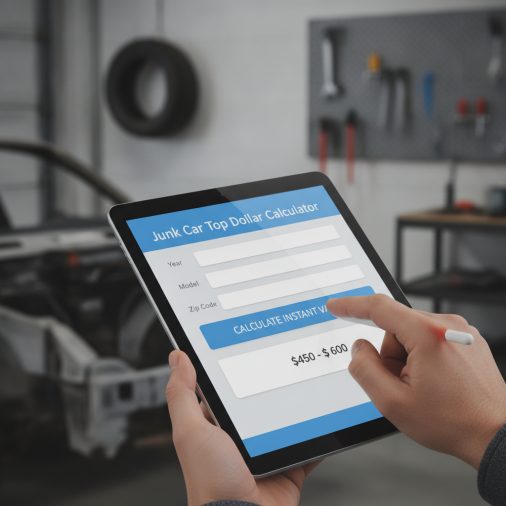
Follow these steps to get your most accurate estimate:
- Enter your vehicle’s curb weight in pounds — find this on the driver’s door jamb sticker or your owner’s manual.
- Input today’s scrap steel price per ton for your region. Check iScrap App or local scrapyard websites for current rates.
- Select your vehicle’s overall condition from the dropdown to apply the appropriate value multiplier.
- Choose your catalytic converter status and enter a realistic base value for your specific converter type.
- Select engine and transmission condition and enter an estimated core value if the powertrain is sellable.
- Slide to indicate how many good tires remain on the vehicle and enter a per-tire resale value.
- Adjust the buyer margin slider to reflect typical junk buyer overhead in your area — 25–35% is common.
- Review all six result cards to understand your scrap baseline, parts add-ons, theoretical maximum, and realistic offer range.
Understanding the Calculator Inputs
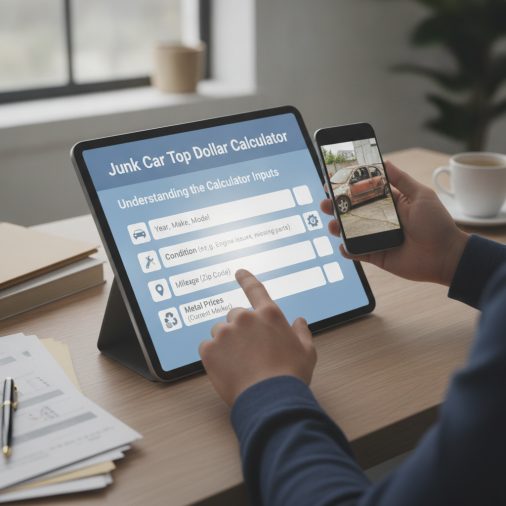
Vehicle Curb Weight (lbs): This is the single most important input. Curb weight is the manufacturer-stated weight of the vehicle with all standard equipment and fluids but no passengers or cargo. You can find it on the sticker inside the driver’s door jamb, in the owner’s manual, or by searching your year, make, and model on a site like Car and Driver or the manufacturer’s website. Compact sedans typically weigh 2,500–3,200 lbs, mid-size SUVs 3,800–4,800 lbs, and full-size trucks 4,500–6,500 lbs. The heavier the vehicle, the more steel it yields at the scrapyard.
Current Scrap Steel Price ($ per ton): Scrap steel is a commodity that fluctuates daily based on global supply and demand. The default of $180 per ton reflects a mid-range national average, but prices can range from $80 to over $300 per ton depending on the market cycle and your region. Check the iScrap App, Scrap Monster, or call a local scrapyard for today’s rate before entering this value. Using an outdated price will skew your estimate significantly.
Overall Vehicle Condition: Select the option that best describes your vehicle’s current state. Complete and Runs/Drives means the car starts, moves under its own power, and has all major components. Complete, Non-Running means all parts are present but the vehicle will not start or drive. Mostly Complete, Non-Running covers cars missing some panels, glass, or minor components. Stripped or Heavy Body Damage applies to vehicles that have had major parts removed or suffered severe collision damage. Fire or Flood Damaged represents the lowest tier, where metal contamination and missing components significantly reduce yield.
Catalytic Converter Present and Base Value: Select whether your OEM (original equipment manufacturer) converter is intact, an aftermarket unit is installed, or the converter has already been removed. Then enter a realistic dollar value for your specific converter. OEM converters on V6 and V8 engines from Honda, Toyota, and domestic trucks can fetch $150–$500 or more. Four-cylinder economy car converters may be worth $50–$150. Research your specific vehicle’s converter value on sites that publish precious metal recovery data before entering this figure.
Engine and Transmission Condition and Core Value: If your engine turns over and the transmission shifts — even if the car does not run reliably — select Runs, Sellable as Core and enter an estimated value. Engine cores are bought by rebuilders and used parts dealers. A common four-cylinder core might be worth $100–$400, while a sought-after V8 truck engine could be worth $500–$1,500. If the engine is seized, cracked, or otherwise destroyed, select Seized or Damaged, Scrap Only and the engine value field will have no effect on the calculation.
Number of Good Usable Tires and Value Per Tire: Slide to indicate how many tires on the vehicle have at least 4/32 inch of tread remaining and no sidewall damage or dry rot. Used tires in good condition sell for $20–$60 each for standard passenger sizes and $40–$100 for truck and SUV sizes. Enter a per-tire value that reflects your local used tire market. Tires with less than 4/32 tread or visible damage are generally not resalable and should not be counted.
Junk Buyer Margin (%): Junk car buyers are businesses. They must cover towing costs, processing labor, title handling, lot fees, and profit. A margin of 25–35% is typical for most buyers. Buyers in rural areas with higher towing costs may operate at 40–55%. Buyers in dense urban markets with high vehicle volume may work at 15–25%. Setting this slider accurately helps you understand the gap between what your car is theoretically worth and what a buyer will realistically offer.
Understanding Your Results
Raw Scrap Metal Value: This is the gross dollar value of your vehicle’s steel if it were sold purely by weight at the current scrap price per ton, with no adjustments for condition or missing parts. It represents the absolute ceiling of what the metal alone is worth and serves as your starting reference point. Most vehicles will never achieve this number in practice because some metal is always lost to processing.
Condition-Adjusted Scrap Value: This figure applies your selected condition multiplier to the raw scrap value. A vehicle in complete, running condition retains 85% of its theoretical scrap value, while a fire-damaged hulk may only yield 20%. This adjusted number is the realistic scrap metal contribution to your total payout and is the figure scrapyards use as their internal baseline when making offers.
Salvage Parts Add-On Value: This result totals the estimated value of your catalytic converter, engine and transmission core, and usable tires. These components are sold separately from the scrap metal and can meaningfully increase your total payout. For many vehicles, the catalytic converter alone represents 20–40% of the total offer. This figure is only as accurate as the values you entered for each component.
Total Theoretical Maximum Value: This is the sum of your condition-adjusted scrap value and all salvage parts add-ons. It represents the absolute ceiling of what your vehicle could be worth if every component were sold at its maximum value with no buyer overhead. No junk car buyer will offer you this amount — it is your negotiating ceiling and a useful benchmark for evaluating offers.
Realistic Buyer Offer (Low End): This is the most practically useful result. It applies the buyer margin you selected to the total theoretical maximum, giving you the cash offer you should realistically expect to receive. If a buyer quotes you significantly less than this figure, it is worth getting additional quotes. If a buyer quotes you close to or above this figure, that is a competitive offer worth considering seriously.
Top Dollar Target (Negotiate To): This result models what you can realistically push for by shopping multiple buyers and negotiating. It is calculated by reducing the buyer margin by 40%, reflecting the fact that competitive buyers in active markets often work on thinner margins to win the vehicle. Use this number as your negotiation goal when you have multiple quotes in hand.
Calculation Formulas Explained
Raw Scrap Metal Value converts curb weight from pounds to tons by dividing by 2,000, then multiplies by the scrap price per ton: (curb_weight / 2000) * scrap_price. This gives the gross dollar value of the vehicle’s steel at current commodity prices.
Condition-Adjusted Scrap Value multiplies the raw scrap value by the condition factor selected from the dropdown: ((curb_weight / 2000) * scrap_price) * condition. The condition factor ranges from 0.20 for fire or flood damage to 0.85 for a complete running vehicle, reflecting the proportion of usable metal that remains.
Salvage Parts Add-On Value sums three independent components: (cat_converter * cat_base_value) + (engine_intact * engine_value) + (tires_good * tire_value). The catalytic converter multiplier (0, 0.5, or 1) scales the base value by converter type. The engine multiplier (0 or 1) acts as an on/off switch. Tires multiply count by per-unit value.
Total Theoretical Maximum Value adds the condition-adjusted scrap value and the salvage parts add-on: condition_adjusted_scrap + salvage_parts, giving the pre-margin ceiling value.
Realistic Buyer Offer applies the buyer margin as a deduction: total_max * (1 – (buyer_margin / 100)). A 30% margin means the buyer retains 30 cents of every dollar of value, so you receive 70%.
Top Dollar Target uses a reduced margin of 60% of the entered buyer margin: total_max * (1 – ((buyer_margin * 0.6) / 100)). This models the scenario where competitive bidding compresses the buyer’s margin, giving you a realistic upper negotiation target.
Worked Example
Example: 2008 Honda Accord, Non-Running, Mostly Complete
A seller has a 2008 Honda Accord with a curb weight of 3,200 lbs. The local scrapyard is paying $175 per ton for scrap steel. The car does not run, is mostly complete but missing the rear bumper cover, and has the original OEM catalytic converter intact (estimated value $200 for this model). The engine is seized and not sellable as a core. Two tires are in good condition at $25 each. The seller uses a buyer margin of 30%.
- Raw Scrap Metal Value: (3200 / 2000) * 175 = 1.6 * 175 = $280.00
- Condition-Adjusted Scrap Value: $280.00 * 0.55 (Mostly Complete, Non-Running) = $154.00
- Salvage Parts Add-On Value: (1 * $200) + (0 * $0) + (2 * $25) = $200 + $0 + $50 = $250.00
- Total Theoretical Maximum Value: $154.00 + $250.00 = $404.00
- Realistic Buyer Offer (Low End): $404.00 * (1 – 0.30) = $404.00 * 0.70 = $282.80
- Top Dollar Target: $404.00 * (1 – (30 * 0.6 / 100)) = $404.00 * (1 – 0.18) = $404.00 * 0.82 = $331.28
The seller should expect offers in the range of $283 to $331 and should be skeptical of any offer below $250 without a clear explanation such as a towing fee deduction.
How to Interpret the Results
When reviewing your results, focus first on the Realistic Buyer Offer (Low End) as your baseline expectation and the Top Dollar Target as your negotiation goal. The gap between these two numbers is your negotiating room — typically 15–25% of the low-end offer.
If the first quote you receive is at or above the Top Dollar Target, that is an unusually strong offer and worth accepting quickly, as scrap prices can change daily. If the first quote is below the Realistic Buyer Offer by more than 15%, get at least two more quotes before accepting.
Pay close attention to whether the buyer’s quote includes free towing. A buyer offering $50 more than a competitor but charging a $75 towing fee is actually offering less. Always ask for the net cash in hand figure after any towing deduction.
The Salvage Parts Add-On Value result tells you how much of your total estimate comes from components rather than raw metal. If this number is high relative to the total, consider whether selling those parts privately before scrapping the shell would yield more money overall — though this requires more time and effort.
The Raw Scrap Metal Value versus the Condition-Adjusted Scrap Value gap shows you the cost of your vehicle’s condition. A large gap here means the condition multiplier is doing significant work, and improving the vehicle’s completeness — for example, reinstalling a bumper or sourcing a missing wheel — could meaningfully increase your offer.
Common Mistakes to Avoid
- Using outdated scrap prices: Scrap steel prices can move 20–40% within a single quarter. Using a price from six months ago will produce an estimate that is significantly off. Always check current local rates before running the calculator.
- Overestimating catalytic converter value: Not all catalytic converters are worth the same. A common four-cylinder economy car converter may be worth $50–$80, while a truck or luxury vehicle converter can be worth $300–$600. Research your specific vehicle’s converter before entering a value.
- Ignoring the towing fee: Many sellers focus on the gross offer and forget to subtract the towing fee. A $350 offer with a $100 towing charge is only $250 net. Always compare net offers.
- Selecting the wrong condition tier: Sellers often overestimate their vehicle’s condition. If the car is missing any major component — catalytic converter, engine, transmission, doors, hood — it is not Complete. Be honest about condition to get a useful estimate.
- Not getting multiple quotes: The junk car buying market is competitive. Prices between buyers for the same vehicle can vary by 30–50% in the same city. Getting at least three quotes is the single most effective way to maximize your payout.
- Selling without a title when one is available: Sellers sometimes accept lower no-title offers when they actually have the title and could get a higher payout. Always locate your title before calling buyers — it can add $50–$200 to your offer.
Limitations and Important Notes
This calculator provides independent planning estimates only and does not represent any offer, quote, or commitment from any junk car buyer, scrapyard, or vehicle purchasing service. Actual offers will vary based on your specific location, the buyer’s current inventory needs, real-time commodity prices, local towing costs, and title status.
The condition multipliers used in this calculator are generalized approximations based on typical industry practices. Individual buyers may apply different internal multipliers. Catalytic converter and engine core values entered by the user are self-reported estimates; actual buyer valuations may differ based on their specific resale channels and current precious metal prices.
Vehicle curb weight is used as a proxy for total recoverable scrap metal. In practice, recoverable metal is typically 75–85% of curb weight due to fluids, plastics, glass, and rubber that are separated during processing. The condition multiplier partially accounts for this, but the calculator does not model processing yield separately.
This tool is designed for planning and negotiation preparation only. Always verify current scrap prices with local buyers, obtain multiple quotes, and consult your state’s DMV regarding title transfer requirements before completing any vehicle sale transaction.
Frequently Asked Questions
How much is a junk car worth per pound?
At typical scrap steel prices of $150–$220 per ton, a junk car is worth roughly $0.075 to $0.11 per pound of curb weight in raw scrap value. However, the per-pound figure you actually receive is lower after the buyer’s margin is applied, typically landing between $0.05 and $0.08 per pound for the net cash offer. High-value components like catalytic converters and engine cores are priced separately and not on a per-pound basis, so the effective per-pound rate for a complete vehicle with intact parts is meaningfully higher than the raw scrap rate alone.
What is the average junk car payout in the United States?
The average junk car payout in the US ranges from approximately $200 to $600 for a typical passenger sedan or small SUV, based on mid-range scrap prices and average vehicle weights. Full-size trucks and large SUVs can fetch $400–$900 or more due to their greater weight and larger catalytic converters. Vehicles in running condition with intact high-value components can exceed $1,000 in competitive markets. These figures fluctuate with scrap steel commodity prices, which have ranged from under $100 to over $400 per ton in recent years.
Does a junk car need a title to be sold?
Title requirements vary by state. Most states require a valid title to transfer ownership of a vehicle to a junk buyer or scrapyard, and buyers will typically pay more for a titled vehicle because it reduces their legal and processing risk. Some states allow a bill of sale or registration documents for older vehicles above a certain age threshold. A small number of states have specific junk vehicle exemptions. If you have lost your title, you can usually obtain a duplicate from your state’s DMV for $10–$25, which is almost always worth doing before selling since it can add $50–$200 to your offer.
How do I find the curb weight of my vehicle?
The easiest place to find your vehicle’s curb weight is the sticker on the inside edge of the driver’s door or door jamb — this label lists the vehicle’s GVWR (Gross Vehicle Weight Rating) and often the curb weight. You can also find it in the owner’s manual under specifications, or by searching your vehicle’s year, make, model, and trim level on the manufacturer’s website or automotive reference sites like Car and Driver, Edmunds, or Motor Trend. If you cannot find the exact figure, use the closest trim level available — curb weight differences between trims of the same model are usually under 200 lbs and will not significantly affect your estimate.
Will a junk car buyer pay more if the car runs?
Yes, significantly. A vehicle that starts and drives under its own power typically commands a condition multiplier of 0.80–0.90 versus 0.50–0.65 for a non-running but complete vehicle. This difference alone can add $50–$150 to the scrap value component of the offer. More importantly, a running vehicle may qualify as a used car purchase rather than a junk purchase, opening up a different buyer pool — including used car dealers and private buyers — who may pay substantially more than scrap value. If your car runs but has high mileage or mechanical issues, always get quotes from both junk buyers and used car buyers before deciding.
What happens to my car after I sell it to a junkyard?
After purchase, a junkyard typically drains all fluids (oil, coolant, transmission fluid, brake fluid, and refrigerant) for proper disposal or recycling. Valuable components — catalytic converters, engines, transmissions, alternators, starters, doors, hoods, and electronics — are removed and inventoried for resale as used parts. The remaining shell is then crushed or shredded and sold to steel mills as scrap metal, where it is melted down and recycled into new steel products. The entire process is regulated under environmental laws governing fluid disposal and hazardous materials, so reputable junkyards follow strict procedures for handling end-of-life vehicles.
Can I sell a junk car without a catalytic converter?
Yes, you can sell a junk car without a catalytic converter, but your offer will be lower. Buyers know the converter is missing and will not pay for it. If you removed the converter yourself and sold it separately, you may have already captured more value than a junk buyer would have paid for it as part of the whole vehicle — this is a legitimate strategy if you have the means to sell the converter independently. However, be aware that selling a catalytic converter separately requires documentation in many states due to theft prevention laws, and buyers may require proof of vehicle ownership before purchasing a converter.
How many quotes should I get before selling my junk car?
Getting at least three quotes is the widely recommended minimum, and five or more is better if you have the time. The junk car buying market is highly fragmented, with national online buyers, regional chains, and independent local scrapyards all competing for vehicles. Prices for the same vehicle can vary by 30–50% between buyers in the same metropolitan area. Online quote platforms can generate multiple offers quickly, but always verify that the quoted price is the net cash amount after any towing fees before comparing. The few hours spent collecting quotes is almost always worth the additional $50–$200 it typically yields.