Wondering how much your old clunker is actually worth? Our junk car cash out calculator gives you a realistic estimate of your vehicle’s scrap and salvage value based on its weight, condition, current steel prices, and your location. Whether your car is totaled, non-running, or simply too costly to repair, knowing your baseline cash-out value puts you in a stronger negotiating position before you call a junkyard or cash-for-cars buyer. Fill in the fields below to get your personalized estimate instantly.
Junk Car Cash Out Calculator: Estimate Your Scrap & Salvage Value
Estimate how much cash you can get for your junk or scrap car based on vehicle weight, steel prices, condition, catalytic converter, and regional market factors.
How to Use This Calculator
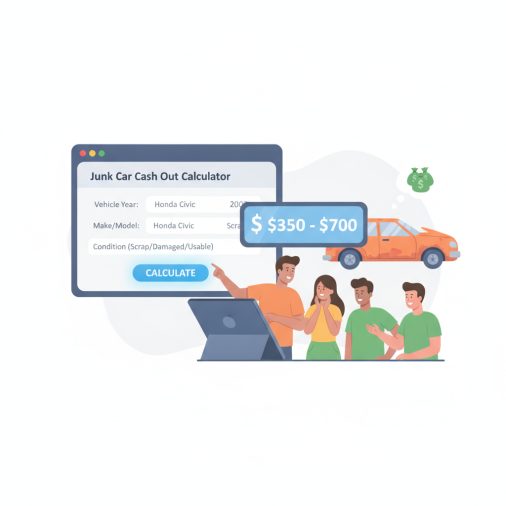
Follow these steps to get the most accurate estimate from the calculator:
- Enter your vehicle’s curb weight — find this on the driver’s door jamb sticker or look it up by year, make, and model online.
- Enter the current scrap steel price — check iScrap App, Scrap Monster, or call a local yard for today’s rate per ton in your area.
- Select your vehicle’s overall condition — be honest; overestimating condition leads to disappointment when the buyer makes a lower offer.
- Choose your catalytic converter status and enter a researched value — OEM converters on trucks and SUVs can be worth $150–$500 or more.
- Select drivability, title status, and regional market — these three factors can shift your total estimate by 10–30%.
- Enter salvageable parts value and set the credit rate — research your specific model’s popular parts on eBay Motors or LKQ to estimate this accurately.
- Review all six result cards and use the Estimated Total Cash Out as your negotiation floor when contacting buyers.
Understanding the Calculator Inputs
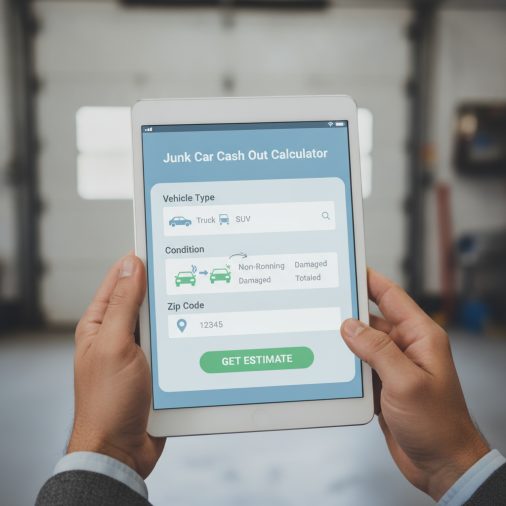
Vehicle Curb Weight (lbs): This is the single most important number in the calculation. Curb weight is the manufacturer-stated weight of the vehicle with all standard equipment and fluids but no passengers or cargo. Find it on the sticker inside the driver’s door jamb, in your owner’s manual, or by searching your year/make/model on a site like Car and Driver or the manufacturer’s website. Compact sedans typically weigh 2,600–3,200 lbs, mid-size SUVs 3,800–4,800 lbs, and full-size trucks 4,500–6,000 lbs. Heavier vehicles produce more recoverable steel, so weight is the primary lever on your payout.
Current Scrap Steel Price ($/ton): Scrap metal prices change daily based on global commodity markets. The default of $180/ton is a conservative mid-range figure, but prices have ranged from under $100/ton to over $400/ton in recent years. Before using the calculator, check the iScrap App, Scrap Monster, or simply call two or three local scrap yards to get today’s actual rate. Using an accurate price makes your estimate far more reliable.
Overall Vehicle Condition: Select the option that honestly describes your car. Complete and Runs means the engine starts and the vehicle moves under its own power with no major missing components. Complete, Non-Running means all major parts are present but the car does not start or drive. Missing Some Parts covers vehicles with absent doors, hoods, engines, or transmissions. Heavily Stripped or Damaged applies to vehicles that have been significantly parted out or suffered major collision damage. Fire or Flood Damaged vehicles have the lowest value because hazardous material handling adds cost for the buyer.
Catalytic Converter Present and Value: Select whether your OEM (original equipment manufacturer) converter is intact, an aftermarket unit is installed, or the converter has already been removed. Then enter your best estimate of its value in dollars. OEM converters on trucks, SUVs, and luxury vehicles can be worth $150–$500 or more due to platinum, palladium, and rhodium content. Research your specific converter using a lookup tool or by contacting a local precious-metals recycler for an accurate figure.
Is the Vehicle Drivable: A car that drives under its own power saves the buyer the cost of dispatching a flatbed tow truck, which typically runs $75–$150. Selecting Yes adds a $75 convenience bonus to your estimate, adjusted for title status and regional market. If the car needs a tow, select No — some buyers deduct towing costs from the offer, so this field helps you understand the net difference.
Title Status: A clean title in hand is the gold standard and receives no penalty. A salvage or rebuilt title reduces the multiplier to 0.90 because the buyer faces more paperwork and resale restrictions. No title (bill of sale only) reduces it to 0.75 — many states require a title to legally process a vehicle, so buyers take on additional risk and administrative cost. If you have lost your title, contact your state DMV about a replacement before selling; it can meaningfully increase your offer.
Regional Market Factor: Buyers in high-density metro areas compete more aggressively for inventory, which tends to push offers higher. Rural markets with fewer competing yards often pay less. Select the option that best describes your location. This is a broad approximation — actual market conditions depend on local yard density, state regulations, and seasonal demand.
Estimated Salvageable Parts Value and Credit Rate: If your vehicle model has popular resaleable parts — think late-model engines, transmissions, infotainment systems, alloy wheels, or airbag modules — enter a realistic total retail value for those parts. Then use the slider to set the percentage of that value you expect the buyer to credit back to you. Most junkyards pass back 15–25% of parts value; setting the slider to 20% is a reasonable starting point. Research your model’s parts on eBay Motors or LKQ Online to estimate the parts value accurately.
Understanding Your Results
Base Scrap Metal Value: This is the foundation of every junk car offer. It converts your vehicle’s curb weight to tons (dividing by 2,000), multiplies by the current steel price per ton, and then applies your condition, title, and regional multipliers. For a 3,200-lb car at $180/ton in average condition with a clean title in an average market, the base value is approximately $288. This number rises and falls directly with steel commodity prices, so checking current rates before negotiating is essential.
Catalytic Converter Bonus: This result shows the additional cash value your catalytic converter adds to the offer. An OEM converter at the default $150 value adds the full $150. An aftermarket converter adds half that amount ($75), and a missing converter adds nothing. If your converter is intact and you drive a truck, SUV, or hybrid, research its specific value — this single component can sometimes exceed the base scrap metal value on smaller vehicles.
Salvageable Parts Credit: This figure represents the realistic share of your vehicle’s resaleable parts value that a buyer might credit back in the offer. At the default settings ($200 parts value, 20% credit rate), this adds $40 to your estimate. Increasing the credit rate slider reflects a more aggressive negotiation stance or a buyer who specializes in parts resale rather than pure scrap.
Drivability and Convenience Bonus: If your vehicle drives, this result shows the additional value attributed to saved towing costs, adjusted for your title status and regional market. In a metro area with a clean title, a drivable vehicle earns approximately $82.50 extra ($75 × 1.1 regional × 1.0 title). This bonus is modest but real — it also gives you leverage to negotiate if a buyer tries to lowball you on a running car.
Estimated Total Cash Out: This is your headline number — the sum of all four value components. Use it as your negotiation floor, not your ceiling. Get at least three quotes from local junkyards and cash-for-cars services before accepting any offer. If a buyer’s quote is significantly below this estimate, ask them to explain the gap; it may reveal a legitimate reason (like a missing title) or confirm that you should shop elsewhere.
Value Per Pound of Vehicle: This metric divides your total estimated cash out by the vehicle’s curb weight to produce a dollars-per-pound rate. It is most useful when comparing offers on vehicles of different sizes, or when evaluating whether a buyer’s per-pound quote is competitive. Typical junk car rates range from $0.06 to $0.20 per pound depending on steel prices and vehicle condition.
Calculation Formulas Explained
All formulas use US short tons (1 ton = 2,000 lbs) and US dollars. Here is how each calculation works:
- Base Scrap Metal Value:
((curb_weight / 2000) * steel_price) * condition_multiplier * title_available * regional_factor— Divides curb weight by 2,000 to convert pounds to tons, multiplies by the steel price per ton to get raw metal value, then applies three multiplicative adjustments: condition (0.45–1.15), title status (0.75–1.0), and regional market (0.88–1.1). All three are multipliers, so they compound — a fire-damaged car with no title in a rural area receives 0.45 × 0.75 × 0.88 = approximately 30% of the raw metal value. - Catalytic Converter Bonus:
cat_bonus * catalytic_converter— Multiplies the user-supplied dollar value by 1 (OEM), 0.5 (aftermarket), or 0 (absent). Simple and direct. - Salvageable Parts Credit:
salvageable_parts_value * (parts_credit_rate / 100)— Converts the percentage slider to a decimal and multiplies by the estimated parts value. At 20% and $200, this yields $40. - Drivability Bonus:
drivable_bonus * title_available * regional_factor— The base bonus ($75 or $0) is scaled by title status and regional factor, reflecting that a drivable car’s convenience premium is also affected by paperwork risk and local market conditions. - Estimated Total Cash Out: The arithmetic sum of all four components above.
- Value Per Pound:
total_cash_out / curb_weight— Divides the total estimate by curb weight in pounds to produce a per-pound rate for benchmarking.
Worked Example
Example: 2008 Ford F-150, 4,500 lbs, suburban Ohio market
- Curb weight: 4,500 lbs. Divided by 2,000 = 2.25 tons.
- Steel price: $200/ton (current local rate). Raw metal value = 2.25 × $200 = $450.
- Condition: Complete, non-running (multiplier = 1.0). Adjusted = $450 × 1.0 = $450.
- Title: Clean title in hand (multiplier = 1.0). Adjusted = $450 × 1.0 = $450.
- Regional factor: Average suburban market (multiplier = 1.0). Base Scrap Metal Value = $450.00.
- Catalytic converter: OEM intact, researched value = $220. Bonus = $220 × 1 = $220.00.
- Salvageable parts: The F-150’s 5.4L engine and tailgate are popular. Estimated parts value = $800. Credit rate = 20%. Parts credit = $800 × 0.20 = $160.00.
- Drivability: Non-running, needs tow. Bonus = $0 × 1.0 × 1.0 = $0.00.
- Estimated Total Cash Out = $450 + $220 + $160 + $0 = $830.00.
- Value per pound: $830 / 4,500 = $0.1844/lb.
Armed with this estimate, the owner contacts three local buyers. Two quote $700–$750; one quotes $875. The owner accepts the $875 offer, which is above the calculator estimate — consistent with the F-150’s strong parts demand in that market.
How to Interpret the Results
Think of the Estimated Total Cash Out as your informed negotiation floor — the minimum you should seriously consider accepting given current market conditions. If every buyer you contact quotes significantly below this number, revisit your inputs: you may have overestimated the steel price, parts value, or condition rating. If buyers are quoting above it, that is a sign your vehicle has additional value the calculator’s conservative assumptions did not fully capture.
The Value Per Pound metric is especially useful when you receive offers on vehicles of very different sizes. A buyer quoting $0.08/lb on a 5,000-lb truck is offering less per unit of metal than one quoting $0.12/lb on a 3,000-lb sedan, even if the dollar totals look similar. Use this figure to compare apples to apples across multiple quotes.
Remember that this estimate does not account for towing fees the buyer may deduct, hazardous material surcharges, or state-specific processing fees. Always ask buyers whether their quote is the amount you will receive in hand or the amount before deductions.
Common Mistakes to Avoid
- Using outdated steel prices: Scrap steel prices can move 20–40% within a single quarter. Using last year’s price — or the calculator’s default — without checking current local rates is the most common source of estimation error. Always verify before negotiating.
- Overestimating vehicle condition: Sellers naturally view their own vehicles favorably. A car with a cracked engine block, missing catalytic converter, and stripped interior is not in “missing some parts” condition — it is heavily stripped. Honest condition selection produces a more useful estimate.
- Forgetting to research the catalytic converter: Many sellers leave significant money on the table by not knowing their converter’s value. A Toyota Prius OEM converter can be worth $800–$1,500; a standard sedan’s may be $80. The difference is enormous and worth a five-minute lookup.
- Accepting the first offer: Cash-for-cars buyers set initial offers low expecting negotiation. Getting at least three quotes is the single most effective way to increase your actual payout.
- Not replacing a lost title before selling: Selling without a title typically reduces your offer by 25% or more. A replacement title from your state DMV usually costs $15–$50 and takes a few days — almost always worth the wait.
- Confusing curb weight with GVWR: Gross Vehicle Weight Rating (GVWR) is the maximum loaded weight, not the vehicle’s actual weight. Always use curb weight for this calculator.
Limitations and Important Notes
This calculator is an independent planning tool designed to help vehicle owners form a realistic baseline estimate before contacting buyers. It is not affiliated with any junkyard, cash-for-cars service, or scrap metal company, and it does not represent any specific buyer’s actual offer methodology.
Key assumptions and limitations include: (1) Curb weight is used as a proxy for recoverable metal; actual recoverable steel is typically 75–85% of curb weight after fluids and non-metal components are removed, but most buyers price on gross curb weight. (2) Steel price is user-supplied and must reflect current local market rates to be meaningful. (3) Catalytic converter values vary widely by make, model, year, and precious-metal spot prices; the user-supplied value should be independently researched. (4) The parts credit rate of 0–50% is a broad approximation of real-world negotiation outcomes. (5) Towing fees, if applicable, are typically deducted by the buyer from the offer and are not explicitly modeled here. (6) Regional factors are broad approximations and do not account for state-specific regulations, seasonal demand swings, or individual yard policies. (7) Prices are in US dollars; weights use US short tons (2,000 lbs). Results should be used for planning and negotiation preparation only.
Frequently Asked Questions
How much is my junk car worth on average?
The average junk car in the United States sells for roughly $200–$500, but the range is wide. A small, heavily stripped sedan in a rural market with low steel prices might fetch $100–$150, while a complete, non-running full-size truck with an intact catalytic converter in a metro area during a high-steel-price period can bring $800–$1,500 or more. Vehicle weight, current scrap steel prices, condition, and catalytic converter value are the four biggest drivers of where your specific car falls in that range.
What is the current scrap car price per ton, and where do I find it?
Scrap steel prices fluctuate daily based on global commodity markets and typically range from $100 to $350 per ton for shredded steel, though they have spiked above $400/ton during periods of high demand. The most reliable way to find your local current rate is to check the iScrap App (iscrapapp.com), call two or three local scrap yards directly, or check Scrap Monster for regional averages. Prices vary significantly by region, so a national average is less useful than a local quote.
Do I need a title to sell my junk car?
Requirements vary by state, but having a clean title in hand almost always results in a higher offer and a smoother transaction. Many states legally require a title for a junkyard to process a vehicle. Without one, buyers take on legal and administrative risk, which they offset with a lower offer — typically 20–30% less. If you have lost your title, contact your state’s DMV about a duplicate title; the fee is usually $15–$50 and the wait is a few business days, making it almost always worth doing before you sell.
How do cash-for-cars companies make money?
Cash-for-cars companies profit through a combination of three revenue streams. First, they resell high-value salvageable parts — engines, transmissions, doors, electronics — through their own lots or online marketplaces like eBay Motors and LKQ. Second, they sell the remaining metal carcass to a shredder or scrap processor at the prevailing steel price. Third, some companies charge towing fees or processing fees that are deducted from the offer. Understanding this model helps you negotiate: if your car has popular resaleable parts, the buyer’s margin is higher, and there is more room to push for a better price.
Is it better to part out my car or sell it whole to a junkyard?
Parting out your car yourself can yield two to five times more money than selling it whole, but it requires significant time, tools, storage space, and knowledge of what parts are worth. If your vehicle has high-demand components — a low-mileage engine, a sought-after transmission, rare trim pieces, or a valuable catalytic converter — and you have the time and ability to remove and sell them individually, parting out is financially superior. For most people, however, the convenience of a single transaction with a junkyard outweighs the extra income from parting out, especially for older or common vehicles where individual parts have limited resale value.
Does the catalytic converter really add significant value to a junk car?
Yes, often dramatically so. Catalytic converters contain platinum, palladium, and rhodium — precious metals that are refined and resold. OEM converters on trucks, SUVs, and hybrids can be worth $150–$1,500 depending on the vehicle and current precious-metal spot prices. On a small sedan with a base scrap value of $150–$200, an intact OEM converter worth $200 can literally double the total payout. Always verify that your converter is present and intact before contacting buyers, and research its specific value using a converter lookup tool or by calling a local precious-metals recycler.
Can I sell a car with a lien on it for scrap?
Technically, you cannot legally sell a vehicle you do not fully own — a lien means the lender has a financial interest in the car. Before selling, you must either pay off the lien and obtain a clear title, or work with the lender to release the lien. Some lenders will cooperate if the payoff amount is less than the vehicle’s value. Selling a liened vehicle without the lender’s knowledge is illegal and can result in serious legal consequences. Contact your lender first to understand your options.
Are junk car prices negotiable, and how do I get a better offer?
Yes, junk car prices are almost always negotiable. The most effective tactics are: (1) get at least three competing quotes before accepting any offer — competition is your strongest leverage; (2) know your vehicle’s catalytic converter value and mention it specifically; (3) have your title ready and in hand; (4) if the car is drivable, offer to drive it to the yard rather than requiring pickup; (5) research your model’s popular parts on eBay Motors and mention specific high-value components during negotiation. Buyers set initial offers low expecting pushback, so a polite counter citing a competing quote is standard practice and frequently results in a higher final offer.