Planning to finance a Jeep? Use this independent Jeep car loans calculator to instantly estimate your monthly payment, total interest, and the true cost of ownership over your loan term. Simply enter your vehicle price, down payment, trade-in value, sales tax rate, annual interest rate, and loan term to see a full financing breakdown. Whether you’re eyeing a Wrangler, Grand Cherokee, or Gladiator, understanding your financing numbers before visiting the dealership puts you in a stronger negotiating position and helps you avoid surprises at the signing table.
Jeep Car Loans Calculator: Monthly Payment & Total Cost
Calculate your Jeep monthly loan payment, total interest paid, and true cost of financing with this free amortization-based Jeep car loans calculator.
How to Use This Calculator

Follow these steps to get accurate results from the Jeep car loans calculator:
- Enter the vehicle price: Use the negotiated purchase price or MSRP of the Jeep you are considering, not the sticker price if you expect to negotiate.
- Add your down payment: Enter any cash you plan to pay upfront. A larger down payment reduces your financed amount and total interest.
- Enter trade-in details: If you are trading in a vehicle, enter its estimated value and any remaining loan balance. If you owe more than the trade-in is worth, that negative equity is rolled into your new loan.
- Set your sales tax rate: Use your state and local combined sales tax rate. Check your state DMV website if you are unsure.
- Add fees: Include documentation, title, and registration fees typically charged by the dealer or your state.
- Set your APR: Enter the annual percentage rate quoted by your lender or use a rate appropriate for your credit tier as a starting estimate.
- Choose your loan term: Select the repayment period in months. Shorter terms mean higher monthly payments but less total interest.
- Review all six results to understand your monthly obligation, total interest burden, and true out-of-pocket cost.
Understanding the Calculator Inputs
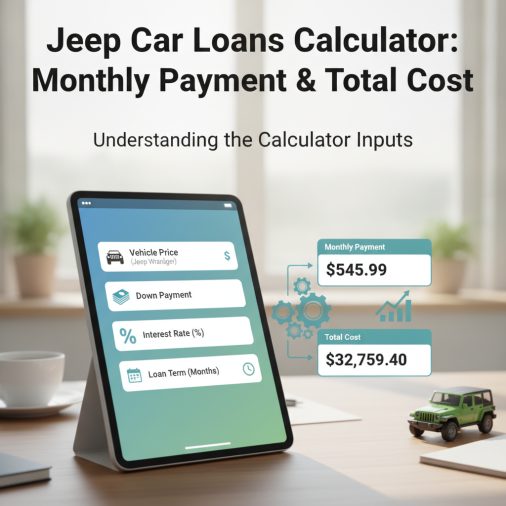
Jeep Vehicle Price: Enter the negotiated purchase price of the Jeep, not necessarily the MSRP. This is the single largest driver of your loan amount. Jeep models range widely — a base Compass may start around $25,000 while a fully loaded Grand Wagoneer can exceed $100,000 — so use the actual price you expect to pay after any dealer negotiation.
Down Payment: This is the cash you pay at signing. It directly reduces the amount you need to borrow. Financial guidance commonly suggests 10–20% of the vehicle price as a down payment, though any amount helps reduce interest costs. If you are buying a Jeep Grand Cherokee as a family vehicle, a larger down payment also reduces the risk of going underwater on the loan.
Trade-In Value: If you are trading in your current vehicle, enter its estimated market value. You can get estimates from independent valuation tools or dealer appraisals. This amount is credited against your purchase price.
Amount Owed on Trade-In: If you still have a loan balance on your trade-in vehicle, enter that remaining balance here. If this number exceeds the trade-in value, you have negative equity, which will be rolled into your new Jeep loan and increase your financed amount.
Sales Tax Rate: Enter your combined state and local sales tax rate as a percentage. This calculator applies tax to the full vehicle price before trade-in deduction, which is the method used in most US states. Some states tax only the difference after trade-in — verify your local rules with your state DMV.
Title, Registration & Dealer Fees: These are the additional costs beyond the vehicle price that are commonly rolled into the loan. They include documentation fees, title fees, registration fees, and any dealer processing charges. A typical range is $500–$1,500 depending on your state and dealer.
Annual Interest Rate (APR): Enter the annual percentage rate your lender has quoted or that you expect to qualify for based on your credit profile. This is the most important variable after the loan amount — even a 1% difference in APR can mean hundreds of dollars over a 60-month term.
Loan Term: Choose the repayment period. Shorter terms (24–36 months) result in higher monthly payments but significantly less total interest. Longer terms (72–84 months) lower the monthly payment but increase total interest paid and the risk of being upside-down on the loan.
Credit Score Tier: This field is informational only and does not automatically change the APR in the formula. It serves as a reminder that your credit score is the primary factor lenders use to set your rate. Use it to prompt yourself to enter a realistic APR for your credit profile.
Understanding Your Results
Total Loan Amount Financed: This is the net principal you will borrow. It equals the vehicle price plus sales tax plus fees, minus your down payment and trade-in equity, plus any negative equity rolled in from your trade-in. This is the number your monthly payment is calculated from.
Monthly Payment: This is the fixed amount you will owe each month for the duration of the loan term, assuming a fixed APR. It is calculated using standard amortization math. Use this figure to assess whether the loan fits your monthly budget — a common guideline is that total vehicle expenses should not exceed 15–20% of your monthly take-home pay.
Total Amount Paid: This is the monthly payment multiplied by the number of months in your loan term. It represents the total cash you will send to the lender over the life of the loan, not counting your down payment or trade-in credit.
Total Interest Paid: This is the total amount paid minus the original loan principal. It is the pure cost of borrowing — the price you pay for spreading the purchase over time. Comparing this figure across different APRs and loan terms is one of the most useful exercises this calculator enables.
Total Out-of-Pocket Cost: This is the most complete picture of what the Jeep will actually cost you financially. It adds your down payment and trade-in value back to the total amount paid to the lender, giving you the full financial outlay for acquiring the vehicle.
Interest as % of Vehicle Price: This expresses total interest paid as a percentage of the original vehicle price. It is a quick benchmark for understanding how expensive your financing is relative to the asset. A result above 20% is a signal to consider a shorter term, larger down payment, or better APR before committing.
Calculation Formulas Explained
This calculator uses the standard fixed-rate amortization formula, which is the same method used by banks and credit unions to calculate auto loan payments. Here is how each piece works:
Step 1 — Loan Principal (P): The financed amount is calculated as: vehicle price + (vehicle price × sales tax rate / 100) + fees + max(0, trade-in owed − trade-in value) − down payment − trade-in value. The max(0, …) function ensures negative equity is only added when the trade-in balance exceeds the trade-in value, and the outer max(0, …) ensures the loan never goes below zero.
Step 2 — Monthly Interest Rate (r): The APR is divided by 1200 to convert the annual percentage rate into a monthly decimal rate. For example, 7.5% APR becomes 7.5 / 1200 = 0.00625 per month.
Step 3 — Monthly Payment: The formula is P × r / (1 − (1 + r)^(−n)), where n is the number of monthly payments. This is the standard present-value annuity formula. The pow() function is used to compute the exponent.
Step 4 — Total Amount Paid: Monthly payment × loan term in months.
Step 5 — Total Interest: Total amount paid − loan principal.
Step 6 — Total Out-of-Pocket: Total amount paid + down payment + trade-in value (since those were real assets you contributed).
Step 7 — Interest as % of Vehicle Price: Total interest ÷ vehicle price × 100.
Worked Example
Scenario: You are purchasing a Jeep Grand Cherokee with a negotiated price of $48,000. You have $6,000 cash for a down payment and a trade-in vehicle worth $8,000 with $3,000 still owed on it. Your state sales tax is 6%, dealer fees are $900, your lender quoted 7.5% APR, and you choose a 60-month term.
- Negative equity on trade-in: $3,000 owed − $8,000 value = −$5,000. Since this is negative, max(0, −5,000) = $0. No negative equity is rolled in.
- Sales tax: $48,000 × 6% = $2,880.
- Loan principal: $48,000 + $2,880 + $900 + $0 − $6,000 − $8,000 = $37,780.
- Monthly interest rate: 7.5 / 1200 = 0.00625.
- Monthly payment: $37,780 × 0.00625 / (1 − (1.00625)^(−60)) = $236.125 / (1 − 0.6897) = $236.125 / 0.3103 ≈ $761.24/mo.
- Total amount paid: $761.24 × 60 = $45,674.40.
- Total interest paid: $45,674.40 − $37,780 = $7,894.40.
- Total out-of-pocket: $45,674.40 + $6,000 + $8,000 = $59,674.40.
- Interest as % of vehicle price: $7,894.40 / $48,000 × 100 ≈ 16.4%.
This example shows that even with a solid down payment and trade-in, financing a $48,000 Jeep at 7.5% for 5 years costs nearly $7,900 in interest alone — a meaningful reason to shop for the best possible APR.
How to Interpret the Results
Use the results together rather than focusing on any single number. The monthly payment tells you whether the loan is affordable month to month, but the total interest paid tells you the real cost of that convenience. A low monthly payment achieved by stretching to an 84-month term can easily double the interest cost compared to a 48-month term on the same principal.
The interest as % of vehicle price metric is a useful sanity check. If it exceeds 20–25%, consider whether you can increase your down payment, shorten the term, or improve your credit score before applying. For buyers financing a Jeep Wrangler as a family vehicle, keeping this ratio low also protects against depreciation risk — Wranglers hold value well, but no vehicle is immune to market shifts.
The total out-of-pocket cost is the most honest number for comparing financing scenarios. Run the calculator multiple times with different APRs, terms, and down payment amounts to find the combination that balances monthly affordability with the lowest total cost. Even a 0.5% reduction in APR on a $40,000 loan over 60 months saves several hundred dollars in interest.
Common Mistakes to Avoid
- Forgetting sales tax and fees: Many buyers focus only on the vehicle price and are surprised when the financed amount is thousands higher. Always include your state tax rate and estimated fees for an accurate result.
- Ignoring negative equity: Trading in a vehicle with an outstanding loan balance that exceeds its value rolls that deficit into your new loan, increasing your principal from day one. This calculator accounts for it — make sure you enter both the trade-in value and the amount owed.
- Using the monthly payment as the only decision metric: A lower monthly payment achieved by extending the loan term often means paying significantly more in total interest. Always check the total interest and total out-of-pocket figures before deciding on a term.
- Entering the wrong APR: The APR field is the most sensitive input. Using a rough estimate instead of the actual rate quoted by your lender can make results meaningfully inaccurate. Get pre-approved before using this calculator for final planning.
- Assuming dealer financing is always competitive: Dealer-arranged financing may carry a markup over the lender’s base rate. Comparing a pre-approval from your bank or credit union against the dealer’s offer is one of the most effective ways to reduce your APR.
- Not accounting for insurance and maintenance: The loan payment is only part of the cost of owning a Jeep. Insurance, fuel, and maintenance costs — especially for off-road-capable models — should be factored into your overall budget before committing to a loan amount.
Limitations and Important Notes
This calculator uses standard fixed-rate amortization and assumes a constant APR for the entire loan term. It does not model variable-rate loans, deferred interest promotions, or balloon payment structures. Sales tax is applied to the full vehicle price before trade-in deduction, which is the method used in most US states; some states apply tax only to the price difference after trade-in — verify your local rules before relying on this figure for budgeting.
The credit score tier field is informational only and does not automatically adjust the APR. No origination fees, prepayment penalties, gap insurance, or extended warranty costs are included in the estimates. Results are planning estimates only and may differ from actual lender quotes due to lender-specific rounding conventions, state regulations, or fees not captured here. This calculator is an independent tool and is not affiliated with Stellantis, Jeep, or any lender or dealership. Always confirm final loan terms with your lender before signing any financing agreement.
Frequently Asked Questions
What credit score do I need to get a good Jeep loan rate?
Most lenders consider a credit score of 700 or above to be in the “good” range for auto loan rates, and scores of 750 or higher typically qualify for the most competitive APRs. Borrowers with scores below 650 will generally face significantly higher rates, which can add thousands of dollars in interest over a 60-month term. If your score is below your target, spending a few months paying down revolving debt and correcting any credit report errors before applying can meaningfully improve the rate you are offered. Use the APR field in this calculator to model the difference between a rate for excellent credit versus fair credit — the total interest difference is often eye-opening.
Can I use this calculator to estimate financing for a used Jeep?
Yes. The calculator works for both new and used Jeep purchases. Simply enter the purchase price of the used vehicle, your expected APR for a used car loan, and the appropriate loan term. Keep in mind that lenders typically charge higher APRs for used vehicles than for new ones, and many lenders cap loan terms at 60 or 72 months for older vehicles. Used Jeep models like the Wrangler and Grand Cherokee tend to hold their value well, which can work in your favor if you are also trading in a used vehicle.
What is a good APR for a Jeep auto loan?
A “good” APR depends heavily on your credit score, the loan term, and whether the vehicle is new or used. For borrowers with excellent credit (750+) financing a new Jeep, rates below 6–7% have historically been considered competitive in a normal interest rate environment, though market rates fluctuate with Federal Reserve policy. For used vehicles or borrowers with fair credit, rates of 8–12% or higher are common. The best approach is to get pre-approved by at least two or three lenders — including your bank or credit union — before visiting the dealership, so you have a benchmark to compare against any dealer-arranged financing offer.
How much should I put down on a Jeep?
A common guideline is to put down at least 10–20% of the vehicle’s purchase price. On a $45,000 Jeep, that means $4,500 to $9,000 upfront. A larger down payment reduces your loan principal, lowers your monthly payment, reduces total interest paid, and decreases the risk of being “upside down” — owing more than the vehicle is worth — which is a real concern given that new vehicles depreciate quickly in the first two years. If you cannot put down at least 10%, consider whether gap insurance is appropriate to protect you in the event of a total loss early in the loan term.
Is a 60-month or 72-month Jeep loan better?
A 60-month loan results in a higher monthly payment than a 72-month loan on the same principal, but you pay significantly less total interest and build equity in the vehicle faster. For example, on a $38,000 loan at 7.5% APR, a 60-month term costs roughly $2,000–$3,000 less in total interest than a 72-month term. The 72-month option makes sense only if the lower monthly payment is genuinely necessary for your budget — not simply to afford a more expensive vehicle than you would otherwise qualify for. Use this calculator to run both scenarios side by side and compare the total interest paid before deciding.
How does negative equity on a trade-in affect my Jeep loan?
Negative equity — sometimes called being “upside down” — occurs when you owe more on your trade-in vehicle than it is currently worth. For example, if your trade-in is valued at $8,000 but you still owe $11,000, you have $3,000 in negative equity. Most dealers will roll this deficit into your new Jeep loan, increasing your principal by $3,000 from the start. This means you are financing more than the Jeep is worth on day one, which increases your monthly payment, total interest, and the risk of being underwater on the new loan as well. This calculator captures this scenario in the “Amount Owed on Trade-In” field — enter both values to see the true impact on your financed amount.
What fees are typically rolled into a Jeep car loan?
Common fees that are rolled into auto loans include documentation fees (charged by the dealer for processing paperwork, typically $100–$800 depending on the state), title fees, registration fees, and sometimes dealer preparation or delivery charges. Some buyers also roll in the cost of gap insurance or an extended warranty, though financial advisors generally recommend paying for these separately if possible to avoid paying interest on them over the loan term. Use the “Title, Registration & Dealer Fees” field in this calculator to capture these costs and see how they affect your financed amount and monthly payment.
Can I pay off my Jeep loan early without a penalty?
Many auto loans do not carry prepayment penalties, meaning you can make extra payments or pay off the loan in full before the term ends without any fee. However, some lenders — particularly those offering subprime loans — do include prepayment penalty clauses. Always read your loan agreement carefully before signing. Paying off a loan early reduces the total interest you pay, since interest accrues on the remaining principal balance each month. If you receive a bonus or tax refund, applying it as a lump-sum payment toward your Jeep loan principal is one of the most cost-effective uses of that money.