Wondering how much it costs to insure your Jeep? This independent Jeep car insurance calculator estimates your annual and monthly premium by weighing the factors insurers care about most — your Jeep model year, trim value, driving record, annual mileage, deductible choice, and coverage level. Enter your details below to get an instant ballpark figure and see exactly how each variable affects your total cost, from liability-only basics to full comprehensive coverage. Results are estimates only and do not represent a quote from any insurer.
Jeep Car Insurance Calculator: Estimate Your Annual & Monthly Cost
An independent calculator that estimates annual and monthly Jeep auto insurance premiums based on model year, vehicle value, coverage level, deductible, driver age, driving record, mileage, credit score, location, and available discounts.
How to Use This Calculator
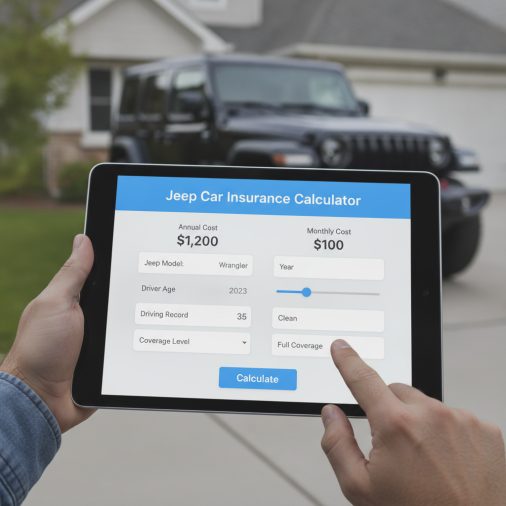
Follow these steps to get the most accurate estimate from the calculator:
- Enter your state base rate — look up your state’s average annual auto insurance premium or use the $1,200 national default as a starting point.
- Enter your Jeep’s current market value — use a resource like Kelley Blue Book or a dealer appraisal for the most accurate figure.
- Select your model year — newer Jeeps cost more to replace and therefore carry higher premiums.
- Choose your coverage level — liability only, standard, or full coverage each produce very different premium estimates.
- Select your deductible — a higher deductible lowers your premium but increases your out-of-pocket cost after a claim.
- Fill in your personal risk factors — driver age group, driving record, annual mileage, and credit score tier all multiply your base premium.
- Add applicable discounts — indicate whether you bundle policies and whether your Jeep has safety or anti-theft features.
- Choose your garaging location — urban areas carry higher theft and accident risk, which raises premiums.
- Review all six result cards. Use the estimated annual and monthly premiums as a benchmark when shopping real quotes from licensed insurers.
Understanding the Calculator Inputs

State Base Annual Rate ($): This is the anchor of the entire calculation. The default of $1,200 approximates the US national average for a personal auto policy on a mid-range vehicle. Because rates vary dramatically by state — Michigan and Louisiana regularly exceed $2,000 while Maine and Vermont often fall below $900 — entering your state’s actual average will produce a much more relevant estimate. You can find state averages from the National Association of Insurance Commissioners (NAIC) annual report or from reputable insurance comparison sites.
Jeep Vehicle Value ($): Enter the current market value of your specific Jeep, not the original MSRP. A 2019 Jeep Wrangler Sport that stickered at $28,000 new may be worth $24,000–$26,000 today depending on mileage and condition. Use a current appraisal tool for accuracy. This figure directly drives the Comprehensive & Collision Component result.
Model Year: Newer Jeeps carry higher replacement part costs and repair labor rates, which insurers pass on as higher premiums. A 2025 Jeep Grand Cherokee will cost meaningfully more to insure than a 2019 model of the same trim, all else equal. The multipliers range from 0.85x for 2020 and older up to 1.15x for 2025.
Coverage Level: This is one of the largest single levers in the calculator. Liability Only (0.55x) covers damage you cause to others but nothing for your own vehicle. Standard coverage adds collision (damage from accidents). Full Coverage adds comprehensive (theft, weather, vandalism). If your Jeep is financed or leased, your lender almost certainly requires full coverage.
Deductible Amount: Your deductible is what you pay out of pocket before insurance pays the rest on a covered claim. A $250 deductible raises your premium (1.2x multiplier) because the insurer absorbs more risk. A $2,000 deductible lowers it (0.72x) but means a larger personal expense after an accident. Choose a deductible you could comfortably pay on short notice.
Primary Driver Age Group: Teen drivers aged 16–19 carry a 2.1x multiplier — more than double the base — reflecting their statistically higher accident rates. Rates improve significantly once drivers reach 25–34, where the multiplier drops to 1.1x. The most favorable age band is 35–54 at 1.0x (no adjustment).
Driving Record: A clean record (1.0x) is the baseline. A single minor violation such as a speeding ticket adds a 1.22x multiplier. A DUI or DWI is the most severe flag at 1.85x, nearly doubling the adjusted premium. Most violations affect rates for three to five years depending on the state.
Annual Mileage: The more miles you drive, the more exposure you have to accidents. Drivers under 7,500 miles per year receive a small discount (0.88x), while those exceeding 18,000 miles pay a 1.22x surcharge. If you work from home or use your Jeep primarily for weekend adventures, selecting the lower mileage band may be appropriate.
Credit Score Tier: In most US states, insurers use a credit-based insurance score as a rating factor. Excellent credit (750+) earns a 0.88x discount. Poor credit (below 650) adds a 1.4x surcharge. Note that California, Hawaii, Massachusetts, and Michigan restrict or prohibit the use of credit scores in auto insurance rating — if you live in one of these states, this field will overstate the credit impact on your premium.
Multi-Policy (Bundle) Discount: Bundling your Jeep’s auto policy with a home or renters policy from the same insurer typically yields a 10–15% discount. The calculator applies a 0.88x multiplier when you select this option, representing approximately a 12% savings.
Safety & Anti-Theft Features: Factory or aftermarket anti-theft devices (GPS trackers, immobilizers) and advanced driver-assistance systems (automatic emergency braking, lane-keep assist) can reduce premiums. Selecting both features applies a 0.91x multiplier — a 9% reduction. Check with your specific insurer, as discount availability and amounts vary.
Primary Garaging Location: Where your Jeep sleeps matters. Urban areas have higher rates of theft, vandalism, and traffic density, producing a 1.18x surcharge. Rural areas benefit from a 0.88x discount. Suburban is the neutral baseline at 1.0x.
Understanding Your Results
Estimated Base Premium ($): This intermediate result shows your premium after applying the state base rate, model year, coverage level, and deductible — but before any personal risk factors or discounts. It is useful for isolating how much your coverage choices alone affect cost, independent of who is driving.
Personal Risk Adjustment Factor (x): This multiplier combines your driver age, driving record, annual mileage, credit score, and garaging location into a single number. A value of 1.0 means your personal profile is exactly average. Values above 1.0 increase your premium proportionally — for example, a 1.5x factor means your personal risk profile adds 50% to the base premium. Values below 1.0 indicate a below-average risk profile and a lower premium.
Discount Factor (x): This multiplier reflects savings from bundling and safety features. A value of 1.0 means no discounts apply. The lowest possible value is 0.91 x 0.88 = approximately 0.801, meaning a maximum combined discount of about 20% from these two sources. Lower is better here.
Estimated Annual Premium ($): This is the primary output — your fully adjusted estimated annual insurance cost incorporating every factor you entered. Use this figure as a benchmark when requesting real quotes. If actual quotes come in significantly higher, review which factors may be rated differently by that insurer.
Estimated Monthly Premium ($): The annual estimate divided by 12. Keep in mind that insurers often charge installment fees for monthly billing, so your actual monthly bill may be $5–$15 higher than this figure. Paying the full annual premium upfront, if affordable, typically eliminates these fees.
Comprehensive & Collision Component ($): This result estimates the physical damage portion of your premium — the part that covers repairs to your own Jeep. It is calculated as approximately 2.5% of your vehicle’s value, adjusted for model year, deductible, location, and safety features. This component is only meaningful if you selected Standard or Full Coverage. If you chose Liability Only, this figure represents a cost you are currently self-insuring.
Calculation Formulas Explained
The calculator uses a multiplicative factor model, which is the same structural approach used by actuaries to build insurance rating algorithms. Each factor is a decimal multiplier applied sequentially to a base rate. Here is how each formula works:
Estimated Base Premium = base_rate × model_year_factor × coverage_level × deductible_factor. This isolates the vehicle and coverage choices from personal risk. For example: $1,200 × 1.08 (2024 model) × 1.35 (full coverage) × 1.0 ($500 deductible) = $1,749.60.
Personal Risk Adjustment Factor = driver_age_factor × driving_record_factor × annual_mileage_factor × credit_score_factor × garaging_factor. Each of these five factors is independent and multiplicative. A 35-year-old with a clean record, average mileage, good credit, and a suburban address produces: 1.0 × 1.0 × 1.0 × 1.0 × 1.0 = 1.0 (exactly average).
Discount Factor = multi_policy_discount × safety_discount. Discounts reduce the premium multiplicatively. Bundling (0.88) combined with both safety features (0.91) = 0.88 × 0.91 = 0.8008, meaning about a 20% total discount.
Estimated Annual Premium = all twelve factors multiplied together. This is the complete formula: base_rate × model_year_factor × coverage_level × deductible_factor × driver_age_factor × driving_record_factor × annual_mileage_factor × credit_score_factor × garaging_factor × multi_policy_discount × safety_discount.
Estimated Monthly Premium = Annual Premium ÷ 12. Simple division to convert the annual figure to a monthly equivalent.
Comprehensive & Collision Component = vehicle_value × 0.025 × model_year_factor × deductible_factor × garaging_factor × safety_discount. The 0.025 (2.5%) rate is a widely cited industry approximation for the physical damage premium as a percentage of vehicle value. It is adjusted for the same factors that most directly affect physical damage risk: how new the vehicle is, how much the deductible absorbs, where it is garaged, and whether safety features reduce claim frequency.
Worked Example
Scenario: Maria is a 28-year-old suburban Chicago resident who just purchased a 2024 Jeep Grand Cherokee with a market value of $48,000. She has a clean driving record, drives about 14,000 miles per year, has good credit (720 score), and wants full coverage with a $500 deductible. She bundles with her renters insurance and her Jeep has an advanced safety package.
- State Base Rate: Illinois average ≈ $1,400/yr → base_rate = 1400
- Vehicle Value: $48,000 → vehicle_value = 48000
- Model Year Factor: 2024 → 1.08
- Coverage Level: Full Coverage → 1.35
- Deductible Factor: $500 → 1.0
- Driver Age Factor: 25–34 → 1.1
- Driving Record Factor: Clean → 1.0
- Annual Mileage Factor: 12,001–18,000 miles → 1.1
- Credit Score Factor: Good (700–749) → 1.0
- Garaging Factor: Urban/City → 1.18
- Multi-Policy Discount: Bundle → 0.88
- Safety Discount: Advanced Safety Package → 0.94
Base Premium: 1400 × 1.08 × 1.35 × 1.0 = $2,041.20
Personal Risk Factor: 1.1 × 1.0 × 1.1 × 1.0 × 1.18 = 1.427
Discount Factor: 0.88 × 0.94 = 0.827
Estimated Annual Premium: $2,041.20 × 1.427 × 0.827 = $2,408.57/yr
Estimated Monthly Premium: $2,408.57 ÷ 12 = $200.71/mo
Comprehensive & Collision Component: 48000 × 0.025 × 1.08 × 1.0 × 1.18 × 0.94 = $1,443.65/yr
Maria’s estimate of about $201/month is a reasonable benchmark for a young adult with full coverage on a newer, higher-value Jeep in a major city. When she shops real quotes, she should expect figures in a similar range, though individual insurer algorithms will produce different results.
How to Interpret the Results
Use the Estimated Annual Premium as your primary shopping benchmark. When you receive actual quotes from insurers, compare them to this figure. If quotes are consistently 20–30% higher, consider whether your inputs accurately reflect your situation — for example, your state base rate may be higher than the national average, or the insurer may be rating your credit or driving record more aggressively.
The Personal Risk Adjustment Factor tells you where you stand relative to an average driver. A factor above 1.5 suggests you are in a higher-risk category and should prioritize shopping multiple insurers, as rate differences for high-risk drivers can be substantial. A factor below 0.95 means your profile is favorable and you may qualify for preferred-tier pricing.
The Comprehensive & Collision Component is particularly useful when deciding whether to carry physical damage coverage on an older Jeep. If this component approaches or exceeds 10% of your vehicle’s value annually, dropping to liability-only coverage may be financially rational — especially if you have savings to self-insure a total loss.
The Discount Factor shows how much you are leaving on the table if you are not bundling or using safety features. A discount factor of 1.0 means you have no discounts applied; even moving to 0.88 by bundling saves a meaningful amount over a multi-year policy period.
Common Mistakes to Avoid
- Using MSRP instead of current market value: Entering the original sticker price rather than today’s actual cash value will overstate the Comprehensive & Collision Component. Use a current appraisal for accuracy.
- Selecting the wrong state base rate: The $1,200 default is a national average. States like Michigan, Louisiana, and Florida have averages well above $2,000, while rural Midwest states may be under $900. Using the wrong base rate is the single largest source of estimation error.
- Ignoring credit score impact: Many drivers underestimate how much a poor credit score raises their premium. In states where credit scoring is permitted, moving from Poor to Good credit can reduce premiums by 20–30%.
- Forgetting that financed Jeeps require full coverage: If you have an auto loan, your lender requires comprehensive and collision coverage. Selecting Liability Only in the calculator while carrying a loan will produce an unrealistically low estimate that does not reflect your actual required coverage.
- Not accounting for aftermarket modifications: Lifted suspensions, oversized tires, aftermarket bumpers, and winches add value to your Jeep that standard policies may not cover without an endorsement. This calculator does not model modification coverage — discuss this separately with your insurer.
- Assuming the monthly result includes all fees: The monthly figure is simply the annual estimate divided by 12. Real monthly billing often includes installment fees of $5–$15 per payment. Annual pay-in-full typically avoids these charges.
Limitations and Important Notes
This calculator is an independent planning tool and does not represent a quote, offer, or binding estimate from any insurance company. It has no affiliation with Stellantis, Jeep, or any insurer. All multipliers are approximations derived from publicly available actuarial research and industry averages — not from any proprietary rating algorithm.
The following factors are not modeled and will affect your actual premium: SR-22 or FR-44 filing requirements, gap insurance, roadside assistance add-ons, usage-based telematics or pay-per-mile programs, multi-vehicle household discounts, good student discounts, military or affinity group discounts, and prior insurance lapse surcharges.
Credit score rating is restricted or prohibited in California, Hawaii, Massachusetts, and Michigan. If you reside in one of these states, set your credit score factor to Good (1.0) regardless of your actual score for a more accurate estimate.
The 2.5% vehicle-value rate used for the Comprehensive & Collision Component is a general industry approximation. Actual rates vary significantly by insurer, ZIP code, vehicle make and model, and claims history. This figure should be treated as directional, not precise.
Results assume a single primary driver. Households with teen drivers added to a policy, multiple vehicles, or commercial use of the Jeep will see materially different rates. Always obtain quotes from at least three licensed insurers before making coverage decisions.
Frequently Asked Questions
How much does it cost to insure a Jeep Wrangler per month?
Based on industry data and this calculator’s model, a Jeep Wrangler with full coverage typically costs between $130 and $220 per month for a driver aged 25–54 with a clean record, good credit, and a suburban address. The Wrangler’s body-on-frame construction, high theft rate, and rollover history push its premiums slightly above the average SUV. Teen drivers or those with violations can see monthly costs exceed $350. Using the calculator with your specific inputs will give you a personalized estimate to benchmark against real quotes.
Is Jeep insurance more expensive than other SUVs?
Jeeps tend to cost slightly more to insure than mainstream crossover SUVs like the Toyota RAV4 or Honda CR-V, primarily because of higher theft rates (especially for the Wrangler), higher repair costs for body-on-frame models, and the rollover risk associated with tall, narrow body styles. However, Jeep models vary widely — the Jeep Compass and Cherokee are generally cheaper to insure than the Wrangler or Grand Cherokee because of their lower vehicle values and more conventional construction. Comparing quotes across models before purchasing is a smart strategy.
Does off-roading void my Jeep insurance coverage?
Standard personal auto insurance policies typically cover your Jeep for road use and incidental off-road driving on public or private land. However, organized off-road racing, competitive events, or using your Jeep on a closed course for motorsport purposes is almost universally excluded from standard policies. Damage sustained during these activities would likely be denied. If you regularly participate in organized trail events or rock-crawling competitions, ask your insurer about a motorsport or off-road endorsement. Casual weekend trail driving on established trails is generally covered, but always confirm with your specific insurer.
What is the cheapest Jeep model to insure?
Among current Jeep models, the Jeep Compass is generally the least expensive to insure because of its lower vehicle value, front-wheel-drive availability, and conventional unibody construction. The Jeep Cherokee is a close second. The Wrangler and Gladiator tend to be the most expensive due to higher theft rates, body-on-frame repair complexity, and rollover statistics. The Grand Cherokee 4xe plug-in hybrid can also carry higher premiums because of its battery replacement cost exposure. If minimizing insurance cost is a priority, the Compass or Cherokee are the most economical choices within the Jeep lineup.
How do aftermarket modifications affect Jeep insurance?
Aftermarket modifications — lift kits, oversized tires, aftermarket bumpers, winches, light bars, and custom wheels — can significantly affect your insurance in two ways. First, they add value to the vehicle that a standard policy may not cover without a declared-value or stated-value endorsement. If your Jeep is totaled, you could receive only the stock vehicle’s value, not the cost of your modifications. Second, some modifications (particularly suspension lifts) may increase rollover risk, which some insurers treat as a rating factor. Always disclose significant modifications to your insurer and ask about an agreed-value or equipment endorsement to protect your investment.
What coverage do I need for a financed Jeep?
If you financed your Jeep through a bank, credit union, or dealership, your lender will require you to carry at minimum comprehensive and collision coverage — what this calculator calls Full Coverage — for the life of the loan. Liability-only coverage does not protect the lender’s collateral interest in the vehicle. Additionally, many lenders recommend or require gap insurance, which covers the difference between your Jeep’s actual cash value and the remaining loan balance if the vehicle is totaled. New Jeeps depreciate quickly in the first two years, making gap coverage particularly valuable during that period. Gap insurance is not modeled in this calculator.
Can I get classic car insurance for an older Jeep?
Yes — older Jeeps, particularly vintage CJ models from the 1960s through 1980s, may qualify for classic or collector car insurance, which typically offers agreed-value coverage (you and the insurer agree on the vehicle’s value upfront, eliminating depreciation disputes) at lower premiums than standard policies. Eligibility requirements vary by insurer but generally include a minimum vehicle age of 15–25 years, limited annual mileage (often under 5,000–7,500 miles), secure storage, and the vehicle not being used as a primary daily driver. If you own a well-maintained vintage Jeep, a classic car policy may provide better coverage at a lower cost than a standard auto policy. If you have children riding in your classic Jeep, you may also want to review whether car seats are covered by auto insurance after an accident.
How do I find the best Jeep insurance rate in my state?
The most effective strategy is to get at least three to five quotes from different insurers — including both national carriers and regional companies that may specialize in your state. Use this calculator’s annual premium estimate as a baseline to evaluate whether quotes are reasonable. Beyond shopping, the highest-impact actions to lower your rate are: maintaining a clean driving record, improving your credit score over time, increasing your deductible if you have adequate savings, bundling with a home or renters policy, and asking about every available discount (good driver, low mileage, safety features, loyalty, and affinity group discounts). Rates can vary by 40–60% for the same driver and vehicle across different insurers, so comparison shopping is the single most valuable step you can take.