Use this independent JS Bank car loan calculator to instantly estimate your monthly instalment, total repayment, and interest cost before you apply. Enter the vehicle price, your down payment, preferred loan tenure, and the annual profit rate to see a full breakdown in seconds. Results are based on standard reducing-balance (amortisation) mathematics and are for planning purposes only — actual figures may vary based on JS Bank’s current rates, processing fees, and credit assessment. Always confirm final terms with a JS Bank representative.
JS Bank Car Loan Calculator: Monthly Payment & Total Cost
Estimate your JS Bank car loan monthly instalment, total repayment, and interest cost using standard reducing-balance amortisation mathematics.
How to Use This Calculator
Follow these steps to get an accurate estimate from the calculator:
- Enter the vehicle price — type the full on-road price of the car you want to finance in Pakistani Rupees.
- Set your down payment percentage — drag the slider to choose how much you will pay upfront. A higher down payment reduces your principal and monthly instalment.
- Enter the annual profit rate — use the rate quoted to you by JS Bank or a benchmark figure for comparison. The default is 22% per annum.
- Select your loan tenure — choose from 12 to 84 months. Longer tenures lower monthly payments but increase total interest paid.
- Add the processing fee percentage — enter the one-time fee JS Bank charges at disbursement, typically around 1% of the loan amount.
- Enter annual insurance cost — comprehensive insurance is mandatory for financed vehicles; enter your estimated annual premium to see the true first-year cost.
- Read your results — the calculator instantly shows your loan principal, monthly instalment, total repayment, total interest, processing fee, and estimated first-year cash outflow.
Understanding the Calculator Inputs
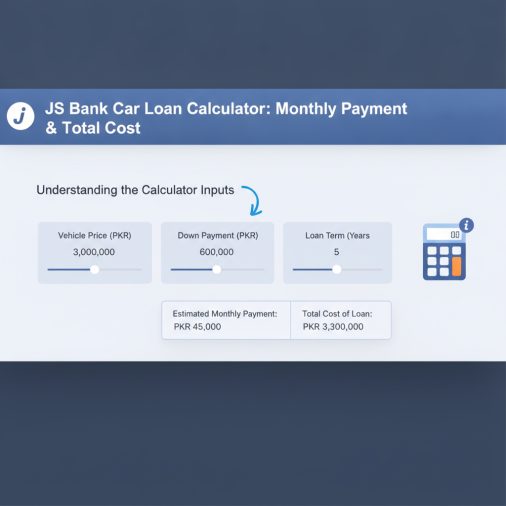
Vehicle Price (PKR): Enter the complete on-road price of the vehicle you intend to finance. This should include registration, excise duty, and any dealer charges if they are being rolled into the purchase price. The calculator uses this figure as the base from which your down payment is subtracted to arrive at the financed principal. The minimum accepted value is PKR 100,000 and the maximum is PKR 50,000,000, covering everything from entry-level hatchbacks to premium SUVs.
Down Payment (%): Use the slider to set the percentage of the vehicle price you will pay upfront from your own funds. JS Bank and State Bank of Pakistan (SBP) regulations generally require a minimum down payment — historically around 15% for new vehicles — but many applicants choose 20–30% to reduce their monthly burden. A higher down payment directly reduces the loan principal, which lowers both the monthly instalment and the total interest paid over the life of the loan.
Annual Profit / Interest Rate (%): Enter the annual markup or interest rate as a percentage. For Islamic financing products this is the profit rate; for conventional loans it is the interest rate. JS Bank’s actual rate depends on your credit profile, vehicle type, and prevailing market conditions. The default of 22% is a representative benchmark — always use the rate quoted in your official offer letter for the most accurate estimate.
Loan Tenure (Months): Select the repayment period from the dropdown. Options range from 12 months (1 year) to 84 months (7 years). Shorter tenures mean higher monthly payments but significantly less total interest. Longer tenures ease monthly cash flow but substantially increase the total cost of borrowing. Most Pakistani car buyers choose 36–60 months as a balance between affordability and total cost.
Processing Fee (% of Loan): Enter the one-time administrative or documentation fee charged by the bank at the time of loan disbursement. This is typically expressed as a percentage of the loan principal and is usually between 0.5% and 2%. It is paid upfront and is not included in the monthly instalment, so it is important to budget for it separately.
Annual Comprehensive Insurance (PKR): Banks financing vehicles require comprehensive insurance for the full loan tenure. Enter your estimated annual premium in PKR. Insurance premiums vary based on vehicle value, make, model, and insurer. A rough industry benchmark is 2–4% of the vehicle’s insured declared value per year, though this decreases as the car depreciates. This figure is used only in the first-year cost estimate.
Understanding Your Results
Loan Principal (PKR): This is the actual amount the bank lends you — the vehicle price minus your down payment. All interest calculations are based on this figure. Reducing this number through a larger down payment is the single most effective way to lower your total financing cost.
Monthly Instalment (PKR): This is the equal monthly payment (EMI) you will make to the bank for the entire loan tenure. It is calculated using the standard reducing-balance amortisation formula, meaning each payment covers both interest on the outstanding balance and a portion of the principal. Early instalments are more interest-heavy; later instalments retire more principal.
Total Repayment (PKR): The sum of all monthly instalments over the full tenure. This is the total amount of money that will leave your account and go to the bank, excluding the down payment, processing fee, and insurance. Comparing this figure against the loan principal immediately shows you the total financing cost in absolute rupee terms.
Total Interest / Profit Paid (PKR): The difference between total repayment and the loan principal. This is the pure cost of borrowing — the amount you pay above and beyond what you originally received. This figure grows substantially with longer tenures and higher rates, making it a critical number for comparing loan offers.
One-Time Processing Fee (PKR): The upfront administrative charge calculated as your entered percentage of the loan principal. This is a cash outflow at the time of disbursement and should be factored into your initial budget alongside the down payment.
Estimated Total First-Year Cost (PKR): This is the most comprehensive single figure the calculator produces. It adds your down payment, twelve monthly instalments, the processing fee, and one year of insurance to show the realistic total cash outflow in the first twelve months of ownership. This figure is particularly useful when comparing financing options or assessing affordability against your annual income.
Calculation Formulas Explained
The calculator uses the standard reducing-balance amortisation formula, which is the internationally accepted method for calculating equal monthly instalments (EMI) on a loan where interest is charged on the declining outstanding principal balance.
The core EMI formula is:
EMI = P × [r × (1 + r)^n] / [(1 + r)^n − 1]
Where: P is the loan principal (vehicle price minus down payment), r is the monthly interest rate (annual rate divided by 12, then divided by 100 to convert from percentage to decimal), and n is the total number of monthly instalments (the tenure in months).
The loan principal is simply: Vehicle Price × (1 − Down Payment % / 100).
The total repayment is EMI × n, representing the sum of all payments made to the bank.
The total interest paid is Total Repayment − Loan Principal, isolating the pure cost of borrowing.
The processing fee is Loan Principal × (Processing Fee % / 100), a straightforward percentage of the financed amount.
The first-year cost sums the down payment, twelve monthly EMIs, the processing fee, and one year of insurance to give a holistic first-year cash outflow figure.
All formulas assume a fixed annual rate and monthly compounding consistent with standard amortisation. A flat-rate loan — where interest is calculated on the original principal throughout — would produce a different (typically higher effective rate) result and is not modelled here.
Worked Example
Suppose you want to finance a car priced at PKR 2,500,000 with a 20% down payment, an annual profit rate of 22%, a 60-month tenure, a 1% processing fee, and PKR 75,000 annual insurance.
Step 1 — Loan Principal: PKR 2,500,000 × (1 − 20/100) = PKR 2,500,000 × 0.80 = PKR 2,000,000
Step 2 — Monthly Rate: 22 / 100 / 12 = 0.018333 (approximately 1.8333% per month)
Step 3 — EMI Numerator: 2,000,000 × (0.018333 × (1.018333)^60) = 2,000,000 × (0.018333 × 2.95540) = 2,000,000 × 0.054182 = 108,364
Step 4 — EMI Denominator: (1.018333)^60 − 1 = 2.95540 − 1 = 1.95540
Step 5 — Monthly Instalment: 108,364 / 1.95540 ≈ PKR 55,419 per month
Step 6 — Total Repayment: PKR 55,419 × 60 = PKR 3,325,140
Step 7 — Total Interest Paid: PKR 3,325,140 − PKR 2,000,000 = PKR 1,325,140
Step 8 — Processing Fee: PKR 2,000,000 × 1% = PKR 20,000
Step 9 — First-Year Cost: PKR 500,000 (down payment) + (PKR 55,419 × 12) + PKR 20,000 + PKR 75,000 = PKR 500,000 + PKR 665,028 + PKR 20,000 + PKR 75,000 = PKR 1,260,028
How to Interpret the Results
Once you have your results, use them in the following ways to make a well-informed borrowing decision:
- Affordability check: A widely used rule of thumb is that your total monthly debt obligations should not exceed 40–50% of your net monthly income. Compare the monthly instalment result against your take-home pay to assess whether the loan is comfortably serviceable.
- Interest-to-principal ratio: Divide total interest paid by the loan principal and multiply by 100. A ratio above 60% signals that the tenure is very long or the rate is very high relative to the loan size. Consider a shorter tenure or larger down payment.
- First-year cost vs savings: Compare the first-year cost result against your liquid savings. Ideally, you should have at least 3–6 months of instalments in reserve after paying the down payment and processing fee, to protect against income disruption.
- Comparing offers: Run the calculator with different annual rates to see how much a 1–2 percentage point difference in profit rate saves over the full tenure. Even a 1% rate reduction on a PKR 2,000,000 loan over 60 months can save tens of thousands of rupees.
- Tenure trade-off: Try the same inputs with 48 months versus 60 months. The monthly instalment will be higher for 48 months, but the total interest saving is often substantial — use this comparison to decide whether the monthly saving from a longer tenure is worth the extra total cost.
Common Mistakes to Avoid
Using the flat-rate method mentally: Many people estimate their monthly payment by simply dividing total interest (calculated on the original principal) by the number of months and adding it to the principal repayment. This overestimates the monthly payment compared to the reducing-balance method used here, but it also underestimates the effective annual rate if a lender quotes a flat rate. Always confirm which method your lender uses.
Ignoring the processing fee and insurance: Focusing only on the monthly instalment and forgetting the upfront costs can leave buyers short of cash at disbursement. The first-year cost result in this calculator is specifically designed to prevent this mistake.
Entering the financed amount instead of the vehicle price: The vehicle price field should contain the full purchase price. The calculator automatically deducts your down payment to arrive at the principal. Entering the already-reduced principal in the vehicle price field will produce incorrect results.
Assuming the calculator rate equals the bank’s current rate: The default 22% is a planning benchmark, not a guaranteed or current JS Bank rate. Profit rates change with monetary policy. Always use the rate from your official bank offer letter or a recent branch quotation.
Forgetting that insurance premiums change annually: The insurance field accepts a flat annual figure. In reality, comprehensive insurance premiums typically decrease each year as the vehicle depreciates. The first-year cost result will therefore be the highest-cost year; subsequent years will be somewhat cheaper on the insurance component.
Limitations and Important Notes
This calculator is an independent planning tool with no affiliation with JS Bank Limited or any other financial institution. It does not access live rate data, credit scoring systems, or JS Bank’s internal pricing models.
The following assumptions and limitations apply:
- A fixed annual profit/interest rate is assumed for the entire tenure. Variable-rate or floating-rate products will produce different actual instalments over time.
- The reducing-balance (amortisation) method is used. If JS Bank applies a different calculation methodology for a specific product, results will differ.
- No prepayment penalties, late payment charges, stamp duty, withholding tax, or documentation charges beyond the processing fee are included.
- Insurance is modelled as a flat annual cost and does not reflect year-on-year depreciation adjustments to the insured declared value.
- SBP minimum down payment regulations and JS Bank’s internal credit policies change over time. Always verify current requirements directly with the bank.
- Results are in Pakistani Rupees (PKR) and assume monthly compounding consistent with standard amortisation practice.
- This tool does not constitute financial advice. Consult a qualified financial adviser or JS Bank representative before making borrowing decisions.
Frequently Asked Questions
What is the minimum down payment required for a JS Bank car loan?
The State Bank of Pakistan has historically set a minimum down payment of 15% of the vehicle’s value for new car financing, though individual banks including JS Bank may require a higher minimum based on their internal credit policies and the applicant’s risk profile. In practice, many applicants are asked for 20% or more. You should confirm the current minimum directly with a JS Bank branch or their car financing helpline, as SBP regulations and bank policies are subject to change. This calculator allows you to model down payments from 10% to 50% so you can compare the impact of different scenarios.
What is the current profit rate offered by JS Bank on car financing?
JS Bank’s car financing profit rates are not fixed and change in line with the State Bank of Pakistan’s policy rate and prevailing market conditions. Rates are also personalised based on the applicant’s credit history, income, employer category, and whether they hold a JS Bank salary account. Because this calculator is an independent tool with no live data connection to JS Bank’s systems, it cannot display the current official rate. The default of 22% per annum is a general planning benchmark. For the most accurate and up-to-date rate, visit a JS Bank branch, call their customer service line, or check the JS Bank website directly.
Can I get a car loan from JS Bank without a salary account?
JS Bank does offer car financing to applicants who do not hold a salary account with the bank, though having an existing relationship — particularly a salary account — may improve your chances of approval and could result in a preferential profit rate. Non-account holders typically need to provide more extensive income documentation, such as salary slips, bank statements from their existing bank, and an employer letter. Self-employed applicants will generally need to submit business financial statements. The specific eligibility criteria can vary, so it is best to speak directly with a JS Bank car financing officer to understand what documentation applies to your situation.
What documents are required to apply for JS Bank car financing?
While exact requirements can vary and should be confirmed with JS Bank directly, a typical car financing application in Pakistan requires: a copy of your valid CNIC (Computerised National Identity Card), recent salary slips (usually the last three months), a bank statement for the past six to twelve months, an employer letter or certificate of employment, proof of residence such as a utility bill, and the vehicle’s proforma invoice or booking confirmation from the dealer. Self-employed applicants typically also need to provide business registration documents and audited or unaudited financial statements. JS Bank may request additional documents based on your credit assessment.
Is it possible to pay off a JS Bank car loan early without penalty?
Early repayment or prepayment policies vary between banks and between specific loan products. Some Pakistani banks charge a prepayment penalty — typically a percentage of the outstanding principal — if you settle the loan before the agreed tenure ends, while others allow partial or full early repayment without penalty after a lock-in period. You should ask JS Bank specifically about their prepayment terms before signing the loan agreement. If early repayment is important to you, negotiate this point upfront and ensure any agreed terms are documented in the loan contract. This calculator does not model prepayment scenarios.
Does JS Bank offer Islamic (Ijarah) car financing?
JS Bank operates both conventional banking and Islamic banking windows. Their Islamic banking division offers Shariah-compliant car financing products, typically structured as Ijarah (lease) or Diminishing Musharakah arrangements, where the bank and customer co-own the vehicle and the customer gradually buys out the bank’s share. The profit rate on Islamic products is benchmarked similarly to conventional rates but is structured differently in terms of ownership and risk. This calculator uses standard amortisation mathematics, which is a reasonable approximation for planning purposes, but the exact payment schedule for an Ijarah product may differ. Consult JS Bank’s Islamic banking team for product-specific details.
How long does JS Bank car loan approval take?
Car loan processing times at Pakistani banks typically range from a few working days to two or three weeks, depending on the completeness of your documentation, the bank’s current workload, and the outcome of the credit assessment process. JS Bank may be able to provide a faster turnaround for existing customers with a strong banking history. To minimise delays, ensure all required documents are complete and accurate before submission, and follow up proactively with your assigned relationship manager. Pre-approval or in-principle approval may be available before you finalise your vehicle choice, which can speed up the final disbursement step.
What happens if I miss a monthly instalment payment?
Missing a monthly instalment on a car loan in Pakistan typically triggers late payment charges as specified in your loan agreement, which are usually calculated as a percentage of the overdue amount per day or per month. Repeated missed payments can negatively affect your credit history with the Credit Information Bureau (CIB), making future borrowing more difficult or expensive. In serious cases of default, the bank has the right to repossess the financed vehicle. If you anticipate difficulty making a payment, it is strongly advisable to contact JS Bank proactively before the due date to discuss restructuring options, as banks generally prefer to work out a solution rather than initiate recovery proceedings.