Use this independent car loan calculator to estimate your monthly auto payment based on vehicle price, down payment, trade-in value, sales tax, and loan terms—similar to the inputs you would find on KBB.com. Enter your vehicle’s purchase price, any trade-in credit, your down payment, the annual interest rate your lender quoted, and your desired loan length to instantly see your estimated monthly payment, total interest, and overall cost of ownership. Adjust the fields to compare scenarios before visiting the dealership.
KBB Car Loan Calculator: Monthly Payment & Total Cost Estimator
An independent car loan calculator that estimates monthly auto payments, total interest, and full vehicle cost using KBB-style inputs including vehicle price, trade-in value, APR, and loan term.
How to Use This Calculator
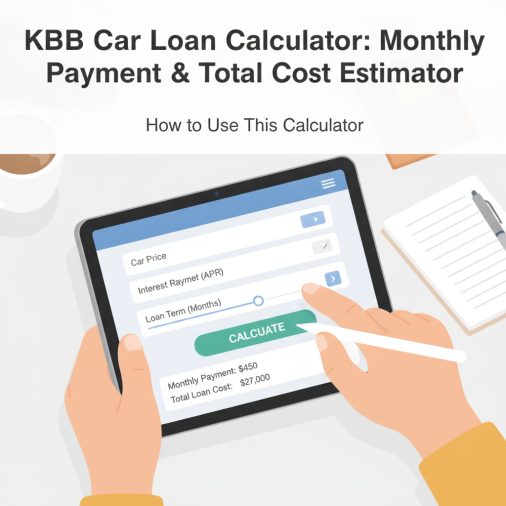
Follow these steps to get an accurate estimate from the calculator:
- Enter the vehicle price — use the negotiated purchase price or the KBB Fair Purchase Price for the car you are considering.
- Add your down payment — enter the cash amount you plan to pay upfront at signing.
- Enter trade-in value — use your KBB Instant Cash Offer or dealer appraisal amount.
- Enter trade-in loan payoff — if you still owe money on your trade-in, enter that balance here; leave it at zero if the vehicle is paid off.
- Set the sales tax rate — use your state and local combined rate; the slider defaults to 6%.
- Set the APR — enter the annual percentage rate your bank, credit union, or dealer has quoted you.
- Choose a loan term — select from 24 to 84 months using the dropdown.
- Enter documentation and dealer fees — include doc fees, registration, and title fees typically shown on the dealer’s worksheet.
- Review all six results — compare scenarios by adjusting any field to see how each change affects your monthly payment and total cost.
Understanding the Calculator Inputs
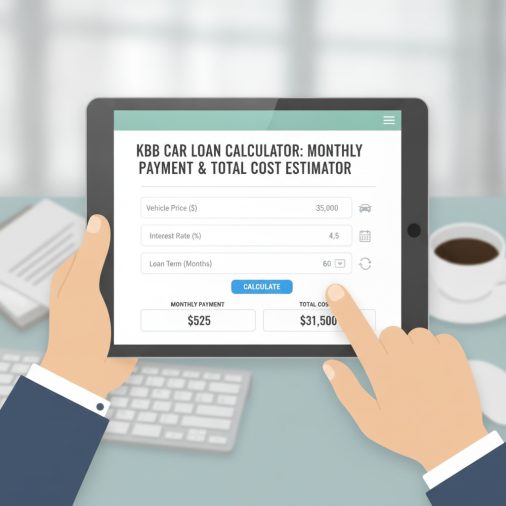
Vehicle Price ($): Enter the negotiated purchase price of the car, truck, or SUV you are buying. This is the starting point for every calculation. You can use the KBB Fair Purchase Price, the dealer’s asking price, or any price you have negotiated. The calculator accepts values from $1,000 to $200,000.
Down Payment ($): Enter the cash amount you will pay at signing before financing begins. A larger down payment directly reduces the amount financed, lowering both your monthly payment and total interest. Most lenders recommend at least 10–20% of the vehicle price as a down payment.
Trade-In Value ($): If you are trading in a vehicle, enter its value here. This amount is subtracted from the purchase price before financing. Use your KBB Instant Cash Offer, a dealer appraisal, or a competing offer from a third-party buyer as your estimate.
Trade-In Loan Payoff ($): If you still owe money on the vehicle you are trading in, enter the remaining loan balance here. If this amount is greater than your trade-in value, you have negative equity (sometimes called being upside down), and the difference will be rolled into your new loan, increasing the amount financed.
Sales Tax Rate (%): Use the slider to set your combined state and local sales tax rate. The default is 6%, which is close to the national average. Note that some states tax only the difference between the vehicle price and trade-in value, while others tax the full purchase price; this calculator applies tax to the full vehicle price as a conservative estimate.
Annual Interest Rate / APR (%): Enter the annual percentage rate your lender has quoted. This is the yearly cost of borrowing expressed as a percentage. The minimum is set to 0.01% to avoid a mathematical divide-by-zero condition. If you have been offered a 0% promotional rate, enter 0.01 as an approximation—the resulting payment will be nearly identical to a true zero-interest loan.
Loan Term: Select the number of months over which you will repay the loan. Options range from 24 months (2 years) to 84 months (7 years). Shorter terms mean higher monthly payments but significantly less total interest. Longer terms reduce the monthly payment but increase the total cost of the loan.
Documentation & Dealer Fees ($): Enter the combined total of documentation fees, registration fees, and title fees shown on the dealer’s finance worksheet. These fees are assumed to be rolled into the financed amount rather than paid upfront. Typical doc fees range from $100 to $900 depending on the state and dealership.
Understanding Your Results
Amount Financed: This is the net loan principal—the actual dollar amount the lender will advance on your behalf. It equals the vehicle price plus sales tax plus dealer fees, minus your down payment and trade-in value, plus any trade-in loan payoff balance. This is the number your lender uses to calculate your monthly payment and interest charges.
Monthly Payment: This is your estimated fixed monthly installment. It is calculated using the standard amortization formula and assumes a fixed interest rate for the entire loan term. This figure covers both principal repayment and interest but does not include insurance, registration renewals, or maintenance costs.
Total Amount Paid: This is the monthly payment multiplied by the number of months in the loan term. It represents the total cash you will send to the lender over the life of the loan, not counting your down payment or trade-in equity.
Total Interest Paid: This is the total amount paid minus the amount financed. It is the true cost of borrowing—the extra money you pay the lender in exchange for spreading payments over time. Comparing this figure across different APR and term scenarios is one of the most useful things this calculator can do.
Total Vehicle Cost (Out-of-Pocket): This is the most comprehensive cost figure. It adds your down payment, the trade-in equity you contributed, and all loan payments made over the full term. It gives you a realistic picture of what the vehicle actually costs you from start to finish.
Effective Interest as % of Vehicle Price: This expresses total interest paid as a percentage of the original vehicle price. For example, a result of 12% means you paid an extra 12 cents in interest for every dollar of vehicle price. This metric makes it easy to compare financing costs across vehicles of different prices.
Calculation Formulas Explained
All calculations use the standard fixed-rate amortization model used by banks and credit unions worldwide.
Amount Financed (P): P = max(0, vehicle_price + (vehicle_price × sales_tax_rate / 100) + doc_fees − down_payment − trade_in_value + trade_in_payoff). The max(0, …) wrapper prevents a negative loan principal in cases where the down payment and trade-in exceed the purchase price.
Monthly Interest Rate (r): The APR is divided by 1200 to convert an annual percentage into a monthly decimal rate. For example, 6.5% APR becomes 6.5 / 1200 = 0.005417 per month.
Monthly Payment (M): M = P × (r × (1 + r)^n) / ((1 + r)^n − 1), where n is the loan term in months. This is the classic present-value annuity formula. Each payment covers the interest accrued that month plus a portion of the remaining principal, with the interest share shrinking and the principal share growing over time.
Total Amount Paid: M × n. Simple multiplication of the fixed monthly payment by the number of payments.
Total Interest Paid: (M × n) − P. The difference between what you pay back and what you borrowed.
Total Vehicle Cost (Out-of-Pocket): down_payment + trade_in_value + (M × n). This combines all cash and equity contributions with all loan payments.
Effective Interest as % of Vehicle Price: ((M × n) − P) / vehicle_price × 100. Dividing by the original vehicle price (not the loan amount) gives a consistent benchmark across different down payment scenarios.
Worked Example
Suppose you are buying a used SUV with the following details:
- Vehicle Price: $28,500
- Down Payment: $4,000
- Trade-In Value: $6,000 (your current car, fully paid off)
- Trade-In Loan Payoff: $0
- Sales Tax Rate: 7%
- APR: 6.9%
- Loan Term: 60 months
- Doc Fees: $450
Step 1 — Calculate Amount Financed: Sales tax = $28,500 × 0.07 = $1,995. Amount Financed = $28,500 + $1,995 + $450 − $4,000 − $6,000 + $0 = $20,945.
Step 2 — Calculate Monthly Interest Rate: r = 6.9 / 1200 = 0.005750 per month.
Step 3 — Calculate Monthly Payment: (1 + r)^60 = (1.005750)^60 ≈ 1.40803. M = $20,945 × (0.005750 × 1.40803) / (1.40803 − 1) = $20,945 × 0.008096 / 0.40803 ≈ $20,945 × 0.019842 ≈ $415.52 per month.
Step 4 — Total Amount Paid: $415.52 × 60 = $24,931.20.
Step 5 — Total Interest Paid: $24,931.20 − $20,945 = $3,986.20.
Step 6 — Total Vehicle Cost (Out-of-Pocket): $4,000 + $6,000 + $24,931.20 = $34,931.20.
Step 7 — Effective Interest as % of Vehicle Price: $3,986.20 / $28,500 × 100 = 13.99%.
In this scenario, financing adds nearly $4,000 to the cost of a $28,500 vehicle over five years at 6.9% APR.
How to Interpret the Results
Monthly Payment: A common guideline is to keep your total monthly vehicle expenses (payment + insurance + fuel) below 15–20% of your gross monthly income. If the monthly payment result pushes you above that threshold, consider a larger down payment, a longer term, or a less expensive vehicle.
Total Interest Paid: This figure is the clearest indicator of financing cost. Even a 1% difference in APR can add hundreds or thousands of dollars over a 60- or 72-month term. Use this number to evaluate whether a dealer’s financing offer beats your bank or credit union’s pre-approval.
Effective Interest as % of Vehicle Price: A result below 10% generally indicates a competitive rate and reasonable term. Results above 20% suggest either a high APR, a very long loan term, or both—and may warrant shopping for a better rate or shortening the term.
Total Vehicle Cost (Out-of-Pocket): Compare this figure to the vehicle’s expected resale value at the end of the loan term. If the total cost significantly exceeds the projected resale value, you may want to reconsider the financing structure or vehicle choice.
Amount Financed vs. Vehicle Price: If the amount financed is close to or exceeds the vehicle’s market value, you are at risk of being underwater on the loan from day one. In that situation, gap insurance is worth considering to protect against a total loss.
Common Mistakes to Avoid
- Forgetting sales tax and fees: Many buyers focus only on the sticker price and are surprised when the financed amount is thousands of dollars higher. Always include your state’s tax rate and estimated dealer fees before comparing loan offers.
- Ignoring negative equity on a trade-in: If you owe more on your trade-in than it is worth, that difference is added to your new loan. Rolling negative equity forward increases your amount financed and can leave you underwater on the new vehicle immediately.
- Comparing monthly payments instead of total cost: Dealers sometimes extend the loan term to make a more expensive vehicle appear affordable. Always compare total interest paid and total vehicle cost, not just the monthly payment.
- Using the dealer’s APR without shopping around: Dealer-arranged financing is convenient but not always the cheapest option. Getting a pre-approval from a bank or credit union before visiting the dealership gives you a benchmark rate to negotiate against.
- Assuming the KBB value equals the loan amount: The KBB value is a market reference for the vehicle’s worth. The actual loan amount depends on your down payment, trade-in, taxes, and fees—all of which this calculator accounts for.
- Entering the interest rate instead of the APR: The APR includes certain lender fees and is always equal to or higher than the base interest rate. Use the APR figure from your loan disclosure documents for the most accurate payment estimate.
Limitations and Important Notes
This calculator is an independent estimating tool and is not affiliated with, endorsed by, or sourced from Kelley Blue Book (KBB) or Cox Automotive. KBB vehicle values used as inputs are the user’s own responsibility to obtain from kbb.com or another valuation source.
The monthly payment formula assumes a fixed interest rate for the entire loan term using standard equal-installment amortization. Variable-rate loans, balloon payment structures, and deferred-interest promotions will produce different results.
Sales tax is applied to the full vehicle price before trade-in deduction. Several states—including Virginia, New Jersey, and others—tax only the net price after trade-in credit. Check your state’s DMV or revenue department for the exact rule in your jurisdiction.
The calculator does not include gap insurance premiums, extended warranty costs, credit life insurance, paint protection packages, or any other add-on products that dealers may roll into the loan.
A minimum APR of 0.01% is enforced to prevent a mathematical divide-by-zero error. For true 0% promotional financing, the resulting payment will be negligibly different from the exact zero-interest calculation.
Results are estimates only and do not constitute a loan offer, pre-approval, or financial advice. Actual loan terms depend on your credit profile, lender policies, and state regulations. Consult a licensed financial professional or lender before making any financing decision.
Frequently Asked Questions
What is the difference between the KBB value and the actual loan amount?
The Kelley Blue Book value is a market-based estimate of what a vehicle is worth—either as a trade-in, a private-party sale, or a dealer retail price. The actual loan amount (amount financed) is a different figure that depends on the negotiated purchase price, your down payment, trade-in credit, any negative equity you carry forward, sales tax, and dealer fees. A vehicle with a KBB value of $25,000 could result in a loan anywhere from $15,000 to $30,000 depending on those variables. This calculator lets you plug in all those factors to arrive at a realistic financed amount rather than relying on the vehicle value alone.
How does my credit score affect my auto loan APR?
Your credit score is the single biggest factor lenders use to set your APR. Borrowers with scores above 720 typically qualify for the lowest advertised rates, while scores below 600 can result in APRs that are 10–15 percentage points higher. Even a modest improvement in your credit score before applying—such as paying down revolving balances or correcting errors on your credit report—can save you hundreds or thousands of dollars in interest over the life of the loan. Use the APR slider in this calculator to model the difference between a good-credit rate and a fair-credit rate on your specific vehicle and term.
Is it better to make a larger down payment or choose a shorter loan term?
Both strategies reduce total interest paid, but they work differently. A larger down payment reduces the principal immediately, which lowers every monthly payment and the total interest charged over any term. A shorter loan term increases the monthly payment but dramatically cuts the number of months interest accrues. In general, if cash flow is tight, a larger down payment with a moderate term is more manageable. If you can afford a higher monthly payment, a shorter term often produces the lowest total cost. The best approach is to use this calculator to model both scenarios side by side with your actual numbers.
What happens if I have negative equity on my trade-in?
Negative equity—sometimes called being upside down—occurs when you owe more on your trade-in vehicle than it is currently worth. For example, if your trade-in is worth $8,000 but you still owe $11,000, you have $3,000 in negative equity. Most dealers will roll that $3,000 into your new loan, increasing the amount financed and your monthly payment. This calculator handles that scenario through the Trade-In Loan Payoff field: enter the full payoff amount, and the calculator will add the difference to your financed amount automatically. Starting a new loan with rolled-in negative equity increases the risk of being underwater again, so gap insurance is worth considering in that situation.
Can I refinance my auto loan later if interest rates drop?
Yes. Auto loan refinancing is straightforward and can be done through most banks, credit unions, and online lenders. If your credit score has improved since you took out the original loan, or if market rates have fallen, refinancing to a lower APR can reduce both your monthly payment and total interest paid. To estimate the savings, simply re-run this calculator using your current loan payoff balance as the vehicle price, set the down payment and trade-in fields to zero, enter the new APR, and choose a term equal to your remaining months. Compare the new total interest figure to what you would pay by continuing with your current loan.
What is a good interest rate for a car loan?
A competitive auto loan rate depends on the loan type (new vs. used), loan term, and your credit profile. As a general benchmark, borrowers with excellent credit (720+) have historically qualified for new-car rates in the 5–7% range and used-car rates in the 6–9% range, though rates fluctuate with the broader interest rate environment. Rates above 15% are generally considered high and suggest either a subprime credit profile or a dealer markup on the financing. Always get at least one pre-approval from a bank or credit union before visiting the dealership so you have a baseline rate to compare against any dealer-arranged financing offer.
Does sales tax get added to the loan or paid separately?
It depends on how you structure the deal. In most states, sales tax on a vehicle purchase is due at the time of registration and is typically rolled into the financed amount by the dealer rather than paid as a separate upfront cash payment. However, you can choose to pay it out of pocket at signing to reduce your loan balance. Some states allow the trade-in value to offset the taxable purchase price, which can meaningfully reduce the tax owed. This calculator applies sales tax to the full vehicle price as a conservative default; if your state taxes only the net price after trade-in, subtract your trade-in value from the vehicle price before entering it, or adjust the tax rate field accordingly.
What is the total cost difference between a 60-month and a 72-month loan?
Extending a loan from 60 to 72 months lowers the monthly payment but adds 12 more months of interest accrual. On a $25,000 loan at 7% APR, the 60-month payment is approximately $495 per month with about $4,700 in total interest, while the 72-month payment drops to roughly $427 per month but total interest rises to about $5,700—a difference of roughly $1,000 in extra interest for the convenience of a lower monthly payment. The gap widens at higher APRs and larger loan amounts. Use this calculator to run both scenarios with your exact numbers to see the precise trade-off before committing to a term.