Child passenger safety laws vary by state, and the age, weight, and height of your child determine which type of car seat is legally required — and which provides the best protection. Getting this wrong isn’t just a legal issue; it’s a safety risk that directly affects how well a seat performs in a crash.
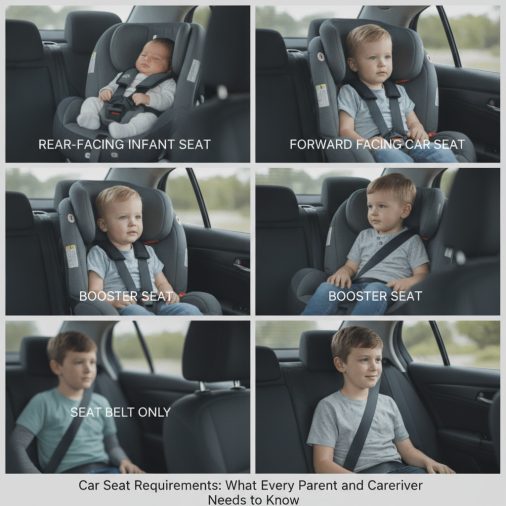
Car seat requirements in the United States are governed by both federal safety standards and individual state laws. In general, infants must use a rear-facing seat, toddlers transition to a forward-facing seat with a harness, older children use a booster seat, and children graduate to a seat belt only when they fit it correctly — typically around age 8 to 12 depending on the child’s size. The specific weight, height, and age thresholds vary by seat model and state law, so always follow the limits printed on your child’s actual car seat rather than using age alone as a guide.
The Four Stages of Child Car Seat Use
Child passenger safety follows a clear progression based on your child’s physical development, not a fixed birthday. Each stage offers a different level of crash protection appropriate for that size and age range.
Stage 1 — Rear-Facing Only or Convertible Seat (Birth to approximately 2–4 years)
Infants and toddlers should ride rear-facing for as long as the seat’s height and weight limits allow. This position cradles the head, neck, and spine during a frontal crash, which represents the majority of serious collisions. Most infant-only seats have rear-facing weight limits of 22 to 35 pounds. Convertible seats used rear-facing often accommodate children up to 40–50 pounds, allowing longer rear-facing use.
Stage 2 — Forward-Facing Seat with Internal Harness (Approximately 2–7 years)
Once a child exceeds the rear-facing weight or height limit of their seat, they move to a forward-facing seat with a five-point harness. Most harness-equipped seats allow forward-facing use up to 40–65 pounds, with some harnessed seats reaching 80–90 pounds. Keep children in a harness seat until they outgrow it completely — do not move to a booster early.
Stage 3 — Belt-Positioning Booster Seat (Approximately 4–12 years)
A booster seat raises the child so the vehicle’s seat belt crosses the body correctly — lap belt low across the hips and shoulder belt across the chest, not the neck. Booster seats are used until the child fits the vehicle’s seat belt properly without one. Most children need a booster until they are 4 feet 9 inches tall and between 8 and 12 years old.
Stage 4 — Vehicle Seat Belt Alone
A child is ready for a seat belt without a booster when the lap belt lies flat across the upper thighs (not the stomach) and the shoulder belt crosses the center of the chest and shoulder — not the neck or face. The child should also be able to sit with their back flat against the seat and feet flat on the floor for the entire trip.
Federal Safety Standards That Apply to All Car Seats
Every car seat sold in the United States must comply with Federal Motor Vehicle Safety Standard 213 (FMVSS 213), which sets minimum crash-test performance requirements, labeling standards, and flame-retardancy requirements. This standard applies regardless of price, brand, or type.
Car seats also carry a manufacture date label, which matters because most manufacturers recommend replacing a seat 6 to 10 years after its manufacture date. The plastic shell, harness webbing, and buckle mechanisms degrade over time, and older seats may not meet current standards.
Additionally, all car seats sold since 2002 must be compatible with the LATCH system — Lower Anchors and Tethers for Children — which provides an alternative to the vehicle seat belt for securing the seat. LATCH use has weight limits, typically 65 pounds combined weight of the child and seat, though this varies. Above those limits, the seat belt is used to secure the seat instead.
State-by-State Law Differences You Should Understand
While federal standards define minimum safety performance, individual states set the legal requirements for when each type of seat must be used. These laws are enforced by law enforcement and typically carry fines for non-compliance.
Most states follow a tiered structure similar to the four stages above, but specific thresholds differ. Some states specify that children must remain rear-facing until age 2. Others use weight thresholds. Several states require booster seat use until age 8, while others extend that requirement to age 9 or even 12 in some circumstances.
A few important points:
– State law defines the minimum legal requirement — the current safety guidance from the American Academy of Pediatrics and the National Highway Traffic Safety Administration often recommends keeping children in each stage longer than the law strictly requires
– Moving a child out of a harness before they outgrow it is legal in some states but still less safe
– A child visiting or traveling through another state is subject to that state’s laws while in that jurisdiction
– Check your specific state’s DMV or Department of Transportation website for current requirements, as laws are updated periodically
Rear-Facing Seat Limits: The Most Commonly Misunderstood Rule
Many parents move children to forward-facing seats too soon. A common misconception is that rear-facing is only for infants, or that a child’s legs touching the vehicle seat back means they’ve outgrown their rear-facing position. Neither is correct.
A child has outgrown a rear-facing seat when their weight exceeds the seat’s rear-facing limit or their head is within one inch of the top of the seat shell. Leg room is not a limiting factor — rear-facing children sitting cross-legged or with bent knees are still well within safe usage. Crash forces are absorbed differently in rear-facing mode, and leg injuries from a cramped position are far less serious than the spinal injuries that can occur from premature forward-facing.
For families using a convertible seat, always check the labels on the specific seat, not general internet guidelines, since rear-facing weight limits vary considerably between models.
LATCH System vs. Seat Belt Installation: Which Is Correct?
Both methods can result in a correctly installed seat — the method itself is less important than correct installation. That said, there are situations where one method is preferable.
| Situation | Recommended Method |
|—|—|
| Child + seat weight under LATCH limit (typically 65 lbs) | LATCH or seat belt |
| Child + seat weight over LATCH limit | Seat belt only |
| Center rear seat without lower LATCH anchors | Seat belt |
| Forward-facing seat in any position | Seat belt or LATCH + top tether |
| Rental vehicle or unfamiliar vehicle | Seat belt (universally compatible) |
The top tether is a critical and frequently overlooked component. Forward-facing seats must always be connected to the vehicle’s top tether anchor when using either installation method. The tether reduces forward head movement by several inches during a crash. Many parents skip this step, particularly in vehicles where the tether anchor requires reaching behind the seat or through a trunk.
If you’re concerned about whether a child seat is properly protecting your vehicle’s upholstery, car seat protectors for child seats can help prevent pressure marks and scuffs on your upholstery while keeping the seat stable on the vehicle seat surface.
Harness Fit: What Correct Adjustment Actually Looks Like
Even a correctly installed seat provides reduced protection if the harness is adjusted improperly. Many child restraint technicians report that harness fit errors are among the most common issues found during seat checks.
Strap height:
For rear-facing seats, harness straps must come from at or below the child’s shoulders. For forward-facing seats, straps must come from at or above the shoulders. This is the reverse of what many parents expect.
Chest clip position:
The chest clip sits at armpit level — not at the belly, not at the throat. Its job is to keep the harness straps in position, not to provide crash protection itself. A chest clip that is positioned too low allows the harness to slide off the shoulders during a crash.
Harness tightness:
The pinch test is the standard check: with the harness buckled and tightened, pinch the webbing at the child’s collarbone. If you can pinch excess webbing between your fingers, the harness is too loose. Properly tightened, the webbing should not gather between your fingers.
Bulky clothing:
Winter coats and thick snowsuits should not be worn under a car seat harness. The padding compresses during a crash, leaving slack in the harness that negates proper tightness. Use a thin fleece layer, buckle the harness, then place a coat or blanket over the child on top of the harness.
When Children Can Ride in the Front Seat
All major safety organizations recommend keeping children in the rear seat until at least age 13. The rear seat is statistically safer in most frontal crash scenarios, and active front airbags present a serious injury risk to smaller passengers who are not in the correct position relative to the airbag deployment zone.
Rear-facing seats must never be placed in a front seat position with an active front passenger airbag. The airbag deploys with enough force to cause fatal injury to a rear-facing infant. If an airbag switch is available and can be turned off, a rear-facing seat may be used in the front with the airbag disabled — but rear positioning remains strongly preferred.
Some vehicles have no rear seat, such as certain pickup trucks and sports cars. In those cases, consult the vehicle owner’s manual and the car seat manufacturer’s guidance for front-seat installation requirements specific to that configuration.
Car Seat Use After a Vehicle Crash
A car seat involved in a moderate to severe crash should be replaced, even if no visible damage is apparent. The structural integrity of the shell may be compromised in ways that are not externally visible.
NHTSA defines a minor crash as one where: the vehicle could be driven away, the door nearest the seat was undamaged, no occupants were injured, no airbags deployed, and there is no visible damage to the car seat. A seat may be reused after a minor crash meeting all five criteria. Any crash that does not meet all five conditions warrants seat replacement.
Check with your insurance provider, as some policies cover car seat replacement after a crash even when the seat shows no visible damage.
Frequently Asked Questions
At what age can a child stop using a booster seat?
There is no universal age cutoff. A child is ready to stop using a booster when the vehicle’s seat belt fits correctly without it — lap belt flat across the upper thighs, shoulder belt across the chest and shoulder, and the child able to sit properly for the entire ride. This typically happens between ages 8 and 12, depending on the child’s height, usually around 4 feet 9 inches tall. Age alone should not determine readiness.
Is it legal to use an expired car seat?
Using an expired car seat is not a traffic violation in most states, but it is strongly discouraged. Manufacturers set expiration dates because plastic, foam, and webbing degrade over time. An older seat may also not meet current safety standards. The expiration date is printed on a label attached to the seat itself, typically on the bottom or back of the shell.
Does every car seat fit every vehicle?
No. Car seats must be compatible with the specific vehicle they are installed in. Some seats are too wide for certain vehicles with shared rear bench seating. The LATCH anchor spacing also varies between vehicles, which can affect lower-anchor attachment. NHTSA provides a vehicle-seat compatibility database online. Doing a physical trial installation before purchasing a seat is the most reliable way to confirm fit.
Can a child ride rear-facing past age 2?
Yes, and it is recommended. The AAP advises keeping children rear-facing until they reach the maximum weight or height limit of their rear-facing seat, regardless of age. The previous guidance citing age 2 as a minimum has been updated to remove that specific age threshold in favor of keeping children rear-facing as long as the seat allows.
What is the difference between a convertible car seat and an infant seat?
An infant-only seat is a smaller, portable seat designed solely for rear-facing use from birth up to approximately 22–35 pounds. A convertible seat is a larger seat that can be used rear-facing first, then converted to forward-facing as the child grows, typically allowing rear-facing use up to 40–50 pounds. Convertible seats are not portable carriers — they stay installed in the vehicle.
How do I know if a car seat was correctly recalled?
Visit NHTSA’s recall lookup website and enter the car seat’s brand and model. You can also register the seat directly with the manufacturer to receive recall notifications automatically. Many recall remedies involve free replacement parts or a voucher for a new seat — not necessarily a requirement to stop using the seat immediately, depending on the issue.
Do car seat requirements change for ride-sharing vehicles?
Most states exempt taxis and ride-share vehicles from standard child restraint laws. However, that legal exemption does not mean it is safe to travel without a car seat. For families using ride-share services regularly, a portable, lightweight seat that can be quickly installed — or a travel system — is a practical solution worth considering. Always follow the physical fit and installation requirements of the specific seat regardless of the vehicle type.
Final Thoughts
Car seat requirements exist because the correct restraint, correctly installed and correctly fitted, dramatically reduces a child’s risk of serious injury or death in a crash. The most important habit is following the weight and height limits printed on your specific seat rather than relying on age guidelines alone, and keeping children in each stage until they genuinely outgrow it. When in doubt about installation, harness fit, or whether a seat is compatible with your vehicle, a certified Child Passenger Safety Technician can perform a free seat check — many fire stations, hospitals, and police departments offer this service.