If you’re driving with children in British Columbia, getting the car seat right isn’t just about safety — it’s a legal requirement. BC has some of the most clearly structured child restraint laws in Canada, and knowing exactly where your child falls within the system helps you stay both compliant and genuinely protected.
British Columbia’s car seat laws require all children to use an appropriate child restraint based on their age, weight, and height rather than age alone. The progression moves from rear-facing infant seats, to forward-facing seats with a harness, to booster seats, and finally to seatbelts. Children must remain in each stage until they physically outgrow it — not simply when they reach a birthday milestone.
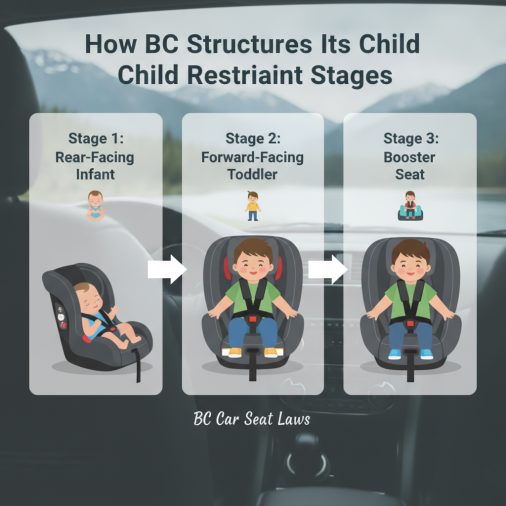
How BC Structures Its Child Restraint Stages
BC’s Motor Vehicle Act and related regulations outline a staged restraint system. The key principle is that children must meet the minimum physical requirements to advance to the next stage. Age is a general guide, but weight and height limits printed on the specific car seat being used are what actually determine readiness.
There are four distinct stages:
– Stage 1: Rear-facing car seat (infants and small toddlers)
– Stage 2: Forward-facing car seat with a harness
– Stage 3: Booster seat with a vehicle seatbelt
– Stage 4: Seatbelt only (when the child fits it correctly)
Moving through each stage too early is one of the most common mistakes parents make. Each stage provides a different level of crash protection, and the protection decreases significantly when a child is moved forward before they’re ready.
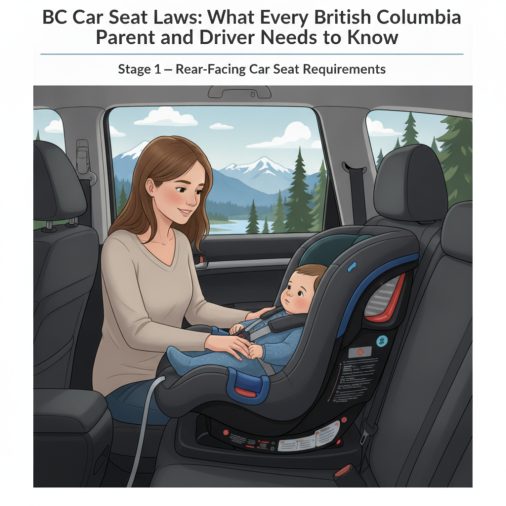
Stage 1 — Rear-Facing Car Seat Requirements
Infants must travel in a rear-facing seat installed in the back seat of the vehicle. BC law requires children to remain rear-facing until they reach the maximum weight or height limit set by their specific car seat’s manufacturer.
Most convertible car seats now support rear-facing up to 40 pounds or higher, which means many children can remain rear-facing well into their second or third year. The old guidance of “turn at one year” is outdated and no longer reflects current BC regulations or safety evidence.
Important practical points for rear-facing installation:
– The seat must recline at the angle specified by the manufacturer (typically 30–45 degrees)
– Harness straps should sit at or below the child’s shoulders
– There should be no more than one finger of slack at the collarbone after tightening
– Coats and thick winter clothing under the harness can create dangerous slack — dress the child first, then tighten
If the rear seat of your vehicle has limited recline clearance or an unusual seat angle, check the seat manufacturer’s compatibility guidance before purchasing. Not every car seat fits well in every vehicle, particularly smaller sedans or rear bench seats with a steep angle.
Stage 2 — Forward-Facing with a Harness
Once a child has outgrown the rear-facing limits of their seat, they transition to a forward-facing seat with an internal harness. In BC, children must remain in this stage until they exceed the maximum weight or height limit of their forward-facing seat.
The harness in a forward-facing seat should:
– Sit at or above the child’s shoulders
– Have the chest clip positioned at armpit level
– Be snug enough that you cannot pinch any webbing at the shoulder
One detail many parents overlook is the top tether strap. BC law requires the top tether to be used with forward-facing seats whenever the vehicle has a tether anchor point — and virtually all vehicles sold in Canada after 2002 do. The tether significantly reduces head movement in a frontal crash and is not optional.
Using a car seat protector designed for child seats underneath the forward-facing seat can help prevent indentations in your vehicle’s upholstery while keeping the seat stable on the cushion.
Stage 3 — Booster Seat with Seatbelt
Children who have outgrown a forward-facing harnessed seat move to a booster seat. The booster’s job is to position the vehicle’s existing seatbelt correctly across the child’s body. BC law requires children to use a booster seat until they can pass the five-step seatbelt fit test.
The five-step test checks whether:
1. The child can sit with their back flat against the vehicle seat
2. Their knees bend naturally over the seat edge
3. The lap belt fits low across the hips and upper thighs (not the abdomen)
4. The shoulder belt crosses the chest and shoulder (not the neck or face)
5. The child can maintain that position for the full trip without slouching
Most children don’t pass this test until they’re between 9 and 12 years old, and often not until they’re around 145 cm (4’9″) tall. The legal seatbelt-only transition in BC is tied to fit, not a specific age.
High-back booster seats are generally preferable to backless boosters for younger children in this stage because they provide head and neck support and better shoulder belt positioning.
Stage 4 — Seatbelt Only
Once a child passes the five-step fit test consistently, they can use a seatbelt without a booster. BC law still requires seatbelt use for all occupants regardless of age. If a child can’t maintain the correct seatbelt position throughout a trip — particularly on longer drives when fatigue sets in — they’re not ready for seatbelt-only use.
Children under 13 should continue riding in the back seat whenever possible. Front seat airbag deployment is dangerous for smaller children, and the back seat position remains statistically safer.
Where BC Car Seat Laws Apply
BC car seat laws apply to all vehicles operating on BC roads. This includes:
– Privately owned cars, trucks, SUVs, and minivans
– Rental vehicles
– Rideshares and taxis (though enforcement and practical compliance in rideshares can vary)
– Borrowed vehicles
The restraint must be appropriate for the child and must be installed according to both the vehicle’s owner manual and the car seat manufacturer’s instructions. These two documents don’t always agree on every point, and when they conflict, the more restrictive guidance is typically the safer choice.
Common Mistakes That Violate BC Law (and Create Real Risk)
Several widespread habits put children outside of legal compliance and, more importantly, outside of adequate protection.
Advancing stages too early. Moving a child to a booster because they turned four — even if they haven’t outgrown the harness — is a frequent mistake. The harness stage provides substantially more crash protection than a booster.
Loose harness straps. A harness that allows significant slack at the collarbone is both a legal concern and a serious safety issue. In a crash, that slack allows excessive forward movement before the harness loads.
Aftermarket accessories not tested with the seat. Padding inserts, head supports, and bundle-me style covers sold separately from the car seat are generally not crash-tested as part of the seat system. BC regulations require the seat to be used as the manufacturer instructs, which typically means only accessories included with the seat or explicitly approved by the manufacturer.
Using an expired or damaged seat. Car seats have expiry dates, usually printed on a sticker on the frame. Plastic degrades over time, and a seat that has been in a significant crash may be compromised even without visible damage. Using an expired or post-crash seat may constitute non-compliance.
Fines and Enforcement in BC
BC RCMP and municipal police enforce child restraint laws under the Motor Vehicle Act. Fines for failing to properly restrain a child typically start around $167 and include driver penalty points. The driver of the vehicle is legally responsible for ensuring passengers under 16 are properly restrained, regardless of who owns the car seat or who installed it.
Getting Your Car Seat Professionally Checked
Knowing the rules is one thing — correct installation is another. Studies consistently show that a large percentage of car seats in use have at least one significant installation error. BC offers certified Child Passenger Safety Technician (CPST) inspection clinics through ICBC, Safe Kids Canada events, and some fire departments and hospitals.
A CPST can verify:
– Correct seat selection for the child’s size
– Proper installation angle and securing
– Correct harness routing and tightening
– Top tether connection and tensioning
– Compatibility between the specific seat and the vehicle
These clinics are typically free and take about 30–45 minutes. Many parents are surprised to discover that an installation they felt confident about had a significant error.
FAQ
At what age can a child stop using a car seat in BC?
BC law doesn’t set a specific age for transitioning away from a car seat or booster. Children must remain in each stage until they outgrow the physical limits of their current seat. The final transition to seatbelt-only use is based on passing the five-step seatbelt fit test, which most children don’t pass until they’re 9–12 years old and approximately 145 cm tall.
Does BC law require a rear-facing seat until age two?
No. BC law requires children to remain rear-facing until they outgrow the maximum weight or height limit of their specific rear-facing seat — not until a particular birthday. Many modern convertible seats support rear-facing past 18 kg (40 lbs), which often keeps children rear-facing well past age two.
Can I use a used car seat that came from another province?
You can use a used car seat in BC provided it meets Transport Canada’s requirements (look for the National Safety Mark label), has not been in a significant crash, is not expired, comes with its original manual, and has all original parts and labels intact. If any of these conditions cannot be verified, the seat should not be used.
Is a booster seat required for a 10-year-old in BC?
Possibly. BC law requires booster seat use until a child can correctly pass the five-step seatbelt fit test. If a 10-year-old cannot maintain proper seatbelt positioning — lap belt low on the hips, shoulder belt across the chest — they still legally require a booster seat regardless of age.
Do BC car seat laws apply to taxis and rideshares?
The Motor Vehicle Act applies to all vehicles on BC roads. Practically speaking, rideshare companies have specific policies, and parents traveling with children are advised to bring their own portable car seat when using any rideshare or taxi service. Assuming the driver will have an appropriate seat available is not a safe or legally reliable expectation.
What happens if my vehicle doesn’t have a LATCH anchor system?
Vehicles manufactured before 2002 may lack lower LATCH anchors. Car seats can still be installed securely using the vehicle’s seatbelt with a locking clip if required. Check the car seat manual for the correct belt-path routing and locking method for your specific seat and vehicle combination.
Can a child sit in the front seat in BC?
There is no BC law that explicitly prohibits children from sitting in the front seat, but it is strongly discouraged for children under 13 due to airbag risk. If a child must ride in front, the seat should be pushed as far back as possible and the child must use the appropriate restraint for their stage.
Final Thoughts
BC’s child restraint laws are built around physical fit, not birthdays. The safest approach is always to keep children in each restraint stage as long as the seat allows, and to verify installation correctness with a certified technician at least once per seat and vehicle combination. A correctly installed, correctly used car seat is one of the most effective safety systems in any family vehicle — understanding BC’s specific requirements helps ensure it’s working as intended.