Buckling a child into the wrong seat type — or skipping the booster too early — is one of the most common and preventable road safety mistakes parents make. Child car seat laws exist to prevent exactly that, but the rules vary significantly depending on where you live, how old your child is, and how much they weigh.
Child car seat laws require children to use age-, weight-, and height-appropriate restraints in motor vehicles. In the United States, federal safety standards set the baseline, but each state enforces its own specific requirements covering rear-facing seats, forward-facing seats, booster seats, and the transition to adult seatbelts. Most states require children to remain in a booster seat until they reach at least 4 feet 9 inches tall or age 8–12, depending on the state.
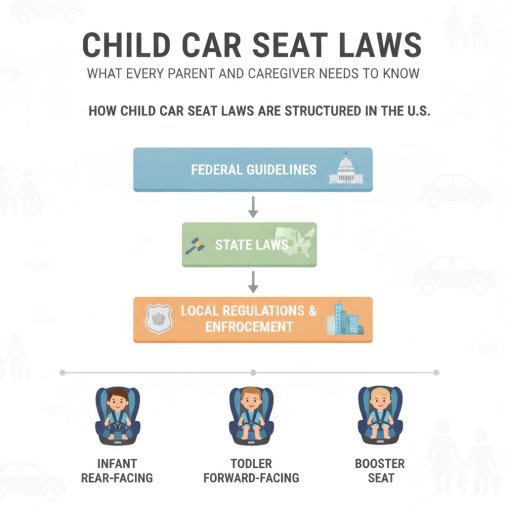
How Child Car Seat Laws Are Structured in the U.S.
Child passenger safety laws operate on two levels. The National Highway Traffic Safety Administration (NHTSA) sets federal safety standards that govern how car seats must be manufactured and tested. Individual states set the legal requirements for how and when children must use those seats.
This means a car seat sold in the U.S. must pass federal safety standards, but whether your child legally needs a rear-facing seat, forward-facing harness, or booster seat depends on your state’s specific statute. No two states have identical rules, which creates genuine confusion for families who travel across state lines.
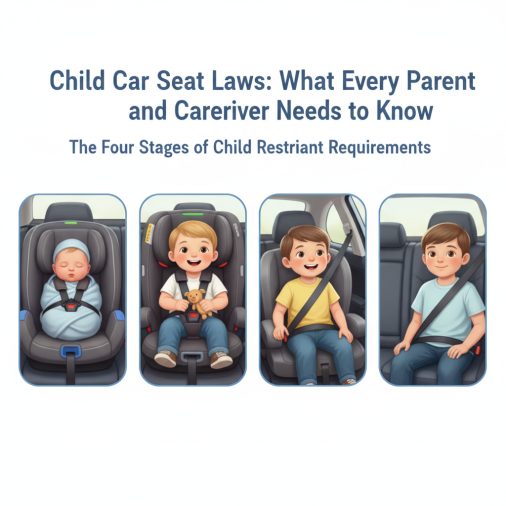
The Four Stages of Child Restraint Requirements
Most state laws follow a progression that aligns with child development and crash-protection research. Understanding each stage helps parents stay both legal and safe.
Stage 1 — Rear-Facing Car Seats
Rear-facing is the safest position for infants and young toddlers. It distributes crash forces across the entire back, neck, and head rather than concentrating stress on the neck and spine.
Legal minimums vary by state, but the American Academy of Pediatrics (AAP) and NHTSA both recommend keeping children rear-facing until they reach the maximum weight or height limit allowed by their specific car seat manufacturer — not just until age 1 or 2.
Many states legally require rear-facing seating until at least age 2. California, for example, requires rear-facing until age 2 or until the child exceeds the rear-facing weight and height limits of their seat. Always check your seat’s manual, because the seat’s own limits may be stricter than your state’s legal minimum.
Stage 2 — Forward-Facing Harness Seats
Once a child outgrows the rear-facing limits of their seat, they transition to a forward-facing car seat with a five-point harness. Most state laws require children to remain harnessed in a forward-facing seat until they reach the seat’s maximum harness weight or height limit, typically 40–65 lbs depending on the seat.
Children should stay in a harnessed seat as long as possible within that seat’s limits. Transitioning to a booster too early — because it seems convenient — significantly reduces crash protection.
Stage 3 — Booster Seats
A booster seat repositions the vehicle’s seatbelt so it fits a child’s smaller body correctly. Without a booster, the shoulder belt typically crosses the neck or face, and the lap belt sits on the soft abdomen instead of the bony hip structure — both dangerous in a crash.
Most state laws require booster seats until the child is:
– At least 40–80 lbs (varies by state)
– At least age 4–8 (varies significantly)
– At least 4 feet 9 inches tall in many states
Some states, including New Jersey and Washington, require booster seat use until age 8 or until the child reaches 4’9″. Others base the requirement entirely on height and weight. A handful of states have weaker requirements, making parental awareness critical.
For parents using a convertible car seat that handles both rear-facing and forward-facing stages, a car seat protector designed for child safety seats helps protect your vehicle’s upholstery through all these transitions without compromising harness access or seat stability.
Stage 4 — Seatbelt Only
A child is ready for an adult seatbelt when the seatbelt fits properly without a booster. The correct fit means:
– Shoulder belt rests across the chest and collarbone — not the neck
– Lap belt lies flat across the upper thighs and hip bones — not the stomach
– The child can sit with their back fully against the seat and feet flat on the floor for the entire trip
Most children don’t achieve this fit until they’re between 8 and 12 years old, regardless of what the law may technically allow.
State-by-State Variation: Key Examples
| State | Rear-Facing Requirement | Forward-Facing/Booster Requirement | Seatbelt Transition |
|—|—|—|—|
| California | Until age 2 or seat limits | Booster until 8 years or 4’9″ | After booster stage |
| Texas | Until age 2 or seat limits | Booster until 8 years or 4’9″ | After booster stage |
| New York | Until age 2 or seat limits | Booster until age 8 or 4’9″ | After booster stage |
| Florida | Until age 1 (minimum) | Booster until age 5 | After booster stage |
| Illinois | Until age 2 or seat limits | Booster until age 8 | After booster stage |
| Georgia | Until age 1 or seat limits | Booster until age 8 or 4’9″ | After booster stage |
Florida’s legal requirements are notably weaker than NHTSA guidance. Parents in states with minimal requirements should prioritize safety recommendations over legal minimums.
The LATCH System and Legal Installation Requirements
Most child car seat laws require not only the correct seat type but also proper installation. An improperly installed seat — even a legally correct one — provides significantly reduced crash protection.
The LATCH system (Lower Anchors and Tethers for Children) is a standardized attachment method available in most vehicles manufactured after September 2002. LATCH includes:
– Lower anchors that attach to the base of the car seat
– Top tether anchors used with forward-facing seats to prevent forward rotation in a crash
LATCH has weight limits. The lower anchors are typically rated to a combined child-plus-seat weight of 65 lbs, though some vehicles allow higher limits. Check both your vehicle’s owner’s manual and the car seat’s manual for the applicable limit. When the combined weight exceeds the lower anchor limit, install the seat using the vehicle’s seatbelt instead — using the top tether anchor for forward-facing seats.
Many parents also use infant car seat covers for temperature regulation and privacy, but it’s worth noting that no cover, insert, or accessory should go between the child and the harness, or alter the harness routing in any way, as this can affect crash performance.
Rear Seat Placement and Airbag Safety
Virtually all child car seat safety guidance — and many state laws — require children to ride in the rear seat. The back seat is measurably safer in frontal crashes, which represent the majority of serious collisions.
Children under 13 should never ride in the front seat when an active passenger airbag is present. Front airbags deploy with significant force designed for adult body mass. For a child or rear-facing infant seat, airbag deployment can cause fatal injury even in a moderate crash.
If a vehicle has only two seats and there is no choice but to place a child in the front, the passenger airbag must be deactivated if the vehicle provides that option. Confirm this in the owner’s manual before making this decision.
Common Legal and Safety Mistakes Parents Make
Many car seat violations involve misunderstanding the law, not intentional neglect.
– Transitioning to a booster too early — Moving a child to a booster before they outgrow their harnessed seat’s limits is both unsafe and may be illegal in your state
– Ignoring the rear-facing limit — A 2-year-old who still fits within the seat’s rear-facing limits should stay rear-facing, regardless of age-based legal minimums
– Using an expired car seat — Car seats have expiration dates (typically 6–10 years from manufacture) because plastic degrades and safety standards evolve
– Using a seat after a crash — Most manufacturers and NHTSA recommend replacing a car seat involved in a moderate or severe crash, even if it appears undamaged
– Loose harness straps — The harness should be snug enough that no more than one finger fits flat under the strap at the collarbone
– Chest clip positioned too low — The chest clip belongs at armpit level, not over the stomach
Traveling Across State Lines: Which Law Applies?
When driving through multiple states, the law of the state you are currently driving in applies. In practice, enforcement officers in another state will apply their own state’s child restraint law.
The practical solution is to follow the strictest applicable guidelines — which typically means following NHTSA’s recommendations rather than the weakest state minimum. This keeps the child safe and legally compliant everywhere.
For families who frequently travel by air and then rent a car at the destination, carrying your own seat avoids uncertainty about rental car seat quality and condition. A durable travel car seat bag protects the seat during baggage handling and makes airport transport significantly easier.
Frequently Asked Questions
What age can a child legally sit without a car seat?
The specific age depends on your state, but most require booster seat use until at least age 8, and many extend requirements to age 12 or until the child reaches 4 feet 9 inches. Legal age minimums are not the same as safety thresholds — a child should transition to seatbelt-only when the belt fits correctly, which typically happens between ages 8 and 12 regardless of what local law permits.
Is it illegal to put a car seat in the front seat?
Most states don’t outright prohibit forward-facing or booster seats in the front seat for older children, but placing any child under 13 in front of an active airbag is extremely dangerous. Many states have laws requiring children under a certain age or weight to ride in the rear seat. Check your state’s specific statute and always prioritize rear seating when possible.
Can I use a second-hand or expired car seat legally?
Using an expired car seat is not explicitly illegal in most states, but it violates manufacturer guidelines and NHTSA recommendations. Car seat plastic degrades over time, and older seats may not meet current safety standards. A seat involved in a significant crash should be replaced. When buying used, verify the manufacture date, expiration date, and confirm it has never been in a crash.
Does my car seat need to be installed with LATCH or can I use the seatbelt?
Either method is acceptable when used correctly, and neither is inherently superior to the other. The key is that the seat must be installed tightly — less than one inch of movement side-to-side or front-to-back when tested at the belt path. LATCH has combined weight limits that vary by vehicle, so seatbelt installation is often preferred for larger children in forward-facing seats.
What happens if my child doesn’t fit the rear-facing seat anymore but my state law requires rear-facing until age 2?
If your child has exceeded the weight or height limit of the specific car seat, they must transition to the next stage, even if they haven’t reached the minimum age stated in the law. No state law requires you to keep a child in a seat configuration that exceeds the seat’s rated limits. The solution is to either switch to a convertible seat with higher rear-facing limits or transition to a forward-facing harness seat.
Are there specific laws about car seat registration?
There is no federal or state law requiring car seat registration, but manufacturers strongly encourage it. Registration allows the manufacturer to notify you directly of a safety recall. Many car seats — including popular models — have been subject to recalls affecting harness buckles, chest clips, or base stability.
Do rideshare vehicles like Uber and Lyft require car seats?
Most states exempt rideshare and taxi vehicles from child car seat laws, meaning drivers are not legally required to provide them. However, as the parent or caregiver, you remain responsible for your child’s safety. Portable car seats or traveling with your own seat are practical options for rideshare trips with young children.
Final Thoughts
Child car seat laws set a legal floor, not a safety ceiling. Following only the minimum legal requirement in your state may leave your child in a statistically less protective restraint configuration than they could be using. The clearest guidance comes from matching the child’s actual size to the appropriate restraint stage — rear-facing as long as the seat allows, harnessed as long as possible, booster until the seatbelt genuinely fits. When in doubt, a certified Child Passenger Safety Technician (CPST) can inspect your installation and confirm your child is in the right seat for free through many fire stations, hospitals, and community programs. Getting the seat right costs nothing extra and matters more than almost any other vehicle safety decision you make.