A dead battery is one of the most common roadside problems drivers face. Whether it happened because you left the lights on overnight or the battery finally gave out after a long winter, knowing how to jumpstart your car correctly can get you back on the road in minutes.
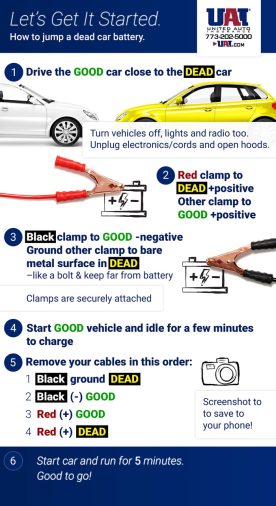
To jumpstart a car, you connect jumper cables between a working vehicle’s battery and the dead battery, positive terminal to positive, then negative to a ground point on the dead vehicle. Start the working car first, let it run for a few minutes, then start the dead vehicle. Once running, disconnect the cables in reverse order and drive for at least 15–20 minutes to recharge the battery.
What You Need Before You Start
You only need two things: a set of jumper cables and a second vehicle with a charged battery. That said, cable quality matters more than most people realize.
Heavy-gauge jumper cables — typically 4-gauge or 6-gauge — transfer current more effectively than cheap, thin cables. Longer cables (at least 12 feet / 3.6 meters) give you more flexibility in positioning the two vehicles. A well-known option that many drivers keep in their trunk is the Energizer 1-Gauge 800A Heavy Duty Jumper Battery Cables, which are long enough for most parking lot situations and handle high-amperage draws from larger engines.
If you’re frequently driving alone or in remote areas, a portable jump starter pack is worth considering as a backup — but the steps below focus specifically on jumping with a second car.
Where to Position the Vehicles
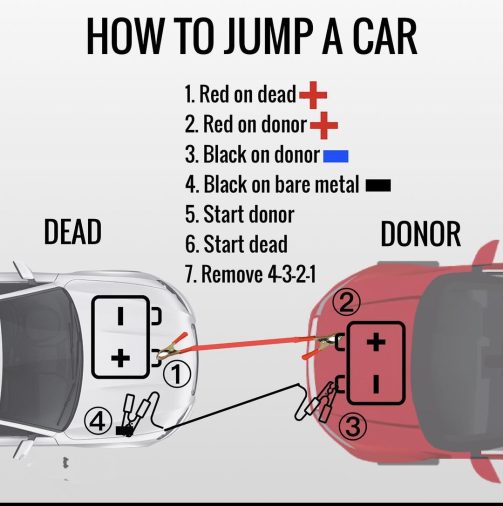
Park the working vehicle close enough that the jumper cables can reach both batteries comfortably. In most cases, that means parking nose-to-nose or alongside each other, depending on where each vehicle’s battery is located.
- Make sure both vehicles are in Park (automatic) or Neutral with the parking brake set (manual)
- Turn off both ignitions before connecting anything
- Keep both vehicles stationary throughout the process — never allow them to touch metal-to-metal
Battery locations vary. Most cars have the battery under the hood, but some vehicles — including certain BMWs, Volvos, and Chrysler models — place the battery in the trunk or under the rear seat. These vehicles typically have dedicated jump terminals under the hood. Check your owner’s manual if you’re unsure where to connect.
Understanding the Cable Colors and Terminals
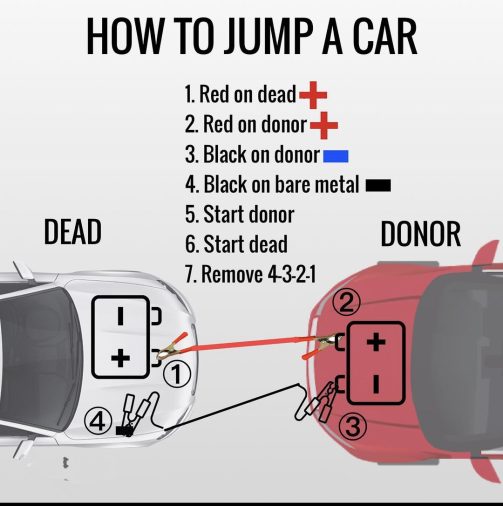
Jumper cables come color-coded for a reason. Getting this wrong can damage vehicle electronics, blow fuses, or in rare cases cause a battery to rupture.
| Cable Color | Terminal | Symbol |
|---|---|---|
| Red | Positive (+) | + |
| Black | Negative (−) | − |
Every connection must go to the correct terminal. Double-check before clamping anything.
Step-by-Step: How to Jumpstart a Car
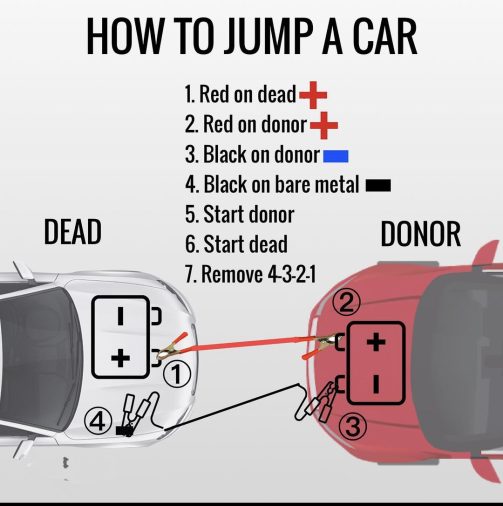
Follow this sequence exactly. The order of connections protects both vehicles from voltage spikes.
1. Position the vehicles — Park the good car close to the dead one with both engines off.
2. Connect the red (positive) cable to the dead battery’s positive terminal — Clamp it securely. There should be no wobble.
3. Connect the other end of the red cable to the good battery’s positive terminal — Positive to positive.
4. Connect the black (negative) cable to the good battery’s negative terminal — This is the only step where you touch the working battery’s negative post directly.
5. Connect the other end of the black cable to an unpainted metal surface on the dead vehicle — Do NOT connect it to the dead battery’s negative terminal. Instead, use a metal bracket, bolt, or engine block ground point away from the battery. This reduces the risk of igniting hydrogen gas that batteries occasionally emit.
6. Start the working vehicle — Let it run for 2–3 minutes. For larger engines or deeply discharged batteries, wait up to 5 minutes.
7. Attempt to start the dead vehicle — If it starts, great. If it doesn’t, wait another few minutes and try again.
- 8. Once the dead vehicle is running, disconnect the cables in reverse order:
- Black cable from the jumped vehicle’s ground point
- Black cable from the good battery
- Red cable from the good battery
- Red cable from the now-running vehicle’s battery
9. Drive the jumped vehicle for at least 15–20 minutes — This allows the alternator to partially recharge the battery. Short trips won’t do it.
Why the Ground Connection Matters
Connecting the final black clamp to a metal ground point rather than the dead battery’s negative terminal is a safety step that’s frequently skipped. Batteries produce small amounts of hydrogen gas, especially if they’ve been deeply discharged. An electrical spark near the terminal — which is possible when making that last connection — could ignite that gas.
In practice, most jumps go fine even when this step is skipped. But the correct technique is always to ground to bare metal on the engine block or chassis, away from the battery itself.
When the Jump Doesn’t Work
If the dead vehicle still won’t start after two or three attempts, the battery may be too far gone to accept a charge. A severely sulfated or internally shorted battery won’t jumpstart regardless of how long you wait.
Other possible reasons a jump fails:
- Corroded or loose battery terminals — Green or white crust on the terminals prevents good contact. Clean them with a wire brush if possible before retrying.
- Blown fusible link — Some vehicles have a main fuse near the battery that blows when there’s an electrical fault.
- Faulty alternator — If the car starts but dies again shortly after, the alternator may not be charging the battery while driving.
- Starter motor failure — If you hear a single click or nothing at all when you turn the key, the starter itself may be the issue rather than the battery.
A battery that requires frequent jumpstarts is a battery nearing the end of its life. Most automotive batteries last 3–5 years depending on climate and usage. Cold climates are especially hard on batteries.
Vehicles That Require Special Caution
Most standard gasoline-powered cars and trucks can be jumped using this method without issue. However, a few situations require extra care:
Hybrid and electric vehicles — Hybrids have a conventional 12V battery that can be jumped normally. However, never use a hybrid or electric vehicle as the donor car to jump another vehicle. The high-voltage systems in these vehicles are not designed to supply jump current through the 12V terminals in the same way a traditional alternator-driven system can. Check the owner’s manual before attempting anything.
Modern vehicles with stop-start systems — These vehicles use AGM (Absorbent Glass Mat) batteries. They can be jumped like a regular car, but they must be replaced with the correct AGM battery type — never a standard flooded lead-acid battery.
Vehicles with older or sensitive electronics — Voltage spikes during a jump can occasionally trigger warning lights or affect sensitive modules. This is uncommon with a properly performed jump but worth knowing if you drive a vehicle with a complex electrical system.
After the Jump: What to Do Next
Getting the car running is only half the job. Once you’re back on the road, a few follow-up steps help you understand whether you have a real problem or a one-time issue.
- Drive continuously for at least 20–30 minutes to give the alternator time to recharge the battery
- Have the battery tested at an auto parts store — most do this for free with a load tester
- Have the alternator output checked at the same time, since a weak alternator causes batteries to drain
- If the battery is more than 4–5 years old, replacement is often the more practical choice over hoping it recovers
A jumpstart is a temporary fix. If the root cause is a failing battery or alternator, the car will leave you stranded again.
FAQ
Can I jumpstart a car with a completely dead battery?
Yes, in most cases. Even a completely discharged battery can accept a charge from a donor vehicle if the battery cells aren’t damaged. Let the donor car run for 3–5 minutes before attempting to start the dead vehicle. If the battery has a dead cell or internal short, it won’t hold a charge regardless of how long you wait.
Is it safe to jumpstart a modern car with another modern car?
Generally yes, provided you follow the correct connection sequence. The main risk is a voltage spike from sloppy technique, not from the jump itself. Connecting cables in the right order — and disconnecting in reverse — keeps both vehicles’ electronics safe in the vast majority of situations.
How long should I drive after jumpstarting to recharge the battery?
Drive at least 15–30 minutes at highway speeds if possible. Idling in a driveway barely charges a battery. The alternator needs load and RPM to push meaningful current back into the battery. Even after this, the battery likely won’t be fully charged — a proper battery charger overnight does a much better job.
Can a hybrid car be used to jumpstart a regular car?
Most hybrid owners’ manuals advise against using the hybrid as a donor vehicle for jumping other cars. The 12V auxiliary battery in a hybrid isn’t backed by a traditional alternator in the same way, and some manufacturers explicitly warn it can strain the hybrid system. Check your specific model’s owner’s manual before using your hybrid as a donor.
What happens if you connect jumper cables in the wrong order?
Reversing the polarity — connecting positive to negative — can blow fuses, damage the battery, destroy alternator diodes, or fry sensitive electronic control modules. Some vehicles have main fuse protection, but others don’t. Always double-check terminal markings before clamping. If you accidentally cross the cables and sparks fly, disconnect immediately and assess both vehicles carefully before trying again.
Why does my car die again shortly after a jumpstart?
If the vehicle starts but stalls or dies within minutes, the alternator is likely not producing enough charge to keep the battery alive while driving. This is a common sign of alternator failure. A dead battery combined with a bad alternator will drain the battery faster than the alternator can replenish it. Have both components tested before driving further.
Can cold weather affect a jumpstart?
Yes, significantly. Cold temperatures reduce a battery’s ability to deliver cranking amps and slow the chemical reactions inside the battery. In very cold conditions, let the donor vehicle run for 5–7 minutes before attempting the jump. If the dead vehicle still won’t turn over, the battery may simply be too cold and depleted to accept enough charge — warming the vehicle in a garage first can help.
A jumpstart is a practical skill every driver should know. Follow the connection sequence carefully, use quality cables, and understand that a successful jump only buys you time — getting the battery and charging system tested afterward is what prevents the next breakdown.