Want that deep, punchy beat that makes your chest thump and your music feel alive? Most factory car stereos simply cannot deliver that kind of sound without some targeted upgrades.
Getting better beat sound from your car stereo comes down to three core elements: a quality subwoofer, an external amplifier, and proper equalizer tuning. Factory head units and speakers lack the power and bass response to reproduce deep beats accurately. Adding a powered subwoofer or a dedicated amp-and-sub setup, then tuning the EQ and crossover settings, produces the chest-felt bass most listeners want.
Why Factory Car Audio Falls Short on Bass
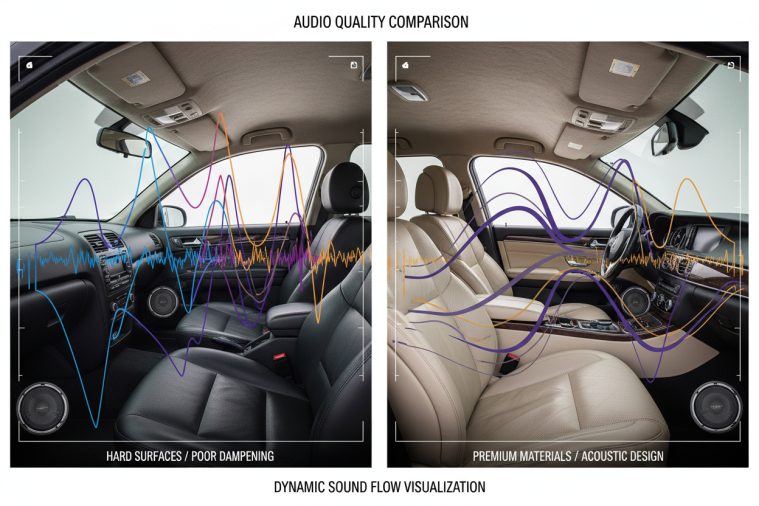
Most OEM audio systems are designed for balanced, quiet sound across all frequencies. They’re not built to push low-frequency bass hard. Factory speakers are typically small, underpowered, and mounted in locations that limit bass response.
The head unit’s built-in amplifier usually outputs between 15–22 watts RMS per channel — far less than the 50–200+ watts per channel that aftermarket amplifiers can deliver. Low-frequency sound requires significantly more power to reproduce cleanly. Without that power, bass either sounds weak and distorted or disappears into the cabin noise.
The Core Components That Create Powerful Beat Sound
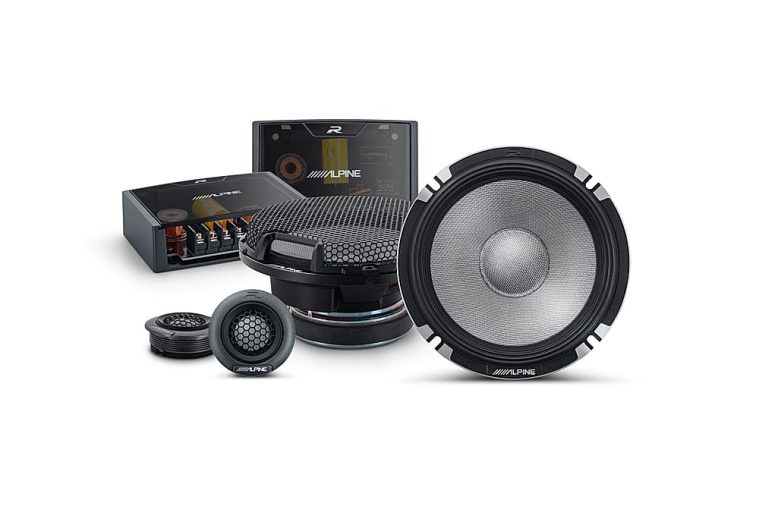
To consistently get that deep, felt bass in a car, these components work together:
- Subwoofer – Handles low frequencies (typically 20–80 Hz) that standard speakers can’t reproduce well
- External amplifier – Provides enough power to drive the subwoofer and full-range speakers properly
- Head unit (stereo receiver) – Controls the source signal, EQ, and crossover settings
- Wiring kit – Proper gauge power wire, ground wire, RCA cables, and signal cables
- Capacitor (optional) – Stabilizes voltage for amplifiers drawing high current
Each component affects the others. A powerful subwoofer connected to an underpowered amplifier will sound weak and can damage both units over time.
Choosing the Right Subwoofer for Deep Bass
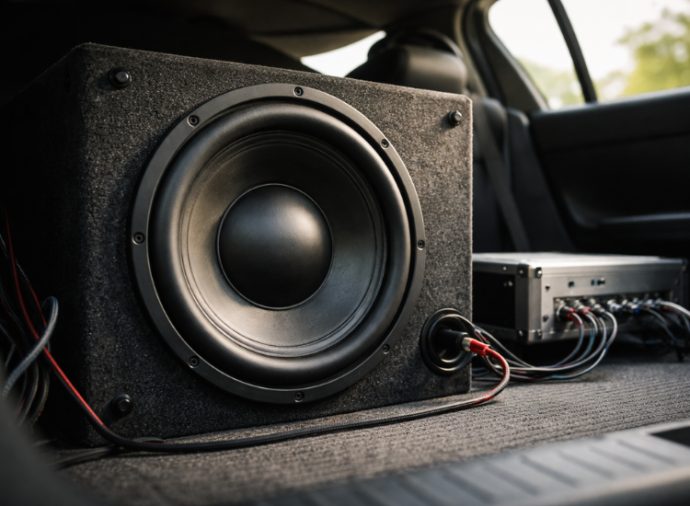
Subwoofer selection matters more than most beginners realize. Key specifications to compare:
| Specification | What It Means | Recommended Range |
|---|---|---|
| RMS Power Handling | Continuous power the sub can handle | Match to amp RMS output |
| Sensitivity (dB) | Efficiency per watt | Higher = louder per watt |
| Enclosure Type | Ported vs. sealed | Ported = louder; sealed = tighter |
| Voice Coil | Single vs. dual coil | Affects wiring flexibility |
| Size | 8″, 10″, 12″, 15″ | Larger = deeper, more output |
A 12-inch subwoofer in a ported enclosure is the most common choice for heavy, punchy hip-hop and EDM bass. A 10-inch in a sealed box suits listeners who want tight, accurate bass without excessive boom. If trunk space is limited, many owners use a shallow-mount 8-inch or 10-inch sub designed to fit under seats or in compact enclosures.
Adding an Amplifier: The Most Impactful Upgrade
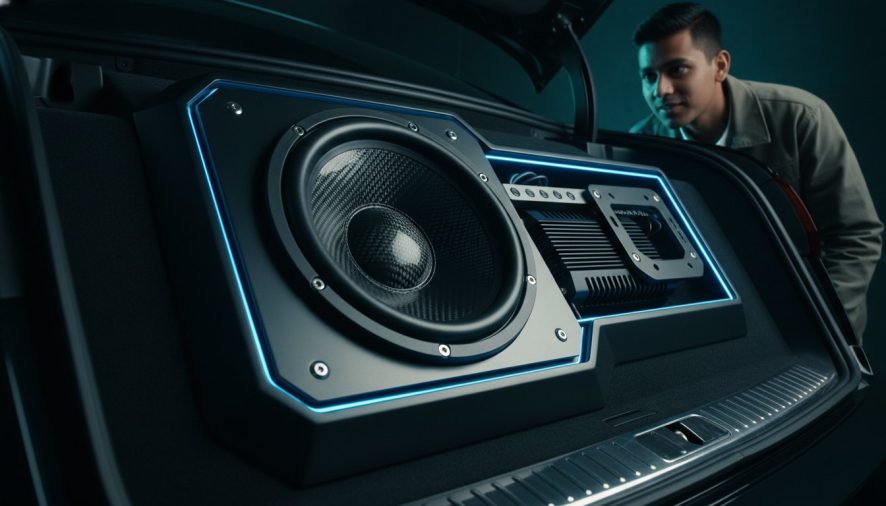
The amplifier is where most factory systems fail. An external amp replaces the weak built-in amplification with real, clean power.
When shopping for an amplifier:
- Match RMS ratings — Never match peak wattage. Match the amp’s RMS output to the subwoofer’s RMS rating (within 75–150% of the sub’s RMS is acceptable)
- Check impedance compatibility — Most subwoofers are 2-ohm or 4-ohm; the amp must be stable at the intended load
- Mono vs. multichannel — A mono (Class D) amplifier is most efficient for powering a subwoofer; a 4-channel amp handles full-range speakers
A monoblock amplifier like the Rockford Fosgate R500X1D Prime or the Alpine MRV-M500 are commonly used examples in this power range. These models are widely available and frequently referenced in car audio communities for reliable performance at moderate budgets.
Step-by-Step: Installing a Subwoofer and Amplifier
- What you’ll need:
- Subwoofer and enclosure
- Monoblock amplifier
- Wiring kit (appropriate gauge — typically 4 AWG or 8 AWG depending on amp draw)
- RCA cables (if your head unit has preamp outputs)
- Speaker-level input adapter (if no RCA outputs available)
- Wire crimpers, panel removal tools, electrical tape, ring terminals
Steps:
- Disconnect the negative battery terminal before beginning any wiring work
- Mount the amplifier in the trunk or under a seat — keep it ventilated
- Run the power wire from the battery through the firewall to the amp location — use a grommet where it passes through the firewall
- Install the inline fuse within 18 inches of the battery positive terminal
- Ground the amplifier to a clean, bare metal bolt point — a poor ground is the most common cause of amplifier problems
- Run RCA cables (or speaker-level input wires) from the head unit to the amplifier — route opposite the power wire to prevent alternator whine
- Run a remote turn-on wire from the head unit’s remote output (blue wire) to the amp’s remote terminal
- Wire the subwoofer to the amplifier’s speaker output terminals
- Reconnect the battery, set the amplifier gain low, power on, and play music before adjusting
- Set the gain by ear or with a multimeter — never use the gain as a volume control
Tuning the Equalizer and Crossover for Maximum Beat
Even a correctly installed system sounds average without proper tuning. This step is where most people leave performance on the table.
Low-pass crossover: Set the amplifier’s low-pass filter between 60–80 Hz for tight bass, or up to 100–120 Hz if you want more mid-bass presence. This prevents the subwoofer from reproducing midrange frequencies where it performs poorly.
Head unit EQ: Boost the 40–80 Hz band for deeper, physical bass. Cutting 150–300 Hz slightly can reduce muddiness and make beats sound more defined.
Subsonic filter: If using a ported enclosure, enable the subsonic filter on the amplifier, typically set around 25–35 Hz. This protects the subwoofer from ultra-low frequencies that the port already handles — frequencies that can over-excite the driver without producing audible sound.
Bass boost: Use this sparingly. Most amplifiers include a bass boost (typically 0–18 dB at 40–50 Hz). A small boost of 3–6 dB can help, but excessive boost causes distortion and can damage the subwoofer over time.
Improving Beat Sound Without a Subwoofer
Not every car or budget allows for a full subwoofer installation. There are meaningful improvements available without one:
- Replace factory speakers with aftermarket coaxials or component sets — Even a quality set of 6.5-inch aftermarket speakers dramatically improves overall clarity and bass response compared to OEM
- Add a DSP (Digital Signal Processor) — A DSP like the AudioControl LC2i or similar unit can clean up signal quality, correct factory EQ curves, and improve imaging without replacing the head unit
- Install sound deadening material — Products like Dynamat or Noico reduce road noise and vibration, which allows lower frequencies to be heard more clearly inside the cabin
- Upgrade the head unit — An aftermarket head unit with preamp outputs, a built-in parametric EQ, and higher voltage preamp output (4V vs. 2V) gives an amplifier a cleaner, stronger signal to work with
Common Problems That Ruin Beat Sound (and How to Fix Them)
Alternator whine: A high-pitched whine that changes with engine RPM usually means the RCA cables are running too close to the power wire, or the amplifier ground is poor. Reroute signal cables and verify the ground connection.
Distorted bass: Gain set too high, or bass boost overdone. Reduce gain until clean, then adjust the head unit volume to match.
Weak bass despite good equipment: Enclosure is wrong for the subwoofer’s parameters — check the manufacturer’s recommended box volume and type.
Bass cuts in and out: Often a loose ground wire, a failing inline fuse, or the amplifier going into thermal protection. Check connections and ensure airflow around the amplifier.
One-note, boomy bass: Usually a ported box that’s tuned too high, or the low-pass crossover is set too high. Lower the crossover frequency and check the box tuning frequency.
FAQ
What is the best way to get deep bass in a car without spending a lot of money?
The most cost-effective upgrade is a compact powered subwoofer — a self-contained unit that includes the subwoofer, enclosure, and amplifier in one box. Models like the Rockford Fosgate P300-10 are commonly used for this purpose. Connect it with a line-output converter if your head unit lacks RCA outputs. Pair it with proper EQ tuning on the head unit for noticeably better bass without complex installation.
Why does my car bass sound muddy instead of tight and punchy?
Muddy bass typically results from a low-pass crossover set too high, excessive bass boost, or a subwoofer enclosure that’s too large for the driver. Try lowering the crossover frequency to around 60–80 Hz, reduce any bass boost setting, and verify the box volume matches the manufacturer’s recommended sealed or ported specification.
Can I improve car stereo beat sound just by adjusting the EQ settings?
EQ adjustments help, but the improvement is limited without adequate hardware. Boosting bass frequencies on a factory system through the head unit’s EQ works only to a point — the factory amplifier and speakers still can’t produce true low-frequency output cleanly. EQ tuning is most effective as a final step after proper speakers and amplification are already installed.
Does adding a capacitor make my bass louder or better?
A capacitor doesn’t increase power. It acts as a local reserve of energy for the amplifier during heavy bass transients, which can help prevent headlights from dimming with bass hits. If your electrical system is marginal, a capacitor (typically 1 farad per 1,000 watts RMS) may help stability. However, upgrading to a higher-output alternator or a second battery is more effective for serious high-power systems.
How do I stop my car stereo from picking up alternator whine when I turn up the bass?
Alternator whine almost always comes from a grounding issue or signal cables running parallel to power cables. First, verify the amplifier is grounded to bare metal with a short, heavy-gauge wire. If whine persists, reroute the RCA cables to the opposite side of the car from the power wire. A ground loop isolator installed on the RCA cables is a useful last resort if rerouting doesn’t eliminate the noise.
Does the type of music I play affect how I should tune my car stereo for bass?
Yes, significantly. Hip-hop and electronic music emphasize sub-bass (20–60 Hz), so a lower low-pass crossover and a ported enclosure work well. Rock and jazz bass lines sit higher (60–120 Hz), suiting a sealed box and a slightly higher crossover. Tuning the EQ and crossover to the music you listen to most will always produce better results than using a one-size-fits-all preset.
Is it safe to install a car audio amplifier and subwoofer myself?
A basic install is within reach for mechanically inclined owners comfortable with electrical work. The most important safety steps are disconnecting the battery before wiring, installing the inline fuse within 18 inches of the battery, and using the correct wire gauge for the amplifier’s current draw. If you’re unfamiliar with automotive electrical work or have a complex factory system with Bose, Harman Kardon, or other OEM audio integration, professional installation is worth considering to avoid damaging factory components.
Getting great beat sound in a car stereo is almost always a combination of the right hardware and the right tuning — not just one or the other. Start with an amplifier and subwoofer matched to each other, install with proper grounding and wiring gauge, then tune the crossover and EQ to the music you actually listen to. That combination consistently produces the deep, clean, physical bass that factory systems simply can’t replicate.