Under Canada’s CARM (CBSA Assessment and Revenue Management) initiative, importers must post a financial security bond to cover potential duties, taxes, and fees owed to the Canada Border Services Agency. The required bond amount is generally based on your estimated annual duties and taxes, your importer risk level, and the bond type selected. Use this independent estimator to calculate an approximate bond amount so you can plan your compliance budget before registering on the CARM Client Portal. Always confirm final requirements with a licensed customs broker or the CBSA directly.
CARM Bond Amount Calculator: Estimate Your Customs Bond
Estimate your required CARM bond amount based on annual duties, importer risk tier, GST/HST, and surety premium rates for CBSA compliance planning.
How to Use This Calculator
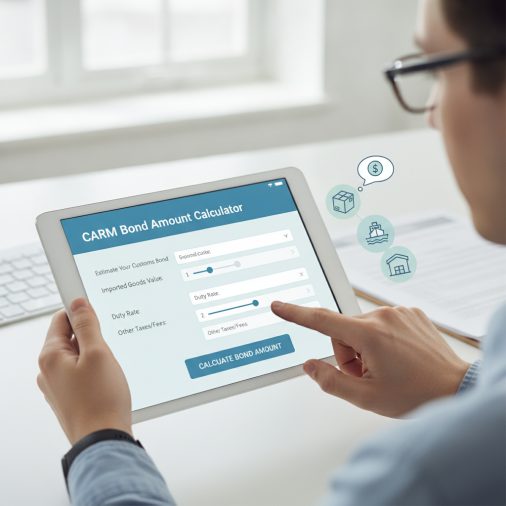
Follow these steps to get your CARM bond estimate:
- Enter your estimated annual duties and taxes in Canadian dollars. Include all customs duties, excise taxes, and any other CBSA-assessed charges you expect to pay in a 12-month period.
- Select your bond percentage tier based on your importer risk classification. New or elevated-risk importers typically use 100%, standard importers use 50%, and pre-approved low-risk importers may qualify for 25%.
- Choose the applicable minimum bond floor that matches your importer category as specified by CBSA.
- Adjust the surety bond surcharge rate to reflect quotes you have received from surety providers, or leave it at the default to see a typical mid-range estimate.
- Select your bond term to see the total surety premium cost over your coverage period.
- Indicate whether GST/HST is already included in your annual duties figure. If not, the calculator adds an estimated 5% to ensure your bond base covers total tax exposure.
- Review all six result fields to understand your required bond face value, annual premium, and multi-year cost.
Understanding the Calculator Inputs
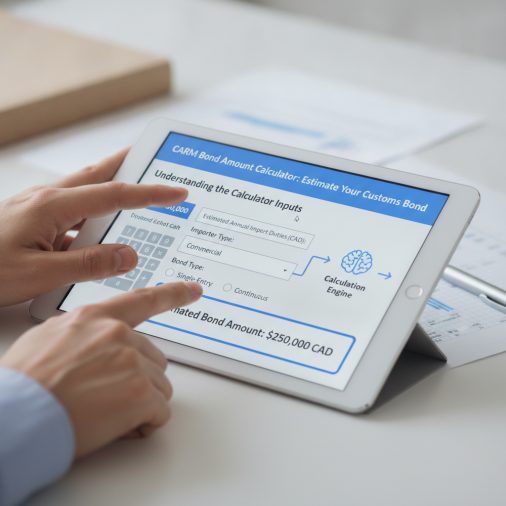
Estimated Annual Duties & Taxes (CAD): Enter the total amount of customs duties, GST/HST, excise taxes, and any other CBSA-assessed charges you expect to pay over a 12-month period. If you are a new importer without historical data, use your best projection based on the value of goods you plan to import and the applicable tariff rates. This is the single most important input because the bond face value is derived directly from it.
Bond Percentage of Annual Duties (%): Select the tier that reflects your CBSA importer risk classification. Standard importers with an established compliance history typically fall under the 50% tier. New importers or those with elevated risk profiles are generally assessed at 100%. Importers who have achieved a pre-approved low-risk status may qualify for the 25% tier. If you are unsure of your classification, select 50% as a conservative starting point and consult a licensed customs broker.
Minimum Bond Floor (CAD): CARM specifies minimum bond thresholds that apply regardless of the percentage calculation. The $25,000 standard minimum applies to most importers. Small importers with very low duty volumes may qualify for the $5,000 floor. High-volume importers may be subject to a $50,000 minimum. Select the floor that best matches your importer category. When in doubt, use the $25,000 standard minimum.
Surety Bond Surcharge Rate (%): This is the annual premium rate charged by a surety company to issue and hold the bond on your behalf. Rates typically range from 0.5% to 5% of the bond face value and depend on your credit profile, business history, and the surety provider’s assessment. Use the slider to input a rate from a quote you have received, or leave it at the 1.5% default for a mid-range planning estimate.
Bond Term (Years): Select how many years you want to model the bond coverage for. Choosing a multi-year term does not change the required bond face value but does show you the cumulative surety premium cost, which is useful for multi-year compliance budgeting and cash flow planning.
GST/HST Included in Annual Duties Figure?: CARM bonds must cover GST/HST in addition to customs duties. If the figure you entered already includes GST/HST, select Yes. If your figure covers only customs duties and excise taxes, select No and the calculator will add an estimated 5% federal GST to your base. Note that HST rates vary by province; this calculator uses the federal 5% GST rate as a conservative estimate.
Understanding Your Results
Adjusted Annual Duties & Taxes (CAD): This is your annual duty and tax figure after the GST/HST adjustment has been applied if needed. It represents the total CBSA liability base used for all subsequent bond calculations. If you selected that GST/HST is already included, this figure will equal your entered amount.
Calculated Bond Amount (Before Floor) (CAD): This is the raw bond amount produced by applying your selected risk-tier percentage to your adjusted annual duties and taxes. It shows what the bond would be based purely on the percentage formula, before any regulatory minimum floor is enforced.
Required Bond Amount (CAD): This is the most important result. It is the greater of the calculated bond amount and the minimum bond floor you selected. This figure represents the face value of the financial security you must post with CBSA under CARM. Use this number when requesting surety bond quotes or arranging a cash deposit.
Estimated Annual Surety Premium (CAD): This is the actual cash cost you pay each year to a surety company to maintain the bond. Unlike a cash deposit, you do not pay the full bond face value — you pay only this annual premium. This figure helps you budget your ongoing compliance costs.
Total Surety Premium Over Bond Term (CAD): This is the cumulative premium cost across your selected bond term. Use this figure to compare the cost of a surety bond against a cash deposit or letter of credit over the same period, and to plan multi-year compliance budgets.
Bond as % of Annual Import Costs: This ratio expresses the required bond face value as a percentage of your total adjusted annual duty and tax liability. When the minimum floor is the binding constraint, this percentage will exceed your selected bond percentage tier, giving you a clear signal that the floor — not the formula — is driving your bond requirement.
Calculation Formulas Explained
The calculator uses the following formulas, all expressed in Canadian dollars:
Step 1 — Adjusted Annual Duties: annual_duties * (1 + (1 – gst_hst_included) * 0.05). When gst_hst_included equals 1 (Yes), the multiplier becomes 1.00 and the figure is unchanged. When it equals 0 (No), the multiplier becomes 1.05, adding a 5% GST estimate to the base.
Step 2 — Calculated Bond Amount Before Floor: The adjusted annual duties are multiplied by the bond percentage divided by 100. For example, at 50%, the multiplier is 0.50, producing a bond equal to half the adjusted duty base.
Step 3 — Required Bond Amount: The max() function compares the calculated bond amount to the selected minimum bond floor and returns whichever is larger. This ensures the bond never falls below the regulatory minimum regardless of how low the duty base is.
Step 4 — Annual Surety Premium: The required bond amount is multiplied by the surcharge rate divided by 100. At a 1.5% rate on a $25,000 bond, the annual premium is $375.
Step 5 — Total Premium Over Term: The annual surety premium is multiplied by the number of years in the bond term to produce the cumulative cash cost.
Step 6 — Bond as % of Import Costs: The required bond amount is divided by the adjusted annual duties and multiplied by 100 to express the bond burden as a percentage. This will equal the selected bond percentage tier when the formula drives the result, or a higher percentage when the minimum floor is binding.
Worked Example
Scenario: A mid-sized Canadian importer expects to pay $80,000 in customs duties annually. GST/HST is not yet included in that figure. They are a standard importer (50% tier), subject to the $25,000 minimum floor, and have received a surety quote of 1.2%. They want to model a 2-year bond term.
- Adjusted Annual Duties: $80,000 * (1 + (1 – 0) * 0.05) = $80,000 * 1.05 = $84,000
- Calculated Bond Amount Before Floor: $84,000 * (50 / 100) = $84,000 * 0.50 = $42,000
- Required Bond Amount: max($42,000, $25,000) = $42,000 (the formula drives the result here, not the floor)
- Estimated Annual Surety Premium: $42,000 * (1.2 / 100) = $42,000 * 0.012 = $504.00 per year
- Total Surety Premium Over 2 Years: $504.00 * 2 = $1,008.00
- Bond as % of Annual Import Costs: ($42,000 / $84,000) * 100 = 50.00% — confirming the formula, not the floor, is the binding constraint.
This importer needs to arrange a $42,000 surety bond and budget approximately $504 per year in premium costs, totalling $1,008 over the two-year term.
How to Interpret the Results
When the Required Bond Amount equals the Calculated Bond Amount Before Floor, your duty volume is large enough that the percentage formula drives your bond requirement. This is the typical situation for established importers with significant annual duty liabilities.
When the Required Bond Amount is higher than the Calculated Bond Amount Before Floor, the minimum floor is the binding constraint. This commonly affects new importers or those with low duty volumes. In this case, the Bond as % of Annual Import Costs result will exceed your selected tier percentage, indicating that the floor imposes a proportionally larger burden on your operation.
A high Estimated Annual Surety Premium relative to your duty base may prompt you to explore whether a cash deposit is more cost-effective for your situation. Conversely, if your duty base is large and your surety rate is low, a surety bond is almost always cheaper than tying up cash in a deposit account.
If your Bond as % of Annual Import Costs result is significantly above 50% or 100% depending on your tier, review whether your annual duties estimate is accurate and whether you qualify for a lower risk tier through CBSA’s pre-approval programs.
Common Mistakes to Avoid
- Omitting GST/HST from the duty base: Many importers enter only customs duties and forget that CARM bonds must also cover GST/HST. Always use the GST/HST toggle to ensure your bond base is complete.
- Selecting the wrong risk tier: Defaulting to the 50% standard tier when CBSA has actually classified you as elevated risk (100%) will produce an underestimate. Confirm your classification with your customs broker before finalizing your bond amount.
- Using last year’s duty figures without adjustment: If your import volumes are growing, using historical data without a forward-looking adjustment will result in an undersized bond that may need to be increased mid-year.
- Ignoring the minimum floor: Small importers sometimes calculate a bond amount well below $25,000 and assume that is their requirement. The minimum floor always applies and can significantly increase the required bond for low-volume importers.
- Confusing bond face value with surety premium: The bond face value (Required Bond Amount) is not what you pay to the surety company. You pay only the annual premium, which is a small percentage of the face value. Confusing these two figures leads to significant budget errors.
- Not accounting for provincial HST: This calculator uses a flat 5% federal GST estimate. Importers in HST provinces may have a higher effective tax rate on certain goods, which could increase the accurate bond base beyond this estimate.
Limitations and Important Notes
This calculator is an independent planning estimator only and does not represent official guidance from the Canada Border Services Agency (CBSA) or the CARM Client Portal. The bond percentage tiers (25%, 50%, 100%) are illustrative of CARM’s risk-based framework; actual importer classification is determined solely by CBSA based on your compliance history and other factors.
The GST/HST adjustment uses a flat 5% federal rate. Actual rates may be higher in HST-participating provinces or for specific commodity categories. Surety premium rates of 0.5%–5% reflect typical market ranges and will vary by surety provider, your business credit profile, and the bond face value. Minimum bond floors used in this calculator are illustrative; importers must verify current CBSA minimums on the official CARM Client Portal, as these thresholds are subject to regulatory change.
This calculator does not account for cash deposit alternatives, letters of credit, or other security instruments accepted by CBSA, nor does it model partial-year bonds, mid-year adjustments, or bond top-up requirements. All monetary values are in Canadian dollars (CAD). Results should be reviewed with a licensed customs broker before submitting any bond or security instrument to CBSA.
Frequently Asked Questions
What is the minimum bond amount required under CARM?
The minimum bond amount under CARM depends on your importer category. Most importers are subject to a standard minimum of $25,000 CAD regardless of how low their calculated bond amount might be. Small importers with very limited duty volumes may qualify for a reduced minimum of $5,000, while high-volume importers may face a $50,000 floor. These thresholds are set by CBSA and are subject to change; always verify the current minimums on the official CARM Client Portal or with a licensed customs broker before arranging your security.
How does CBSA determine my importer risk tier for bond purposes?
CBSA assigns importer risk tiers based on a combination of factors including your compliance history, the length of time you have been importing, the nature and value of the goods you import, and any prior enforcement actions or audit findings. New importers with no established track record are typically placed in the higher 100% tier as a precautionary measure. Importers with a strong, consistent compliance record may qualify for the standard 50% tier, and those who have completed CBSA pre-approval programs may be eligible for the reduced 25% tier. Your customs broker can help you understand your likely classification and advise on steps to improve your risk profile over time.
Can I use a cash deposit instead of a surety bond for CARM?
Yes, CBSA accepts cash deposits as an alternative to surety bonds under CARM. With a cash deposit, you transfer the full bond face value directly to CBSA rather than paying an annual premium to a surety company. This approach eliminates the ongoing surety premium cost but ties up working capital equal to the full bond amount. For importers with a large required bond amount, a surety bond is usually more cost-effective because the annual premium is only a small fraction of the face value. However, for importers with very small bond requirements close to the minimum floor, the difference in cost may be negligible. A licensed customs broker or financial advisor can help you compare both options for your specific situation.
What happens if my import volumes increase and my bond is too low?
If your actual annual duties and taxes exceed the amount your bond was calculated on, CBSA may require you to increase your bond face value to maintain adequate security coverage. This can happen mid-year if your import activity grows significantly. An undersized bond can result in CBSA placing holds on your shipments or requiring additional security before releasing goods. To avoid disruption to your supply chain, it is good practice to review your bond amount annually and proactively request an increase from your surety provider if your duty base has grown materially since the bond was last set.
Is GST/HST included in the CARM bond calculation base?
Yes, CARM bonds are required to cover the full scope of amounts owed to CBSA, which includes both customs duties and GST/HST on imported goods. This is an important distinction because many importers initially think of their bond only in terms of customs duties. If you enter an annual duties figure that excludes GST/HST, this calculator adds an estimated 5% federal GST to ensure your bond base is more complete. Note that if you import goods into an HST-participating province, the applicable rate may be higher than 5%, so you should adjust your inputs accordingly or consult your customs broker for a more precise figure.
What is a surety bond and how does it differ from a bank guarantee?
A surety bond is a three-party agreement between you (the principal), a surety company (the guarantor), and CBSA (the obligee). The surety company guarantees to CBSA that it will pay up to the bond face value if you fail to meet your duty and tax obligations. You pay the surety company an annual premium for this guarantee but do not need to provide the full bond amount upfront. A bank guarantee, sometimes called a letter of credit, is issued by a financial institution and typically requires you to pledge collateral or maintain a corresponding deposit with the bank. Both instruments are generally accepted by CBSA, but surety bonds are more commonly used by importers because they do not require collateral and the premium cost is relatively low compared to tying up capital in a bank guarantee.
How often must I renew or review my CARM bond amount?
Surety bonds issued under CARM are typically annual instruments that must be renewed each year. At renewal, your surety provider will reassess your premium rate based on your current credit profile and any changes in your risk classification. Beyond the formal renewal cycle, CBSA may also require you to adjust your bond amount if your import volumes change materially. Best practice is to review your estimated annual duties and taxes at least once a year — ideally before your bond renewal date — and to update your bond face value if your duty base has increased by more than 10% to 15% since the bond was last set. Your customs broker can assist with the renewal process and advise on whether an adjustment is warranted.
What are the consequences of not having adequate security under CARM?
Failing to maintain adequate financial security under CARM can have serious operational consequences. CBSA has the authority to withhold release of your imported goods until appropriate security is in place, which can disrupt your supply chain and result in storage fees, missed delivery commitments, and customer dissatisfaction. In more serious cases, CBSA may suspend your import privileges or take enforcement action to recover unpaid duties and taxes. The CARM system is designed to give CBSA greater visibility into importer compliance in real time, making it more likely that security shortfalls will be identified quickly. Ensuring your bond is correctly sized from the outset — and reviewed regularly — is the most effective way to avoid these disruptions.