Use this car mileage calculator to instantly find your vehicle’s fuel efficiency, estimate how far you can drive on a full tank, and see exactly what your fuel costs per mile, per trip, or per month. Simply enter the distance you drove, the fuel you used, your tank size, and your local fuel price — the calculator handles the rest, giving you clear MPG or L/100 km figures alongside actionable cost breakdowns to help you budget smarter and drive more efficiently.
Car Mileage Calculator – MPG, Cost & Range Estimator
Calculate your car's fuel efficiency in MPG and L/100 km, estimate your full-tank driving range, and find your fuel cost per mile, per trip, and per month.
How to Use This Calculator

Follow these four steps to get accurate results from the calculator:
- Record a real fill-up: Fill your tank completely, reset your trip odometer, drive normally, then fill up again. Note the miles driven and the gallons pumped — these are your Distance Driven and Fuel Used inputs.
- Enter your tank size and fuel price: Check your owner’s manual or fuel-filler door for your tank capacity. Enter the current price per gallon at your local station.
- Set your planned trip distance and monthly miles: Type in an upcoming trip length and your typical monthly driving distance to get cost projections.
- Choose a driving condition: Select the option that best matches how you drive — highway, mixed, city, or severe — so the range and cost estimates reflect real-world conditions rather than ideal lab figures.
Understanding the Calculator Inputs
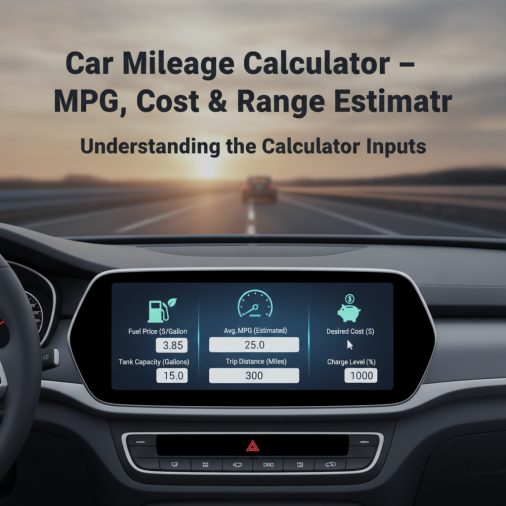
Distance Driven (miles): Enter the number of miles you covered between two complete fill-ups. The most accurate way to measure this is to reset your trip odometer the moment you fill up, then read it at your next fill-up. Avoid estimating from memory — even a 5% error in distance produces a 5% error in your MPG figure.
Fuel Used (gallons): Enter the number of gallons you pumped at your second fill-up, filling the tank to the brim both times. The pump receipt is the most reliable source. Do not include any fuel added mid-trip, as this will skew the calculation.
Full Tank Size (gallons): This is the total usable capacity of your fuel tank, found in your owner’s manual or on the inside of the fuel-filler door. Most passenger cars range from 10 to 20 gallons; trucks and SUVs can reach 30+ gallons. The calculator uses this figure to estimate your maximum driving range.
Fuel Price per Gallon ($/gal): Enter the price you paid or expect to pay per gallon. For road trip planning, use an average of prices along your route rather than your local price, since fuel costs vary by region and can shift daily.
Planned Trip Distance (miles): Type the total one-way or round-trip distance of a specific journey you are planning. The calculator will estimate how much fuel you will need and what it will cost at your entered fuel price.
Monthly Miles Driven (miles): Enter how many miles you typically drive in a month. The U.S. average is roughly 1,100 miles per month, but commuters and road-trip enthusiasts often drive significantly more. This input drives the monthly fuel cost projection.
Driving Condition Adjustment: This dropdown applies a real-world efficiency multiplier to your range and cost estimates. Ideal (highway) assumes steady-speed freeway driving with no adjustment. Mixed applies an 88% factor for typical suburban driving with some highway. Heavy city applies 75% for dense stop-and-go traffic. Severe applies 65% for mountain driving, extreme heat with constant AC, or towing. Choose the option that best matches the conditions for your trip or monthly driving pattern.
Understanding Your Results
Fuel Efficiency (MPG): Your measured miles per gallon based on the distance and fuel you entered. This is the most direct measure of how efficiently your car converts fuel into forward motion. A higher number means better efficiency and lower running costs.
Fuel Efficiency (L/100 km): The metric equivalent of your MPG, expressed as liters of fuel consumed per 100 kilometers traveled. Unlike MPG, a lower L/100 km value means better efficiency. This figure is standard in Canada, Australia, and most of Europe.
Estimated Full-Tank Range: The approximate number of miles you can travel on a completely full tank under your selected driving conditions. This accounts for your measured MPG, your tank capacity, and the efficiency factor you chose. Note that most manufacturers recommend not running the tank below about one-eighth full, so your practical range is slightly less than this figure.
Cost per Mile: The fuel cost of driving exactly one mile at your entered fuel price and measured MPG. This figure is useful for comparing vehicles, reimbursement calculations, and understanding the true cost of any drive regardless of length.
Estimated Trip Fuel Cost: The projected total fuel spend for your planned trip, adjusted for driving conditions. Use this to budget before a road trip or to compare the cost of driving versus other transport options.
Estimated Monthly Fuel Cost: Your projected monthly fuel expenditure based on your typical monthly mileage, adjusted MPG, and current fuel price. This is a powerful budgeting figure — small improvements in MPG or reductions in monthly miles can produce meaningful annual savings.
Calculation Formulas Explained
All six results flow from one core ratio: MPG = Distance Driven / Fuel Used. Every other formula builds on this ratio.
- MPG: distance_driven / fuel_used — divides miles traveled by gallons consumed. Units: miles per gallon.
- L/100 km: 235.214 / MPG — the constant 235.214 is derived from the exact conversion factor between miles, kilometers, gallons, and liters (235.21458…). Dividing this constant by MPG converts directly to liters per 100 kilometers.
- Full-Tank Range: tank_size * MPG * efficiency_factor — multiplies your tank capacity by your measured MPG to get the ideal range, then scales it down by the efficiency factor (a number between 0.65 and 1.0) to reflect real-world driving conditions.
- Cost per Mile: fuel_price / MPG — divides the price of one gallon by the number of miles that gallon covers. Result is in dollars per mile.
- Trip Fuel Cost: (trip_distance / (MPG * efficiency_factor)) * fuel_price — calculates how many gallons the trip requires under your driving conditions, then multiplies by the fuel price.
- Monthly Fuel Cost: (monthly_miles / (MPG * efficiency_factor)) * fuel_price — same logic as the trip cost but applied to your monthly mileage.
The efficiency_factor is a unitless multiplier. A value of 1.0 means no adjustment; 0.75 means the effective MPG for planning purposes is 75% of your measured highway figure. This is a general approximation, not a vehicle-specific engineering model.
Worked Example
Scenario: Sarah drives a mid-size sedan. She fills up, resets her odometer, and drives 350 miles before filling up again with 13.5 gallons. Her tank holds 16 gallons, fuel costs $3.80 per gallon, she has a 200-mile road trip planned, and she drives about 1,200 miles per month. She selects Mixed (city + highway) as her driving condition.
- MPG: 350 / 13.5 = 25.9 MPG
- L/100 km: 235.214 / 25.9 = 9.1 L/100 km
- Full-Tank Range: 16 * 25.9 * 0.88 = 16 * 22.8 = 365 miles
- Cost per Mile: 3.80 / 25.9 = $0.147 per mile
- Trip Fuel Cost: (200 / (25.9 * 0.88)) * 3.80 = (200 / 22.8) * 3.80 = 8.77 * 3.80 = $33.33
- Monthly Fuel Cost: (1200 / 22.8) * 3.80 = 52.6 * 3.80 = $199.89 per month
Sarah can see she gets just under 26 MPG, her 200-mile road trip will cost about $33, and she spends roughly $200 a month on fuel. If she improved her MPG to 28 by maintaining proper tire pressure and reducing highway speed, her monthly cost would drop to about $185 — saving over $180 per year.
How to Interpret the Results
What counts as good MPG? For a compact or mid-size car, 30+ MPG is considered efficient. SUVs and trucks typically range from 18 to 28 MPG. Anything below 20 MPG for a passenger car warrants attention. Compare your result to the EPA estimate for your vehicle’s make, model, and year — if you are more than 15% below the EPA figure, there may be a maintenance or driving-habit issue worth investigating.
L/100 km benchmarks: Under 6 L/100 km is excellent for a petrol car. Between 6 and 9 is average. Above 12 L/100 km for a standard passenger car suggests poor efficiency.
Cost per mile context: The IRS standard mileage rate (which covers fuel, depreciation, and maintenance) is typically around $0.67 per mile. Your fuel-only cost per mile should be well below this — if it is above $0.20 per mile on fuel alone, your vehicle’s efficiency is significantly below average for its class.
Monthly cost trends: If your monthly fuel cost feels high, consider whether your monthly mileage, fuel price, or MPG is the dominant driver. Reducing highway speed from 75 mph to 65 mph can improve fuel economy by 10–15%, which translates directly into lower monthly costs.
Range planning: Always plan to refuel before your estimated range is exhausted. Running a tank very low can damage fuel pumps on many modern vehicles and leaves no buffer for detours or closed stations.
Common Mistakes to Avoid
- Not filling to the brim both times: If the tank is not completely full at the start and end of your measurement, your fuel-used figure will be inaccurate, making your MPG calculation unreliable. Always click the pump handle to the first automatic shutoff.
- Using estimated distance: Relying on a rough guess of how far you drove instead of a trip odometer or GPS reading introduces significant error. Even a 10-mile error on a 200-mile trip is a 5% mistake.
- Ignoring driving conditions: Applying your highway MPG to a city commute will dramatically overestimate your range and underestimate your fuel costs. Always select the driving condition that matches your actual use case.
- Confusing MPG and L/100 km direction: Higher MPG is better; lower L/100 km is better. These metrics move in opposite directions, so do not compare them directly without converting.
- Using a single data point: One fill-up cycle can be skewed by unusual driving, a partial fill, or a faulty pump. For the most accurate MPG, average the results from three or more consecutive fill-up cycles.
- Forgetting that fuel price varies on long trips: Entering your local price for a cross-country trip will produce an inaccurate cost estimate if fuel is significantly cheaper or more expensive along your route.
Limitations and Important Notes
This calculator assumes your fuel efficiency is constant and equal to the MPG you measured during your recorded fill-up cycle. In reality, MPG varies with speed, load, temperature, wind, road gradient, and vehicle condition. The efficiency_factor multiplier is a general approximation based on broad driving condition categories and is not derived from your specific vehicle’s engineering data.
The full-tank range calculation assumes the tank starts completely full and does not account for a manufacturer-recommended reserve or the fuel gauge’s inherent inaccuracy. Practical range is typically 10–30 miles less than the calculated figure.
Fuel price is assumed constant throughout the trip. For long-distance travel, actual costs will vary by region. The L/100 km conversion uses the standard constant 235.214, which is accurate to five significant figures and introduces negligible rounding error for planning purposes.
Results are estimates intended for budgeting and planning only. They do not constitute mechanical advice, and significant deviations from your vehicle’s EPA rating should be evaluated by a qualified mechanic rather than addressed solely through driving-habit changes.
Frequently Asked Questions
How do I calculate my car's MPG manually?
To calculate MPG manually, fill your tank completely and reset your trip odometer to zero. Drive normally until you need to refuel, then fill the tank to the brim again and note exactly how many gallons you pumped. Divide the miles shown on your trip odometer by the gallons pumped. For example, if you drove 280 miles and used 11 gallons, your MPG is 280 / 11 = 25.5 MPG. For the most reliable result, repeat this process over three or more fill-up cycles and average the figures, since a single cycle can be skewed by pump variation or unusual driving conditions.
What is a good MPG for a car?
What counts as good MPG depends heavily on the vehicle class. For a compact or mid-size sedan, 30 MPG or above on a combined city/highway basis is considered efficient. Hybrid vehicles routinely achieve 45–55 MPG combined. SUVs and crossovers typically range from 22 to 32 MPG combined, while full-size trucks often fall between 16 and 24 MPG. As a general rule, if your vehicle’s real-world MPG is within 10% of its EPA combined estimate, it is performing normally. If it is more than 15–20% below the EPA figure, a maintenance check — covering tire pressure, air filter, spark plugs, and oxygen sensors — is worthwhile.
Why is my actual MPG lower than the EPA estimate?
EPA fuel economy estimates are produced under controlled laboratory conditions using a standardized drive cycle that does not fully replicate real-world driving. Common reasons your actual MPG falls short include driving at highway speeds above 65 mph (aerodynamic drag increases sharply with speed), frequent hard acceleration and braking, running the air conditioning in hot weather, carrying heavy loads or roof cargo, cold weather (which thickens engine oil and requires longer warm-up periods), under-inflated tires, and a clogged air filter or worn spark plugs. The EPA itself notes that real-world results typically run 15–20% below the tested figures for many drivers, which is why the calculator’s driving condition adjustment exists.
How does driving speed affect fuel efficiency?
Fuel efficiency peaks for most gasoline vehicles between approximately 45 and 60 mph. Above 60 mph, aerodynamic drag increases with the square of speed, meaning the engine must work disproportionately harder to maintain velocity. Driving at 75 mph instead of 65 mph typically reduces fuel economy by 10–15%, and driving at 80 mph can cut it by 20% or more compared to 65 mph. Below 45 mph, stop-and-go patterns and frequent idling reduce efficiency in a different way — the engine runs but the vehicle covers little distance. Smooth, steady driving at moderate highway speeds is the single most effective habit for maximizing MPG.
Does air conditioning significantly reduce mileage?
Yes, air conditioning can reduce fuel economy by 5–25% depending on the outside temperature, humidity, vehicle size, and how hard the AC system is working. At low speeds in stop-and-go traffic on a hot day, the impact is at the higher end of that range because the AC compressor draws a relatively large share of the engine’s total output. At steady highway speeds, the impact is smaller — typically 5–10% — because the engine is producing much more power overall. The calculator’s Severe driving condition option (65% efficiency factor) is designed to capture scenarios that combine mountains or towing with heavy AC use.
How do I convert MPG to L/100 km?
The conversion formula is: L/100 km = 235.214 / MPG. The constant 235.214 comes from combining the number of kilometers per mile (1.60934) with the number of liters per gallon (3.78541), scaled to a 100 km base. For example, 25 MPG converts to 235.214 / 25 = 9.4 L/100 km. To go the other direction — from L/100 km to MPG — use the same formula: MPG = 235.214 / (L/100 km). So a car rated at 7 L/100 km achieves 235.214 / 7 = 33.6 MPG. This calculator performs both conversions automatically from your distance and fuel inputs.
How far can I drive on a full tank?
Your estimated full-tank range equals your tank capacity multiplied by your MPG, then adjusted for driving conditions. For example, a 15-gallon tank in a car achieving 28 MPG gives a theoretical range of 420 miles under ideal highway conditions. Under mixed city and highway driving (88% efficiency factor), that drops to about 370 miles. In practice, most drivers plan to refuel when the gauge reaches one-quarter tank, which reduces the usable range by roughly 25%. Always treat the calculator’s range figure as a planning ceiling rather than a target to reach, since running a modern fuel-injected engine very low on fuel can damage the fuel pump.
Does tire pressure affect fuel economy?
Yes, tire pressure has a measurable effect on fuel economy. Under-inflated tires increase rolling resistance — the force the engine must overcome to keep the vehicle moving — which raises fuel consumption. The U.S. Department of Energy estimates that for every 1 PSI drop in pressure across all four tires, fuel economy decreases by approximately 0.2%. A tire that is 10 PSI under-inflated therefore costs about 2% in fuel economy, which may seem small but adds up over thousands of miles. Checking and correcting tire pressure monthly to the vehicle manufacturer’s recommended level (found on the door jamb sticker, not the tire sidewall) is one of the easiest and cheapest ways to maintain your car’s rated fuel efficiency.