Use this car loan interest rate calculator to instantly see your estimated monthly payment, total interest charges, and overall loan cost before you sign anything. Enter your vehicle price, down payment, annual interest rate, and loan term to get a clear breakdown of what you will actually pay over the life of the loan. Comparing even a half-percent difference in interest rates can save hundreds of dollars, so run multiple scenarios to find the most affordable financing option for your budget.
Car Loan Interest Rate Calculator: Monthly Payment & Total Cost
Calculate your monthly car loan payment, total interest paid, and full financing cost based on vehicle price, APR, loan term, down payment, trade-in value, and sales tax.
How to Use This Calculator
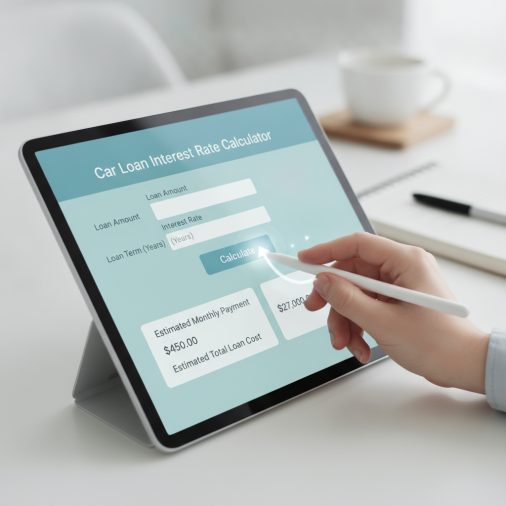
Follow these steps to get accurate results from the calculator:
- Enter the vehicle price — use the agreed purchase price or sticker price before any discounts are applied separately.
- Enter your down payment — the cash amount you plan to pay upfront at signing.
- Enter your trade-in value — the credit your dealer is offering for your current vehicle; enter 0 if you have no trade-in.
- Set the annual interest rate (APR) — use the rate quoted by your lender or dealer; drag the slider to compare scenarios.
- Select your loan term — choose the number of months you plan to finance the vehicle.
- Set the sales tax rate — enter your local combined sales tax percentage; this is added to the vehicle price before financing.
- Read your results — the calculator instantly shows your loan principal, monthly payment, total amount paid, total interest, full out-of-pocket cost, and interest as a percentage of the vehicle price.
Understanding the Calculator Inputs
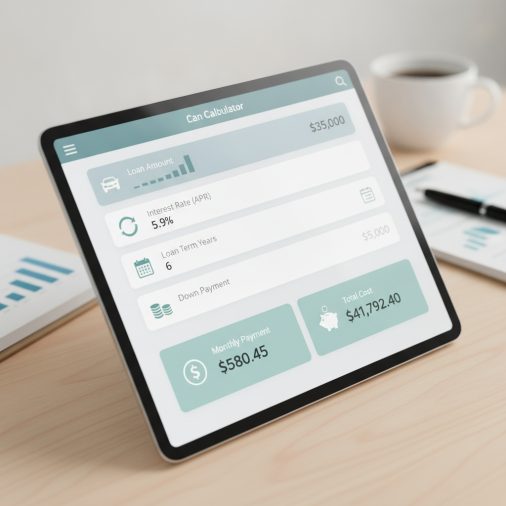
Vehicle Price ($): Enter the full agreed purchase price of the vehicle. This is the number on the window sticker or the price you have negotiated with the dealer before any financing adjustments. Do not subtract your down payment here — that is handled separately. The calculator applies sales tax to this figure first, which is the standard method used in most U.S. states.
Down Payment ($): Enter the cash amount you will pay at the time of signing. A larger down payment directly reduces the loan principal, which lowers both your monthly payment and the total interest you will pay. Financial advisors commonly suggest putting down at least 10–20% of the vehicle price to avoid being underwater on the loan early in the term.
Trade-In Value ($): If you are trading in a current vehicle, enter the credit amount your dealer has offered. This is treated as a direct reduction of the financed amount, similar to a down payment. If you are selling your car privately or have no trade-in, leave this field at 0.
Annual Interest Rate / APR (%): Enter the annual percentage rate quoted by your lender. Use the slider to quickly compare how different rates affect your payment. Even a 0.5% difference on a $25,000 loan over 60 months changes your total interest by roughly $350. If you have not yet received a rate quote, use average rates for your credit tier as a planning estimate.
Loan Term (months): Select the number of months over which you will repay the loan. Common terms range from 36 to 72 months. Shorter terms mean higher monthly payments but significantly less total interest. Longer terms reduce the monthly burden but increase the total cost of borrowing and raise the risk of negative equity.
Sales Tax Rate (%): Enter your combined state and local sales tax rate for vehicle purchases. In most states, sales tax is calculated on the full vehicle price before your down payment or trade-in is deducted, and the tax amount is typically rolled into the financed amount. Check your state’s DMV or revenue department website for the exact rate in your county.
Understanding Your Results
Loan Principal (Amount Financed): This is the net dollar amount you are actually borrowing. It equals the tax-inclusive vehicle price minus your down payment and trade-in credit. This is the figure on which interest accrues, so reducing it through a larger down payment or trade-in has a compounding benefit over the life of the loan.
Monthly Payment: This is the fixed amount due each month for the duration of the loan term, calculated using the standard amortizing loan formula. Early payments are weighted heavily toward interest; later payments pay down more principal. This figure assumes no missed payments, no prepayments, and a fixed interest rate throughout the term.
Total Amount Paid: This is the sum of all monthly payments over the full loan term. It represents the total cash outflow to your lender and does not include your upfront down payment or trade-in credit. Comparing this figure across different loan terms and rates is one of the most useful exercises this calculator enables.
Total Interest Paid: This is the difference between the total amount paid and the original loan principal — the pure cost of borrowing money. It is the figure most sensitive to changes in APR and loan term length. Reducing your APR by even 1–2 percentage points or shortening your term by 12 months can cut this number substantially.
Total Out-of-Pocket Cost: This combines your down payment, trade-in credit applied, and all loan payments into a single number representing the complete economic cost of acquiring the vehicle through financing. Use this figure when comparing the true cost of financing versus paying cash, or when comparing two different vehicles at different price points.
Interest as % of Vehicle Price: This ratio expresses total interest paid as a percentage of the original vehicle price, giving you an intuitive benchmark. If this figure exceeds 15–20%, it is a strong signal to consider a shorter loan term, a larger down payment, or negotiating a lower APR before committing to the loan.
Calculation Formulas Explained
All results use the standard amortizing loan payment formula, which is the same method banks and credit unions use to calculate fixed monthly payments on installment loans.
The loan principal is calculated as:
Principal = (Vehicle Price × (1 + Sales Tax Rate / 100)) − Down Payment − Trade-In Value
Sales tax is divided by 100 to convert the percentage to a decimal, then added to 1 and multiplied by the vehicle price to produce the tax-inclusive cost before deductions.
The monthly payment uses the standard amortization formula:
Monthly Payment = P × (r × (1 + r)^n) / ((1 + r)^n − 1)
Where P is the loan principal, r is the monthly interest rate (APR divided by 1200, converting annual percent to a monthly decimal), and n is the number of monthly payments (loan term in months). The pow() function raises the base to the exponent.
The total amount paid is simply the monthly payment multiplied by the number of months in the loan term.
The total interest paid is the total amount paid minus the original loan principal — the excess above what was borrowed.
The total out-of-pocket cost adds the down payment and trade-in value back to the total amount paid, representing the full financial commitment including upfront costs.
The interest as % of vehicle price divides total interest paid by the original vehicle price and multiplies by 100 to express the result as a percentage, providing a normalized benchmark independent of loan size.
Worked Example
Scenario: You are buying a used SUV priced at $28,000. You plan to put down $4,000 cash and trade in your current car for $2,500. The dealer quotes you an APR of 7.5% on a 60-month loan. Your state sales tax rate is 6%.
Step 1 — Tax-inclusive vehicle price: $28,000 × (1 + 6/100) = $28,000 × 1.06 = $29,680
Step 2 — Loan principal: $29,680 − $4,000 − $2,500 = $23,180
Step 3 — Monthly interest rate: 7.5 / 1200 = 0.00625
Step 4 — Monthly payment numerator: $23,180 × (0.00625 × (1.00625)^60) = $23,180 × (0.00625 × 1.45410) = $23,180 × 0.009088 = $210.66
Step 5 — Monthly payment denominator: (1.00625)^60 − 1 = 1.45410 − 1 = 0.45410
Step 6 — Monthly payment: $210.66 / 0.45410 = $463.82 per month
Step 7 — Total amount paid: $463.82 × 60 = $27,829.20
Step 8 — Total interest paid: $27,829.20 − $23,180 = $4,649.20
Step 9 — Total out-of-pocket cost: $27,829.20 + $4,000 + $2,500 = $34,329.20
Step 10 — Interest as % of vehicle price: $4,649.20 / $28,000 × 100 = 16.60%
This result is near the 15–20% caution threshold, suggesting that increasing the down payment or negotiating the APR down to 6.5% would meaningfully reduce the total cost.
How to Interpret the Results
When reading your results, focus on total interest paid and interest as % of vehicle price rather than just the monthly payment. Dealers often emphasize the monthly payment because it feels manageable, but stretching a loan to 72 or 84 months to lower the monthly figure can double the total interest compared to a 48-month term at the same rate.
A useful rule of thumb: if your interest as % of vehicle price result is below 10%, your financing terms are generally favorable. Between 10–20% is common and acceptable for longer terms or moderate credit. Above 20% is a signal to shop for a better rate, increase your down payment, or shorten the loan term before signing.
Compare your monthly payment against the widely cited guideline that total vehicle expenses — including insurance, fuel, and maintenance — should not exceed 15–20% of your monthly take-home pay. The monthly payment alone should ideally stay under 10–15% of your net monthly income to leave room for those additional ownership costs.
Run the calculator at least three times: once with your current quoted rate, once with a rate 1% lower (representing what you might get from a credit union or with a better credit score), and once with a shorter loan term. The difference in total interest across these scenarios often reveals thousands of dollars in potential savings.
Common Mistakes to Avoid
- Focusing only on the monthly payment: A lower monthly payment achieved by extending the loan term almost always means paying significantly more total interest. Always check the total interest paid result alongside the monthly figure.
- Forgetting sales tax: In most states, sales tax is added to the vehicle price and financed along with it. Omitting this from your calculation can underestimate your actual loan principal by thousands of dollars.
- Not accounting for fees: Dealer documentation fees, title fees, registration costs, and add-ons like GAP insurance or extended warranties are often rolled into the loan. This calculator does not include those fees — add them to the vehicle price field if your dealer is financing them.
- Using the interest rate instead of the APR: The APR includes certain lender fees and is always equal to or higher than the stated interest rate. Always use the APR for the most accurate cost comparison between lenders.
- Assuming the dealer’s rate is the best available: Dealers mark up the interest rate they receive from lenders, sometimes by 1–2 percentage points. Getting pre-approved through your bank or credit union before visiting the dealership gives you a benchmark rate to negotiate against.
- Overvaluing the trade-in without verification: Dealer trade-in offers vary widely. Check independent valuation sources before entering your trade-in value to ensure you are not underestimating your vehicle’s worth.
Limitations and Important Notes
This calculator assumes a fixed interest rate for the entire loan term. Variable-rate auto loans exist but are uncommon; if your loan has a variable rate, results will only be accurate for the initial rate period.
Sales tax is calculated on the full vehicle price before down payment and trade-in deductions, which is the standard method in most U.S. states. A minority of states allow the trade-in value to be deducted before tax is applied. Check your state’s specific rules for precise figures.
The calculator does not include dealer documentation fees, title and registration fees, origination fees, GAP insurance premiums, extended warranty costs, or any other add-ons that may be rolled into your actual loan. Add these to the vehicle price field if they will be financed.
Results assume standard monthly amortization with no prepayments. Making extra principal payments will reduce your total interest below the calculated figure, but this calculator does not model prepayment scenarios.
A minimum loan principal of $1 is assumed to be meaningful. If your combined down payment and trade-in value exceeds the tax-inclusive vehicle price, the results will not reflect a realistic financing scenario.
All results are estimates for planning and comparison purposes only. They do not constitute a loan offer, a guarantee of financing terms, or financial advice. Consult your lender for exact payment figures and review all loan documents carefully before signing.
Frequently Asked Questions
What is the difference between APR and interest rate on a car loan?
The interest rate is the base cost of borrowing expressed as an annual percentage of the loan principal. The APR (Annual Percentage Rate) is a broader measure that includes the interest rate plus certain lender fees and charges, expressed as a single annualized figure. On auto loans, the APR is always equal to or slightly higher than the stated interest rate. When comparing loan offers from different lenders, always compare APRs rather than interest rates alone, because the APR reflects the true cost of the loan more accurately. This calculator uses APR as its input for the most realistic cost estimates.
What credit score do I need to get the best car loan interest rate?
Lenders typically reserve their lowest advertised rates — often called prime or super-prime rates — for borrowers with credit scores of 720 or higher, and the very best rates generally require scores above 750–780. Borrowers in the 660–719 range (near-prime) typically qualify for rates a few percentage points higher, while subprime borrowers below 620 may face rates two to three times the prime rate or higher. Improving your credit score before applying — by paying down revolving balances, correcting errors on your credit report, and avoiding new credit inquiries — can meaningfully lower your APR and save hundreds or thousands of dollars over the loan term.
Is it better to finance through a dealership or my own bank or credit union?
Both options have advantages. Dealer financing is convenient and sometimes includes manufacturer-subsidized promotional rates (such as 0% APR offers on new vehicles) that you cannot get elsewhere. However, dealers also act as intermediaries between you and the actual lender, and they are permitted to mark up the rate above what the lender quoted — a practice called the dealer reserve. Bank and credit union financing gives you a direct rate with no markup, and credit unions in particular often offer lower rates than banks for members with good credit. The best strategy is to get pre-approved through your own financial institution before visiting the dealership, then use that rate as a negotiating baseline against any dealer financing offer.
How does a larger down payment affect my interest rate and monthly payment?
A larger down payment reduces your loan principal — the amount you actually borrow — which directly lowers your monthly payment and the total interest you pay over the life of the loan. It does not automatically lower your APR, since the interest rate is set by the lender based on your creditworthiness and market conditions. However, a lower loan-to-value ratio (the loan amount relative to the vehicle’s value) can sometimes help you qualify for a slightly better rate with certain lenders, because it reduces their risk. Additionally, a larger down payment reduces the risk of negative equity, meaning you are less likely to owe more than the car is worth if its value depreciates quickly in the first year or two.
Should I choose a 60-month or 72-month loan term?
The right choice depends on your budget and financial priorities. A 60-month term results in a higher monthly payment than 72 months but significantly less total interest paid — often $1,000–$2,500 less on a typical mid-size vehicle loan, depending on the rate. A 72-month term lowers the monthly payment, which can help cash flow, but you will pay more interest overall and spend a longer period at risk of negative equity as the vehicle depreciates. As a general guideline, financial planners often recommend keeping auto loan terms at 60 months or fewer for new vehicles and 48 months or fewer for used vehicles, where depreciation risk is higher. Use this calculator to compare the total interest paid across both terms before deciding.
What happens if I pay off my car loan early — are there prepayment penalties?
Most modern auto loans in the United States do not carry prepayment penalties, meaning you can pay off the loan early without any additional fees. Paying extra principal each month or making a lump-sum payment reduces the outstanding balance faster, which means less interest accrues over the remaining term and you pay off the loan ahead of schedule. However, some lenders — particularly those offering subprime loans — do include prepayment penalty clauses, so always read your loan agreement carefully before signing. If early payoff is part of your financial plan, confirm with the lender that no penalty applies before committing to that loan.
How do I calculate how much car I can afford based on my monthly budget?
A common budgeting guideline suggests that your total monthly vehicle expenses — including the loan payment, insurance, fuel, and estimated maintenance — should not exceed 15–20% of your monthly take-home pay. For the loan payment alone, staying under 10–15% of net monthly income is a reasonable target. To work backward from a budget: decide the maximum monthly payment you can comfortably afford, then use this calculator to find the vehicle price and loan term combination that produces that payment at your expected APR. For example, if you can afford $400 per month at 7% APR over 60 months, your maximum loan principal is approximately $20,200. Add your down payment and trade-in to find your total vehicle budget.
Can I negotiate the interest rate on a car loan?
Yes — auto loan interest rates are negotiable, particularly when financing through a dealership. Dealers receive a buy rate from the lender and are often permitted to mark it up by 1–2.5 percentage points, keeping the difference as profit. If you arrive with a pre-approval from your bank or credit union, you have a concrete rate to compare against the dealer’s offer and a strong negotiating position. You can ask the dealer’s finance office to beat your pre-approved rate. Even a 1% reduction in APR on a $25,000 loan over 60 months saves approximately $650 in total interest. Manufacturer-sponsored financing promotions on new vehicles sometimes offer rates below what any outside lender can match, so compare both options before deciding.