Use this car loan interest calculator to instantly see your estimated monthly payment, total interest charges, and the full cost of financing your vehicle. Enter the loan amount, annual interest rate, and repayment term, then adjust the down payment and any trade-in value to reflect your real purchase scenario. Whether you are buying new or used, comparing dealer financing versus a bank offer, or planning a refinance, these results give you the numbers you need to negotiate confidently and budget accurately.
Car Loan Interest Calculator: Monthly Payment & Total Cost
Calculate your estimated monthly car loan payment, total interest paid, and full financing cost based on vehicle price, APR, loan term, down payment, trade-in value, and sales tax.
How to Use This Calculator
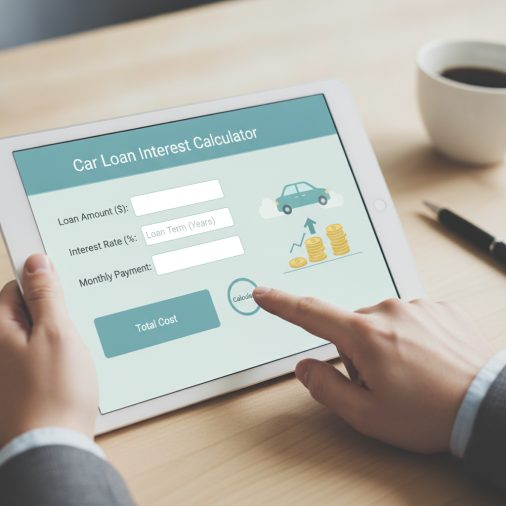
Follow these steps to get accurate results from the calculator:
- Enter the vehicle price — type the agreed purchase price or sticker price of the car before any discounts are applied at the lender level.
- Enter your down payment — include any cash you plan to pay upfront at signing. A larger down payment reduces the amount you borrow and the interest you pay.
- Enter your trade-in value — if you are trading in a vehicle, enter its estimated value. This offsets the purchase price just like a down payment.
- Set the annual interest rate (APR) — drag the slider to match the APR quoted by your lender or dealer. Check your pre-approval letter or use current average rates as a benchmark.
- Select the loan term — choose the repayment period in months. Shorter terms mean higher monthly payments but less total interest; longer terms lower the monthly payment but increase total cost.
- Set the sales tax rate — enter your local combined sales tax rate. In most US states, sales tax is financed as part of the loan principal.
- Review your results — the calculator instantly displays your loan principal, monthly payment, total amount paid, total interest, interest as a percentage of vehicle price, and total ownership cost.
Understanding the Calculator Inputs
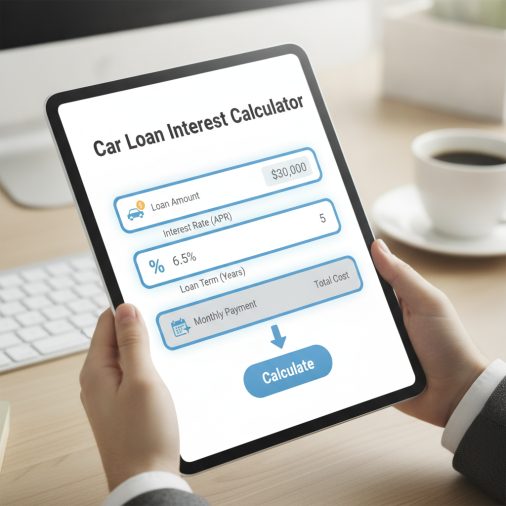
Vehicle Price ($): Enter the full agreed purchase price of the car — the number on the window sticker or the price you have negotiated with the dealer. Do not subtract your down payment here; that is handled separately. If you are buying privately, use the agreed sale price. The calculator applies sales tax to this figure before subtracting your down payment and trade-in, which matches the tax treatment used in most US states.
Down Payment ($): Enter the cash amount you will pay at signing. This is money you contribute directly from your pocket and is not financed. A higher down payment reduces your loan principal, which lowers both your monthly payment and the total interest you pay over the life of the loan. Financial planners commonly suggest a down payment of at least 10–20% of the vehicle price.
Trade-In Value ($): If you are trading in your current vehicle, enter its estimated value. Dealers typically apply the trade-in as a credit against the purchase price, reducing the amount you need to finance. You can get a free estimate from services like Kelley Blue Book or CarMax before visiting the dealership. Leave this field at zero if you are not trading in a vehicle.
Annual Interest Rate / APR (%): Drag the slider to the APR shown on your loan pre-approval, dealer quote, or bank offer. APR stands for Annual Percentage Rate and represents the yearly cost of borrowing expressed as a percentage. For planning purposes, use the rate from your most recent pre-approval or check published average rates for your credit tier. Even a half-point difference in APR can meaningfully change your total interest paid on a multi-year loan.
Loan Term (months): Select the repayment period from the dropdown. Common terms range from 36 months (3 years) to 84 months (7 years). Shorter terms produce higher monthly payments but dramatically reduce total interest. Longer terms lower the monthly payment but increase the total cost of the loan and can leave you owing more than the car is worth — a situation called being underwater or upside-down on the loan.
Sales Tax Rate (%): Enter your combined state and local sales tax rate for vehicle purchases. In most US states, sales tax on a vehicle purchase is added to the financed amount rather than paid separately at the time of sale. Rates vary widely — from 0% in states like Oregon and Montana to over 10% in some localities. Check your state’s department of motor vehicles or revenue website for the exact rate in your county or city.
Understanding Your Results
Loan Principal (Amount Financed): This is the actual dollar amount you are borrowing from the lender. It equals the vehicle price minus your down payment and trade-in value, with estimated sales tax added back. This is the balance on which interest accrues every month. Reducing this number — through a larger down payment or higher trade-in credit — is the most direct way to cut your total interest cost.
Monthly Payment: This is the fixed amount you will owe the lender each month for the duration of the loan term. It is calculated using the standard amortizing loan formula, meaning each payment covers the interest that accrued during that period first, with the remainder applied to reducing the principal. Early payments are weighted more heavily toward interest; later payments pay down more principal.
Total Amount Paid: This is the sum of all monthly payments over the entire loan term. It represents the total cash you will send to the lender, not counting your upfront down payment or trade-in. Comparing this figure across different loan terms and APRs is one of the clearest ways to evaluate financing options.
Total Interest Paid: This is the total amount paid minus the original loan principal. It is the true dollar cost of borrowing — the premium you pay the lender for the privilege of spreading the purchase over time. This figure is often surprising to first-time buyers and underscores why APR and loan term are such important negotiating points.
Interest as % of Vehicle Price: This metric expresses total interest paid as a percentage of the original vehicle price, giving you an intuitive sense of financing overhead. For example, a result of 12% means you are effectively paying 12 cents in interest for every dollar the car costs. This is useful for comparing financing scenarios on vehicles of different prices.
Total Cost of Ownership (Financed): This is the most comprehensive cost figure the calculator produces. It adds your total loan payments to the upfront cash you contributed (down payment plus trade-in value), representing the complete financial commitment required to acquire the vehicle through financing. Use this number when comparing the true cost of buying versus leasing, or when evaluating two vehicles at different price points.
Calculation Formulas Explained
The calculator uses the standard amortizing loan payment formula, which is the same method used by banks, credit unions, and auto lenders worldwide. Here is how each piece works:
Step 1 — Loan Principal: The financed amount is calculated as (Vehicle Price − Down Payment − Trade-In Value) × (1 + Sales Tax Rate / 100). Sales tax is applied to the full vehicle price first, then the down payment and trade-in are subtracted. This matches the tax treatment in most US states where tax is assessed on the full sale price.
Step 2 — Monthly Interest Rate: The APR is divided by 1,200 to convert the annual percentage rate into a monthly decimal rate. For example, a 6.5% APR becomes 6.5 / 1200 = 0.005417 per month.
Step 3 — Monthly Payment Formula: The payment is calculated as P × (r × (1 + r)^n) / ((1 + r)^n − 1), where P is the loan principal, r is the monthly interest rate, and n is the number of monthly payments (loan term in months). The pow() function handles the exponentiation. This formula produces a fixed payment that fully amortizes the loan — meaning the balance reaches exactly zero at the final payment.
Step 4 — Total Amount Paid: Monthly payment multiplied by the number of months in the loan term.
Step 5 — Total Interest Paid: Total amount paid minus the original loan principal. This isolates the cost of borrowing from the cost of the vehicle itself.
Note on 0% APR: When the interest rate is exactly zero, the standard formula produces a division-by-zero condition. For 0% financing scenarios, enter 0.1% as an approximation; the result will be negligibly different from a true zero-interest calculation.
Worked Example
Scenario: You are buying a used SUV priced at $28,000. You have $4,000 saved for a down payment and a trade-in vehicle worth $2,500. Your credit union has pre-approved you at 6.0% APR for 60 months. Your state sales tax rate is 6.5%.
Step 1 — Net price before tax: $28,000 − $4,000 − $2,500 = $21,500
Step 2 — Add sales tax: $21,500 × (1 + 0.065) = $21,500 × 1.065 = $22,897.50 loan principal
Step 3 — Monthly interest rate: 6.0 / 1200 = 0.005 per month
Step 4 — Monthly payment: $22,897.50 × (0.005 × pow(1.005, 60)) / (pow(1.005, 60) − 1) = $22,897.50 × (0.005 × 1.34885) / (1.34885 − 1) = $22,897.50 × 0.006744 / 0.34885 = $22,897.50 × 0.019333 ≈ $442.71 per month
Step 5 — Total amount paid: $442.71 × 60 = $26,562.60
Step 6 — Total interest paid: $26,562.60 − $22,897.50 = $3,665.10
Step 7 — Interest as % of vehicle price: $3,665.10 / $28,000 × 100 = 13.09%
Step 8 — Total cost of ownership: $26,562.60 + $4,000 + $2,500 = $33,062.60
This means the $28,000 SUV ultimately costs you $33,062.60 in total cash outflows when you include your upfront contributions and all loan payments.
How to Interpret the Results
Monthly Payment: A general rule of thumb is that your total monthly vehicle expenses — payment, insurance, and fuel — should not exceed 15–20% of your monthly take-home pay. If the monthly payment result pushes you above that threshold, consider a larger down payment, a longer term, or a less expensive vehicle.
Total Interest Paid: For a typical 5-year loan at moderate APRs, total interest of 8–15% of the vehicle price is common. If your interest-as-a-percentage result is above 20%, you are either carrying a high APR, a long loan term, or both. This is a signal to shop for a better rate or shorten the term if your budget allows.
Loan Term Comparison: Run the calculator twice — once with a 60-month term and once with a 72-month term — to see the trade-off. The 72-month option will show a lower monthly payment but a noticeably higher total interest figure. That difference is the real cost of the extra convenience.
Total Cost of Ownership: Compare this figure to the vehicle’s expected market value at the end of the loan term. If the total cost significantly exceeds the projected resale value, the vehicle may not represent strong financial value, especially for rapidly depreciating models.
Underwater Risk: If your loan principal is close to or exceeds the vehicle’s market value from day one — which can happen with small down payments and high sales tax — you are immediately at risk of being underwater. In this situation, GAP insurance becomes especially worth considering.
Common Mistakes to Avoid
- Confusing APR with the interest rate: Some lenders quote a base interest rate and a separate APR that includes fees. Always use the APR for this calculator, as it reflects the true annual cost of the loan under US Regulation Z disclosure rules.
- Forgetting sales tax: Many buyers focus on the negotiated vehicle price and forget that sales tax — often 6–10% — is added to the financed amount. This can add thousands of dollars to the loan principal and meaningfully increase monthly payments.
- Not accounting for fees in the vehicle price: Documentation fees, dealer prep fees, and title fees are often rolled into the financed amount. If your lender includes these in the loan, add them to the vehicle price field for a more accurate result.
- Assuming the dealer’s rate is the best available: Dealer financing is convenient but not always the cheapest option. Getting a pre-approval from a bank or credit union before visiting the dealership gives you a benchmark rate to negotiate against.
- Choosing the longest term to minimize monthly payments: Extending the loan to 72 or 84 months dramatically increases total interest paid and increases the risk of being underwater on the loan. Always compare the total interest figure, not just the monthly payment.
- Overestimating trade-in value: Dealer trade-in offers are typically lower than private-sale values. Using an inflated trade-in estimate will make the calculator results look more favorable than your actual financing scenario.
Limitations and Important Notes
This calculator provides estimates for planning and comparison purposes only and does not constitute a loan offer, financial advice, or guarantee of any specific rate or payment. Actual loan terms are determined by your lender based on your credit profile, the vehicle, and current market conditions.
The following assumptions are built into the calculations: (1) Sales tax is applied to the full vehicle price before subtracting the down payment and trade-in, which is the rule in most US states — some states tax only the difference, so verify your local rules. (2) The APR is treated as a nominal rate compounded monthly (APR divided by 12 per period), consistent with standard US auto loan disclosures. (3) No origination fees, documentation fees, GAP insurance premiums, or extended warranty costs are included unless you manually add them to the vehicle price field. (4) The loan is assumed to carry a fixed interest rate for the entire term; adjustable-rate auto loans are not modeled. (5) Trade-in value is applied as a straightforward price reduction with no additional tax credit implications. (6) At exactly 0% APR, the formula may produce a mathematical error; enter 0.1% as a close approximation for zero-interest financing scenarios.
Frequently Asked Questions
What is a good interest rate for a car loan right now?
Auto loan rates vary based on your credit score, the lender, the vehicle type (new vs. used), and broader economic conditions. As a general benchmark, borrowers with excellent credit (scores above 720) have historically qualified for new-car rates in the 5–7% APR range during moderate-rate environments, while used-car rates tend to run 1–3 percentage points higher due to greater collateral risk. Borrowers with fair credit (scores in the 580–669 range) may see rates of 10–15% or more. The best way to know what rate is available to you is to get pre-approved by at least two or three lenders — a bank, a credit union, and an online lender — before visiting a dealership. Credit unions in particular often offer rates below the national average for their members.
How does my credit score affect my car loan APR?
Your credit score is the single most influential factor in the APR a lender will offer you. Lenders use credit tiers — often labeled super prime, prime, near prime, subprime, and deep subprime — to assign risk-based pricing. Moving from a subprime score (below 580) to a prime score (above 660) can reduce your APR by 5–10 percentage points, which translates to thousands of dollars in savings over a 60-month loan. If your score is below your target, it may be worth delaying the purchase by 6–12 months to pay down existing debt, correct any errors on your credit report, and avoid new credit inquiries. Even a 20-point improvement in your score can move you into a lower rate tier.
Is it better to put more money down on a car loan?
In most cases, yes. A larger down payment reduces your loan principal, which lowers both your monthly payment and the total interest you pay over the life of the loan. It also reduces the risk of being underwater — owing more than the car is worth — which is a common problem in the first two years of a loan when depreciation is steepest. A down payment of 10–20% of the vehicle price is a widely cited guideline. That said, if putting more money down would drain your emergency fund or prevent you from paying off higher-interest debt, the math may favor a smaller down payment. Use the calculator to compare scenarios and weigh the interest savings against your overall financial picture.
What happens if I pay extra on my car loan each month?
Making extra principal payments reduces your outstanding balance faster, which means less interest accrues in subsequent months. Over time, this can shorten your loan term and save a meaningful amount in total interest. For example, paying an extra $50 per month on a $20,000 loan at 7% APR over 60 months can cut several months off the repayment period and save hundreds of dollars in interest. Before making extra payments, confirm with your lender that there is no prepayment penalty — most modern auto loans do not carry one, but it is worth verifying. Also confirm that extra payments are applied to principal rather than being held as a future payment credit, which is how some servicers handle overpayments by default.
What is the difference between APR and interest rate on a car loan?
The interest rate is the base cost of borrowing the principal, expressed as an annual percentage. The APR (Annual Percentage Rate) is a broader measure that includes the interest rate plus certain fees charged by the lender — such as origination fees — expressed as a single annualized figure. For auto loans, the APR and the stated interest rate are often very close or identical because many auto loans carry minimal origination fees compared to mortgages. However, if a lender charges upfront fees that are rolled into the loan, the APR will be slightly higher than the nominal interest rate. Always compare APRs across lenders rather than nominal rates to make an apples-to-apples comparison of financing costs.
Does a longer loan term always mean lower monthly payments?
Yes, a longer term always produces a lower monthly payment for the same principal and APR — but it also always produces higher total interest paid. The trade-off is straightforward: spreading payments over 84 months instead of 60 months reduces each individual payment, but you are paying interest for 24 additional months on a balance that declines more slowly. On a $25,000 loan at 7% APR, extending from 60 to 84 months might save roughly $100 per month but cost an additional $2,000–$3,000 in total interest. Longer terms also increase the period during which you may owe more than the car is worth, which matters if you need to sell or the vehicle is totaled. Use the calculator to run both scenarios side by side before deciding.
Can I negotiate the interest rate at a dealership?
Yes, and doing so can save you a significant amount of money. Dealers often act as intermediaries between you and the lender, and they may mark up the rate above what the lender actually requires — a practice sometimes called dealer reserve or rate markup. The most effective negotiating tool is a competing pre-approval from a bank or credit union. When you walk in with a written offer at, say, 6.0% APR, the dealer’s finance office has an incentive to match or beat it to earn your financing business. Focus the price negotiation on the vehicle price and the APR separately; avoid letting the conversation shift entirely to monthly payment, which can obscure the true cost of the loan.
How does refinancing a car loan work and when should I do it?
Refinancing means replacing your existing auto loan with a new loan — ideally at a lower APR or shorter term — from a different lender. It makes financial sense when your credit score has improved significantly since you took out the original loan, when market interest rates have fallen, or when you initially accepted a high-rate dealer loan and now qualify for better terms. The process involves applying to a new lender, who pays off your existing loan and issues a new one. There are typically no closing costs comparable to a mortgage refinance, though some lenders charge a small origination fee. Refinancing is generally most beneficial in the first half of the loan term, when the majority of your remaining payments are still weighted toward interest rather than principal.