Use this car hire purchase calculator to instantly estimate your monthly repayments, total interest, and overall cost before you visit a dealership. Enter the vehicle price, your deposit, the annual interest rate, and the loan term to see a full breakdown of your hire purchase agreement. Understanding these figures upfront helps you negotiate better terms, avoid overpaying, and budget confidently. All calculations use the standard reducing-balance amortisation method common to UK HP agreements, so results closely reflect real lender quotes.
Car Hire Purchase Calculator: Monthly Payment & Total Cost
Calculate your car hire purchase monthly repayments, total interest charged, and overall cost before visiting a dealership. Enter vehicle price, deposit, APR, and term for a full HP breakdown.
How to Use This Calculator
Follow these steps to get an accurate hire purchase estimate:
- Enter the vehicle price — the full on-the-road price of the car you want to buy.
- Enter your deposit — the amount you will pay upfront. A larger deposit reduces your monthly payments and total interest.
- Enter the APR — use the representative APR quoted by the lender. If you have only a flat rate, convert it to APR before entering.
- Select the loan term — choose how many months you want to spread repayments over, from 12 to 84 months.
- Add any arrangement fee — enter the admin or documentation fee the lender charges. Leave at zero if none applies.
- Add monthly PPI if applicable — enter any payment protection insurance premium quoted to you, or leave at zero to exclude it.
- Read your results — the calculator instantly shows your monthly repayment, total interest, total amount repayable, and your deposit percentage.
Understanding the Calculator Inputs
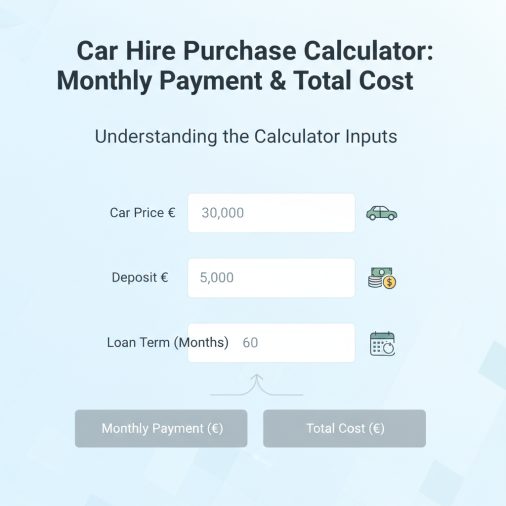
Vehicle Price (£): Enter the full on-the-road price of the car, including any dealer-added options or delivery charges. This is the figure before any deposit is subtracted. The calculator accepts values from £500 up to £500,000, covering everything from used city cars to prestige vehicles.
Deposit Amount (£): Enter the cash deposit you plan to put down at the start of the agreement. This directly reduces the amount you borrow, lowering both your monthly payment and total interest. Some lenders accept a part-exchange vehicle as a deposit — use its agreed trade-in value here. A deposit of at least 10% of the vehicle price is typically required by mainstream HP lenders, and the calculator flags your deposit percentage in the results.
Annual Interest Rate (APR %): Enter the Annual Percentage Rate quoted by the lender. APR is the standardised cost of borrowing and includes the base interest rate. If a dealer quotes you a flat rate (e.g. 4% flat), this is not the same as APR — a 4% flat rate is roughly equivalent to 7–8% APR. Always ask for the APR figure and use that here for accurate results. Typical UK HP APRs range from around 6% for strong credit profiles to 25%+ for non-prime borrowers.
Loan Term: Select the number of months over which you want to repay the loan. Shorter terms mean higher monthly payments but significantly less total interest. Longer terms reduce monthly outgoings but increase the total cost of the car. Most UK HP agreements run for 24 to 60 months; 84-month terms are available but carry the highest total interest cost.
Arrangement / Admin Fee (£): Many lenders charge a documentation or arrangement fee, typically between £100 and £300. This calculator assumes the fee is added to the financed amount (rolled into the loan) rather than paid upfront, which is the most common practice. If your lender charges this fee upfront and you pay it separately, enter zero here and add it manually to your total cost.
Monthly PPI Premium (£): Payment Protection Insurance is an optional add-on that covers your repayments if you lose your job or become unable to work. Enter the monthly premium if you have been quoted one and wish to include it in your total cost calculation. Leave this field at zero if you are not taking PPI or wish to see the base repayment figure only.
Understanding Your Results
Amount Financed: This is the net sum you are borrowing — the vehicle price minus your deposit, plus any arrangement fee rolled into the loan. It is the principal on which interest is calculated throughout the agreement.
Monthly Repayment (excl. PPI): This is your core monthly instalment covering capital and interest only, calculated using the standard reducing-balance amortisation formula. This is the figure most lenders quote as the headline monthly payment.
Total Monthly Cost (incl. PPI): Your true monthly outgoing if you add the PPI premium to the base repayment. If you entered zero for PPI, this figure will match the monthly repayment above.
Total Amount Repayable: The complete sum you will have paid by the end of the agreement — all monthly payments over the full term (including PPI) plus your initial deposit. This is the true total cost of acquiring the car through HP finance.
Total Interest Charged: The total interest paid over the life of the agreement. This is the difference between all capital-and-interest repayments and the original amount financed. It does not include PPI premiums, which are shown separately in the total monthly cost.
Deposit as % of Vehicle Price: Your deposit expressed as a percentage of the vehicle price. Most mainstream HP lenders require a minimum of 10%. A higher percentage reduces your loan-to-value ratio and may help you qualify for a lower APR.
Calculation Formulas Explained
This calculator uses the standard reducing-balance amortisation formula, which is the method used by UK hire purchase lenders regulated under the Consumer Credit Act 1974. Under this method, each monthly payment covers the interest accrued on the outstanding balance that month, plus a portion of the capital. As the balance reduces, the interest portion of each payment falls and the capital portion rises.
The monthly payment formula is:
Monthly Payment = P × r × (1 + r)^n ÷ ((1 + r)^n − 1)
Where P is the amount financed (vehicle price − deposit + arrangement fee), r is the monthly interest rate (APR ÷ 12 ÷ 100), and n is the number of monthly payments (loan term in months).
The total amount repayable is calculated as: (monthly total cost including PPI) × term months + deposit. This gives the true all-in cost of the car.
The total interest charged is: (monthly repayment excluding PPI) × term months − amount financed. This isolates the pure interest cost from the capital repayment.
The deposit percentage is simply: (deposit ÷ vehicle price) × 100, expressed as a percentage.
All interest calculations treat the APR as a nominal annual rate compounded monthly. This is standard practice for UK consumer credit. If a lender quotes a flat rate, you must convert it to APR before entering it, as flat-rate calculations produce a different (lower) monthly payment figure that understates the true cost of borrowing.
Worked Example
Scenario: You want to buy a used car priced at £15,000. You have £2,000 saved as a deposit. The dealer quotes a representative APR of 9.9%. You choose a 48-month term. The lender charges an arrangement fee of £150, and you decline PPI.
- Amount Financed: £15,000 − £2,000 + £150 = £13,150
- Monthly interest rate (r): 9.9 ÷ 100 ÷ 12 = 0.00825
- Monthly Repayment: £13,150 × 0.00825 × (1.00825)^48 ÷ ((1.00825)^48 − 1)
(1.00825)^48 ≈ 1.4834
Numerator: £13,150 × 0.00825 × 1.4834 ≈ £160.93
Denominator: 1.4834 − 1 = 0.4834
Monthly payment ≈ £160.93 ÷ 0.4834 ≈ £332.93/mo - Total Amount Repayable: £332.93 × 48 + £2,000 = £15,980.64 + £2,000 = £17,980.64
- Total Interest Charged: £332.93 × 48 − £13,150 = £15,980.64 − £13,150 = £2,830.64
- Deposit %: £2,000 ÷ £15,000 × 100 = 13.3% — above the typical 10% minimum.
In this example, financing the car over 4 years at 9.9% APR costs approximately £2,831 in interest on top of the vehicle price. Increasing the deposit to £3,000 would reduce the amount financed to £12,150 and save roughly £260 in total interest.
How to Interpret the Results
Monthly Repayment: Compare this figure against your monthly take-home pay. Most financial advisers suggest keeping total debt repayments (including mortgage or rent) below 40% of net income. If the monthly payment feels stretched, consider a larger deposit, a longer term, or a less expensive vehicle.
Total Interest Charged: This is the clearest measure of the cost of borrowing. Compare it against the interest you would pay on a personal loan for the same amount — personal loans sometimes offer lower APRs than dealer HP finance, particularly for borrowers with good credit histories.
Total Amount Repayable: Divide this by the vehicle price to see how much extra you are paying as a multiplier. For example, a total repayable of £18,000 on a £15,000 car means you are paying 1.2× the vehicle price — a useful gut-check figure when comparing deals.
Deposit Percentage: If your deposit is below 10%, some mainstream lenders may decline the application or offer a higher APR. If it is above 20%, you are in a strong position and may be able to negotiate a better rate. When choosing a family vehicle, remember that the car’s suitability for child passengers matters too — factors like interior space and safety ratings are worth researching alongside the finance figures.
Comparing deals: Run the calculator multiple times with different APRs, terms, and deposit amounts to find the combination that minimises total interest while keeping monthly payments affordable. Even a 1% reduction in APR on a £13,000 loan over 48 months saves roughly £270 in total interest.
Common Mistakes to Avoid
- Confusing flat rate with APR: A dealer quoting a 4% flat rate is not offering 4% APR. Flat rates are applied to the original loan balance for every year, making the true APR roughly double the flat rate. Always ask for the APR and use that figure in this calculator.
- Ignoring the arrangement fee: A £200 arrangement fee rolled into a 60-month loan at 9.9% APR adds roughly £55 in interest on top of the fee itself. Always include it in your calculation.
- Choosing the longest term to minimise monthly payments: Stretching to 84 months dramatically increases total interest. On a £13,000 loan at 9.9% APR, moving from 48 to 84 months saves about £90/month but costs an extra £2,200 in total interest.
- Forgetting PPI in the total cost: PPI premiums of £20–£40/month add £960–£1,920 over a 48-month term. Always include PPI in your total cost comparison if you intend to take it.
- Not checking the deposit percentage: Putting down less than 10% may result in a declined application or a higher APR offer. Check the deposit percentage result before approaching a lender.
- Treating the calculator result as a guaranteed quote: Results are planning estimates. Your actual monthly payment will depend on your credit score, the lender’s exact rate structure, and any additional fees not captured here.
Limitations and Important Notes
This calculator uses the reducing-balance amortisation method, which is standard for UK hire purchase agreements. However, the following limitations and assumptions apply:
- The APR is treated as a nominal annual rate compounded monthly. Some lenders use slightly different compounding conventions, which may produce marginally different results.
- No balloon payment or optional final payment is modelled. This calculator covers standard HP agreements only, not Personal Contract Purchase (PCP), which includes a Guaranteed Minimum Future Value (GMFV) balloon payment.
- The arrangement fee is assumed to be rolled into the financed amount. If your lender requires it upfront, add it separately to your deposit figure.
- PPI premiums are modelled as a fixed monthly add-on and do not themselves attract interest within this model. In practice, some lenders add PPI to the financed amount, which would increase the interest cost slightly.
- Results do not account for credit scoring, lender-specific underwriting criteria, or promotional rate offers that may not be available to all applicants.
- Currency is displayed in pounds sterling (£), but the arithmetic applies to any currency.
- These results are estimates for planning and comparison purposes only and do not constitute a financial offer, advice, or guarantee. Always obtain a formal written quote from a Financial Conduct Authority (FCA) authorised lender before entering into a hire purchase agreement.
Frequently Asked Questions
What is the difference between hire purchase and PCP?
Hire purchase (HP) and Personal Contract Purchase (PCP) are both secured car finance products, but they work differently. With HP, your monthly payments cover the full cost of the car (minus deposit) plus interest, so you automatically own the vehicle outright at the end of the term. With PCP, a portion of the car’s value — called the Guaranteed Minimum Future Value (GMFV) or balloon payment — is deferred to the end of the agreement. This makes PCP monthly payments lower than HP for the same car, but at the end of the PCP term you must either pay the balloon payment to own the car, hand it back, or use any equity as a deposit on a new PCP deal. HP is generally simpler and better suited to buyers who want to own the car outright without a large final payment.
Can I pay off my hire purchase early and save interest?
Yes. Under the Consumer Credit Act 1974, you have a statutory right to settle your HP agreement early at any time. Because HP uses reducing-balance interest, settling early means you pay interest only up to the settlement date rather than for the full term, which can produce meaningful savings. The lender must provide a settlement figure on request, which includes the outstanding capital plus a rebate calculation (typically using the Rule of 78 or actuarial method). However, some lenders charge an early settlement fee — check your agreement for details. As a rough guide, settling halfway through a 48-month agreement at 9.9% APR on a £13,000 loan could save several hundred pounds in interest.
Do I own the car during a hire purchase agreement?
No — this is one of the most important features of hire purchase to understand. During the agreement, the finance company legally owns the vehicle. You are essentially hiring it with an option (and obligation) to purchase it at the end of the term once all payments have been made. This means you cannot legally sell the car without the lender’s consent while the agreement is active, because you do not hold the title. Ownership transfers to you automatically once the final payment is made. This also means that if you default on payments, the lender has the right to repossess the vehicle, subject to the protections set out in the Consumer Credit Act 1974.
What is a good APR for car hire purchase in the UK?
A competitive HP APR in the UK depends heavily on your credit profile and the lender. Borrowers with excellent credit histories can access rates from around 5–8% APR through mainstream banks and manufacturer finance arms. Representative APRs advertised by dealers typically range from 8–12% for standard used car finance. Borrowers with limited or adverse credit history may be offered rates of 15–30% APR or higher through specialist lenders. As a general rule, any APR below 10% is considered competitive for a used car HP deal in the current market, while anything above 20% should prompt you to explore alternative lenders or consider improving your credit score before applying.
Is a larger deposit always better on hire purchase?
A larger deposit reduces the amount financed, which lowers both your monthly payment and the total interest you pay — so mathematically it is almost always beneficial if you have the cash available. However, there are practical trade-offs. Tying up a large sum in a depreciating asset means that money is not available for emergencies or higher-return investments. A sensible approach is to put down enough to meet the lender’s minimum (typically 10%) and keep a cash buffer for running costs, insurance, and unexpected repairs. If you are part-exchanging a current vehicle, its trade-in value counts as your deposit, which can significantly reduce the amount you need to finance.
What is voluntary termination and when can I use it?
Voluntary termination (VT) is a legal right under Section 99 of the Consumer Credit Act 1974 that allows you to end a regulated HP agreement early by returning the vehicle to the lender, provided you have paid at least 50% of the total amount payable (including any arrears). If you have paid less than 50%, you can still terminate but must make up the shortfall to reach the 50% threshold. VT is not the same as defaulting — it is a clean legal exit and should not damage your credit file if exercised correctly. The vehicle must be returned in reasonable condition, accounting for fair wear and tear. VT is particularly useful if your financial circumstances change significantly during the agreement.
Does hire purchase affect my credit score?
Yes, in both positive and negative ways. When you apply for HP finance, the lender will typically perform a hard credit search, which leaves a footprint on your credit file and may temporarily lower your score slightly. Once the agreement is active, it appears as an open credit account. Making all payments on time consistently is one of the most effective ways to build a positive credit history, which can improve your score over time. Conversely, missed or late payments are recorded and can significantly damage your credit score, making future borrowing more expensive or difficult. Settling the agreement early or completing it on time both have a positive long-term effect on your credit profile.
What is the minimum deposit required for hire purchase?
There is no single legally mandated minimum deposit for hire purchase in the UK, but in practice most mainstream HP lenders require a minimum deposit of 10% of the vehicle price. Some lenders offer 0% deposit deals, particularly on new cars through manufacturer finance schemes, but these typically require an excellent credit score and may carry a higher APR to compensate for the increased lender risk. A deposit below 10% increases the lender’s exposure and may result in a declined application or a higher interest rate offer. From a consumer perspective, a deposit of 10–20% strikes a reasonable balance between reducing borrowing costs and preserving cash reserves for running costs and emergencies.