Use this independent car finance estimator to calculate your estimated monthly instalment, total interest, and overall repayment cost before approaching a lender. Simply enter your vehicle price, deposit, interest rate, and loan term — and optionally include a balloon payment and standard initiation fee — to see a full cost breakdown in seconds. Results mirror the structure of South African hire-purchase agreements and are ideal for comparing quotes from WesBank or any other registered credit provider. All figures are estimates only and do not constitute a credit offer.
Car Finance Calculator – WesBank-Style Monthly Payment Estimator
An independent South African car finance calculator that estimates monthly instalments, total interest, balloon payments, and full repayment cost using hire-purchase logic consistent with WesBank-style agreements and NCA fee structures.
How to Use This Calculator
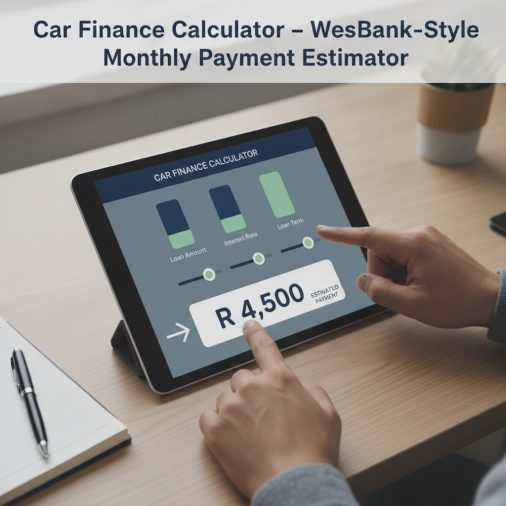
Follow these steps to get an accurate estimate from the calculator:
- Enter the vehicle purchase price — use the full on-the-road price including dealer fees if applicable.
- Enter your deposit — the amount you will pay upfront. A 10% deposit is a common South African benchmark.
- Check the initiation fee — the default of ZAR 1,207.50 reflects the approximate NCA cap for 2024. Adjust if your lender quotes differently.
- Set the monthly service fee — ZAR 69 is the typical NCA-regulated value; update if your quote differs.
- Adjust the annual interest rate — use the slider to match the rate quoted by your lender. South African prime was 11.75% in mid-2024.
- Select your loan term — choose between 12 and 84 months. Longer terms lower monthly payments but increase total interest paid.
- Set a balloon payment percentage — leave at 0% for a standard loan, or increase to reduce monthly instalments at the cost of a lump sum due at term end.
- Enter your credit life insurance premium — use your quoted monthly premium or set to ZAR 0 to exclude it from the estimate.
- Read your results — the calculator instantly shows your financed amount, monthly instalment, total interest, and total cost of finance.
Understanding the Calculator Inputs
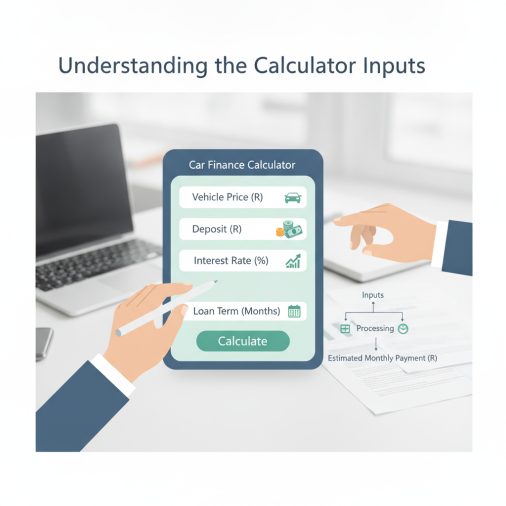
Vehicle Purchase Price (ZAR): Enter the full purchase price of the vehicle as quoted by the dealer. This should be the on-the-road price and may include dealer delivery fees, number plates, and roadworthy certificate costs. Do not subtract the deposit here — there is a separate field for that. The default is ZAR 350,000, which represents a typical mid-range used or entry-level new vehicle in South Africa.
Deposit Amount (ZAR): Enter the cash amount you intend to pay upfront. A larger deposit reduces the amount financed, which lowers both your monthly instalment and the total interest you pay. South African lenders commonly recommend a minimum 10% deposit, though some lenders offer 100% finance (zero deposit) subject to credit approval. The default is ZAR 35,000, representing 10% of the default vehicle price.
Initiation Fee (ZAR): This is a once-off fee charged by the credit provider when the loan is granted. Under the National Credit Act (NCA), this fee is regulated and capped. The default of ZAR 1,207.50 reflects the approximate NCA cap as of 2024. This fee is typically capitalised into the loan — meaning it is added to the principal rather than paid upfront — which is how this calculator treats it. Verify the exact amount with your lender.
Monthly Service Fee (ZAR): This is a flat monthly administration fee charged by the credit provider for maintaining your account. The NCA regulates this fee; ZAR 69 per month is the typical current value. It is added directly to each monthly instalment and does not accrue interest in this model.
Annual Interest Rate (%): Use the slider to set the annual interest rate quoted by your lender. South African vehicle finance is typically priced at prime rate or prime plus a risk margin. The South African prime lending rate was 11.75% in mid-2024. Consumers with excellent credit may receive prime or below; those with lower credit scores may be quoted prime plus 2% to 5% or more. Adjust this slider to match your personalised quote.
Loan Term: Select the number of months over which you will repay the loan. South African vehicle finance terms typically range from 12 to 84 months. A shorter term means higher monthly payments but significantly less total interest paid. A 72-month (6-year) term is the most common choice in South Africa because it balances affordability with reasonable total cost.
Balloon / Residual Payment (%): A balloon payment is a lump sum deferred to the very end of the loan term. Setting this to, say, 20% means 20% of the net financed amount (vehicle price minus deposit) is not amortised monthly — it becomes a single payment due at the end. This reduces your monthly instalment but means you must either pay the lump sum, refinance it, or trade in the vehicle at term end. Most South African lenders cap balloon payments at 30–35%. Set to 0% for a standard fully amortising loan.
Credit Life Insurance (ZAR/month): Credit life insurance covers your outstanding loan balance in the event of death, disability, or retrenchment. While not legally mandatory, most lenders require it. Enter your quoted monthly premium here, or set to ZAR 0 to see the base instalment without insurance. Premiums vary based on the insurer, your age, and the outstanding loan balance, so use the figure from your actual quote for the most accurate result.
Understanding Your Results
Financed Amount (Principal): This is the total amount the lender will advance to you. It equals the vehicle price minus your deposit, plus the capitalised initiation fee. This is the figure on which interest is calculated. A larger deposit directly reduces this number and therefore reduces every other result in the calculator.
Balloon Payment Amount: This shows the rand value of the balloon payment that will be due at the end of your loan term. If you set the balloon percentage to 0%, this result will be ZAR 0. If you set it to 20% on a ZAR 315,000 net financed amount, you will owe ZAR 63,000 as a lump sum at the end of the term. Plan carefully for this amount — it is a real obligation.
Estimated Monthly Instalment (excl. insurance): This is your core monthly payment — the reducing-balance instalment on the financed amount plus the monthly service fee, but excluding credit life insurance. Use this figure to compare the base cost of different loan structures. It is calculated using the standard annuity (PMT) formula applied to the net financed amount after deducting the present value of the balloon.
Total Monthly Instalment (incl. insurance): This is the full amount that will leave your bank account each month, including the base instalment, monthly service fee, and your credit life insurance premium. This is the most realistic figure to use when budgeting and assessing affordability.
Total Interest Paid: This shows the total rand amount of interest charged over the full loan term on the reducing balance. It does not include fees or insurance. This figure is highly sensitive to the interest rate and loan term — extending your term by 12 months or increasing your rate by 1% can add tens of thousands of rands to this number.
Total Cost of Finance: This is the grand total you will pay to own the vehicle through finance. It includes your deposit, all monthly instalments (with service fees and insurance), and the balloon payment if applicable. Comparing this figure across different loan structures — rather than just the monthly instalment — gives you the truest picture of what the vehicle actually costs you.
Calculation Formulas Explained
This calculator uses the standard reducing-balance annuity formula, which is the method required under South African NCA-compliant hire-purchase agreements. Here is how each calculation works:
Financed Amount: Vehicle Price − Deposit + Initiation Fee. The initiation fee is capitalised (added to the loan), which is standard practice in South Africa.
Balloon Amount: (Vehicle Price − Deposit) × (Balloon % ÷ 100). The balloon is expressed as a percentage of the net vehicle cost (before the initiation fee), consistent with how South African lenders typically structure it.
Monthly Instalment (base): The standard annuity payment formula is applied to the net financed amount minus the balloon. The net financed amount minus balloon equals the portion of the principal that is actually amortised monthly. The formula is: PMT = P × r × (1 + r)^n ÷ ((1 + r)^n − 1), where P is the amortised principal, r is the monthly interest rate (annual rate ÷ 12), and n is the number of monthly payments. The monthly service fee is then added as a flat amount.
Total Interest Paid: (Monthly base instalment × Number of months) − Amortised principal. This isolates the interest component from the total repayments on the amortised portion of the loan.
Total Cost of Finance: (Full monthly instalment including insurance × Loan term) + Balloon payment + Deposit. This aggregates every rand you pay — upfront and over time — to arrive at the true total cost of the vehicle purchase through finance.
Assumption note: The balloon payment is treated as a deferred lump sum and is not itself subject to monthly interest amortisation in this model. In practice, some lenders may calculate the balloon differently. The monthly service fee and credit life insurance premium are treated as flat additions that do not compound. The interest rate is assumed fixed for the full term.
Worked Example
Scenario: Thabo wants to finance a ZAR 350,000 SUV. He has a ZAR 35,000 deposit (10%), accepts the standard ZAR 1,207.50 initiation fee capitalised into the loan, and his lender charges ZAR 69/month in service fees. He is quoted an annual interest rate of 11.75% (prime), chooses a 72-month term, sets a 20% balloon payment, and his credit life insurance is ZAR 150/month.
Step 1 — Net vehicle cost: ZAR 350,000 − ZAR 35,000 = ZAR 315,000.
Step 2 — Balloon amount: ZAR 315,000 × 20% = ZAR 63,000 due at end of term.
Step 3 — Financed amount (principal): ZAR 315,000 + ZAR 1,207.50 = ZAR 316,207.50.
Step 4 — Amortised principal (financed amount minus balloon): ZAR 316,207.50 − ZAR 63,000 = ZAR 253,207.50.
Step 5 — Monthly interest rate: 11.75% ÷ 12 = 0.979167% = 0.00979167.
Step 6 — Annuity factor: (1 + 0.00979167)^72 = approximately 2.0264. Numerator: 0.00979167 × 2.0264 = 0.019843. Denominator: 2.0264 − 1 = 1.0264.
Step 7 — Base instalment on amortised principal: ZAR 253,207.50 × (0.019843 ÷ 1.0264) = ZAR 253,207.50 × 0.019330 ≈ ZAR 4,893.10.
Step 8 — Monthly instalment excl. insurance: ZAR 4,893.10 + ZAR 69.00 = ZAR 4,962.10/month.
Step 9 — Total monthly instalment incl. insurance: ZAR 4,962.10 + ZAR 150.00 = ZAR 5,112.10/month.
Step 10 — Total interest paid: ZAR 4,893.10 × 72 − ZAR 253,207.50 = ZAR 352,303.20 − ZAR 253,207.50 = ZAR 99,095.70.
Step 11 — Total cost of finance: (ZAR 5,112.10 × 72) + ZAR 63,000 + ZAR 35,000 = ZAR 368,071.20 + ZAR 63,000 + ZAR 35,000 = ZAR 466,071.20.
This means Thabo pays ZAR 466,071.20 in total for a vehicle listed at ZAR 350,000 — a premium of ZAR 116,071.20 for the convenience of finance, and he still owes ZAR 63,000 at the end of 72 months.
How to Interpret the Results
Monthly instalment vs. affordability: South African financial advisers generally recommend that your total vehicle costs (instalment, insurance, fuel, maintenance) should not exceed 15–20% of your gross monthly income. If your total monthly instalment from this calculator exceeds that threshold, consider a larger deposit, a longer term, or a less expensive vehicle.
Total interest paid: A high total interest figure — often 30–50% of the vehicle price on a 72-month loan — is a signal to consider a shorter term or a larger deposit if you can afford the higher monthly payment. Even an extra ZAR 500/month toward your instalment can save tens of thousands in interest over the loan life.
Balloon payment caution: A balloon payment makes monthly instalments more affordable but creates a significant financial obligation at term end. If you cannot pay the balloon in cash, you will need to refinance it (incurring new interest) or trade in the vehicle. Ensure the vehicle’s trade-in value at term end is likely to cover or exceed the balloon amount — this is not guaranteed, especially for vehicles that depreciate quickly.
Total cost of finance: Always compare this figure — not just the monthly instalment — when evaluating different loan offers. A lower monthly payment achieved through a longer term or larger balloon often means a significantly higher total cost. Two quotes with the same monthly instalment can have very different total costs depending on their structure.
Interest rate sensitivity: Even a 1% difference in annual interest rate has a material impact over 72 months. Use this calculator to model the difference between, say, 11.75% and 13.75% to understand the value of negotiating your rate or improving your credit profile before applying.
Common Mistakes to Avoid
- Focusing only on the monthly instalment: Dealers and lenders often present only the monthly payment. Always calculate and compare the total cost of finance to understand the true price of the vehicle.
- Ignoring the balloon payment obligation: Many buyers choose a balloon payment to reduce monthly costs without a clear plan for the lump sum due at term end. Treat the balloon as a real debt, not a discount.
- Not including all fees in the comparison: When comparing quotes from different lenders, ensure you are comparing like-for-like — including initiation fees, service fees, and insurance premiums. A lower interest rate with higher fees may cost more overall.
- Using the vehicle price before negotiation: Always negotiate the vehicle price before calculating finance. A ZAR 10,000 reduction in purchase price saves you more than ZAR 10,000 over the loan term because it also reduces the interest base.
- Assuming the quoted rate is fixed: Some South African vehicle finance products are linked to the prime rate and can change if the South African Reserve Bank adjusts the repo rate. Confirm whether your rate is fixed or variable before signing.
- Forgetting ongoing ownership costs: This calculator covers finance costs only. Budget separately for comprehensive insurance, fuel, tyres, services, and licence renewal — these can easily add ZAR 3,000–6,000 per month on top of your instalment.
- Not shopping around: WesBank is one of South Africa’s largest vehicle finance providers, but banks such as Absa, Standard Bank, Nedbank, and FNB also offer competitive vehicle finance. Getting multiple quotes and using this calculator to compare them can save you a meaningful amount over the loan term.
Limitations and Important Notes
This calculator is an independent planning tool and is not affiliated with, endorsed by, or connected to WesBank, FirstRand Bank Limited, or any other registered credit provider. Results are mathematical estimates based on the inputs you provide and the assumptions described below.
Key assumptions and limitations:
- Interest is calculated on a reducing balance basis, which is standard for NCA-compliant hire-purchase agreements in South Africa.
- The initiation fee is assumed to be capitalised into the loan (added to the principal). Some lenders may allow or require upfront payment, which would change the result.
- The balloon payment is modelled as a deferred lump sum excluded from monthly amortisation. Actual lender treatment of balloon payments may differ slightly.
- The monthly service fee and credit life insurance premium are treated as flat monthly additions that do not accrue interest. In reality, some products may structure these differently.
- The interest rate is assumed fixed for the entire loan term. Variable-rate products linked to prime will produce different results if the prime rate changes.
- No VAT, licensing, registration, roadworthy, or dealer preparation fees are included unless you add them to the vehicle price field.
- Credit life insurance premiums are user-supplied estimates. Actual premiums depend on the insurer, your age, health, and the outstanding loan balance.
- NCA fee caps (initiation fee and service fee defaults) reflect approximate 2024 values and may be updated by the National Credit Regulator. Always verify current caps.
- Results do not constitute a credit offer, pre-approval, or financial advice. Consult a registered credit provider or financial adviser for a formal, personalised quote before making any financial commitment.
Frequently Asked Questions
What interest rate does WesBank typically offer on vehicle finance?
WesBank, like most South African vehicle finance providers, prices loans relative to the South African prime lending rate. The rate offered to any individual depends on their credit score, income, existing debt obligations, the age and type of vehicle, and the loan term. Consumers with excellent credit histories may be offered prime or even slightly below prime, while those with lower scores may be quoted prime plus 2% to 5% or more. As of mid-2024, the South African prime rate was 11.75%. This calculator allows you to adjust the interest rate slider to match any personalised rate you are quoted, so you can model your exact scenario before committing.
What is the minimum deposit required for car finance in South Africa?
There is no legally mandated minimum deposit for vehicle finance in South Africa under the National Credit Act. Some lenders, including WesBank, offer 100% finance (zero deposit) to qualifying applicants with strong credit profiles. However, a deposit of at least 10% is widely recommended by financial advisers because it reduces the financed amount, lowers monthly instalments, reduces total interest paid, and improves your loan-to-value ratio — which can help you secure a better interest rate. A larger deposit also provides a buffer against negative equity, where you owe more on the loan than the vehicle is worth, which is a common risk in the early years of a long-term vehicle loan.
What does a balloon payment mean and what happens at the end of the term?
A balloon payment — also called a residual value — is a lump sum that is deferred to the very end of your loan term instead of being spread across monthly instalments. For example, a 20% balloon on a ZAR 315,000 net financed amount means ZAR 63,000 is not included in your monthly payments and becomes due as a single payment on the final month of the agreement. At that point, you have three main options: pay the balloon in cash, refinance the balloon amount into a new loan (which will incur additional interest), or trade in or sell the vehicle and use the proceeds to settle the balloon. If the vehicle has depreciated significantly, its trade-in value may be less than the balloon amount, leaving you with a shortfall. Always plan for the balloon before choosing this option.
How is the initiation fee calculated under the National Credit Act?
The National Credit Act (NCA) regulates the maximum initiation fee a credit provider may charge. The fee is calculated as a percentage of the loan amount subject to a rand cap. As of 2024, the approximate maximum is ZAR 1,207.50 (inclusive of VAT) for most consumer credit agreements, though the exact formula is set by the National Credit Regulator (NCR) and may be updated periodically. The initiation fee is typically capitalised into the loan — added to the principal — rather than paid upfront, which means you also pay interest on it over the loan term. Always ask your lender for the exact initiation fee applicable to your agreement and verify it against the current NCR schedule.
What is the difference between hire-purchase and a personal loan for buying a car?
In a hire-purchase (also called an instalment sale) agreement — the most common vehicle finance structure in South Africa — the lender retains ownership of the vehicle until the final payment is made. The vehicle itself serves as security for the loan, which typically results in lower interest rates than unsecured lending. WesBank and most South African banks offer vehicle finance on this basis. A personal loan, by contrast, is unsecured: the lender has no claim over the vehicle, so interest rates are generally significantly higher. Personal loans may be useful for purchasing older vehicles that do not qualify for standard vehicle finance, but the higher cost of borrowing usually makes hire-purchase the more economical choice for qualifying vehicles and buyers.
Can I get car finance in South Africa with a bad credit score?
It is possible to obtain vehicle finance with a poor credit score in South Africa, but it is more difficult and more expensive. Lenders assess credit risk using your credit bureau report, and a low score typically results in a higher interest rate, a requirement for a larger deposit, or outright decline. Some specialist lenders and dealerships offer finance to consumers with impaired credit, but the rates can be substantially above prime. If your credit score is low, it is worth taking time to improve it before applying — paying existing accounts on time, reducing outstanding debt, and disputing any errors on your credit report can all help. You can check your credit report for free once a year through registered credit bureaux such as TransUnion or Experian South Africa.
Does paying off my car loan early save money, and are there penalties?
Under Section 125 of the National Credit Act, South African consumers have the right to settle a credit agreement early at any time. For fixed-rate agreements, the lender may charge an early settlement penalty, but this is regulated and capped by the NCA — it cannot exceed a specified number of months’ interest. In most cases, settling early still results in a net saving because you stop paying interest on the outstanding balance from the settlement date. To calculate your settlement amount, contact your lender directly — they are required to provide a settlement quote within a reasonable time. Use this calculator to model a shorter loan term as a proxy for understanding how much interest you save by repaying faster.
How do I compare car finance quotes from different lenders effectively?
When comparing vehicle finance quotes, never rely on the monthly instalment alone. Two quotes with identical monthly payments can have very different total costs depending on the interest rate, loan term, fees, balloon structure, and insurance premiums included. Use this calculator to model each quote using the same inputs, then compare the Total Cost of Finance result — this is the most honest measure of what each option actually costs you. Also check whether the quoted interest rate is fixed or variable, whether the initiation fee is capitalised or payable upfront, and what credit life insurance is included and at what premium. Getting at least two or three competing quotes from different registered credit providers before signing any agreement is strongly advisable.