Use this free UK car finance calculator to instantly estimate your monthly payments, total interest, and overall repayment cost based on your chosen vehicle price, deposit, loan term, and annual interest rate. Whether you are exploring hire purchase (HP) or a standard personal loan, understanding the full cost of borrowing before you visit a dealership can save you hundreds of pounds. Simply enter your figures below and the calculator will break down every key number in seconds.
Car Finance Calculator UK – Monthly Payment & Total Cost
Estimate your monthly car finance payments, total interest, and overall repayment cost for hire purchase or personal loan agreements in the UK.
How to Use This Calculator

Follow these steps to get an accurate estimate of your car finance costs:
- Enter the car price – type the on-the-road price of the vehicle you are considering.
- Add your deposit – enter any cash deposit you plan to put down upfront.
- Include a part-exchange value – if you are trading in your current car, enter its agreed value (enter 0 if not applicable).
- Set the APR – use the slider to enter the annual interest rate quoted by your lender or the representative APR from an advertisement.
- Choose your loan term – select how many months you want to spread the repayments over.
- Add a balloon payment (optional) – if your agreement includes an optional final payment (common in PCP deals), enter that amount; otherwise leave it at 0.
- Read your results – the calculator instantly shows your monthly payment, total repayable, total interest, and the true all-in cost of the car.
Understanding the Calculator Inputs
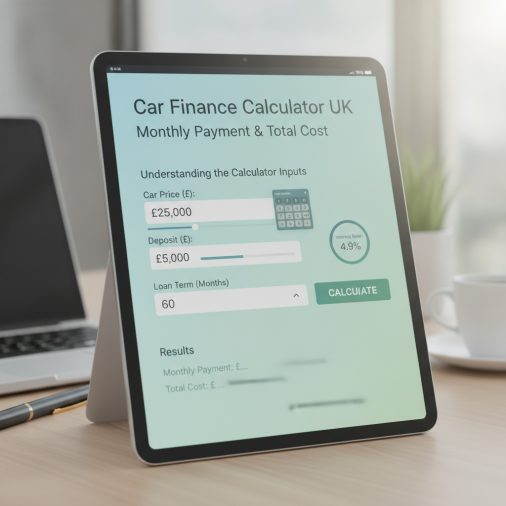
Car Price (£): Enter the full on-the-road (OTR) price of the vehicle. This should be the total price you have agreed with the dealer or private seller, including any delivery charges or registration fees already bundled into the asking price. Do not deduct your deposit here — there are separate fields for that.
Deposit (£): Enter the cash amount you intend to pay upfront at the start of the agreement. A larger deposit reduces the amount you need to borrow, which lowers both your monthly payment and the total interest you pay. Many UK lenders require a minimum deposit of around 10% of the car price.
Part-Exchange / Trade-In Value (£): If you are handing over your current vehicle as part of the deal, enter the value the dealer has agreed to give you for it. This acts in the same way as a cash deposit — it reduces the amount you need to finance. If you are not trading in a car, leave this field at 0.
Annual Interest Rate (APR %): Use the slider to set the Annual Percentage Rate quoted by your lender. The representative APR is the rate that at least 51% of accepted applicants receive; your personal rate may be higher or lower depending on your credit profile. UK car finance APRs typically range from around 4% for strong credit profiles to 30% or more for bad-credit products. Check your finance quote or pre-approval letter for the exact figure.
Loan Term (Months): Select how many months you want to spread repayments over. Shorter terms mean higher monthly payments but less total interest. Longer terms reduce monthly payments but increase the total cost of borrowing. UK hire purchase agreements most commonly run for 36 to 60 months.
Optional Final Balloon Payment (£): In a Personal Contract Purchase (PCP) or balloon hire purchase agreement, a large lump sum is deferred to the end of the term. This reduces your monthly payments during the agreement but leaves a significant amount to pay — or refinance — at the end. If your agreement has no balloon payment (standard HP or personal loan), leave this field at 0.
Understanding Your Results
Amount to Finance: This is the net loan principal — the car price minus your deposit and any trade-in value. It is the actual sum of money the lender is advancing to you, and it is the figure on which interest is calculated throughout the agreement.
Monthly Payment: Your estimated fixed monthly repayment. This figure assumes a constant interest rate for the full term and that payments are made in arrears (one month after the agreement starts). Use this figure to check affordability against your monthly budget before committing to a deal.
Total Amount Repayable: The sum of every monthly payment you will make over the full term, plus any balloon payment at the end. This is the total cash you will hand over to the lender from the first payment to the last.
Total Interest Paid: The cost of borrowing — calculated as the total amount repayable minus the original loan principal. This is the extra money you pay purely for the privilege of spreading the cost over time. Comparing this figure across different APRs and terms is one of the most powerful ways to evaluate a finance deal.
Deposit as % of Car Price: Shows the combined deposit and trade-in as a percentage of the vehicle price. Most mainstream UK lenders prefer to see at least 10%, and a higher percentage can improve your chances of approval and may help you negotiate a lower rate.
Total Cost of Car (inc. all finance): The true all-in cost of owning the car through finance — your upfront contributions (deposit plus trade-in) added to the total amount repayable. This is the most important figure for overall budget planning and for comparing finance against buying outright or using a personal loan.
Calculation Formulas Explained
All monetary results use the standard reducing-balance amortisation formula, which is the method used by the vast majority of UK hire purchase and personal loan providers.
The monthly interest rate is derived by dividing the annual APR by 12: monthly rate = APR / 100 / 12. For example, a 9.9% APR gives a monthly rate of approximately 0.825%.
The adjusted principal accounts for any balloon payment by discounting it back to its present value at the start of the agreement: adjusted principal = (car price − deposit − trade-in) − balloon × (1 + monthly rate)^(−term). This ensures the monthly payments are calculated only on the portion of the loan that is being amortised over the term, not on the deferred balloon amount.
The monthly payment formula is: monthly payment = adjusted principal × monthly rate / (1 − (1 + monthly rate)^(−term)). This is the standard present-value annuity formula used in financial mathematics.
The total amount repayable is simply: monthly payment × term months + balloon.
The total interest paid is: total amount repayable − original loan principal, where the original loan principal is car price − deposit − trade-in.
The deposit percentage is: (deposit + trade-in) / car price × 100.
The total cost of car is: deposit + trade-in + total amount repayable, representing every pound spent to acquire the vehicle.
Worked Example
Scenario: Sarah wants to buy a used car priced at £15,000. She has a £2,000 cash deposit and is trading in her old car for £1,500. The dealer quotes a representative APR of 9.9% over 48 months with no balloon payment.
- Amount to Finance: £15,000 − £2,000 − £1,500 = £11,500
- Monthly interest rate: 9.9 / 100 / 12 = 0.00825
- Adjusted principal (no balloon): £11,500 − 0 = £11,500
- Monthly payment: £11,500 × 0.00825 / (1 − (1.00825)^(−48)) = £94.875 / (1 − 0.6729) = £94.875 / 0.3271 ≈ £290.10/mo
- Total amount repayable: £290.10 × 48 + £0 = £13,924.80
- Total interest paid: £13,924.80 − £11,500 = £2,424.80
- Deposit as % of car price: (£2,000 + £1,500) / £15,000 × 100 = 23.3%
- Total cost of car: £2,000 + £1,500 + £13,924.80 = £17,424.80
Sarah can see that while her monthly payment is a manageable £290, the finance adds £2,424.80 to the overall cost of the car. Her strong 23.3% upfront contribution puts her in a good position when negotiating with lenders.
How to Interpret the Results
Is the monthly payment affordable? A common budgeting guideline is that total car costs (finance, insurance, fuel, tax) should not exceed 15–20% of your monthly take-home pay. Use the monthly payment figure as a starting point and add your estimated running costs to check overall affordability.
Is the total interest reasonable? As a rough benchmark, total interest below 15% of the loan principal is generally considered competitive for a borrower with a good credit score on a standard HP deal. If your total interest is significantly higher, consider increasing your deposit, shortening the term, or shopping around for a lower APR.
Deposit percentage: A deposit below 10% may limit your lender options or result in a higher APR. Aiming for 20% or more gives you the strongest negotiating position and the lowest total cost.
Balloon payment deals: A large balloon payment makes monthly figures look attractive but can create financial pressure at the end of the term. Ensure you have a clear plan — whether to pay the balloon, refinance it, or return the vehicle — before signing a PCP agreement.
Comparing deals: Run the calculator multiple times with different APRs and terms to see how sensitive your total cost is to each variable. Even a 1–2% difference in APR can add or save hundreds of pounds over a 48-month term.
Common Mistakes to Avoid
- Using the flat rate instead of the APR: Some dealers quote a flat interest rate, which looks lower than the APR but is calculated on the original balance rather than the reducing balance. Always use the APR for fair comparisons.
- Ignoring fees and add-ons: Arrangement fees, documentation charges, GAP insurance, and paint protection can add hundreds of pounds to the true cost. This calculator does not include those — always ask for a full cost breakdown from the lender.
- Focusing only on the monthly payment: A lower monthly payment achieved by extending the term often means paying significantly more interest overall. Always check the total interest paid and total cost figures, not just the monthly amount.
- Forgetting the balloon payment: In PCP deals, the optional final payment can be thousands of pounds. Failing to plan for it — or assuming you will simply hand the car back — can lead to unexpected financial pressure.
- Not accounting for running costs: Finance payments are just one part of car ownership costs. Insurance, road tax, fuel, servicing, and tyres all add to the monthly outlay and should be budgeted alongside the finance payment.
- Applying to multiple lenders simultaneously: Each hard credit search can temporarily lower your credit score. Use eligibility checkers (soft searches) before making formal applications to protect your credit profile.
Limitations and Important Notes
This calculator provides estimates only and does not constitute a credit offer, financial advice, or a binding quote. Results are based on the inputs you provide and the following assumptions:
- The APR is treated as a nominal annual rate compounded monthly (divided by 12 for the monthly rate), consistent with standard UK HP and personal loan structures.
- The interest rate is fixed for the entire term. Variable-rate products will produce different results over time.
- No arrangement fees, documentation fees, early repayment charges, or optional add-ons are included.
- The balloon payment is discounted to present value to approximate PCP-style monthly payments; actual PCP calculations vary by lender and may include guaranteed future values (GFV) determined differently.
- Payments are assumed to be made in arrears, with the first payment one month after the agreement start date.
- The car price must exceed the combined deposit and trade-in for a valid finance amount. Negative loan amounts are not meaningful.
- UK consumers should always review the full credit agreement, including the total charge for credit, as disclosed under the Consumer Credit Act 1974, before signing any finance document.
Frequently Asked Questions
What is a good APR for car finance in the UK?
A good APR for car finance in the UK depends heavily on your credit score and the type of product. As a general guide, borrowers with excellent credit can access rates from around 4% to 8% APR on hire purchase deals from mainstream lenders and manufacturer finance arms. Average credit profiles typically see rates between 9% and 15%, while bad-credit or specialist lenders may charge 20% to 40% APR or more. The representative APR advertised by a lender is the rate offered to at least 51% of successful applicants, so your personal rate may differ. Always compare the total interest paid across multiple quotes rather than focusing solely on the headline APR figure.
How much deposit do I need for car finance in the UK?
Most mainstream UK car finance lenders require a minimum deposit of around 10% of the vehicle price, though some will accept lower amounts for borrowers with strong credit histories. Putting down a larger deposit — ideally 20% or more — reduces the amount you borrow, lowers your monthly payments, decreases the total interest paid, and can improve your chances of approval at a competitive rate. Your part-exchange vehicle counts towards the deposit in most dealership finance arrangements. If you have little or no deposit available, some lenders offer zero-deposit finance, but these products typically carry higher APRs and result in a greater total cost of borrowing.
What is the difference between HP and PCP car finance?
Hire Purchase (HP) and Personal Contract Purchase (PCP) are the two most common forms of car finance in the UK. With HP, you pay a deposit followed by fixed monthly instalments that cover the full value of the car; at the end of the term you own the vehicle outright. With PCP, a large portion of the car’s value — the Guaranteed Future Value (GFV) or balloon payment — is deferred to the end of the agreement, which makes monthly payments lower. At the end of a PCP term you have three options: pay the balloon to own the car, hand the car back with nothing more to pay (subject to mileage and condition), or use any equity as a deposit on a new PCP deal. PCP offers flexibility but is more complex; HP is simpler and results in outright ownership.
Can I get car finance with bad credit in the UK?
Yes, it is possible to get car finance in the UK with a poor credit history, but your options will be more limited and the APR will typically be significantly higher than for borrowers with good credit. Specialist bad-credit lenders and some dealership finance arms offer products designed for people with defaults, CCJs, or thin credit files. Putting down a larger deposit can improve your chances of approval and reduce the lender’s risk. It is worth checking your credit report before applying — errors are surprisingly common and can be corrected. Using a soft-search eligibility checker before making a formal application helps you gauge your options without leaving a hard footprint on your credit file.
What happens if I miss a car finance payment in the UK?
Missing a car finance payment in the UK can have serious consequences. The lender will typically contact you and may charge a late payment fee. If you miss multiple payments, the lender can issue a default notice and, if the arrears are not cleared, apply to repossess the vehicle. Under the Consumer Credit Act 1974, if you have paid more than one-third of the total amount payable, the lender requires a court order to repossess the car. Missed payments will also be recorded on your credit file, damaging your credit score for up to six years. If you are struggling, contact your lender as early as possible — many will offer a payment holiday or restructured arrangement rather than proceed to repossession.
Can I pay off my car finance early in the UK?
Yes, you have a legal right to settle a regulated car finance agreement early in the UK under the Consumer Credit Act 1974. This is known as voluntary early settlement. The lender must provide you with a settlement figure, which will be less than the remaining balance because you receive a rebate of future interest. However, some lenders charge an early repayment fee — typically up to 58 days’ interest — so check your agreement before settling. Paying off early can save a significant amount of interest, particularly in the early months of the agreement when the outstanding balance is highest. Request a settlement figure directly from your lender before making any overpayments.
Does applying for car finance affect my credit score?
A formal car finance application involves a hard credit search, which is recorded on your credit file and can temporarily lower your credit score by a small number of points. Multiple hard searches in a short period can have a more noticeable negative effect, as lenders may interpret this as financial stress. To protect your score, use soft-search eligibility checkers — offered by many comparison sites and lenders — before making formal applications. These give you a good indication of whether you are likely to be accepted without leaving a visible mark on your credit report. Once you have identified the most suitable deal, make a single formal application rather than applying to several lenders simultaneously.
Is 0% car finance really free in the UK?
Zero percent car finance deals, typically offered by manufacturer finance arms on new vehicles, do not charge interest in the traditional sense — but they are rarely truly free. The cost of the finance is usually built into the vehicle price, meaning you may be paying more for the car than you would if you negotiated a cash discount and arranged your own finance separately. Additionally, 0% deals often require a substantial deposit, a shorter term, and a strong credit score to qualify. Always compare the total cost of a 0% deal (including the vehicle price) against the cost of a discounted cash purchase or a competitive personal loan before assuming the 0% option is the cheapest route.