Upgrading your car’s mid-range speakers is one of the most impactful changes you can make to your audio system. Mid-range drivers handle the vocal and instrumental frequencies that matter most to how music sounds in a real listening environment — roughly 90 Hz to 16,000 Hz depending on the driver. Whether you’re building a dedicated three-way system or replacing weak factory speakers, the right mid-range driver determines how clear, detailed, and dynamic your in-car audio feels.
As an Amazon Associate I earn from qualifying purchases.
At a Glance
Best for High-Efficiency Builds
Deaf Bonce Apocalypse AP-M61AN Hybrid (Pair)
- 101.5 dB sensitivity — unusually high for a mid-range driver, meaning loud output with modest amplifier power
- Hybrid neodymium-ferrite motor keeps weight down while maintaining strong magnetic force
- Slim 2.66″ mounting depth suits tight door installations; sold as a pair
Best for 4-Ohm Three-Way Systems
DS18 PRO-GM6.4B 6.5″ Midrange (4 Ohm, Single)
- 140W RMS / 480W max at 4 ohms — works with most standard car amplifiers
- 1.5″ high-temperature Kapton voice coil designed to resist heat-related failure
- Sold as a single speaker; budget accordingly if you need a pair
Best for 8-Ohm Amp Outputs
DS18 PRO-GM6B 6.5″ Midrange (8 Ohm, Single)
- Same 140W RMS / 480W max specs as the 4-ohm sibling, but at 8 ohms for specific amp compatibility needs
- Shares the high-temperature Kapton voice coil construction for durability
- Single-unit purchase — confirm your amplifier’s rated load before choosing 4-ohm vs. 8-ohm version
Best SPL Bundle Value
Timpano TPT-MR6-4 Bullet Midrange (Pair, 4 Ohm)
- Comes as a bundle of two speakers rated at 150W RMS / 500W max each
- Ultra-shallow 2.20″ mounting depth is among the most install-friendly in this group
- Stamped steel frame and ferrite magnet — heavier than aluminum-frame alternatives but well-suited to SPL builds
Best Complete Mid-High Package
DS18 Mid and High Car Speaker Package (2x Midrange + 2x Tweeters)
- Bundles two 6.5″ mid-range drivers (250W RMS each) with two super tweeters and a built-in crossover
- Most turnkey option here — no separate crossover purchase required
- Higher combined RMS ratings mean this system needs a capable amplifier to run at full potential
Quick Product Comparison
| Speaker | Impedance | RMS / Max Power | Sensitivity | Sold As | Key Consideration |
|---|---|---|---|---|---|
| Deaf Bonce AP-M61AN Hybrid | Not specified | 180W / 360W | 101.5 dB | Pair | Highest sensitivity here; hybrid motor adds cost |
| DS18 PRO-GM6.4B | 4 Ohm | 140W / 480W | Not specified | Single | Buy two for stereo; suits most 4-ohm amps |
| DS18 PRO-GM6B | 8 Ohm | 140W / 480W | Not specified | Single | Confirm amp load compatibility before ordering |
| Timpano TPT-MR6-4 Bullet | 4 Ohm | 150W / 500W each | Not specified | Bundle (2) | Shallowest mount (2.20″); stamped steel frame |
| DS18 Mid and High Package | 4 Ohm | 250W RMS mid / 225W RMS tweeter | Not specified | 2 mids + 2 tweeters | Built-in crossover; needs strong amplifier |
Deaf Bonce Apocalypse AP-M61AN Hybrid

The Deaf Bonce Apocalypse AP-M61AN is a 6.5-inch midrange speaker sold as a pair, built around a hybrid motor system that combines neodymium and ferrite magnets. That combination is relatively uncommon in this size class and is intended to balance magnetic strength with weight. The speaker is positioned for listeners who want high-sensitivity, efficient output in a dedicated midrange role within a multi-way system.
Verified Specifications
| Specification | Manufacturer-Listed Value |
|---|---|
| Speaker Size | 6.5 inches |
| RMS Power Handling | 180W |
| Max Power Handling | 360W |
| Sensitivity | 101.5 dB |
| Frequency Range | 90 Hz – 16,000 Hz |
| Mounting Depth | 2.66 inches |
| Frame Material | Aluminum |
| Cone Material | Pressed paper |
| Surround Material | Cloth |
| Voice Coil | CCAW (Copper-Clad Aluminum Wire) |
| Sold As | Pair |
Key Features and Practical Benefits
The 101.5 dB sensitivity rating is the most practically significant number here. High-sensitivity midrange drivers produce more volume per watt, which means even a modest amplifier can push these speakers to real listening levels without working hard. That matters in a three-way build where you want the mids to keep pace with a louder subwoofer and tweeters.
The frequency range listed runs from 90 Hz to 16,000 Hz. Used in a true three-way system with a crossover, the lower end hands off to a subwoofer and the upper end crosses into tweeter territory. The stated range suggests this driver is genuinely designed to work as a dedicated midrange, not a full-range speaker trying to fill that role.
The CCAW voice coil is lighter than a standard copper coil, which can improve transient response—the speaker’s ability to start and stop cleanly with the music signal. The aluminum frame is intended to resist flex under high excursion and road vibration.
Documented Advantages and Trade-Offs
The most meaningful advantages over similarly sized drivers are the hybrid motor design and the high sensitivity. Both are listed by the manufacturer and represent legitimate technical differentiators. The aluminum frame and cloth surround are durable material choices, and the shallow 2.66-inch mounting depth adds installation flexibility in doors with limited clearance.
On the trade-off side, 180W RMS is a solid but not exceptional power rating compared to some competitors in this guide. The pressed-paper cone is a traditional choice that is well-regarded for natural midrange tonality but is less exotic than polypropylene or fiber composites. No impedance value is listed in the supplied product data, which is a specification buyers should confirm before pairing this driver with an amplifier.
Who Should Consider It
This pair suits enthusiasts building or upgrading a dedicated three-way car audio system who want a high-sensitivity midrange driver that won’t demand a large amplifier. The shallow mounting depth makes it a practical choice for vehicles with tighter door cavities. Buyers running a two-way system who need a full-range speaker should look elsewhere.
Setup and Everyday Use
As a dedicated midrange driver, the AP-M61AN requires a crossover—either active (from a DSP or head unit) or passive—to restrict its frequency range properly. Running it full-range without a high-pass filter is not recommended for a speaker designed in this role. The 2.66-inch mounting depth should be measured against your door panel before purchase; confirm the cutout diameter against your vehicle’s factory opening or a mounting adapter.
DS18 PRO-GM6.4B Loudspeaker

The DS18 PRO-GM6.4B is a single 6.5-inch dedicated midrange speaker designed for professional-style car and truck audio builds. It features a distinctive red aluminum bullet dust cover, a 4-ohm impedance rating, and a Kapton voice coil—a construction choice aimed at durability under sustained high-temperature operation. It is sold individually, so buyers building a stereo pair will need to purchase two units.
Verified Specifications
| Specification | Manufacturer-Listed Value |
|---|---|
| Speaker Size | 6.5 inches |
| RMS Power Handling | 140W |
| Max Power Handling | 480W |
| Impedance | 4 Ohms |
| Voice Coil Size | 1.5 inches |
| Voice Coil Material | Kapton (high-temperature) |
| Dust Cover | Red aluminum bullet |
| Sold As | Single speaker |
Key Features and Practical Benefits
The 1.5-inch Kapton voice coil is a meaningful construction detail. Kapton is a heat-resistant polyimide film used as the voice coil former in many pro-audio drivers. It handles thermal stress better than some standard materials, which matters when a speaker is pushed at sustained power levels for long periods. This makes the PRO-GM6.4B a reasonable choice for installations where the amplifier will be running hard regularly.
The red aluminum bullet serves two functions according to the listing: protecting the voice coil from debris and directing sound for more consistent dispersion. Aluminum bullets are common in pro-style midrange drivers and are a recognizable visual marker of that category. The 4-ohm impedance is the standard match for most aftermarket amplifiers, making pairing straightforward.
The 480W max power figure is eye-catching, but the more practically useful number is the 140W RMS rating—that’s the continuous power level the driver is designed to handle in everyday use. Buyers should size their amplifier to the RMS rating, not the peak figure.
Documented Advantages and Trade-Offs
The Kapton voice coil and bullet construction are genuine differentiators from basic coaxial replacements. The 4-ohm rating is convenient and compatible with the widest range of amplifiers. DS18 is a widely distributed brand with established US availability, which can be a practical advantage for buyers who want straightforward ordering and returns.
The main trade-off relative to other options in this guide is that this is a single-speaker listing. Budgeting for a stereo pair means doubling the cost. No sensitivity rating or mounting depth is included in the supplied product data, so buyers cannot directly compare loudness-per-watt efficiency or confirm fit without checking the full Amazon listing for those details. Sensitivity in particular is an important planning number for matching midrange output to the rest of a system.
Who Should Consider It
The PRO-GM6.4B fits builders assembling a pro-audio–influenced car system who want a proven, thermally robust midrange driver at 4 ohms. It works well for truck installs and louder builds where sustained power levels are expected. Buyers who need to purchase exactly two matched drivers should account for the single-unit listing in their planning.
Setup and Everyday Use
Like all dedicated midrange drivers, the PRO-GM6.4B requires a crossover to function correctly—running it full-range without filtering will stress the driver and produce poor sound. The 4-ohm rating simplifies amplifier matching, but confirm your amplifier’s stable output at 4 ohms before finalizing the pairing. Sensitivity and exact mounting dimensions are not listed in the supplied data, so verify those figures on the product page before cutting or drilling any mounting locations.
DS18 PRO-GM6B Loudspeaker

The DS18 PRO-GM6B is a 6.5-inch dedicated midrange driver sold as a single unit, designed for car and truck audio systems where a separate mid channel is already planned. Its 8-ohm impedance sets it apart from the more common 4-ohm variants in this lineup, making it a specific fit for amplifier setups built around higher impedance loads. The speaker is built around protecting the voice coil and delivering clear, natural midrange reproduction across vocals and instruments.
Verified Specifications
| Specification | Advertised Value |
|---|---|
| Driver Size | 6.5 inches |
| Impedance | 8 Ohms |
| RMS Power Handling | 140W |
| Max Power Handling | 480W |
| Voice Coil Material | 1.5″ Kapton, high-temperature |
| Dust Cover | Red aluminum bullet |
Key Features and Practical Benefits
The 1.5-inch Kapton voice coil is the headline construction detail here. Kapton is a heat-resistant material commonly used in professional audio applications; the listing advertises that it can withstand extreme thermal stress while maintaining structural integrity, which matters in a car environment where temperatures inside door panels can climb significantly. A long-lasting voice coil directly affects the speaker’s overall service life, so this is a meaningful spec for buyers prioritizing durability.
The red aluminum bullet dust cover does two jobs: it physically shields the voice coil from debris, and DS18 states it contributes to optimized sound output. Whether you view that as an acoustic claim or a protective feature, the bullet design is characteristic of the DS18 PRO series and gives the speaker a distinctive appearance consistent with a dedicated pro-audio build.
Documented Advantages and Trade-Offs
The 8-ohm impedance is the most important compatibility consideration for this model. Most factory head units and entry-level aftermarket amplifiers are optimized for 4-ohm loads; an 8-ohm driver will draw less current from the same amplifier, which translates to lower output power delivered to the speaker. For builders pairing this with a purpose-matched amplifier channel, that’s a non-issue — but buyers who haven’t checked their amp’s 8-ohm power rating should do so before purchasing. The PRO-GM6B is sold as a single speaker, so a stereo midrange install requires purchasing two units separately, which affects total cost planning. Sensitivity and frequency response are not specified in the supplied product information.
Who Should Consider It
This driver is best suited to experienced car audio builders assembling a 3-way active system who specifically need an 8-ohm midrange — for example, to match an amplifier’s bridged output impedance requirements or to wire two drivers in a series configuration for a specific load. It is not a plug-and-play upgrade from stock speakers and is not ideal for passive, all-in-one installs.
Setup and Everyday Use
Because this is a dedicated midrange driver, it requires a crossover — either an active crossover on the amplifier or a passive inline crossover — to keep low bass frequencies and upper high frequencies out of its range. DS18 does not include crossover hardware with this single-speaker listing, so that cost and selection should be factored into your build plan. Confirm your amplifier’s rated output at 8 ohms before finalizing the purchase to ensure you’re delivering adequate power.
Timpano 1000 Watts Midrange Speakers for Car Audio Systems TPT-MR6-4

The Timpano TPT-MR6-4 is a 6.5-inch pro-audio midrange driver that comes as a bundle of two speakers, which is a practical advantage over single-unit competitors for anyone building a stereo system. Timpano positions this driver as a crossover between stadium and car audio technology, advertising warm midrange detail at any volume and the ability to keep pace with high-SPL applications. The shallow mounting depth and stamped steel construction make it a workable choice for installs where door panel space is limited.
Verified Specifications
| Specification | Advertised Value |
|---|---|
| Driver Size | 6.5 inches (Pro Audio) |
| Impedance | 4 Ohms |
| RMS Power Handling (each) | 150W |
| Max Power Handling (each) | 500W |
| Mounting Depth | 2.20 inches |
| Frame Material | Stamped steel |
| Magnet Type | Ferrite |
| Bundle Quantity | 2 speakers |
Key Features and Practical Benefits
The 2.20-inch mounting depth is one of the more concrete and useful specs in this listing. Shallow-mount drivers are genuinely harder to find in the midrange pro-audio category, and this figure gives installers working with thin door panels or custom enclosures a clear number to measure against before purchasing. Pair that with the standard 4-ohm impedance, and the TPT-MR6-4 is broadly compatible with most aftermarket amplifiers without requiring special wiring considerations.
Timpano advertises that the driver draws on technology from pro audio and stadium speaker design. While that claim can’t be independently verified here, the practical upshot they describe — warm midrange detail at high and low volumes — aligns with what a large motor structure and tight suspension typically deliver in midrange-only drivers. The ferrite magnet and stamped steel basket are reliable, proven construction choices that prioritize durability over exotic materials.
Documented Advantages and Trade-Offs
Buying two speakers in one transaction simplifies pricing and ensures matched drivers — an important factor for balanced stereo imaging. The 150W RMS per speaker is a reasonable continuous power target for a mid-level amplifier, and the 500W max per driver gives headroom for short transient peaks. On the trade-off side, no sensitivity rating is specified in the supplied product information, which makes it harder to compare efficiency directly against competitors like the Deaf Bonce Apocalypse’s advertised 101.5 dB. Frequency response range is also not specified, so buyers planning an active 3-way system will need to test or research crossover points independently. Voice coil specifications are not detailed in the listing data.
Who Should Consider It
The TPT-MR6-4 bundle makes the most sense for builders putting together a 3-way car audio system — subwoofer, midrange, tweeter — who want a shallow-mount midrange that works with standard 4-ohm amplifier channels and don’t want to purchase drivers one at a time. It’s also a reasonable choice for anyone upgrading from stock door speakers to a dedicated midrange stage without jumping to the premium price tier.
Setup and Everyday Use
Like all dedicated midrange drivers, the TPT-MR6-4 requires a crossover to function properly in a system — either active (via an amplifier’s built-in DSP or crossover controls) or passive (inline crossover network). The shallow 2.20-inch mounting depth should be confirmed against your specific door panel cavity measurements before installation. Because the listing does not specify a recommended crossover frequency range, consulting a car audio installer or the manufacturer directly for crossover point guidance is advisable before finalizing your system design.
DS18 Mid and High Car Speaker Package
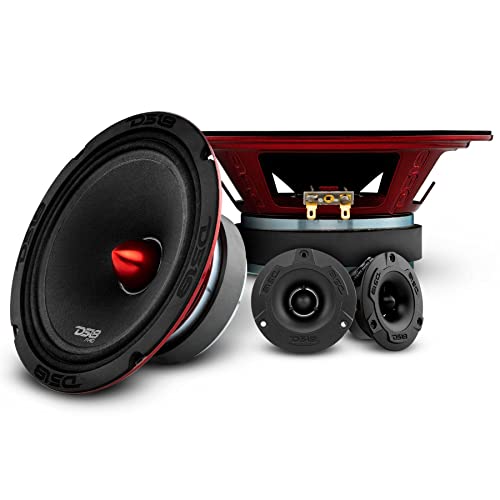
This DS18 bundle takes a different approach from the individual midrange drivers in this guide by pairing two 6.5″ midrange speakers with two 1″ super tweeters and a built-in crossover — giving you a more complete upper-frequency solution in a single purchase. If you’re building a three-way system from scratch or upgrading a tired factory setup, the fact that crossover filtering is already integrated reduces the number of separate components you need to source and wire. The midrange drivers are identified in the listing as the PRO-X6.4BM, while the tweeters are the PRO-TW220 — both DS18 Pro-series units.
Verified Specifications
| Specification | Advertised Value |
|---|---|
| Midrange (PRO-X6.4BM) Max Power | 500W per speaker |
| Midrange (PRO-X6.4BM) RMS Power | 250W at 4 ohms |
| Tweeter (PRO-TW220) RMS Power | 225W at 4 ohms |
| Tweeter (PRO-TW220) Max Power | 350W |
| Tweeter impedance | 4 ohms |
| Tweeter size | 1 inch |
| Midrange size | 6.5 inches |
| Crossover | Built-in capacitor filter (tweeter) |
Key Features and Practical Benefits
The midrange drivers are rated at 250W RMS — the highest continuous power rating among the midrange speakers in this guide — making them a strong candidate for amplified builds where headroom matters. The PRO-TW220 tweeters use a ferrite magnet design with a built-in capacitor filter, which provides basic high-pass filtering to protect the tweeters without requiring a separate external crossover network. That’s a meaningful convenience advantage for installers working with limited budget or limited mounting space for additional components.
DS18 positions both drivers as professional-grade audio components, consistent with the brand’s broader Pro series lineup. The tweeters are described as capable of handling high frequencies “with ease,” and the listing emphasizes aesthetic design as well as sonic performance — a consideration if your installation will be visible inside the cabin.
Documented Advantages and Trade-Offs
The bundle format is the clearest advantage here: two midranges, two tweeters, and integrated filtering in one purchase simplifies system planning and reduces the risk of mismatched components. The 250W RMS midrange rating gives this package more continuous power handling than either DS18 PRO-GM6.4B or PRO-GM6B in a single-driver comparison. However, this package is sold as a set of four drivers total, so individual per-unit pricing versus buying components separately is worth evaluating based on your specific needs. Impedance details for the midrange drivers are not fully specified in the supplied listing beyond the tweeter’s confirmed 4-ohm rating, which is worth clarifying before amplifier matching.
Who Should Consider It
This package suits a builder who wants midrange and high-frequency coverage handled together, particularly someone upgrading from a basic two-way factory system toward a three-way setup that still needs a separate subwoofer. It’s less appropriate if you only need replacement midrange drivers and already have tweeters you’re satisfied with, since you’d be paying for components you won’t use.
Setup and Everyday Use
The built-in capacitor filter on the tweeters simplifies wiring, but this package still benefits from an external amplifier to take full advantage of the 250W RMS midrange rating — a standard head unit will not approach that power level. Mounting dimensions for the 6.5″ midrange drivers are not specified in the supplied product information, so confirming fitment in your door panels before purchasing is advisable. As with any Pro-series driver, these are designed to work within a broader active or semi-active system, not as a standalone upgrade to a stock receiver.
Detailed Buying Guide for Best Mid Range Car Speakers
A dedicated midrange speaker handles the frequency band your ears are most sensitive to — roughly 200 Hz to 5,000 Hz — covering vocals, guitars, piano, and most instrument fundamentals. Choosing the right one means balancing sensitivity, power handling, impedance, and physical fit before you even think about sound character. Getting these four factors right will do more for your system than any single brand preference.
Sensitivity: Why It Matters More Than Wattage
Sensitivity — measured in decibels at one watt, one meter — tells you how loud a speaker gets from a given amount of power. Higher sensitivity means more volume from the same amplifier output. The Deaf Bonce AP-M61AN lists a 101.5 dB sensitivity rating, which is genuinely high for a 6.5-inch midrange driver; it will play loudly even with a modest amplifier. When pairing a new midrange with an existing amp, sensitivity should be one of the first numbers you check, because a 3 dB difference in sensitivity roughly doubles perceived loudness.
Power Handling: RMS vs. Max
Always match amplifier RMS output to speaker RMS rating, not the max (peak) figure. Max power numbers describe short-burst handling and are not a reliable guide for daily use. Among the speakers reviewed here, RMS ratings range from 140W (both DS18 PRO-GM6 models) to 250W (DS18 PRO-X6.4BM in the mid-and-high package). Under-powering a speaker and pushing an amplifier into clipping is a leading cause of voice-coil failure, so it is safer to run a speaker at 70–90% of its RMS rating than at its floor. If you are unsure how amplifier power relates to speaker control and tone, the article on what an amp does in a car stereo system explains the relationship clearly before you commit to a wiring plan.
Impedance: 4 Ohm vs. 8 Ohm
Impedance affects how much current your amplifier delivers. A 4-ohm speaker draws more current and generally gets louder from the same amp than an 8-ohm speaker does, but some amplifiers are not stable at 4 ohms on every channel. The DS18 PRO-GM6.4B and Timpano TPT-MR6-4 are 4-ohm designs; the DS18 PRO-GM6B is 8 ohms. Before buying, check your amplifier’s minimum rated impedance per channel. Mixing impedances across channels without checking stability can cause overheating or shutdown. If you plan to wire two speakers per channel, consult your amplifier manual for parallel or series wiring guidance.
Crossover Compatibility and Frequency Range
Dedicated midrange drivers are not full-range speakers. They perform best within a defined band, and running low bass frequencies through them can cause distortion or mechanical damage. Most of the speakers reviewed here are designed to work within a 3-way system alongside a subwoofer and a tweeter. The Deaf Bonce AP-M61AN specifies a 90 Hz–16,000 Hz range, which is usefully wide; setting a high-pass crossover just below the listed low end protects the driver. If your amplifier has built-in crossover controls, set a high-pass filter between 80 Hz and 100 Hz for a typical 6.5-inch midrange. For a practical walkthrough of crossover wiring, the guide on connecting a 4-channel car amplifier with crossover covers the process step by step.
Physical Fit: Mounting Depth and Cutout Diameter
A speaker that sounds great in a test rig is useless if it cannot physically fit your door or pod. The most common obstacle in car installs is mounting depth — the distance from the speaker’s mounting flange to the back of the magnet. The Timpano TPT-MR6-4 lists a 2.20-inch depth and the Deaf Bonce AP-M61AN lists 2.66 inches. Always measure available depth in your target location before ordering, accounting for window regulators and door panel hardware. Cutout diameter for all five speakers reviewed here is based on the standard 6.5-inch format, but actual cutout requirements vary slightly by model, so verify the manufacturer spec sheet for your specific vehicle’s existing hole size.
Build Materials and Long-Term Durability
Voice coil material and cone composition determine how a speaker handles sustained heat and vibration. CCAW (copper-clad aluminum wire) coils, used in the Deaf Bonce AP-M61AN, offer lower mass for faster transient response. Kapton voice coils, cited by both DS18 PRO-GM6 models, are known for heat resistance and structural stability under sustained power. Cone materials (pressed paper, polypropylene, composite) each have different stiffness and damping characteristics that affect sound quality, though no independent measurement was conducted on these specific models. Frame rigidity — aluminum versus stamped steel — affects resonance under road vibration; both materials appear across the reviewed lineup.
Installation, Assembly and First-Time Setup
Before installing any midrange driver, disconnect the vehicle’s negative battery terminal to prevent short circuits during wiring. Keep the cable secured away from battery contact while you work.
Start by removing the door panel or mounting surface according to your vehicle’s factory service procedure — most panels use plastic clips and one or two hidden screws near the armrest or grab handle. Once the panel is off, check the existing wiring harness for speaker leads. Identify polarity using a 1.5V battery: the terminal that makes the cone move forward is positive.
Verify mounting depth clearance with the door glass raised and lowered. If the magnet contacts the window regulator track at any point, a speaker spacer ring (also called an adapter ring) will be needed to push the speaker forward. These are sold separately and are not included with any of the speakers reviewed here unless explicitly stated in the packaging.
If you are installing the DS18 Mid and High package, the included built-in crossover network should be mounted in a protected location — away from moisture, direct heat, and the speaker’s magnet field. Connect the crossover input to your amplifier channel and run separate leads from the crossover high-pass output to the midrange driver and the tweeter output to the tweeter. Keep wiring runs as short as practical to reduce resistance.
Torque speaker mounting screws by hand to seat the gasket evenly; overtightening into sheet metal or MDF adapters can strip the threads or crack the frame. Once the speaker is secured, reattach the door panel without fully seating it, play audio at moderate volume, and check for rattles before final assembly. Set your amplifier’s high-pass crossover according to the speaker’s listed low-frequency limit, then replace the door panel fully.
If vocals still sound unbalanced after installation, the guide on turning down vocals on a car amp explains how to use your amplifier’s EQ or crossover controls to correct midrange peaks without replacing components.
Maintenance and Common Troubleshooting
Midrange speakers require relatively little maintenance, but a few habits extend their service life significantly. Avoid running the system at or near maximum volume for extended periods; sustained clipping from an overdriven amplifier produces DC-like signal that overheats voice coils faster than any clean audio signal at rated power. If you notice distortion at moderate volumes that was not present when the speaker was new, check your amplifier’s gain setting before assuming the speaker is damaged.
Periodically inspect the surround — the flexible ring between the cone and the frame — for cracking or separation, especially in climates with extreme heat or cold. A separated surround produces audible rattling or a complete loss of bass response from that driver. Cloth surrounds, as specified in the Deaf Bonce AP-M61AN, generally hold up well in varied climates but should be kept clear of liquids.
If a speaker cuts out intermittently, check the terminal connections at the speaker and amplifier first. Loose push-on terminals are a frequent cause of intermittent audio loss that is often mistaken for a failing driver. For a systematic approach to diagnosing this symptom, the article on fixing car speakers that cut in and out walks through the most common causes in order of likelihood.
If one speaker produces noticeably less volume than the other in a stereo pair, check for a wiring polarity reversal — one speaker wired out of phase will partially cancel the other. A quick polarity check with a 1.5V battery confirms correct wiring before you open the door panel again.
Frequently Asked Questions
Do I need an external amplifier to run these midrange speakers?
All five speakers reviewed here have RMS ratings well above what a factory head unit typically delivers (most head units produce 15–18W RMS per channel in practice). To reach their rated performance and protect the voice coil from underpowered clipping distortion, an external amplifier is strongly recommended for each of these drivers.
Can I use a 4-ohm speaker if my amplifier is rated for 4 ohms?
Yes, as long as your amplifier’s published stable impedance is 4 ohms or lower per channel. Always verify the amplifier specification rather than assuming compatibility. Running a 4-ohm speaker on an amplifier rated only to 8 ohms will cause the amp to run hot and may trigger thermal protection cutoffs.
What is the difference between the DS18 PRO-GM6.4B (4-ohm) and PRO-GM6B (8-ohm)?
Both DS18 models share the same 480W max / 140W RMS power handling and the same 1.5-inch Kapton voice coil. The sole specified difference is impedance — 4 ohms versus 8 ohms. Choose based on your amplifier’s stable load rating and how you plan to wire multiple speakers per channel. The 4-ohm version will draw more current and generally output more volume from the same amplifier.
Are these speakers sold individually or as a pair?
Both DS18 PRO-GM6 models are listed as single speakers, so you need to order two for a stereo installation. The Deaf Bonce AP-M61AN and the Timpano TPT-MR6-4 bundle are listed as pairs. The DS18 mid-and-high package includes two 6.5-inch midrange drivers and two tweeters as a complete set.
Do any of these speakers include a crossover?
The DS18 Mid and High Car Speaker Package (B08177FLL6) specifically lists built-in crossover as a feature. The other four speakers do not mention an included crossover in the supplied product information. For those, you will need either an amplifier with adjustable crossover controls or an outboard passive crossover network to protect the driver from out-of-range frequencies.
What mounting depth should I check for in my door?
The Timpano TPT-MR6-4 lists a 2.20-inch mounting depth and the Deaf Bonce AP-M61AN lists 2.66 inches. Mounting depth for the DS18 models is not specified in the supplied product information. Measure the available space from the mounting surface to the nearest obstruction (glass, regulator, inner door skin) with the window fully raised before purchasing any speaker.
Can these speakers handle bass frequencies without a subwoofer?
These are dedicated midrange drivers, not full-range speakers. Running heavy bass content through them risks exceeding the mechanical limits of the surround and voice coil. They are intended for use in a 3-way system where a subwoofer handles low frequencies. Using a properly set high-pass crossover is essential for protecting the driver and getting clean sound.
Is the bullet dust cover on the DS18 and Timpano speakers purely cosmetic?
No. The bullet-style dust cover on the DS18 PRO-GM6 models and the Timpano TPT-MR6-4 serves a functional purpose: it protects the voice coil gap from debris while also helping direct sound from the cone’s center. It is a common feature in pro-audio-style midrange drivers and contributes to the speaker’s directional dispersion characteristics, though the degree of sonic impact is design-specific.
Final Verdict
For most buyers building or upgrading a 3-way car audio system, the right midrange speaker comes down to matching impedance to your amplifier, confirming physical fit before ordering, and using a crossover to protect the driver. The Deaf Bonce AP-M61AN stands out for its high sensitivity and slim depth, making it a strong choice where power is limited or installation space is tight. The DS18 PRO-GM6 models offer proven pro-audio construction with flexible impedance options, and the DS18 mid-and-high bundle is the most complete starter package. The Timpano TPT-MR6-4 bundle suits buyers focused on SPL output at a competitive entry point.