Choosing an 18-inch car subwoofer means committing to serious low-frequency output and trunk space. These massive drivers deliver visceral bass that smaller subs simply can’t match, but they demand careful attention to power handling, enclosure requirements, and amplifier compatibility. This guide examines five current models to help you match power specs, impedance configurations, and excursion capabilities to your audio system and installation constraints.
At a Glance
For Budget Systems
CT Sounds TROPO-18-D2
- 650W RMS with dual 2-ohm configuration for wiring flexibility
- Carbon fiber reinforced cone with advanced air cooling
- Lower power handling limits headroom in high-output setups
For Maximum Output
Sundown Audio M18
- 2000W RMS with 35mm excursion for extreme low-distortion SPL
- Quad magnet motor and aluminum voice coil with comprehensive cooling
- Requires substantial amplifier investment and large enclosure volume
For Competition SPL
Skar Audio ZVX-18v2 D2
- 1600W RMS with triple stack magnet and 8-layer voice coil
- 29mm excursion and 26.8 Hz resonant frequency for deep extension
- Dual 2-ohm design simplifies amplifier matching at 1 or 4 ohms
For Turnkey Installation
Harmony Audio HA-ML1X18D2 with Enclosure
- Pre-loaded vented enclosure eliminates box-building requirements
- 1750W RMS handling in optimized ported cabinet
- 100-pound total weight and 32-inch dimensions demand significant trunk space
For Custom Builds
Harmony Audio HA-ML181
- 1750W RMS with dual 1-ohm configuration for 0.5-ohm final load option
- Vented T-yoke backplate enhances thermal management
- Requires custom enclosure design and high-current amplifier
Quick Product Comparison
| Product | Impedance | RMS Power | Key Feature |
|---|---|---|---|
| CT Sounds TROPO-18-D2 | Dual 2Ω | 650W | 4-layer copper coil |
| Sundown Audio M18 | Dual 1Ω | 2000W | 35mm excursion |
| Skar Audio ZVX-18v2 D2 | Dual 2Ω | 1600W | 8-layer voice coil |
| Harmony HA-ML1X18D2 | Dual 2Ω | 1750W | Includes vented box |
| Harmony HA-ML181 | Dual 1Ω | 1750W | Vented T-yoke plate |
CT Sounds TROPO-18-D2 18 Inch Car Subwoofer Dual 2 Ohm, 1300

The CT Sounds TROPO-18-D2 represents a mid-power entry in the 18-inch subwoofer category, designed for enthusiasts seeking substantial bass without the extreme electrical demands of competition-grade models. With 650 watts RMS and dual 2-ohm voice coils, this subwoofer offers straightforward wiring flexibility and compatibility with a broad range of amplifiers. The carbon fiber reinforced cone and advanced cooling system suggest attention to durability during sustained use.
Verified Specifications
| Specification | Value |
|---|---|
| RMS Power Handling | 650 Watts |
| Maximum Power | 1300 Watts |
| Voice Coil Configuration | Dual 2 Ohm |
| Voice Coil Diameter | 3 Inch, 4-Layer Copper |
| Cone Material | 3% Carbon Fiber Reinforced |
| Surround Type | Flexible High Foam |
Key Features and Practical Benefits
The 3-inch four-layer high-temperature copper voice coil pairs with a double slug Y30 grade optimized motor structure to handle power efficiently while maintaining thermal stability. This construction aims to prevent voice coil failure during extended listening sessions at moderate to high volumes. The dual 2-ohm configuration allows wiring to either 1 ohm or 4 ohms depending on amplifier requirements, providing flexibility for system matching.
The cone uses a 3% carbon fiber reinforcement blend, which adds stiffness without excessive weight. This material choice helps the cone maintain its shape during excursion, reducing distortion in the 30-60 Hz range where most subwoofer work occurs. The flexible high foam surround permits adequate linear travel while maintaining edge support.
CT Sounds includes an advanced air cooling system with a vented design and chrome-plated low carbon iron bottom plate. Heat dissipation remains critical for any subwoofer operating above 500 watts RMS, and the ventilation pathways help move air across the voice coil and magnet assembly. The dual round weaved copper tinsel leads and 12-gauge push terminals simplify installation and reduce the risk of connection failure.
Documented Advantages and Trade-Offs
The TROPO-18-D2’s 650-watt RMS rating falls in the moderate power range for 18-inch subwoofers, making it easier to match with amplifiers in the 600-800 watt range without requiring substantial electrical upgrades. The dual 2-ohm voice coils provide wiring versatility that accommodates both single and multi-subwoofer configurations.
The 1300-watt maximum power specification indicates the subwoofer can handle transient peaks, though sustained operation should remain near the 650-watt RMS figure. Buyers seeking competition-level output in the 2000-watt and above category will find this model underpowered for extreme SPL applications. The carbon fiber reinforced cone offers a balance between rigidity and weight, though pure carbon fiber cones typically provide superior performance at higher price points.
The product listing does not specify excursion limits (Xmax), resonant frequency (Fs), or Thiele-Small parameters, which are useful for enclosure design. Buyers planning custom enclosures may need to contact the manufacturer directly for these specifications.
Who Should Consider It
This subwoofer suits enthusiasts building a first serious bass system or upgrading from smaller drivers without investing in high-output electrical infrastructure. The 650-watt RMS requirement works with moderately powered amplifiers and factory alternators in many vehicles. Daily drivers, SUV installations, and moderate SPL setups benefit from this power range.
Competition SPL builders, bassheads requiring sustained output above 140 dB, or those with amplifiers exceeding 1000 watts RMS should consider higher-rated models. The TROPO-18-D2 prioritizes reliability and moderate output over extreme performance.
Setup and Everyday Use
The dual 2-ohm voice coils wire in series for 4-ohm operation or parallel for 1-ohm final impedance. Most class D amplifiers rated between 600-800 watts at 1 ohm will match this subwoofer well. Enclosure requirements are not specified in the supplied product information, though 18-inch subwoofers typically perform best in 4-6 cubic foot ported enclosures tuned between 28-35 Hz for extended low-frequency response, or 2.5-3.5 cubic feet sealed for tighter bass.
The 12-gauge push terminals accept bare wire, spade connectors, or banana plugs. Ensure amplifier gain settings match the subwoofer’s power handling to avoid thermal overload or mechanical failure. Monitor the voice coil for signs of overheating during break-in, particularly during the first 10-12 hours of use at moderate volume.
Sundown Audio M18 Car Subwoofer

The Sundown Audio M18 occupies the high-performance tier of 18-inch subwoofers, engineered specifically for enthusiasts demanding extreme output with low distortion. With 2000 watts RMS and 4000 watts peak power handling, this driver requires substantial amplification and electrical infrastructure. The 35mm one-way linear excursion specification and quad magnet motor structure position this subwoofer for SPL competition and serious bass applications.
Verified Specifications
| Specification | Value |
|---|---|
| RMS Power Handling | 2000 Watts |
| Peak Power | 4000 Watts |
| Voice Coil Configuration | Dual 1 Ohm |
| Voice Coil Diameter | 3 Inch, 4-Layer Aluminum |
| One-Way Linear Excursion (Xmax) | 35mm |
| Motor Diameter | 200mm (7.87 inches), Quad Stacked |
| Top Plate Thickness | 20mm |
| Recommended Ported Enclosure | 7.0 cu ft net, tuned to 32Hz, 112 sq in port area |
| Recommended Sealed Enclosure | 3.0 cu ft |
Key Features and Practical Benefits
The M18’s defining characteristic is its Mega-Roll Surround and patented frame design, which enable 35mm of one-way linear excursion. This exceptional travel allows the cone to move substantial air volume without entering nonlinear distortion territory, critical for producing deep bass at high SPL. The surround’s custom tooling suggests proprietary geometry optimized for long-throw applications.
Sundown equips this subwoofer with a 3-inch diameter four-layer round wire aluminum voice coil on a thick aluminum former. Aluminum offers superior heat dissipation compared to copper, essential for handling 2000 watts RMS continuously. The advanced thermal management system includes a high-velocity pole vent, heavily vented magnetic gap, and proprietary cast-aluminum frame-base venting that creates airflow pathways through the motor structure. These features work together to prevent thermal compression and voice coil failure during extended high-power operation.
The quad stacked 200mm motor with 20mm thick top plate generates substantial magnetic flux in the gap, providing control over the cone during extreme excursion. The etched all-black backplate and M-series magnet boot design contribute to both thermal performance and structural rigidity.
Documented Advantages and Trade-Offs
The M18’s 2000-watt RMS power handling places it firmly in the competition and extreme SPL category. The 35mm Xmax specification exceeds most 18-inch subwoofers in this data set by a significant margin, translating to higher output capability before mechanical or acoustic distortion becomes problematic. The aluminum voice coil and comprehensive venting system address the thermal challenges inherent in high-power operation.
Sundown provides specific enclosure recommendations: 7.0 cubic feet net volume ported and tuned to 32 Hz with 112 square inches of port area for maximum low-frequency extension, or 3.0 cubic feet sealed for tighter response. The product information notes the M-series also performs well in infinite baffle applications, offering installation flexibility for users with suitable mounting locations.
The dual 1-ohm voice coil configuration limits wiring options compared to dual 2-ohm or dual 4-ohm alternatives. Wiring in series yields 2 ohms, while parallel results in 0.5 ohms—an impedance few amplifiers can drive safely. Most installations will use the 2-ohm series configuration, requiring amplifiers rated for substantial power at 2 ohms.
This subwoofer demands significant electrical infrastructure. Sustained 2000-watt output requires high-output alternators, upgraded battery banks, and heavy-gauge wiring. The physical enclosure size, particularly the 7 cubic foot ported recommendation, exceeds the cargo capacity of many sedans and compact SUVs.
Who Should Consider It
The Sundown Audio M18 targets serious enthusiasts, SPL competitors, and bassheads who prioritize extreme output and low distortion over cost and ease of installation. Users with amplifiers capable of 2000+ watts at 2 ohms and the electrical system to support sustained high-power operation will benefit from this subwoofer’s capabilities.
This model is excessive for daily drivers seeking moderate bass enhancement, systems with amplifiers below 1500 watts, or installations where cargo space is a priority. The enclosure requirements and power demands make this a specialized choice rather than a general-purpose solution.
Setup and Everyday Use
Wire the dual 1-ohm voice coils in series to achieve 2 ohms final impedance, matching most high-power class D amplifiers. Ensure the amplifier provides clean power at 2 ohms and verify the electrical system can support the continuous current draw—2000 watts at 12 volts requires approximately 167 amperes of current at the amplifier terminals, plus additional draw accounting for inefficiency.
Construct the ported enclosure to Sundown’s specifications: 7.0 cubic feet net internal volume tuned to 32 Hz with 112 square inches of port area. Net volume accounts for driver displacement, bracing, and port volume. The 32 Hz tuning frequency provides extension into the lowest audible bass range. For sealed applications, use 3.0 cubic feet for a tighter, more controlled response suitable for musical accuracy.
Allow a break-in period of 10-15 hours at moderate volume before pushing the subwoofer to its power limits. Monitor voice coil temperature during initial use and verify the amplifier is not clipping, as distorted signals cause thermal damage even within rated power limits. The high-velocity venting system requires unobstructed airflow—avoid blocking vent pathways with packing material or tight mounting configurations.
Skar Audio ZVX-18v2 D2 18" 3200 Watt Max Power Dual 2
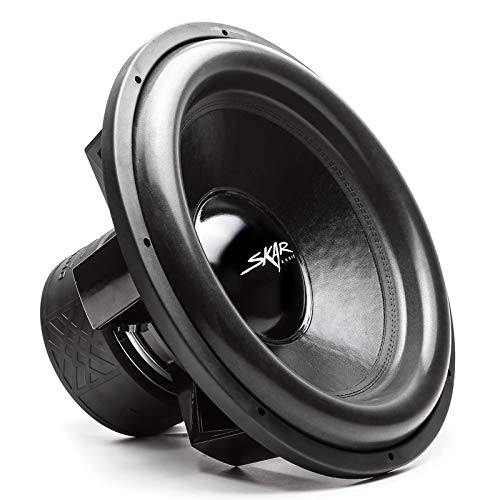
The Skar Audio ZVX-18v2 represents a competition-focused approach to 18-inch bass reproduction. Built around an 8-layer copper voice coil and triple-stacked magnet assembly, this dual 2-ohm subwoofer targets SPL applications where maximum output matters. The manufacturer rates it at 1,600 watts RMS with a 3,200-watt peak capability, positioning it for serious amplifier power and large enclosure volumes.
Verified Specifications
| Specification | Value |
|---|---|
| Voice Coil Configuration | Dual 2 Ohm, 3″ diameter, 8-layer copper |
| Power Handling | 1,600W RMS / 3,200W Peak |
| Magnet Structure | Triple stack assembly |
| Cone Material | Competition grade paper |
| Surround Type | High roll foam |
| Resonant Frequency (Fs) | 26.8 Hz |
| Linear Excursion (Xmax) | 29mm |
Key Features and Practical Benefits
The triple-stack magnet design provides the magnetic force needed to control the 8-layer voice coil through its 29mm of linear excursion. That Xmax figure sits in the upper range for 18-inch drivers, enabling the cone to move substantial air volumes without leaving its linear operating range. The high-temperature copper coil construction addresses thermal concerns that arise when feeding kilowatt-level continuous power into a driver.
Skar specifies a 26.8 Hz resonant frequency, which influences enclosure tuning decisions. In a ported box tuned near this frequency, you can expect extension into the mid-20 Hz range with appropriate cabinet volume. The competition-grade paper cone offers rigidity without the added mass of composite materials, prioritizing efficiency and transient response over cosmetic durability.
The dual 2-ohm configuration provides wiring flexibility. You can wire the coils in series for a 4-ohm load or in parallel for a final 1-ohm impedance, giving you options to match amplifier topology and extract maximum power transfer.
Documented Advantages and Trade-Offs
The advanced airflow cooling system uses strategic venting to move heat away from the voice coil gap. This matters during extended high-power operation, where thermal compression can reduce output and, in extreme cases, cause coil failure. The high roll foam surround contributes to the driver’s excursion capability, though foam surrounds generally require more break-in time than rubber alternatives.
The SPL orientation means this subwoofer prioritizes maximum output over refinement. Competition-grade components are engineered for short-duration bursts at extreme levels rather than extended listening sessions focused on tonal accuracy. The 1,600-watt RMS rating demands a substantial amplifier and electrical system; underpowering this driver leaves its capabilities untapped.
No mounting depth or recommended enclosure volume is provided in the supplied data, which are critical planning details. The triple-stack magnet assembly adds rear depth, and 18-inch SPL subwoofers typically require 4–6 cubic feet minimum in ported configurations.
Who Should Consider It
This subwoofer suits enthusiasts building SPL competition systems or daily drivers focused on maximum bass impact. If your goal is to achieve chest-rattling output and you have the amplifier power and enclosure space to support it, the ZVX-18v2’s design aligns with that purpose.
It’s less appropriate for audiophile-focused systems where tonal balance and low-distortion reproduction at moderate levels take priority. The power requirements also make it impractical for factory electrical systems without upgrades.
Setup and Everyday Use
General best practices for 18-inch high-power subwoofers include ensuring adequate wire gauge—typically 4 AWG or larger from the battery, 8 AWG minimum to the amplifier terminals—and confirming your alternator can sustain the current draw. A subsonic filter set below the enclosure tuning frequency protects the driver from over-excursion on content below its operating range.
Break-in periods for high-excursion drivers typically span 10–20 hours of moderate playback before the suspension reaches full compliance. Initial output may sound constrained; this is normal as the foam surround relaxes. Monitor voice coil temperature during initial high-power sessions; excessive heat indicates insufficient amplifier power, poor enclosure airflow, or impedance mismatch.
Harmony Audio 18" Subwoofer Box Dual 2 Ohm Ported 3000W Monolith

The Harmony Audio HA-ML1X18D2 delivers an 18-inch subwoofer pre-mounted in a vented enclosure, eliminating the need for separate driver purchase and custom box construction. The package combines the Monolith Series dual 2-ohm subwoofer with a ported cabinet designed to optimize its low-frequency extension. Harmony rates the driver at 1,750 watts RMS with a 3,500-watt peak capability, and the complete assembly measures 32.4 × 30 × 26 inches while weighing just over 100 pounds.
Verified Specifications
| Specification | Value |
|---|---|
| Subwoofer Size | 18 inches, Dual 2 Ohm |
| Power Handling | 1,750W RMS / 3,500W Peak |
| Enclosure Type | Vented (ported) |
| Enclosure Dimensions | 32.4 × 30 × 26 inches |
| Total Weight | 100.35 pounds |
| Advertised RMS (listing variance) | 3,000W RMS in title / 1,750W RMS in specs |
Key Features and Practical Benefits
The vented enclosure design uses port tuning to extend low-frequency response below what a sealed box of similar size would achieve. Harmony describes the design as optimized for “deep hard-hitting low end,” which typically corresponds to tuning in the 28–35 Hz range. The ported configuration also increases efficiency, producing more output per watt compared to sealed alignments, though at the cost of steeper rolloff below the tuning frequency.
Pre-mounting the driver in the enclosure saves significant time and removes the complexity of box design, cutting, carpeting, and assembly. For buyers without woodworking tools or experience calculating port dimensions and internal volume, this turnkey approach removes a substantial barrier to entry.
The dual 2-ohm impedance provides wiring options: series connection yields 4 ohms, parallel yields 1 ohm. This flexibility helps match the subwoofer to amplifier output impedance for maximum power transfer. The solid construction mentioned in the product description suggests bracing and material choices intended to minimize cabinet flex under high-power operation.
Documented Advantages and Trade-Offs
The all-in-one format offers convenience and consistency. The enclosure volume, port area, and tuning frequency are engineered together, eliminating guesswork. The universal vehicle fit claim refers to the absence of vehicle-specific mounting hardware; you’ll need to secure the enclosure using the available cargo space and appropriate tie-downs or brackets.
A significant consideration is the size and weight. At over 100 pounds and more than 32 inches in its longest dimension, this enclosure demands substantial cargo area—a full-size SUV, van, or extended-cab truck bed. Standard sedan trunks and many hatchbacks lack the necessary clearance. Permanent installation becomes impractical; this is typically a semi-permanent setup that consumes most usable rear cargo volume.
The product listing shows a discrepancy between the title’s “3000W RMS” and the detailed specifications’ “1750W RMS.” The latter figure aligns more closely with typical continuous power handling for drivers in this class. Prospective buyers should use the 1,750-watt RMS specification for amplifier matching and avoid overdriving the system based on the higher title figure.
Who Should Consider It
This package suits buyers who want maximum bass output without the time or skills to design and build a custom enclosure. If you have the vehicle space to accommodate a large ported box and you’re feeding it with an amplifier in the 1,500–2,000 watt range, this turnkey solution provides immediate results.
It’s less suitable for space-constrained vehicles, anyone requiring frequent cargo access, or enthusiasts who want to fine-tune enclosure parameters for specific frequency response curves. The fixed design also limits future flexibility; you cannot swap drivers or adjust tuning without modifying or replacing the entire assembly.
Setup and Everyday Use
When installing a 100-pound loaded enclosure, plan the lift carefully. Recruit help and use a furniture dolly or hand truck where possible. Position the enclosure with the port facing a rear or side panel for proper acoustic loading; blocking the port with cargo or positioning it inches from a wall reduces output and can cause port noise.
Secure the enclosure to prevent shifting during driving. Unsecured subwoofers become projectiles in sudden stops or collisions. Ratchet straps anchored to factory tie-down points or custom L-brackets bolted through the enclosure base provide adequate retention. Check fasteners periodically; vibration can loosen hardware over time.
General amplifier setup guidance includes gain adjustment using a multimeter and test tones to match input sensitivity to head unit output voltage, preventing clipping distortion. Set the subsonic filter 5 Hz below the enclosure tuning frequency to protect the driver from over-excursion on content below the port’s operating range. The dual 2-ohm configuration wired to 1 ohm final impedance typically pairs with Class D monoblock amplifiers rated for 1-ohm stable operation.
Harmony Audio 18" Competition Subwoofer Dual 1 Ohm 3500W HA-ML181 SPL

The Harmony Audio HA-ML181 is designed for competition-grade SPL applications where maximum output takes priority. According to the manufacturer, this 18-inch subwoofer handles 3500 watts peak power and 1750 watts RMS, positioning it among the higher-power options in this comparison. The dual 1-ohm impedance configuration offers specific wiring flexibility for those running low-impedance competition amplifiers.
Verified Specifications
| Specification | Value |
|---|---|
| Impedance | Dual 1 Ohm |
| Peak Power Handling | 3500 Watts |
| RMS Power Handling | 1750 Watts |
| Weight | 61.1 pounds |
| Dimensions | 21.46 x 21.26 x 16.67 inches |
Key Features and Practical Benefits
The dual 1-ohm impedance allows this subwoofer to be wired to 0.5 ohms in parallel or 2 ohms in series, which is particularly useful for competition setups running high-current amplifiers designed for ultra-low impedance loads. This configuration is less common than dual 2-ohm and requires careful amplifier matching.
The manufacturer highlights a vented T-yoke back plate designed to dissipate heat during sustained high-power use. Thermal management becomes critical at the power levels this subwoofer is rated for, especially in competition environments where extended bursts at maximum output are common. The cone construction uses materials selected for rigidity under high excursion, which helps maintain linearity when pushed hard.
At 61.1 pounds, this subwoofer is noticeably lighter than some competitors in the same power class, which may simplify installation in applications where weight is a consideration. The stated dimensions indicate a fairly standard 18-inch frame footprint.
Documented Advantages and Trade-Offs
The primary advantage is the dual 1-ohm impedance for those specifically seeking this configuration to match competition amplifiers. The vented back plate addresses thermal concerns that arise at sustained high power levels. The manufacturer positions this as competition-ready, which suggests design priorities favoring maximum output over sound quality refinement.
The dual 1-ohm configuration limits amplifier compatibility compared to dual 2-ohm alternatives. If wired in parallel to 0.5 ohms, you’ll need an amplifier specifically rated stable at that impedance—many aren’t. The product information does not specify excursion limits, voice coil details beyond the impedance, or motor structure specifics, making direct technical comparison difficult.
Who Should Consider It
This subwoofer makes sense for SPL competition enthusiasts or those building high-output systems around amplifiers designed for ultra-low impedance operation. If you already own or plan to purchase an amplifier rated stable at 0.5 ohms and want maximum power transfer, the dual 1-ohm configuration directly supports that goal.
This is not the right choice for daily-driven sound quality setups or for buyers without amplifiers specifically designed for 1-ohm or 0.5-ohm loads. The competition focus suggests design compromises that favor output over refinement.
Setup and Everyday Use
Installing an 18-inch subwoofer of this size requires a ported enclosure with significant internal volume—competition applications often use 6 to 8 cubic feet or larger tuned to the lower end of the bass spectrum. Verify your vehicle has adequate space before purchasing.
Wiring a dual 1-ohm subwoofer requires careful attention to impedance matching. In parallel, you present a 0.5-ohm load; in series, 2 ohms. Confirm your amplifier’s specifications at the final impedance before connecting. Use heavy-gauge wire rated for the current levels these power ratings demand, and ensure all connections are secure to prevent resistance that generates heat.
The vented back plate design requires adequate airflow behind the subwoofer. Avoid completely sealing the rear of the enclosure in a way that blocks these vents, as doing so defeats the thermal management design. Competition use at sustained high volume will generate significant heat regardless of venting, so monitor amplifier and voice coil temperatures during initial testing.
Detailed Buying Guide for Best 18 Inch Car Subwoofer
Choosing an 18-inch subwoofer means committing to a substantial enclosure, significant power demands, and the potential for truly floor-shaking bass. These drivers are built for enthusiasts who want maximum SPL, competition-grade output, or simply the deepest low-frequency extension possible in a car audio system. Understanding what separates one 18″ sub from another helps match the driver to your amplifier, vehicle space, and listening goals.
Power Handling and Amplifier Requirements
RMS wattage is the continuous power rating a subwoofer can handle safely over extended periods. The supplied products range from 650 watts RMS on the CT Sounds TROPO-18-D2 up to 2000 watts RMS on the Sundown Audio M18. Peak power numbers are less useful for amplifier matching; focus on RMS when sizing your amplifier to avoid under-driving or clipping distortion.
Voice coil impedance determines how you wire the subwoofer to your amplifier’s output. Dual 2-ohm configurations can be wired to present a 1-ohm or 4-ohm load, while dual 1-ohm setups allow for a 0.5-ohm or 2-ohm final impedance. Verify that your amplifier is stable at the impedance you intend to run; many competition amplifiers can handle sub-ohm loads, but not all amplifiers are rated for this. Matching impedance correctly ensures efficient power transfer and prevents overheating.
Excursion and Motor Design
Xmax, or one-way linear excursion, measures how far the cone can move in one direction while remaining within the magnetic field’s linear control region. The Sundown M18 lists 35mm Xmax, while the Skar ZVX-18v2 specifies 29mm. Greater excursion allows the driver to move more air, which translates to deeper bass and higher output at lower frequencies without mechanical distortion. Drivers with shorter excursion can still perform well but typically require larger enclosures or higher tuning frequencies to achieve similar output levels.
Motor structure—magnet size, voice coil diameter, and cooling design—determines how much force the driver can generate and how efficiently it dissipates heat. Multi-layer voice coils and vented pole pieces help manage thermal stress during sustained high-power operation, which is critical for SPL competition or extended listening at high volume.
Enclosure Type and Volume Requirements
Sealed enclosures offer tight, accurate bass and require less volume, typically around 3.0 to 4.0 cubic feet for an 18-inch driver. Ported (vented) enclosures produce higher output and deeper extension but demand significantly more space—often 6.0 to 8.0 cubic feet or more—and require precise tuning to match the driver’s parameters. The Sundown M18, for example, is optimized for a 7.0 cubic foot ported enclosure tuned to 32 Hz with 112 square inches of port area.
Choosing between sealed and ported depends on available trunk or cargo space, desired bass character, and whether you prioritize accuracy or raw SPL. Infinite baffle installations, where the subwoofer is mounted directly into a partition between the trunk and cabin, eliminate the enclosure entirely but require a driver designed for free-air use and adequate rear-wave absorption.
Build Quality and Thermal Management
High-power subwoofers generate substantial heat, especially during competition runs or extended bass-heavy playback. Look for features such as vented T-yoke back plates, aluminum voice coil formers, heavily vented magnetic gaps, and large-diameter pole vents. These design elements improve airflow around the voice coil and reduce thermal compression, which can otherwise cause power handling to drop and sound quality to degrade as the coil heats up.
Cone materials and surround construction also matter. Carbon fiber reinforced cones resist flexing at high excursion, while high-roll foam or rubber surrounds allow greater cone travel without mechanical failure. Competition-grade drivers typically use stiffer materials to handle extreme power and excursion without cone breakup or distortion.
Impedance Compatibility and Wiring Flexibility
Dual voice coil subwoofers offer wiring flexibility. If you plan to run multiple 18-inch drivers, dual 2-ohm or dual 1-ohm configurations let you wire the subs in series-parallel arrangements to present a stable load to your amplifier. Single voice coil drivers are simpler but limit your options when building multi-sub arrays. Always verify your amplifier’s minimum stable impedance before finalizing a wiring plan.
If you’re new to multi-sub wiring or working with high-current amplifiers, understanding how amplifier bridging and voice coil configurations interact can prevent costly mistakes and ensure you get the most from your system.
Vehicle Space and Installation Planning
An 18-inch subwoofer in a properly sized ported enclosure can easily occupy 8 to 10 cubic feet once port volume and material thickness are accounted for. Measure your trunk, cargo area, or under-seat space carefully before committing to a specific driver. Pre-loaded enclosures, like the Harmony Audio HA-ML1X18D2 Subwoofer Box, provide a turn-key solution but still require substantial room—this particular enclosure measures over 32 inches wide and weighs more than 100 pounds.
Consider access for installation, wiring routing, and whether the enclosure will block rear visibility or interfere with cargo use. Large enclosures may also require reinforcement or additional bracing to prevent rattling or structural resonance, especially at high output levels.
Installation, Assembly and First-Time Setup
Installing an 18-inch subwoofer starts with verifying that your vehicle’s electrical system can support the power demands. A high-output alternator and an upgraded battery are often necessary for systems drawing more than 1500 watts RMS. Run appropriate gauge power and ground wire directly from the battery to the amplifier location—typically 1/0 or 2 AWG for high-current systems—and install an inline fuse or circuit breaker within 18 inches of the battery terminal.
Mount the subwoofer securely to the enclosure using the manufacturer-supplied hardware or appropriately sized machine screws. Over-tightening can crack the mounting flange or strip threads; snug the screws evenly in a star pattern rather than tightening one fully before moving to the next. If building a custom enclosure, ensure all internal bracing is solid and all seams are sealed with wood glue or silicone to prevent air leaks, which degrade bass output and can cause port noise.
Connect the amplifier’s output terminals to the subwoofer’s voice coil terminals using high-quality speaker wire—12 to 16 AWG depending on wire length and current demands. Strip only enough insulation to make a clean connection, and secure terminals tightly. Verify polarity by checking that positive amplifier output connects to positive voice coil terminal, and negative to negative. Reversed polarity on one sub in a multi-driver system will cause phase cancellation and severely reduce output.
Set the amplifier’s gain control to match your head unit’s output voltage. Start with the gain at minimum, play a familiar bass-heavy track at approximately 75% head unit volume, and slowly increase gain until you hear distortion or clipping, then back off slightly. Use a multimeter or oscilloscope if available to set gain more precisely. Set the subsonic filter, if present, to protect the driver from infrasonic frequencies below its tuning range, typically 5 to 10 Hz below the port tuning frequency for ported enclosures.
Maintenance and Common Troubleshooting
Inspect voice coil terminals and speaker wire connections periodically, especially after the first few weeks of use when vibration can loosen hardware. Check that mounting screws remain snug and that the surround shows no tears or separation from the cone or basket. Dust and debris can accumulate around the voice coil gap; use compressed air to gently clear the area around the cone if necessary, but avoid direct contact with the cone or surround.
If the subwoofer suddenly loses output or sounds distorted, first verify amplifier settings and connections. Clipping or sustained overpowering can damage the voice coil, often indicated by a burnt smell or complete loss of sound. Measure the subwoofer’s DC resistance with a multimeter; a reading far below the nominal impedance or an open circuit indicates coil failure. Mechanical noise such as scraping or rubbing during excursion usually means the voice coil is no longer centered in the gap, often caused by impact damage or over-excursion.
Enclosures can develop air leaks over time, particularly at seams and around the subwoofer mounting surface. Listen for hissing or whistling at high output levels, and re-seal any gaps with silicone sealant. Rattles or vibrations from the enclosure itself can be reduced by adding internal bracing or applying dampening material to large flat panels. Proper maintenance extends driver life and ensures consistent performance, especially under demanding use.
Frequently Asked Questions
What size amplifier do I need for an 18-inch subwoofer?
Match the amplifier’s RMS output to the subwoofer’s RMS power handling at the impedance you plan to wire. For a 1600-watt RMS subwoofer wired to 2 ohms, choose an amplifier rated for at least 1600 watts RMS at 2 ohms. Under-powering is safer than over-powering, but significantly under-powering can lead to clipping distortion if you push the system too hard.
Can I run an 18-inch subwoofer on a factory alternator?
Factory alternators typically provide 80 to 120 amps, which may struggle to support systems drawing more than 1200 to 1500 watts continuously. High-power 18-inch subwoofers, particularly those rated above 2000 watts RMS, often require a high-output alternator and upgraded battery to prevent voltage sag and dimming headlights during bass peaks.
How much trunk space does an 18-inch ported subwoofer enclosure require?
A properly sized ported enclosure for an 18-inch driver typically requires 6.0 to 8.0 cubic feet net internal volume, plus additional space for port displacement and material thickness. Expect the finished box to measure 30 to 36 inches in at least one dimension, depending on the design and tuning frequency.
What is the difference between dual 1-ohm and dual 2-ohm voice coils?
Dual 1-ohm coils can be wired in series for a 2-ohm load or in parallel for a 0.5-ohm load. Dual 2-ohm coils can be wired in series for a 4-ohm load or in parallel for a 1-ohm load. Choose the configuration that matches your amplifier’s stable impedance range and the total impedance of your subwoofer array.
Do I need a subsonic filter for an 18-inch subwoofer?
Yes, especially in ported enclosures. A subsonic filter blocks infrasonic frequencies below the enclosure’s tuning frequency, which the driver cannot reproduce efficiently and which can cause excessive cone excursion and potential damage. Set the subsonic filter 5 to 10 Hz below the port tuning frequency for best protection.
Can I use an 18-inch subwoofer in a sealed enclosure?
Yes, though sealed enclosures for 18-inch drivers still require substantial volume—typically 3.0 to 4.0 cubic feet. Sealed boxes provide tighter, more accurate bass and better power handling but produce less output and less deep extension than a properly tuned ported enclosure of the same driver.
How do I know if my subwoofer voice coil is damaged?
Measure the DC resistance across the voice coil terminals with a multimeter. A dual 2-ohm coil should read approximately 1.6 to 2.2 ohms per coil; a reading far below this range, infinite resistance, or intermittent connection indicates coil damage. A burnt smell, complete loss of sound, or mechanical scraping during cone movement are also clear signs of failure.
What tuning frequency should I use for a ported 18-inch subwoofer enclosure?
Tuning frequency depends on the driver’s parameters and your listening preferences. Most 18-inch SPL subwoofers perform well tuned between 30 and 35 Hz, balancing deep extension with high output. Lower tuning increases extension but requires more enclosure volume and larger port area; higher tuning increases efficiency and output at the expense of the deepest frequencies. Consult the manufacturer’s recommended enclosure specifications for best results.
Final Verdict
The right 18-inch subwoofer depends on your power budget, available space, and whether you prioritize SPL competition output or daily-driver musicality. The Sundown Audio M18 offers the highest power handling and excursion for serious SPL applications, while the CT Sounds TROPO-18-D2 provides a more approachable entry point for enthusiasts building their first large-format system. Pre-loaded enclosures like the Harmony Audio HA-ML1X18D2 eliminate the guesswork of box design but demand significant cargo space. Match the driver’s RMS rating to a quality amplifier, plan your enclosure carefully, and verify your vehicle’s electrical system can support the load before installation.