Houston drivers pay some of the highest auto insurance rates in Texas due to dense traffic, frequent hailstorms, and elevated flood risk. Use this car insurance calculator for Houston to estimate your annual and monthly premium based on your driver profile, vehicle details, and chosen coverage level. Simply fill in the fields below and get an instant ballpark figure to help you compare quotes from licensed Texas insurers. Results are estimates only and do not constitute an insurance offer or binding quote.
Car Insurance Calculator Houston: Estimate Your Annual Cost
Estimate your Houston car insurance premium instantly using key rating factors including driver age, driving record, coverage level, vehicle value, flood risk zone, and available discounts.
How to Use This Calculator

Follow these steps to get your personalized Houston car insurance estimate:
- Enter your base annual premium — use the default $1,800 (approximate Houston full-coverage average) or adjust it to match a quoted base rate from your insurer.
- Select your driver age group — teen and young adult drivers carry significantly higher multipliers due to actuarial risk data.
- Choose your driving record — violations and at-fault accidents raise your multiplier; a clean record keeps costs lowest.
- Pick your coverage level — Texas minimum liability is the cheapest option; premium full coverage is the most comprehensive.
- Enter your vehicle’s current market value — use the actual cash value (ACV), not the original purchase price or loan balance.
- Select remaining factors — vehicle age, deductible, credit score tier, annual mileage, flood-risk zone, bundle discount, and safety discounts all adjust your estimate.
- Review your results — six output cards show your estimated annual and monthly premiums, component breakdowns, 3-year cost, and potential discount savings.
Understanding the Calculator Inputs
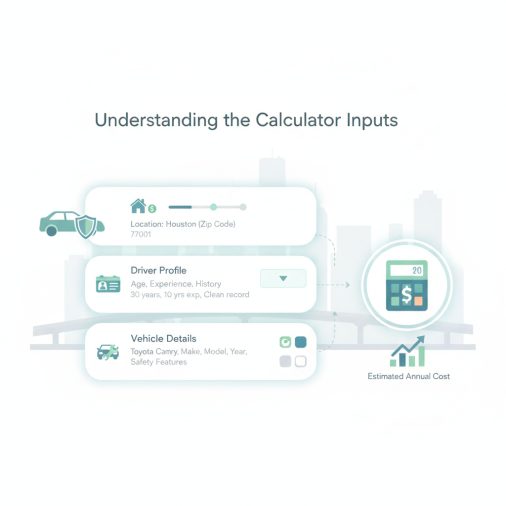
Houston Base Annual Premium ($): This is your starting point. The default value of $1,800 reflects the approximate 2023–2024 Houston metro average for standard full-coverage auto insurance based on industry survey data. If you have already received a base quote from an insurer, replace this figure with that number for a more personalized estimate. The field accepts values from $500 to $8,000 in $50 increments.
Driver Age Group: Age is one of the strongest actuarial rating factors in auto insurance. Teen drivers (16–19) carry a multiplier of 2.1x, reflecting their statistically higher crash rates. Young adults (20–24) are rated at 1.5x. Drivers aged 25–54 are considered the lowest-risk cohort. Seniors (65+) see a modest increase to 1.2x due to elevated injury severity risk.
Driving Record: Your claims and violation history directly affects your premium. A clean record applies no surcharge. A single minor violation (speeding ticket) adds 20%. Two or more minor violations add 45%. An at-fault accident adds 40%. A DUI or DWI conviction — which triggers an SR-22 requirement in Texas — adds 85% and may place you in the non-standard market.
Coverage Level: Texas state law requires minimum 30/60/25 liability coverage. Selecting minimum liability only reduces your premium to roughly 45% of the full-coverage base. Adding Personal Injury Protection (PIP) brings it to 55%. Standard full coverage (liability + comprehensive + collision) is the 1.0 baseline. Upgraded and premium full-coverage tiers add 20–40% for higher limits and lower deductibles on physical damage.
Vehicle Market Value ($): Enter the current actual cash value (ACV) of your vehicle — what it would sell for today, not what you paid for it or what you owe on a loan. This figure drives the comprehensive and collision component calculation. Use a resource like Kelley Blue Book or NADA Guides to find your vehicle’s current ACV.
Vehicle Age: Newer vehicles cost more to insure for physical damage because replacement parts and repair labor are more expensive. A vehicle 0–2 years old carries a 1.15x multiplier. Vehicles 16 years or older drop to 0.65x, reflecting their lower ACV and reduced comprehensive/collision exposure.
Deductible Amount: Your deductible is the amount you pay out of pocket before insurance pays on a comprehensive or collision claim. A $250 deductible increases your premium by 18% compared to the $500 baseline. Choosing a $1,000 deductible saves 13%; a $2,000 deductible saves 28%. Higher deductibles make sense if you have sufficient emergency savings to cover the out-of-pocket cost.
Credit Score Tier: Texas law permits insurers to use credit-based insurance scores as a rating factor. Drivers with excellent credit (750+) receive an 12% discount. Fair credit (650–699) adds 18%. Very poor credit (below 600) can increase premiums by 60%. If you believe your credit score has been used incorrectly, the Texas Department of Insurance (TDI) provides a dispute process.
Annual Mileage: More miles driven means more exposure to accidents. Drivers logging under 7,500 miles per year receive a 10% discount. Those driving over 20,000 miles annually pay 22% more than the average-mileage baseline of 7,500–12,000 miles.
Houston Flood-Risk ZIP Zone: Houston’s unique geography — including Brays Bayou, Buffalo Bayou, the Addicks and Barker Reservoir areas, and low-lying neighborhoods — creates significant flood exposure that affects comprehensive premiums. Select your zone based on FEMA flood map data available at msc.fema.gov. High-risk FEMA Zone AE properties carry an 18% surcharge on this calculator.
Multi-Policy (Bundle) Discount: Bundling your auto policy with a homeowners or renters policy from the same insurer typically saves 10%. Adding a life insurance policy to the bundle can push savings to 15%. This is one of the most reliable and widely available discounts in the Texas market.
Safety & Telematics Discounts: Anti-theft devices provide a modest 3% reduction. Completing a state-approved defensive driving course saves 5%. Enrolling in a telematics or usage-based insurance (UBI) program — where your insurer monitors driving behavior via an app or plug-in device — can save up to 10% or more depending on your actual driving score. Stacking multiple safety discounts can reduce your premium by 15%.
Understanding Your Results
Estimated Annual Premium: This is your primary output — the total estimated cost of your auto insurance policy for one year, incorporating all selected rating factors. Use this figure as a benchmark when comparing quotes from licensed Texas insurers. Remember that actual insurer quotes will reflect proprietary algorithms, underwriting guidelines, and market conditions not captured here.
Estimated Monthly Premium: Your annual estimate divided by 12. Many Houston drivers pay monthly, but be aware that insurers often charge a small installment fee (typically $3–$10 per month) for monthly billing that is not reflected in this estimate. Paying your full annual premium upfront usually eliminates this fee.
Estimated Comprehensive & Collision Component: This card isolates the physical damage portion of your premium — the part that pays to repair or replace your vehicle after a covered event such as a collision, hailstorm, flood, theft, or fire. It is calculated as approximately 3.5% of your vehicle’s ACV, adjusted for vehicle age, deductible, flood zone, and coverage level. In Houston, hail and flood events make this component particularly significant.
Estimated Liability & PIP Component: This output estimates the portion of your premium that covers bodily injury liability, property damage liability, and personal injury protection. Unlike the physical damage component, this portion scales primarily with driver risk factors (age, record, mileage, credit) rather than vehicle value. It represents approximately 45% of the base rate before driver-risk adjustments.
Total Estimated 3-Year Cost: Your annual estimate multiplied by three. This figure helps you evaluate the long-term financial impact of your coverage choices and compare the cost of different deductible or coverage-level scenarios over a realistic policy horizon. It assumes your profile and market rates remain constant, which is unlikely but useful for planning purposes.
Potential Annual Savings vs. No Discounts: This result shows the dollar value of your selected bundle and safety discounts compared to carrying no discounts at all. If this number is zero, you have not selected any discounts. Maximizing this figure by bundling policies and enrolling in telematics programs is one of the most actionable ways to reduce your Houston insurance costs.
Calculation Formulas Explained
The calculator uses a multiplicative rating factor model, which is the standard approach in personal auto insurance actuarial practice. Each factor is a decimal multiplier applied sequentially to the base annual premium. A factor above 1.0 increases the premium; a factor below 1.0 decreases it.
Annual Premium Formula: The estimated annual premium equals the base rate multiplied by all twelve rating factors: driver age factor, driving record factor, coverage level factor, vehicle age factor, deductible factor, credit score factor, annual mileage factor, flood ZIP factor, multi-policy discount, and safety discount factor. Written out: Annual Premium = base_rate × driver_age_factor × driving_record_factor × coverage_level_factor × vehicle_age_factor × deductible_factor × credit_score_factor × annual_mileage_factor × flood_zip_factor × multi_policy_discount × safety_discount_factor.
Monthly Premium: Annual premium divided by 12.
Comprehensive & Collision Component: Calculated as 3.5% of vehicle market value (a widely cited industry approximation for physical damage premiums), then adjusted by vehicle age factor, deductible factor, flood ZIP factor, and coverage level factor. Formula: vehicle_value × 0.035 × vehicle_age_factor × deductible_factor × flood_zip_factor × coverage_level_factor.
Liability & PIP Component: Estimated as 45% of the base rate, then adjusted by driver-risk factors (age, record, mileage, credit) that primarily affect liability exposure rather than vehicle value. Formula: base_rate × 0.45 × driver_age_factor × driving_record_factor × annual_mileage_factor × credit_score_factor.
3-Year Cost: Annual premium multiplied by 3.
Discount Savings: The difference between the pre-discount annual premium (without multi-policy and safety discount factors applied) and the post-discount annual premium. This isolates the dollar value of the two discount fields.
Worked Example
Example: 32-year-old Houston driver, clean record, standard full coverage
- Base Rate: $1,800 (default Houston average)
- Driver Age Factor (25–34): 1.15 → $1,800 × 1.15 = $2,070
- Driving Record (Clean): 1.0 → $2,070 × 1.0 = $2,070
- Coverage Level (Standard Full Coverage): 1.0 → $2,070 × 1.0 = $2,070
- Vehicle Value: $28,000 (used for comp/collision component separately)
- Vehicle Age (3–5 years): 1.0 → $2,070 × 1.0 = $2,070
- Deductible ($500): 1.0 → $2,070 × 1.0 = $2,070
- Credit Score (Good, 700–749): 1.0 → $2,070 × 1.0 = $2,070
- Annual Mileage (7,500–12,000): 1.0 → $2,070 × 1.0 = $2,070
- Flood ZIP (Moderate risk): 1.08 → $2,070 × 1.08 = $2,235.60
- Bundle Discount (home/renters): 0.90 → $2,235.60 × 0.90 = $2,012.04
- Safety Discount (telematics): 0.90 → $2,012.04 × 0.90 = $1,810.84
Estimated Annual Premium: $1,810.84 | Monthly: $150.90
Comp & Collision Component: $28,000 × 0.035 × 1.0 × 1.0 × 1.08 × 1.0 = $1,058.40/year
Liability & PIP Component: $1,800 × 0.45 × 1.15 × 1.0 × 1.0 × 1.0 = $931.50/year
3-Year Cost: $5,432.52 | Discount Savings vs. No Discounts: $446.80/year
How to Interpret the Results
Use your estimated annual premium as a planning benchmark, not a final price. If your estimate falls significantly below or above quotes you receive from insurers, the most likely explanation is that your base rate input does not match the insurer’s own base for your specific vehicle, ZIP code, and underwriting tier.
A useful rule of thumb: if your estimated annual premium exceeds 10% of your vehicle’s current market value, it may be worth evaluating whether full coverage is cost-effective — particularly for older vehicles. For example, if your car is worth $8,000 and your full-coverage estimate is $1,600 per year, you are paying 20% of the vehicle’s value annually for physical damage protection.
The discount savings result is especially actionable. If it shows $300 or more in annual savings, prioritize calling your insurer to confirm you are receiving all eligible discounts. Many Houston drivers leave bundling and telematics discounts unclaimed simply because they did not ask.
For flood-risk zones, note that standard auto comprehensive coverage does cover flood damage to your vehicle — unlike homeowners insurance, which requires a separate NFIP flood policy. If you live in a high-risk FEMA Zone AE neighborhood, maintaining comprehensive coverage is strongly advisable regardless of your vehicle’s age.
Common Mistakes to Avoid
- Using purchase price instead of ACV: Entering what you paid for your car rather than its current market value overstates the comprehensive and collision component. Use a current valuation tool to find your vehicle’s actual cash value.
- Selecting minimum liability to save money without understanding the risk: Texas minimum 30/60/25 limits are low by modern standards. A serious accident can easily exceed these limits, leaving you personally liable for the difference. The premium savings may not justify the financial exposure.
- Ignoring the credit score factor: Many Houston drivers are unaware that Texas insurers can legally use credit-based insurance scores. Improving your credit score from Poor to Good can reduce your premium by more than 25% on this calculator — and in real-world quotes.
- Not accounting for installment fees: Monthly payment plans often include per-installment fees that add $36–$120 per year to your effective cost. The monthly result shown here does not include those fees.
- Forgetting to update coverage after paying off a vehicle loan: Lenders require full coverage while a loan is outstanding. Once the loan is paid off, you may choose to drop collision or comprehensive on older vehicles — but many drivers forget to reassess and continue paying for coverage they no longer need.
- Assuming all ZIP codes in Houston are rated the same: Insurers rate by specific ZIP code. A home in Meyerland (high flood risk) will carry a materially different comprehensive premium than one in The Woodlands or Sugar Land, even within the broader Houston metro area.
Limitations and Important Notes
This calculator is an independent planning tool and does not represent, replicate, or affiliate with any specific insurance company, broker, or the Texas Department of Insurance. Results are estimates based on generalized actuarial multipliers and should not be treated as a binding quote, offer of insurance, or guarantee of any specific premium.
The following factors are not modeled and may significantly affect your actual premium: SR-22 or FR-44 filings, non-standard or high-risk market placement, commercial vehicle use, rideshare (TNC) endorsements, exotic or collector vehicle classifications, multi-vehicle household discounts, good student discounts, military discounts, continuous coverage discounts, and insurer-specific underwriting guidelines.
The base rate default of $1,800 is derived from publicly available industry survey averages for the Houston metro area and may not reflect current market conditions, your specific insurer’s pricing, or rate changes filed with the TDI after the calculator’s last update. Always obtain at least three competitive quotes from licensed Texas insurers before making a coverage decision.
Flood risk zone classifications used here are generalized into three tiers. Your actual FEMA flood zone designation should be verified at the official FEMA Flood Map Service Center (msc.fema.gov). This calculator does not constitute flood insurance advice.
Frequently Asked Questions
What is the average cost of car insurance in Houston, TX?
Based on industry survey data for 2023–2024, Houston drivers pay approximately $1,600–$2,200 per year for standard full-coverage auto insurance, making it one of the more expensive markets in Texas. The Houston metro average is notably higher than the Texas statewide average of roughly $1,400–$1,600 per year for full coverage. Factors driving Houston’s elevated rates include high population density, frequent severe weather events (hail, flooding), elevated vehicle theft rates, and high medical cost inflation in the region. Minimum liability-only coverage in Houston typically runs $600–$900 per year for a driver with a clean record and good credit.
Is car insurance more expensive in Houston than the rest of Texas?
Yes, in most cases. Houston consistently ranks among the most expensive cities in Texas for auto insurance, alongside Dallas and San Antonio. The primary reasons are higher traffic density (more accidents per mile driven), a greater frequency of comprehensive claims from hailstorms and flooding, higher average vehicle repair costs, and elevated uninsured motorist rates in Harris County. Drivers relocating to Houston from smaller Texas cities or rural areas should expect their premiums to increase, sometimes by 20–40%, even with no change to their driving record or coverage level.
Does Houston's flood risk affect my car insurance premium?
Yes, and it affects the comprehensive portion of your premium specifically. Standard auto comprehensive coverage does cover flood damage to your vehicle — this is an important distinction from homeowners insurance, which requires a separate National Flood Insurance Program (NFIP) policy for structural flood damage. Houston’s geography, including its bayou system and flat terrain, makes it one of the most flood-prone major cities in the United States. Insurers price this risk into comprehensive premiums, particularly for drivers in FEMA-designated Special Flood Hazard Areas (Zone AE). If you live in a high-risk flood zone, maintaining comprehensive coverage is strongly advisable regardless of your vehicle’s age or value. You can verify your specific flood zone at msc.fema.gov. If you have questions about what your auto policy covers after a flood event, you may also want to review whether related items like child car seats are covered by auto insurance after an accident or flood claim.
What is the Texas minimum car insurance requirement?
Texas law requires all drivers to carry minimum liability coverage of 30/60/25: $30,000 for bodily injury per person, $60,000 for bodily injury per accident, and $25,000 for property damage per accident. These limits have not been updated in many years and are considered low relative to the cost of modern vehicles and medical care. Texas also requires insurers to offer Personal Injury Protection (PIP) coverage of at least $2,500, though drivers may reject it in writing. Uninsured/underinsured motorist (UM/UIM) coverage must also be offered but can be rejected in writing. Driving without the required minimum coverage in Texas can result in fines, license suspension, and vehicle impoundment.
Can my credit score affect my car insurance rate in Texas?
Yes. Texas is one of the majority of U.S. states that permits insurers to use credit-based insurance scores as a rating factor. Insurers use a specialized version of your credit score — not your FICO score directly — that weighs factors like payment history, outstanding debt, and length of credit history. Drivers with excellent credit can pay 20–30% less than drivers with poor credit for identical coverage and driving records. If you believe an insurer has used your credit information incorrectly, you have the right to request a re-rating under Texas Insurance Code rules. The Texas Department of Insurance (TDI) at tdi.texas.gov provides consumer resources on this topic.
How does a DUI or DWI affect car insurance rates in Houston?
A DUI or DWI conviction is one of the most severe rating events in personal auto insurance. In Texas, a DWI conviction typically triggers an SR-22 filing requirement — a certificate of financial responsibility that your insurer files with the Texas Department of Public Safety (DPS) to confirm you carry the required minimum coverage. SR-22 status itself signals high risk to insurers and often results in placement in the non-standard (high-risk) insurance market. Premium increases of 70–100% or more are common following a DWI conviction, and the surcharge typically remains on your record for three to five years. This calculator applies an 85% surcharge multiplier for DUI/DWI, which is a conservative midpoint estimate; actual increases may be higher depending on the insurer and circumstances.
What discounts are most commonly available to Houston drivers?
The most widely available and impactful discounts for Houston-area drivers include: multi-policy bundling (combining auto with home, renters, or life insurance, typically saving 10–15%); telematics or usage-based insurance programs (saving up to 10–30% based on actual driving behavior); defensive driving course completion (5–10% in Texas); anti-theft device discounts (3–5%); good student discounts for drivers under 25 with a qualifying GPA; continuous coverage discounts for drivers who have maintained uninterrupted insurance; and paid-in-full discounts for paying the annual premium upfront rather than monthly. Not all discounts are available from every insurer, so it is worth asking each company specifically which discounts apply to your profile.
Should I drop comprehensive coverage on an older vehicle in Houston?
This is a common financial planning question, and the answer depends on your vehicle’s current actual cash value (ACV) and your ability to absorb an out-of-pocket loss. A widely used rule of thumb is to consider dropping comprehensive and collision coverage when the annual premium for those coverages exceeds 10% of the vehicle’s ACV. For example, if your car is worth $5,000 and your comp and collision premium is $700 per year, you are paying 14% of the vehicle’s value annually — and in the event of a total loss, you would receive at most $5,000 minus your deductible. However, Houston’s elevated flood and hail risk complicates this calculation. Even an older vehicle can sustain a total-loss flood claim, making comprehensive coverage more valuable here than in drier markets. Weigh the premium cost against the realistic probability of a comprehensive claim in your specific neighborhood.