Use this car finance calculator to instantly estimate your monthly repayments, total interest, and the full cost of your car loan in Australia. Simply enter your vehicle price, deposit amount, loan term, and interest rate to see a clear breakdown of what you will pay over the life of the loan. Whether you are buying new or used, through a dealer or a bank, understanding your repayments before you sign helps you budget confidently and compare finance offers side by side.
Car Finance Calculator Australia: Monthly Repayments & Total Cost
Estimate your Australian car loan monthly repayments, total interest paid, and full vehicle cost using standard reducing-balance loan mathematics with support for balloon payments and lender fees.
How to Use This Calculator
Follow these steps to get an accurate estimate of your Australian car loan costs:
- Enter the vehicle price — type the full purchase price of the car including any dealer delivery charges.
- Enter your deposit or trade-in value — include any cash you are putting down plus the agreed trade-in value of your current vehicle. This reduces the amount you need to borrow.
- Select your loan term — choose how many years you want to repay the loan, from 1 to 7 years.
- Set the annual interest rate — drag the slider to match the rate quoted by your lender. Use the advertised rate, not the comparison rate, for this field.
- Enter a balloon payment if applicable — if your loan includes a residual or balloon amount due at the end, enter it here. Leave at zero if your loan has no balloon.
- Enter lender fees — add the establishment fee and any monthly account fee your lender charges. Check your loan contract or product disclosure statement for these figures.
- Read your results — the calculator instantly shows your monthly repayment, total interest, total amount repaid, total vehicle cost, and interest as a percentage of the vehicle price.
Understanding the Calculator Inputs
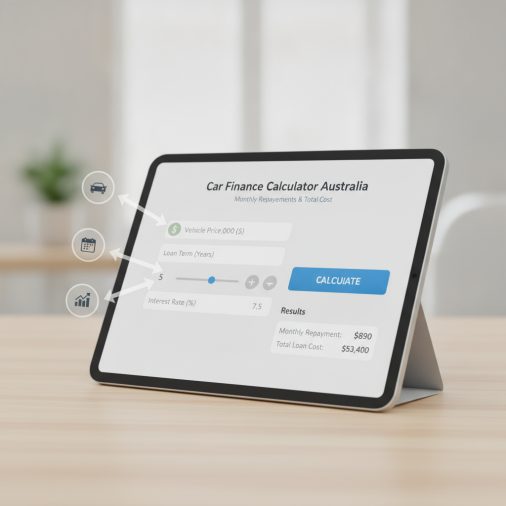
Vehicle Price (AUD): Enter the full on-road price of the car as agreed with the dealer or private seller. This should include any dealer delivery fee but not stamp duty or registration, which you will typically pay separately. The default is $35,000, which is close to the Australian median for a used car purchase.
Deposit / Trade-In Value (AUD): Enter the total amount you are contributing upfront. This can be a cash deposit, the agreed trade-in value of your existing vehicle, or a combination of both. A larger deposit directly reduces the principal you borrow and therefore reduces both your monthly repayment and total interest paid.
Loan Term (Years): Select how long you want to take to repay the loan. Australian car loans typically range from 1 to 7 years. A shorter term means higher monthly repayments but significantly less interest paid overall. A longer term lowers your monthly repayment but increases the total cost of the loan.
Annual Interest Rate (%): Drag the slider to the advertised annual interest rate quoted by your lender. This is the nominal rate, not the comparison rate. Australian car loan rates vary widely — secured loans on new cars from banks and credit unions typically sit between 6% and 10% per annum, while unsecured or bad-credit loans can exceed 20%. Check your loan offer document carefully.
Balloon / Residual Payment (AUD): Some Australian car loans, particularly novated leases and dealer finance products, include a balloon payment — a lump sum due at the end of the loan term. Entering a balloon amount reduces your monthly repayments during the loan but means you must pay or refinance a large sum at the end. Leave this at zero if your loan has no balloon component.
Loan Establishment Fee (AUD): Many Australian lenders charge an upfront fee to set up the loan, typically between $150 and $600. Check your loan contract or product disclosure statement. This fee is added to your total cost but is not added to the financed principal in this calculator — it is assumed to be paid upfront.
Monthly Account Fee (AUD): Some lenders charge an ongoing monthly administration fee, commonly between $5 and $15. This is added to each monthly repayment and accumulates significantly over a long loan term. If your lender charges no monthly fee, set this to zero.
Understanding Your Results
Loan Amount (Principal): This is the net amount you are borrowing — the vehicle price minus your deposit and trade-in value. All interest calculations are based on this figure. Reducing this number by increasing your deposit is the single most effective way to lower your total loan cost.
Monthly Repayment: This is the fixed amount you will pay each month for the duration of the loan term. It includes the interest and principal component calculated using the reducing-balance formula, plus any monthly account fee. This is the figure to compare against your monthly budget and against competing loan offers.
Total Amount Repaid: This is the sum of every dollar you will pay to the lender over the life of the loan — all monthly repayments multiplied by the number of months, plus the balloon payment at the end, plus the upfront establishment fee. It does not include your deposit, which you paid directly toward the vehicle.
Total Interest Paid: This is the true cost of borrowing — the total amount repaid minus the original principal. It includes all interest charges, monthly fees accumulated over the loan term, and the establishment fee. This figure is the most useful for comparing two loan offers with different rates and fee structures.
Total Cost of Vehicle: This is the complete out-of-pocket cost of owning the vehicle, including your deposit, all loan repayments, the balloon payment, and all fees. It represents the real price you paid for the car when financing is taken into account.
Interest as % of Vehicle Price: This expresses the total interest and fees as a percentage of the vehicle’s purchase price. It gives you a quick, intuitive sense of the financing premium. For example, a result of 20% means you paid an extra 20 cents in interest and fees for every dollar of the car’s sticker price.
Calculation Formulas Explained
The calculator uses the standard reducing-balance amortisation formula, which is the method used by Australian banks, credit unions, and most finance companies for personal and car loans. Under this method, each monthly repayment covers the interest accrued on the outstanding balance during that month, with the remainder reducing the principal. As the principal falls, the interest component of each repayment decreases and the principal component increases.
The monthly repayment formula for a loan with a balloon payment is:
Monthly Repayment = [ P × r × (1 + r)^n − B × r^n ] / [ (1 + r)^n − 1 ] + monthly_fee
Where: P = principal (vehicle price minus deposit); r = monthly interest rate (annual rate divided by 12, then divided by 100 to convert from percentage); n = total number of monthly repayments (loan term in years multiplied by 12); B = balloon payment amount.
When the balloon payment is zero, the formula simplifies to the standard mortgage-style amortisation formula. The max(0, …) wrapper prevents the formula from returning a negative repayment in edge cases where the balloon payment is very large relative to the loan.
The Total Amount Repaid is the monthly repayment multiplied by the number of months, plus the balloon payment, plus the establishment fee. The Total Interest Paid subtracts the original principal from the total amount repaid, leaving only the cost of borrowing. The Total Cost of Vehicle adds the deposit back in to show the complete out-of-pocket expenditure. The Interest as % of Vehicle Price divides total interest paid by the vehicle price and multiplies by 100.
The annual interest rate is treated as a nominal rate compounded monthly. This is the standard convention for Australian personal and car loans. It is not an effective annual rate and it is not the comparison rate.
Worked Example
Scenario: Sarah wants to buy a used SUV priced at $42,000. She has $7,000 saved as a deposit. She has been offered a 5-year secured car loan at 7.9% per annum with a $395 establishment fee and a $10 monthly account fee. There is no balloon payment.
- Loan principal: $42,000 − $7,000 = $35,000
- Monthly interest rate (r): 7.9 / 100 / 12 = 0.006583
- Number of payments (n): 5 × 12 = 60
- (1 + r)^n: (1.006583)^60 = 1.47746 (approximately)
- Monthly principal and interest repayment: [ 35,000 × 0.006583 × 1.47746 ] / [ 1.47746 − 1 ] = [ 340.37 ] / [ 0.47746 ] = $712.77
- Monthly repayment including fee: $712.77 + $10.00 = $722.77
- Total amount repaid: $722.77 × 60 + $0 balloon + $395 establishment = $43,366.20 + $395 = $43,761.20
- Total interest paid: $43,761.20 − $35,000 = $8,761.20
- Total cost of vehicle: $43,761.20 + $7,000 deposit = $50,761.20
- Interest as % of vehicle price: $8,761.20 / $42,000 × 100 = 20.9%
Sarah can see that financing the SUV will cost her approximately $8,761 in interest and fees over five years, bringing the true cost of the vehicle to just over $50,700. Comparing this against a competing loan at 6.9% using the same calculator would show her the potential saving.
How to Interpret the Results
When reading your results, focus first on the Monthly Repayment and ask whether it fits comfortably within your monthly budget after all other expenses. A common guideline used by Australian lenders is that total debt repayments should not exceed 30–35% of your gross monthly income, though this is a general rule rather than a regulatory requirement.
Next, examine the Total Interest Paid. This is the most honest measure of what a loan actually costs you. A loan with a lower advertised rate but higher fees may cost more in total than a loan with a slightly higher rate and no fees. Use the calculator to compare both scenarios directly.
The Interest as % of Vehicle Price result is a useful sanity check. For a 5-year loan at typical Australian rates, a figure between 15% and 25% is common. A figure above 30% suggests either a high interest rate, a long loan term, or significant fees — and may be worth renegotiating.
If you have entered a balloon payment, note that your monthly repayments will be lower but you will owe a large lump sum at the end of the term. Make sure you have a clear plan to pay or refinance that amount before committing to a balloon loan structure.
Finally, remember that the calculator does not include stamp duty, registration, compulsory third-party insurance, or comprehensive car insurance — all of which are real costs of car ownership in Australia that should be factored into your overall budget.
Common Mistakes to Avoid
- Confusing the advertised rate with the comparison rate: The comparison rate includes most fees and gives a more accurate picture of the true annual cost. Always ask your lender for both figures. This calculator uses the advertised nominal rate, so enter that figure in the interest rate field.
- Forgetting on-road costs: Stamp duty on the vehicle purchase, registration, and compulsory third-party insurance can add $1,500 to $5,000 or more to the cost of buying a car in Australia depending on the state and vehicle price. These are not included in the calculator and should be budgeted separately.
- Underestimating the balloon payment risk: A balloon payment reduces monthly repayments and can make a loan look affordable, but you must have the funds or refinancing arranged before the balloon falls due. If the car has depreciated significantly, you may owe more than the vehicle is worth.
- Using the sticker price without negotiating: The vehicle price you enter should be the final agreed price, not the advertised price. Negotiating even $1,000 off the purchase price reduces your principal and saves you interest over the life of the loan.
- Ignoring the monthly fee over time: A $10 monthly fee seems trivial but adds $600 to the cost of a 5-year loan. A $15 monthly fee adds $900. Always include ongoing fees when comparing loan products.
- Choosing the longest term to minimise repayments: Extending a loan from 5 to 7 years can reduce monthly repayments noticeably, but the additional two years of interest can add thousands of dollars to the total cost. Use the calculator to compare terms side by side before deciding.
Limitations and Important Notes
This calculator provides estimates only and does not constitute financial advice. Results are based on the inputs you provide and the following assumptions: repayments are made monthly; the interest rate is a nominal annual rate compounded monthly; the establishment fee is paid upfront and not added to the financed principal; monthly fees remain constant for the full loan term; and the balloon payment is due as a single lump sum at the end of the final month.
The calculator does not include stamp duty on the vehicle purchase, registration fees, compulsory third-party insurance, comprehensive insurance, lenders mortgage insurance, government charges on the loan, or any break costs or early repayment fees. It does not model fortnightly or weekly repayment schedules, which some lenders offer and which can reduce total interest slightly. It does not account for variable interest rates that may change during the loan term.
Actual repayments offered by a lender may differ from these estimates due to rounding conventions, the lender’s specific fee structure, or the use of a different compounding method. Always obtain a formal loan quote and read the product disclosure statement before signing any finance agreement. If you are unsure whether a particular loan product is suitable for your circumstances, consider seeking advice from a licensed financial adviser or mortgage broker.
Frequently Asked Questions
What is the average car loan interest rate in Australia?
Car loan interest rates in Australia vary significantly depending on the lender, the type of loan, and the borrower’s credit profile. As a general guide, secured car loans from banks and credit unions for new vehicles have typically ranged from around 6% to 10% per annum in recent years, while used car loans tend to attract slightly higher rates due to the greater depreciation risk for the lender. Unsecured personal loans used to finance a car, or loans offered to borrowers with impaired credit, can range from 12% to over 25% per annum. Dealer finance rates vary widely and may be subsidised by the manufacturer on certain new models or inflated to generate commission income. Always compare the comparison rate, not just the advertised rate, when evaluating offers from multiple lenders.
How much deposit do I need for a car loan in Australia?
Most Australian lenders do not require a minimum deposit for a car loan — it is possible to borrow 100% of the vehicle’s value, particularly for new cars with a secured loan. However, putting down a deposit of at least 10% to 20% of the vehicle price is generally recommended for several reasons. A larger deposit reduces the principal you borrow, which lowers both your monthly repayment and the total interest paid over the life of the loan. It also reduces the risk of being in negative equity — owing more on the loan than the car is worth — which can be a problem if you need to sell or refinance early. Use the deposit field in this calculator to see exactly how much a larger deposit saves you in interest.
What is a balloon payment on a car loan?
A balloon payment, sometimes called a residual payment, is a lump sum that falls due at the very end of a car loan term. Instead of fully amortising the loan over the term, the lender calculates your monthly repayments as if only part of the principal will be repaid during the term, with the remainder due in one final payment. This structure lowers your monthly repayments, which can make a more expensive vehicle appear affordable. However, you must be prepared to either pay the balloon amount in cash, refinance it into a new loan, or sell the vehicle to cover it. If the car has depreciated more than expected, you may find yourself owing more than the car is worth at the end of the term. Balloon payments are common in novated lease and dealer finance products in Australia.
How does the comparison rate differ from the advertised interest rate?
The advertised interest rate on a car loan is the base rate used to calculate your interest charges. The comparison rate is a standardised figure that incorporates the advertised rate plus most fees and charges — such as establishment fees and monthly account fees — expressed as a single annual percentage rate. Under Australian law, lenders are required to display the comparison rate alongside the advertised rate for most consumer loan products. The comparison rate gives you a more accurate picture of the true annual cost of the loan and makes it easier to compare products from different lenders on a like-for-like basis. This calculator uses the advertised nominal rate for its repayment formula, so enter the advertised rate in the interest rate field and use the total interest and fees results to make your own cost comparison.
Is dealer finance more expensive than bank or credit union finance?
Dealer finance is not always more expensive, but it requires careful scrutiny. Dealers act as intermediaries for finance companies and may receive a commission based on the interest rate they charge you — a practice that has been subject to regulatory attention from ASIC in Australia. Manufacturer-subsidised finance deals on new vehicles can sometimes offer genuinely competitive rates, particularly at the end of a financial year or model cycle. However, for used vehicles or standard purchases, a bank, credit union, or online lender will often offer a lower comparison rate than dealer finance. The most effective approach is to obtain pre-approval from your own bank or a comparison service before visiting the dealership, so you have a benchmark rate to negotiate against.
Can I get car finance with bad credit in Australia?
Yes, it is possible to obtain car finance in Australia with a poor credit history, but the terms will typically be less favourable. Specialist lenders and some finance brokers offer loans to borrowers with defaults, judgments, or a thin credit file, but these products usually carry significantly higher interest rates — sometimes exceeding 20% per annum — and may include additional fees or require a larger deposit. Before applying with a specialist lender, it is worth checking your credit report through a free service such as Equifax, Experian, or illion to understand your current score and whether any errors can be corrected. Improving your credit score before applying, even by a few months of on-time bill payments, can make a meaningful difference to the rate you are offered.
What is the maximum loan term for a car loan in Australia?
Most Australian lenders offer car loan terms of up to 7 years, and this calculator supports terms from 1 to 7 years. Some lenders may offer terms of up to 8 years for higher-value vehicles, but this is less common. Longer loan terms reduce your monthly repayment but substantially increase the total interest paid over the life of the loan. There is also a practical consideration: a 7-year loan on a used car means you may still be making repayments on a vehicle that is 10 or more years old and potentially unreliable or worth less than the outstanding loan balance. Financial advisers generally recommend matching the loan term to the expected useful life of the vehicle.
Does a car loan affect my home loan application?
Yes, an existing car loan will be assessed as a liability when you apply for a home loan in Australia. Lenders calculate your borrowing capacity by comparing your income against your existing financial commitments, and a car loan repayment reduces the amount of income available to service a mortgage. The impact depends on the size of the car loan repayment relative to your income. In some cases, it may be worth paying off or significantly reducing a car loan before applying for a home loan to maximise your borrowing capacity. Conversely, if you are planning to buy a car and a home in the near future, it may be worth applying for the home loan first. A mortgage broker can help you model the impact of your car loan on your home loan eligibility.