Every car ride with a child involves one quiet background question: is my kid still supposed to be in that seat? The rules around car seat graduation can feel confusing, especially when age, weight, height, and state law all seem to tell a different story.
Most children no longer need a car seat or booster seat somewhere between ages 8 and 12, but age alone should never drive that decision. The correct transition point depends on your child’s height, weight, and whether the vehicle’s seat belt fits them properly without any booster assistance. A child is generally ready to use a seat belt alone only when they can sit with their back flat against the vehicle seat, knees bent naturally over the seat edge, and the shoulder belt crossing the chest — not the neck — while the lap belt sits low across the hips.
That standard, often called the 5-Step Test, is the most reliable measure of seat belt readiness regardless of what birthday has just passed.
Why Age Is the Wrong Measurement
Car seat guidance from the American Academy of Pediatrics, NHTSA, and most major child passenger safety organizations has consistently moved away from age-based cutoffs. The reason is simple: two eight-year-olds can differ significantly in height and body proportions.
A child who is small for their age at nine may still need a booster seat because an adult seat belt will ride across their abdomen and neck rather than their hips and chest. An improperly fitted seat belt can cause serious abdominal, spine, and neck injuries in a crash — sometimes called seat belt syndrome — that a booster would have prevented.
Age-based laws in many states exist primarily because they are easier to enforce, not because they reflect the safest physical threshold.
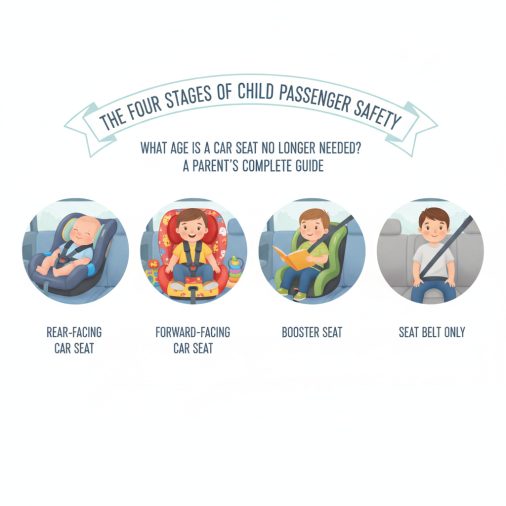
The Four Stages of Child Passenger Safety
Understanding where your child is in the progression helps clarify when each seat is appropriate.
Stage 1 — Rear-Facing Car Seat
Infants and toddlers should ride rear-facing as long as possible, up to the maximum height and weight limits of their specific car seat. Most convertible seats accommodate rear-facing children up to 40–50 pounds, which often means children can remain rear-facing well into age 3 or 4 depending on their size.
Turning a child forward-facing before they reach those limits provides no safety benefit and removes a meaningful layer of crash protection. If you’re evaluating which seat supports extended rear-facing use, the Graco Extend2Fit Convertible Car Seat is commonly noted for its extended rear-facing capacity.
Stage 2 — Forward-Facing Car Seat with Harness
Once a child outgrows rear-facing limits, they move to a forward-facing seat with a five-point harness. Children should stay harnessed as long as the seat allows — typically up to 65 pounds on many models, and up to 90 pounds on higher-capacity seats.
Many parents rush this transition when their child looks “too big” for the harness, but the harness distributes crash forces across strong skeletal points. A booster seat with a seat belt does not replicate that protection. The Graco 4Ever DLX 4-in-1 Car Seat is one example that accommodates harnessed children up to 65 pounds before transitioning to booster mode.
Stage 3 — Booster Seat
A booster seat lifts the child so the vehicle’s seat belt aligns correctly across their body. There are two main types:
– High-back booster — includes a back and headrest, suitable for vehicles without adequate head restraints or rear headrests
– Backless booster — compact and portable, appropriate when the vehicle seat provides sufficient head and neck support
Most children use a booster seat between ages 4 and 8, though many should continue using one past age 8 based on fit. The Graco TurboBooster 2.0 Backless Booster is a commonly used option for older children who have outgrown a high-back booster but still need repositioning for proper belt fit.
Children typically stay in this stage until they are approximately 4 feet 9 inches tall, though body proportions matter more than height alone.
Stage 4 — Seat Belt Only
A child graduates to using the vehicle seat belt alone only when they consistently pass the 5-Step Test described above, on every ride, in every vehicle they travel in. This typically happens between ages 8 and 12, and for many children, closer to 10 or 11.
The 5-Step Seat Belt Fit Test
This is the standard evaluation used by child passenger safety technicians to determine whether a booster is still needed.
1. Can the child sit with their back completely against the vehicle seatback?
2. Do their knees bend naturally at the front edge of the seat without needing to slide forward?
3. Does the lap belt sit low and flat across the upper thighs — not across the stomach?
4. Does the shoulder belt cross the center of the chest and shoulder — not the neck or face?
5. Can the child maintain this position comfortably for the entire trip without slouching?
If any answer is no, a booster seat is still needed. A child who passes all five steps in one vehicle may still need a booster in a vehicle with different seat geometry, so the test applies per vehicle.
State Laws vs. What Safety Research Actually Recommends
Most U.S. states legally require booster seats until a child is either 8 years old, 4 feet 9 inches tall, or 80 pounds — whichever comes first. Some states extend those requirements to age 9 or 12. A few states still reference age 4 or 6 in older statutes.
Meeting the legal minimum does not mean the seat belt fits correctly. Safety research consistently shows that many children who are legally allowed to use a seat belt alone are not physically ready for one. Following the 5-Step Test rather than the legal minimum is the safer approach.
| State Requirement Type | Common Threshold |
|—|—|
| Age-based only | Age 8 in many states |
| Age and height combined | Age 8 OR 4 ft 9 in |
| Weight-based | 80 lbs in some states |
| Extended requirements | Up to age 12 in a few states |
Always verify your specific state’s current child passenger safety laws, as these are updated periodically.
Common Mistakes Parents Make at Each Stage
Moving out of rear-facing too early. Turning a toddler forward-facing at age 1 or 2 because it “seems like time” removes protection before the child has the skeletal development to handle forward crash forces.
Skipping the booster stage. Some parents transition directly from a harness seat to a seat belt because the child requests it or because siblings did the same at a similar age. The seat belt fit is what determines safety at this stage.
Accepting a poor seat belt fit. A shoulder belt that the child tucks behind their back or under their arm is more dangerous than a properly used booster. A tucked shoulder belt provides no chest protection and concentrates all belt force across the abdomen in a crash.
Using a booster in a vehicle without a shoulder belt. Backless booster seats require a three-point seat belt with both a lap and shoulder portion. Using a booster in a seat with only a lap belt is unsafe.
Assuming the back seat is always safer without checking fit. The back seat does offer meaningful advantages for children, but only when the belt fits correctly. A poorly fitting belt in the rear seat is not inherently safer than a well-fitted belt elsewhere.
Vehicles with Unusual Seat Belt Geometry
Not all vehicle seat belts are positioned identically. Older vehicles, trucks with bench seating, and some SUVs with third-row seating may have shoulder belt anchor points that make proper fit difficult even for a child who passes the 5-Step Test in the family sedan.
If a child consistently cannot achieve a proper belt fit in a specific vehicle, a belt-positioning booster can solve the problem even if the child has technically “outgrown” a booster in other vehicles. There is no rule that says a 10-year-old cannot use a backless booster when vehicle geometry requires it.
Frequently Asked Questions
At what age can a child legally stop using a car seat in the U.S.?
Legal requirements vary by state, but most require a booster seat until age 8 or until the child reaches 4 feet 9 inches. Some states extend requirements to age 12. Meeting the legal minimum does not guarantee the seat belt fits correctly, so always apply the 5-Step Test before removing the booster regardless of what state law technically permits.
My child is 8 years old but only 4 feet 5 inches tall. Do they still need a booster?
Yes. A child who is 4 feet 5 inches tall will almost certainly not pass the 5-Step Test for proper seat belt fit. Height is a better predictor than age for most children, and the consistent recommendation is to keep the booster until the child reaches approximately 4 feet 9 inches and can maintain a correct seat belt position throughout an entire trip.
Can a child use a backless booster seat in the front passenger seat?
Child passenger safety guidelines recommend that children under 13 always ride in the rear seat regardless of the booster type. Active frontal airbags pose a serious risk to children, particularly rear-facing infants and smaller children whose heads are positioned closer to the airbag deployment zone. If the rear seat is unavailable, the front passenger airbag should be disabled if the vehicle allows it, and the seat should be moved as far back as possible.
Is a high-back booster safer than a backless booster?
Both types position the vehicle seat belt correctly across the child’s body, which is the primary safety function. A high-back booster adds side-impact containment and head support, which is beneficial in vehicles without adequate rear headrests. The safety difference between the two is modest when the vehicle provides sufficient head restraint. The most important factor remains whether the seat belt fits correctly across the child’s body. If you’re looking at options for older children who have outgrown a high-back style, the Graco TurboBooster 2.0 Backless Booster is a commonly referenced choice.
What if my child refuses to stay in a booster seat on longer trips?
A child who consistently slouches, pulls the shoulder belt behind their back, or moves out of position is not ready to use a seat belt alone. A booster makes the seat belt comfortable and correctly positioned, which should reduce — not increase — the tendency to fidget with the belt. If the child is uncomfortable, it is worth checking whether the booster is correctly positioned and whether the seat itself is an appropriate size for the child’s current height and weight.
Does a child need a car seat or booster in a taxi, rideshare, or school bus?
For taxis and rideshares, the same seat belt fit rules apply. Many families traveling without a booster use a travel-friendly belt-positioning product, though a full booster provides better crash protection when available. School buses with lap-and-shoulder belts follow the same guidelines as private vehicles. Traditional school buses without seat belts are designed with compartmentalization safety principles and are regulated differently by federal standards — this does not apply to smaller school vans or private vehicles.
Can a child use a convertible car seat past toddler age?
Yes. Many convertible and all-in-one seats support forward-facing harnessed children up to 65 or 90 pounds. A child who is 5 or 6 years old and still within the harness weight and height limits of their seat should remain in the harness rather than transitioning to a booster early. Staying in a harness seat as long as the limits allow is the safer choice at this stage. Parents evaluating multi-stage seats may find the Graco TriRide 3-in-1 Convertible Car Seat relevant as it transitions from harness to high-back booster mode.
Final Thoughts
The clearest answer to the car seat question is this: your child is ready to use a seat belt alone when their body fits the seat belt correctly — not when their birthday arrives. For most children, that happens somewhere between 8 and 12 years old, often closer to 10 or 11. Apply the 5-Step Test honestly in each vehicle your child rides in, check your state’s current legal requirements, and resist outside pressure to advance through stages before the fit is right. The seat exists to protect your child in the event of a crash, and that protection only works when the belt is positioned correctly across their body.