Car seat laws exist to protect children during some of the most dangerous situations they will ever face. Understanding exactly when your child legally needs a car seat — and what type — can feel confusing when laws vary from state to state.
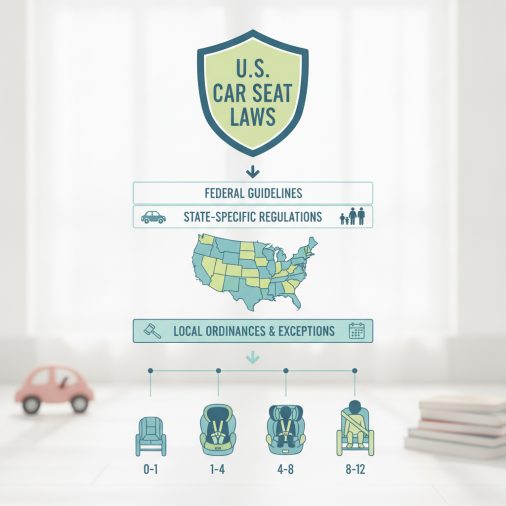
In the United States, all 50 states require children to use a car seat or booster seat, but the specific age, weight, and height requirements differ by state. Generally, children must use a rear-facing car seat from birth until at least age 2, a forward-facing harness seat until at least ages 4–5, and a booster seat until ages 8–12 or until the adult seat belt fits correctly. No federal law sets a single national standard — each state governs its own child passenger safety requirements.
How Car Seat Laws Are Structured in the U.S.
Car seat laws in the United States operate at the state level, not the federal level. This means a child who is legally compliant in one state may technically fall short of requirements in another.
That said, most state laws follow a similar progression through three or four stages of child restraint. The American Academy of Pediatrics (AAP) and the National Highway Traffic Safety Administration (NHTSA) both publish guidance that heavily influences state legislation.
The key distinction to understand is that legal minimums and safety best practices are not the same thing. A child who meets the minimum age requirement to move to the next seat stage is not necessarily ready to do so safely, especially if they have not yet reached the weight and height limits of their current seat.
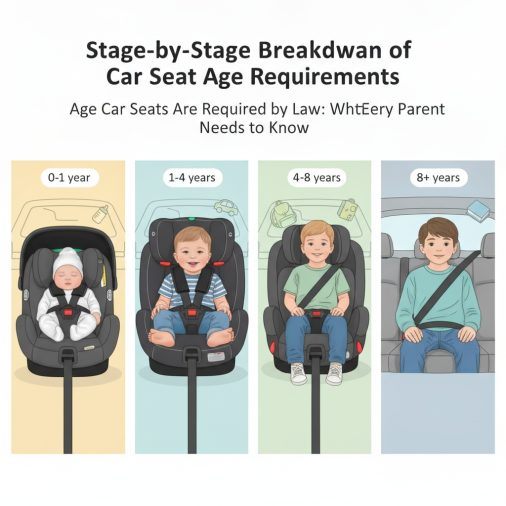
Stage-by-Stage Breakdown of Car Seat Age Requirements
Rear-Facing Car Seats (Birth to Age 2 and Beyond)
Most states require infants to remain rear-facing until at least age 1 and 20 pounds. However, many states have updated their laws to align with AAP guidance, which recommends keeping children rear-facing until they reach the maximum height or weight limit of their seat — regardless of age.
In practice, most convertible car seats support rear-facing use to 40–50 pounds, meaning many children can stay rear-facing well past age 3 or 4. The rear-facing position is recognized as the safest orientation for young children because it distributes crash forces across the head, neck, and spine.
For families looking at seats that cover this stage and beyond, extended rear-facing convertible seats with high weight limits are worth considering for this longer-term use.
Once a child outgrows the rear-facing limits of their seat, they transition to a forward-facing car seat with a five-point harness. Most state laws require this type of restraint until at least age 4, though many states extend the requirement to age 5 or until the child reaches the seat’s maximum weight or height limit.
Parents should follow the specific seat’s manufacturer guidelines rather than switching early based solely on meeting the legal minimum age. Many forward-facing harness seats accommodate children up to 65–80 pounds, so the harness stage can appropriately last until school age or beyond.
For families managing multiple seats across a family or vehicle, narrow car seat options designed to fit three across can be a practical solution during this stage.
Booster Seats (Approximately Ages 4–12)
A booster seat positions the adult seat belt correctly across a child’s body, since a standard seat belt is designed for adults who are approximately 4’9″ tall or taller. Most states require booster seat use until age 8 or until the child reaches a certain height.
There are two types of booster seats:
– High-back boosters — Provide head and neck support and are ideal for vehicles without headrests or with low seat backs
– Backless boosters — Compact and portable, appropriate when the vehicle seat already provides adequate head support
For many 8-year-olds, a booster seat is still the appropriate restraint. Booster seats designed for 8-year-olds are built to position the shoulder belt correctly across growing kids who are not yet ready for the adult belt alone.
Adult Seat Belt Only (Approximately Age 8–12 and Up)
A child is ready for an adult seat belt when:
– They are at least 4’9″ tall
– The lap belt rests flat across the upper thighs — not the stomach
– The shoulder belt crosses the chest and shoulder — not the neck or face
– They can sit with their back against the vehicle seat back and knees bent at the seat edge naturally, without slouching
Many children do not meet all of these criteria until ages 10–12, even if their state law permits seat belt use at age 8.
Car Seat Age Requirements by Stage (General Reference)
| Stage | Seat Type | Typical Age Range | Key Requirement |
|—|—|—|—|
| Stage 1 | Rear-facing | Birth to 2+ years | Rear-facing until height/weight limit is reached |
| Stage 2 | Forward-facing with harness | ~2–7 years | Harness until height/weight limit is reached |
| Stage 3 | Booster seat | ~4–12 years | Booster until seat belt fits correctly |
| Stage 4 | Adult seat belt | ~8–12 years and up | Correct belt fit across thighs and chest |
Age ranges are general estimates. Always follow your state’s specific law and your car seat manufacturer’s height and weight limits.
Why State Laws Differ — And What That Means for You
State legislatures update car seat laws periodically, so your state’s current requirement may be different from what you remember from an older child. Some states use age as the primary trigger for transitioning between stages. Others rely on height and weight.
A few important examples:
– California requires children to ride in a rear-facing car seat until age 2 or until they reach the seat’s maximum rear-facing height or weight limit, whichever comes first.
– Texas requires a car seat or booster seat until age 8 or 4’9″ tall.
– Florida requires car seats for children under age 5 and booster seats until age 6.
The NHTSA’s official website and your state’s department of motor vehicles maintain current legal requirements. Before traveling across state lines, it is worth confirming whether the destination state has stricter requirements than your home state.
The Difference Between Legal Minimums and Safety Best Practices
Meeting the legal minimum age requirement does not necessarily mean your child is ready to move to the next seat stage. Safety organizations consistently recommend:
– Keep children rear-facing as long as their seat’s height and weight limits allow
– Keep children in a forward-facing harness seat until they outgrow the seat’s limits
– Keep children in a booster seat until the adult belt fits correctly across the body
Moving a child to the next stage before they physically meet the seat’s limits — simply because they have reached the legal minimum age — reduces the protection the seat is designed to provide.
For parents evaluating seats built to last through multiple stages, convertible car seats that grow with your child can reduce the number of transitions needed.
Back Seat Requirement for Children
Most states require that children under a certain age ride in the rear seat of the vehicle, not the front passenger seat. This is because front passenger airbags deploy with significant force designed for adult occupants, and this force can seriously injure a child in a car seat or booster seat.
As a general safety practice:
– Children under 13 should ride in the back seat whenever possible
– A rear-facing car seat should never be placed in front of an active airbag
– Many vehicles allow front passenger airbags to be disabled for specific circumstances — check your owner’s manual for the correct procedure
Traveling Across State Lines and International Travel
When driving across state lines, the law of the state you are traveling through applies. Since most state requirements differ primarily in age thresholds rather than seat-type requirements, the practical approach is to follow the most conservative requirement — which almost always aligns with keeping children in the most age-appropriate seat for their size.
For families traveling by air and renting vehicles, bringing a certified car seat is generally the safest approach. Not all rental car seats are properly maintained or installed. Portable travel car seats designed for toddlers are built specifically for this situation, balancing safety certification with manageable weight and size.
LATCH System and Installation Requirements
Federal law requires all vehicles manufactured after September 2002 to include the LATCH (Lower Anchors and Tethers for Children) system. Car seats designed for harness use must include LATCH-compatible connectors, and most booster seats with backs include tether anchors.
However, LATCH anchors have weight limits that include the child and the seat combined. Once a child and seat exceed the LATCH weight limit — often 65 pounds combined — the seat belt installation method is required. Check your vehicle’s owner’s manual and your car seat’s documentation for these specific limits.
Vehicles with unusual seat configurations, like the Jeep Wrangler’s narrow rear bench, add an additional compatibility challenge for parents. Car seats specifically suited to the Jeep Wrangler’s tight rear seat address this fitment problem directly.
Frequently Asked Questions
What age does a child legally not need a car seat?
Most states allow children to transition to an adult seat belt around age 8, provided they are at least 4’9″ tall and the belt fits correctly. However, many children do not physically meet the belt-fit criteria until ages 10–12. The law sets the minimum — your child’s actual size and seat belt fit should guide the transition.
Is it illegal for a child to sit in the front seat?
No federal law in the United States prohibits children from sitting in the front seat. However, most safety organizations recommend keeping children under 13 in the back seat whenever possible due to airbag deployment risks. Some states have additional front-seat age restrictions — check your state’s specific requirements.
Do car seat laws apply to taxis, rideshares, and rental vehicles?
This varies significantly by state. Many states exempt taxis and rideshare vehicles from child restraint requirements, though this is changing in some jurisdictions. When traveling by rideshare with a young child, bringing a portable car seat provides the safest solution regardless of legal exemptions.
Can a 4-year-old use a booster seat?
Legally, some states permit booster seat use starting at age 4. However, safety guidance recommends keeping a 4-year-old in a forward-facing harness seat as long as the seat’s weight and height limits allow. A five-point harness provides superior restraint compared to a belt-positioning booster for most children at this age. Booster seats for 4-year-olds are available for situations where a harness seat has been outgrown, but the harness stage should last as long as the seat allows.
What happens if my child’s car seat is in a car accident?
Most manufacturers recommend replacing a car seat after any moderate or severe crash, even if visible damage is not apparent. A minor, low-speed fender bender may not require replacement — check the manufacturer’s guidelines for their specific definition of a crash that requires replacement. Never use a car seat that has been through a moderate or severe crash without manufacturer confirmation that it remains safe.
Does a booster seat need to be installed with the seat belt?
A backless booster seat is held in place by the child’s weight and the seat belt during use. A high-back booster with a tether may include the option to secure it to the vehicle between uses. The seat belt routes through or across the child to complete the restraint system — the booster itself positions the belt, not the other way around.
What is the safest car seat position in the vehicle?
The rear center seat is statistically the safest position in most vehicles because it is furthest from any impact point. However, LATCH anchors are often not present in the center position, and the center seat may not provide adequate belt geometry for a booster. A correctly installed car seat in a rear outboard seat with LATCH is preferable to an improperly positioned center seat installation.
Final Thoughts
Car seat laws exist on a state-by-state basis, but the underlying safety science is consistent: children should remain in the most protective seat appropriate for their size, not just their age. Legal minimums define the floor, not the ceiling.
Follow your seat’s manufacturer height and weight limits, confirm your state’s current requirements before long trips, and treat the seat belt fit test — not the birthday — as the real milestone for transitioning between stages. For any car seat installation you are unsure about, a certified Child Passenger Safety Technician (CPST) can inspect the installation at no charge through many hospitals, fire stations, and community programs.