Buckling a child into the wrong seat — or using the right seat incorrectly — is one of the most common and preventable safety mistakes made by well-meaning parents. Arkansas car seat laws set specific requirements for how children must be restrained, and getting it wrong can mean both a traffic citation and, far more seriously, a child at greater risk in a crash.
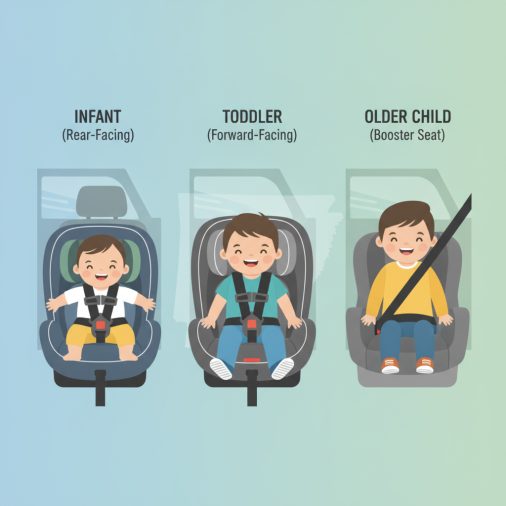
Arkansas law requires all children to ride in an appropriate child restraint system based on age, weight, and height. Children under 6 years old must use a federally approved car seat or booster seat. Children under 15 must be buckled, regardless of seating position. Specific seat type — rear-facing, forward-facing with harness, or belt-positioning booster — depends on the child’s size and developmental stage. The law sets minimums; safety recommendations from the American Academy of Pediatrics go further and should guide your actual choices.
Arkansas Child Restraint Law by Age and Stage
Arkansas Code § 27-34-104 outlines the state’s child passenger safety requirements. The law divides requirements broadly by age, but a child’s weight and height — and the seat manufacturer’s specifications — ultimately determine which seat is appropriate.
Here is a practical breakdown of the legal requirements and the corresponding safety guidance:
| Age Group | Legal Requirement | Safety Recommendation |
|—|—|—|
| Under 1 year | Car seat required | Rear-facing until minimum weight/height limit of seat |
| Ages 1–5 | Car seat or booster required | Rear-facing as long as possible, then forward-facing with harness |
| Ages 6–14 | Seat belt or appropriate restraint | Booster until seat belt fits properly; then lap/shoulder belt |
| Ages 15+ | Standard seat belt required | Standard seat belt in every seating position |
The law specifies that children under 6 must use a child passenger restraint system that meets federal motor vehicle safety standards. Children ages 6 through 14 must be restrained, though the law allows for a standard seat belt at this stage.
Rear-Facing: How Long Does Arkansas Law Require It?
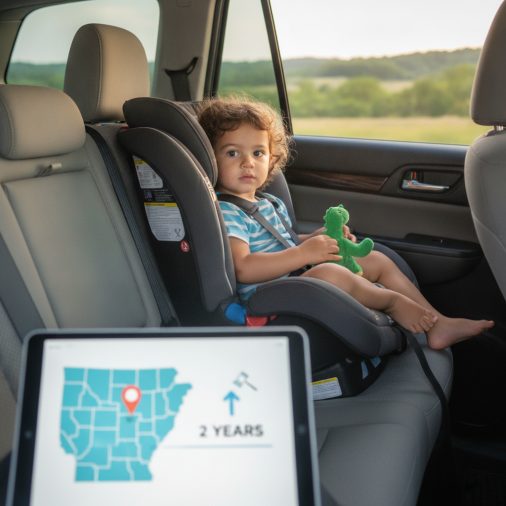
Arkansas law does not specify a minimum period for rear-facing use beyond the general under-6 car seat requirement. However, the safety standard is clear: children should remain rear-facing until they reach the maximum weight or height limit allowed by their specific car seat — not just until their first birthday.
Rear-facing seats distribute crash forces across the entire back, head, and neck. This matters most during the critical early years when a child’s spine and neck are still developing. Many convertible car seats accommodate rear-facing children up to 40–50 pounds, meaning most children can remain rear-facing well past age 2.
If you’re choosing a convertible seat with extended rear-facing capacity, look for options with high rear-facing weight limits. The Graco Extend2Fit Convertible Car Seat, for example, is a commonly used option that supports rear-facing use to 50 pounds and is frequently cited by child passenger safety technicians for its extended usability.
Forward-Facing with a Harness: When to Move Up
Once a child exceeds the rear-facing weight or height limit of their seat, they move to a forward-facing seat with an internal harness. Under Arkansas law, this still counts as an appropriate child passenger restraint system for children under 6.
The harness should be snug — no more than one finger’s width of slack at the collarbone. The chest clip belongs at armpit level, not at the belly. Bulky winter coats should be removed before buckling, because the extra padding prevents the harness from fitting correctly against the child’s body.
Children should remain in a harnessed forward-facing seat until they outgrow the seat’s harness limit — typically somewhere between 40 and 65 pounds, depending on the seat. Moving to a booster too early places the child at significantly greater risk because the seat belt was not designed to restrain a small child’s body without a harness.
Parents who use forward-facing seats with a rigid LATCH connector or top tether should always engage the top tether when it is available. Many parents overlook the top tether, but it substantially reduces forward head movement during a frontal collision.
Booster Seats: Belt-Positioning and the Proper Seat Belt Fit
When a child outgrows the harness limits of their forward-facing seat, a belt-positioning booster becomes the correct next step. The booster does not restrain the child directly — it repositions the vehicle’s seat belt so it crosses the body correctly.
A proper seat belt fit for a child means:
– The lap belt lies flat across the upper thighs, not across the soft abdomen
– The shoulder belt crosses the center of the chest and shoulder, not the neck or face
– The child can sit with their back flat against the seat and knees bent comfortably at the seat edge
– The child can maintain this position throughout the entire trip
Most children are not ready to use a seat belt alone until they are between 8 and 12 years old and at least 4 feet 9 inches tall. Arkansas law permits a seat belt for children ages 6 and older, but that legal permission does not mean the seat belt fits the child correctly.
High-back boosters are generally preferred over backless boosters for vehicles without headrests or with low seat backs. Many car seat protectors designed for child seats can help protect your vehicle’s upholstery beneath the booster base without compromising the seat’s stability.
Back Seat Requirement and Placement Rules
Arkansas law requires children under 15 to be properly restrained, but does not explicitly mandate back seat placement for all ages under state statute in the same way some other states do. That said, every major child passenger safety organization recommends that children under 13 ride in the back seat.
Front airbags pose a serious risk to children in rear-facing seats and to smaller children in general. A rear-facing seat should never be placed in front of an active passenger airbag. If your vehicle’s front passenger airbag cannot be disabled, rear-facing children must always ride in the back.
Penalties for Noncompliance in Arkansas
Violating Arkansas’s child restraint law carries a fine. The base penalty is relatively modest — typically under $100 for a first offense — but the fine structure can vary by county and court. More importantly, Arkansas allows a fine reduction or dismissal if the defendant can show proof of a purchased and properly installed car seat before the court date.
A citation is far less significant than the real cost of an improperly restrained child in a crash. Child passenger safety violations are a primary offense in Arkansas, meaning an officer can stop a vehicle solely for this reason.
Common Mistakes That Are Legal But Still Dangerous
Arkansas law sets a floor, not a ceiling. Many situations are technically legal but put children at unnecessary risk:
– Moving to a forward-facing seat too early — legal once a child turns 1 in many interpretations, but physically unsafe if they have not reached the seat’s rear-facing limit
– Using a booster at age 6 — legal, but often developmentally inappropriate if the child cannot maintain proper belt positioning
– Placing a child in the front seat — legal for older children, but strongly discouraged under age 13 due to airbag risk
– Using a second-hand seat without history — legal, but a seat that has been in a crash may no longer provide full protection
– Loose harness straps or incorrect chest clip position — legal to drive away, discovered only in a crash
Traveling in Arkansas with a Rental or Borrowed Vehicle
Arkansas’s car seat law applies to all passenger vehicles operated in the state, regardless of whether the vehicle is owned, rented, or borrowed. If you are renting a vehicle, you are still required to use appropriate restraints for children in your care.
If you are traveling through Arkansas with a car seat installed, verify that the seat is correctly secured using either LATCH or the vehicle’s seat belt system — not both simultaneously unless the car seat manufacturer’s instructions specifically allow it. Many parents assume that using both LATCH and a seat belt together adds security, but in most seats this can actually put excess stress on the LATCH anchors.
Traveling through airports with a child seat can be physically demanding. A car seat dolly designed for airport use makes it far easier to move the seat through terminals without checking it or straining your back.
When to Replace a Car Seat After a Crash
Any car seat involved in a moderate to severe crash should be replaced, regardless of visible damage. The National Highway Traffic Safety Administration defines a minor crash as one where:
– The vehicle could be driven away from the scene
– No door nearest the car seat was damaged
– No one in the vehicle was injured
– The airbags did not deploy
– The car seat shows no visible damage
If the crash does not meet all five of those criteria, the seat should be replaced before the child rides in it again. This is a commonly overlooked but important safety step.
FAQ
At what age can a child stop using a car seat in Arkansas?
Arkansas law requires children under 6 to use an appropriate child passenger restraint system and requires all occupants under 15 to be buckled. In practice, the transition from a car seat to a booster, and then to a seat belt alone, should be based on the child’s size and seat manufacturer limits — not a specific birthday. Most children are not ready for a seat belt alone until they are at least 8 years old and approximately 4 feet 9 inches tall.
Can a child ride in the front seat in Arkansas?
Arkansas law does not set a minimum age for front seat use, but front passenger airbags create serious injury risk for children under 13. A rear-facing seat should never be in front of an active airbag. For children who must ride in the front seat, the seat should be pushed as far back as possible and the child should be properly restrained. In practice, keeping children in the back seat until at least age 13 is the standard safety recommendation.
Is a booster seat required in Arkansas for a 6-year-old?
Arkansas law requires children under 6 to use a federally approved child restraint and allows seat belts for children 6 and older. However, if the seat belt does not fit the child correctly — crossing the neck instead of the shoulder, or the abdomen instead of the thighs — a belt-positioning booster is still the appropriate choice regardless of age.
Do Arkansas car seat laws apply to taxis, rideshares, and borrowed vehicles?
Arkansas child restraint requirements apply to passenger vehicles operated in the state. The law does not specifically exempt taxis or rideshare vehicles from the requirement, though enforcement in those situations can be inconsistent. When traveling in any vehicle with a child, using an appropriate restraint is always the safest choice, irrespective of who owns or operates the vehicle.
What happens if I’m using an expired car seat in Arkansas?
Car seats have expiration dates printed on the seat or label — typically 6 to 10 years from the manufacture date. Using an expired seat is not explicitly addressed in Arkansas statute, but an expired seat may have degraded plastic, worn harness webbing, or components that no longer meet current federal safety standards. Arkansas requires that the seat meet federal motor vehicle safety standards, which an expired seat may technically no longer satisfy.
Does Arkansas require rear-facing until age 2?
Arkansas law does not require rear-facing until age 2 by statute. The under-6 mandate requires a car seat, but does not specify seat orientation beyond what meets federal approval. The age-2 rear-facing guideline comes from the American Academy of Pediatrics, which recommends staying rear-facing until the child reaches the maximum limit of their seat — a recommendation that frequently extends well past age 2.
Can I use a second-hand car seat legally in Arkansas?
Using a second-hand seat is not prohibited by Arkansas law, but it carries real safety risk. A used seat may have been in a crash, may have missing or degraded parts, may have an expired date, or may have been recalled. If you choose to use a second-hand seat, you must be able to verify its full history, confirm it has never been in a crash, check that all parts are intact, and confirm it has not been recalled.
Final Thoughts
Arkansas car seat law sets the legal minimum, but a child’s size and developmental stage should always drive the actual seat choice. Keep children rear-facing as long as the seat allows, move to a forward-facing harness seat when they outgrow it, use a booster until the seat belt fits correctly, and keep children in the back seat until at least age 13. When in doubt, a certified Child Passenger Safety Technician can inspect your installation for free — the National Highway Traffic Safety Administration’s website lists inspection stations by zip code.