If you’ve ever placed a child safety seat or pet carrier on a car seat, you’ve probably noticed the pressure marks, indentations, and scuff damage left behind. Car seat protectors seem like an obvious solution — but many parents and pet owners wonder whether they’re actually safe to use.
Car seat protectors are generally safe when used correctly, but they can create risks if they interfere with a child safety seat’s installation. Most child safety seat manufacturers strongly caution against using thick, padded protectors beneath a car seat, because they can reduce the stability of the LATCH system or seat belt installation. Thin, non-slip mat-style protectors are typically less problematic, but you should always check the child safety seat manufacturer’s guidelines before using any protector under a car seat.
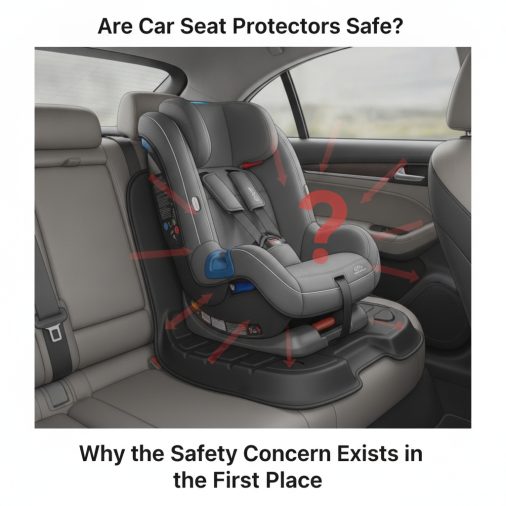
Why the Safety Concern Exists in the First Place
The concern around car seat protectors isn’t about the material touching your upholstery — it’s specifically about what happens underneath a child safety seat or convertible car seat when a padded layer is added.
Child safety seats are crash-tested and certified on vehicle seats without additional padding or accessories between them and the vehicle seat. When you introduce a thick foam or padded protector beneath a child safety seat, you change the contact surface. This can affect how securely the safety seat anchors into position, potentially allowing it to shift or rock during a crash.
The LATCH system (Lower Anchors and Tethers for Children) depends on firm contact between the child safety seat’s base and the vehicle’s seat cushion. A thick, compressible protector can reduce that firmness, which is exactly the kind of variable that wasn’t accounted for during crash-test certification.
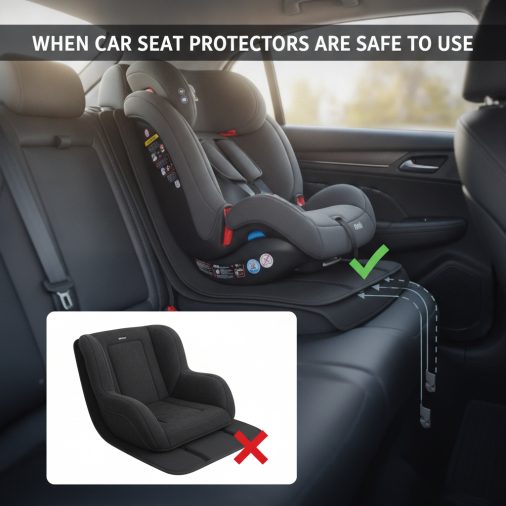
When Car Seat Protectors Are Safe to Use
Not every car seat protector carries the same level of risk. The key is understanding what’s underneath the protector and how it affects your specific setup.
Generally considered lower-risk:
– Thin, non-padded rubber or silicone mat protectors that don’t significantly compress under load
– Protectors designed and certified specifically for use with child safety seats
– Protectors used beneath pet carriers rather than child safety seats
– Protectors placed on seats that don’t have a child safety seat installed
Situations requiring more caution:
– Thick foam or padded protectors placed under rear-facing or forward-facing child safety seats
– Any protector that causes noticeable rocking or instability in the child safety seat
– Protectors that don’t allow the LATCH system to connect firmly
Many parents use car seat protectors designed specifically for child seats, which are built to remain as thin as possible while still protecting upholstery. These are a meaningfully different product from thick, padded seat covers or general-purpose seat protectors.
What Child Safety Seat Manufacturers Actually Say
This is the most important piece of information, and many parents overlook it.
Every major child safety seat manufacturer — Graco, Britax, Chicco, Evenflo, and others — publishes guidelines in their product manuals regarding accessories placed between the car seat and the vehicle seat. Most explicitly state that only accessories they have tested alongside the seat are approved for use.
Evenflo, for example, has stated that no additional products or padding should be placed beneath their car seats unless those products were tested with the specific seat and approved. Britax has published similar guidance.
This matters because if a car seat is involved in a crash and a non-approved accessory is found beneath it, the manufacturer’s warranty and crash-test certification may not apply in the same way. More importantly, the actual crash performance of the seat may differ from what testing showed.
Before purchasing any seat protector to use under a child safety seat, pull out the manual for your specific child safety seat and read the accessory guidelines carefully. If the manual is unclear, contact the manufacturer directly — most have customer support lines and respond quickly to safety questions.
Protectors Used for Pets, Cargo, and General Seat Protection
When a car seat protector is being used to protect upholstery from a pet carrier, a dog harness setup, or general cargo — without a child safety seat involved — the safety calculus changes considerably.
In these cases, the primary concerns are:
– Slipping: A protector that moves freely across the seat can allow a pet carrier or cargo to shift while driving
– Compatibility with seat belts: Some seat protectors have openings or slots for seat belt buckles; confirm the buckle seats properly and latches securely before driving
– Airbag compatibility: On seats with side-curtain or seat-mounted airbags, a protector shouldn’t obstruct the airbag deployment zone
For leather interiors in particular, protecting leather car seats from daily wear is a valid and worthwhile goal — leather is expensive to repair or condition after sustained pressure damage. Most leather-seat protectors used without child safety seats are simple, thin covers that create no meaningful safety concern.
How to Check If Your Protector Is Properly Installed
Regardless of what’s sitting on top of the protector, a quick stability check is worth doing every time you install or reposition a seat.
For use with a child safety seat:
1. Install the child safety seat normally using either the LATCH system or the vehicle seat belt, following the manufacturer’s instructions
2. Grab the child seat at the base and try to rock it side-to-side and front-to-back — movement should be less than one inch in any direction
3. Check that the LATCH connectors or seat belt are fully engaged and not riding on top of the protector’s edge
4. Confirm the child seat sits flat and doesn’t tilt abnormally due to protector thickness
5. Check for any rocking caused by the protector compressing unevenly
If the child safety seat passes less than one inch of movement at the base, there’s no unusual tilt, and all connectors are properly engaged, the installation meets the general safety standard regardless of whether a thin protector is present.
If the seat fails this check with the protector in place, remove the protector first and recheck. If the seat passes without the protector but fails with it, the protector should not be used in that configuration.
Leather Versus Fabric Seat Protectors: Does Material Matter?
From a safety standpoint, the primary concern is protector thickness and compressibility — not the material facing your upholstery. A thin silicone mat under a child seat raises fewer concerns than a two-inch foam pad regardless of whether it’s covered in neoprene, cotton, or polyester.
From a protection standpoint, material matters quite a bit depending on your seat type:
Protector Type
Best For
Child Seat Use
Thin rubber/silicone mat
Firm contact, minimal compression
Lower risk if thin
Certified child-seat protector
Direct use under child safety seats
Designed for this purpose
Padded foam protector
Pet carriers, cargo areas
Not recommended under child seats
Leather-backed protector
Leather interiors, general use
Avoid under child seats
Universal fabric cover
General seat protection
Avoid under child seats
Common Mistakes to Avoid
Many owners and parents make the same errors when purchasing or installing seat protectors.
Using any protector without checking the child seat manual. This is the most common and potentially most significant mistake. The manual is the final authority, not general internet advice.
Assuming “designed for child seats” means approved by the child seat manufacturer. A product being marketed for use with child seats doesn’t mean the child seat brand has tested or approved it. These are different standards.
Skipping the installation stability check. Installing the protector and assuming everything is fine without testing the child seat’s movement is a missed opportunity to catch a problem before it matters.
Using a protector that shifts freely. A protector that slides on the seat surface can allow the child seat to creep out of position during everyday driving, even without a crash. Non-slip backing is a basic requirement.
If you’re looking at options for general upholstery protection across your back seat — not specifically under a child seat — browsing well-reviewed seat protectors for general upholstery protection gives you a clearer picture of what features matter most.
FAQ
Can a car seat protector affect how a child safety seat performs in a crash?
Yes, potentially. Child safety seats are crash-tested on bare vehicle seat surfaces. A thick or compressible protector beneath the child seat can reduce the firmness of the LATCH connection or seat belt installation, allowing more movement than what was tested. Even small changes in the installation surface can affect how the seat performs under crash forces. Always check the child seat manufacturer’s guidelines before using any accessory beneath it.
Are there car seat protectors that are officially approved for use with child safety seats?
A small number of protectors have been tested alongside specific child safety seats by their manufacturers. Products like the Britax Vehicle Seat Protector have been tested with Britax seats. However, approval is typically brand-specific — a protector tested with one brand’s seat is not automatically approved for another. Always verify approval with your specific child seat manufacturer, not just the protector brand.
Do car seat protectors damage vehicle seats?
Most well-designed seat protectors do not damage vehicle seats under normal use. Thin protectors with smooth or non-abrasive backing are generally safe for fabric and leather. However, moisture trapped between the protector and seat surface over long periods can affect some materials, particularly leather, over time. Using a protector with breathable materials and occasionally removing it to air the seat reduces this risk.
Is it safe to use a car seat protector under a dog harness or pet carrier in the back seat?
Generally yes, provided the protector doesn’t interfere with the seat belt routing used to secure the pet harness or carrier, and doesn’t slip freely during travel. Always confirm that the seat belt buckle engages fully and that the harness or carrier is stable after the protector is in place. If your dog is secured by a seat belt harness, the belt must pass through or around the protector without being pinched or misaligned.
Do car seat protectors work on heated or ventilated seats?
Thick or non-breathable protectors can reduce the effectiveness of heated or ventilated seat functions. Ventilated seats rely on airflow through the seat cushion, which a dense protector can block. For heated seats, a thick protector creates an insulating layer that slows heat transfer to the occupant. If you use heated or ventilated seats regularly, look for thin, perforated, or breathable protectors and test seat function after installation.
At what age or stage should I stop using a protector under my child’s car seat?
There’s no defined age cutoff. The relevant factor is whether a child safety seat — rear-facing, forward-facing, or high-back booster — is present and needs a solid, stable installation. Once your child transitions to a backless belt-positioning booster or no longer requires a child safety seat, the upholstery protection concern remains but the installation stability concern no longer applies in the same way.
Are car seat protectors worth using at all given the safety concerns?
For general upholstery protection without a child safety seat present, they’re a practical and low-risk accessory. For use under child safety seats, the answer depends on which protector you choose, how it’s installed, and what your child seat manufacturer approves. A thin, certified protector properly checked for installation stability can protect your upholstery without compromising child seat safety. A thick, padded, non-approved protector should not be used under any child safety seat.
Final Thoughts
Car seat protectors are safe when used in the right context with the right product. The critical boundary is whether a child safety seat is being installed on top of the protector — in that case, protector choice, thickness, and manufacturer approval all matter directly to safety. Always confirm compatibility with your specific child seat’s manual, perform a stability check after every installation, and give priority to your child seat’s installation integrity over protecting your upholstery.