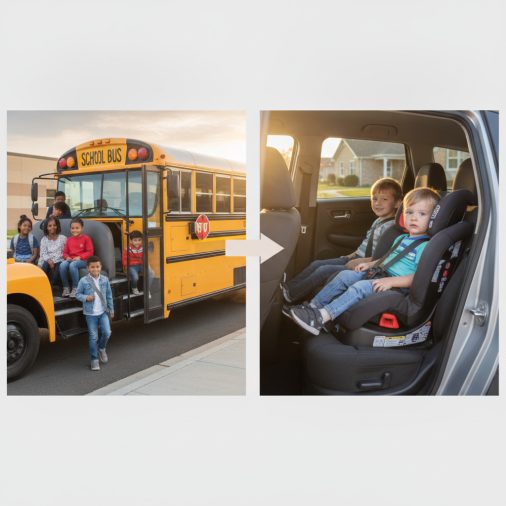
School buses, transit coaches, and charter vehicles create a genuine dilemma for parents and caregivers. You’re used to strapping your child into a car seat for every car trip, and suddenly the rules seem to change the moment they board a bus.
In most cases, child car seats are not required on school buses because school buses are governed by federal safety standards based on “compartmentalization” — high-backed, padded seats positioned closely together that absorb crash forces. However, for infants and young toddlers on transit buses, charter coaches, or privately operated vehicles, standard child restraint laws still apply. Rules vary by state, country, and vehicle type, so confirming local regulations and the specific bus classification matters significantly.
Why School Buses Have Different Safety Rules
The federal exemption for school buses isn’t a loophole — it’s based on decades of crash research. The National Highway Traffic Safety Administration (NHTSA) determined that school buses offer strong passive protection through a system called compartmentalization.
This means the seats are engineered to work together as a unit. Tall, energy-absorbing seatback foam surrounds children within a padded compartment. In a frontal collision, children are cushioned by the seat in front of them rather than restrained by a harness.
NHTSA data consistently shows that school buses are among the safest vehicles on the road for child transportation. The fatality rate per mile traveled is significantly lower than for passenger vehicles, even without individual harness restraints.
That said, compartmentalization has limitations. It performs well in frontal and rear impacts but offers less protection in side impacts and rollovers — which is part of why some states have moved toward requiring lap-shoulder belts on newer school buses.
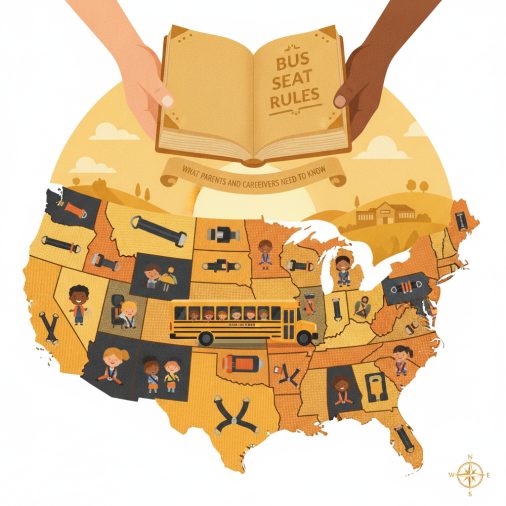
State-by-State Differences for School Bus Seat Belts
Federal law does not require seat belts on large school buses, but several states have enacted their own laws. The landscape looks roughly like this:
State Example
Seat Belt Requirement
California
Required on all school buses
New York
Required on school buses
New Jersey
Required on school buses
Florida
Required on new school buses
Texas
Required on new school buses (certain districts)
Most other states
Not required on school buses
New York, California, New Jersey, Florida, and Texas are among the states that have passed legislation requiring lap-shoulder belts on school buses, typically phased in for newly purchased vehicles rather than as a retrofit requirement on existing fleets.
If your child’s school bus has seat belts installed, teaching your child to buckle up correctly matters. A seat belt that’s worn improperly — particularly across the neck or abdomen — can cause injury in a crash.
When Car Seats Are Required on a Bus
The car seat exemption applies specifically to large school buses and certain regulated transit vehicles. It does not automatically extend to every vehicle with the word “bus” on the side.
Car seat laws typically do apply in these situations:
– Transit buses and city buses — Local and state child restraint laws generally apply to passengers in transit vehicles when seats with belts are available.
– Charter buses and coach buses — Privately operated motor coaches operating under FMCSA regulations are required to have seat belts. Child restraint laws in the state of travel can apply.
– Small school buses — Vehicles with a gross vehicle weight rating under 10,000 pounds are classified differently. Standard child restraint laws apply, meaning car seats or booster seats are required based on the child’s age, weight, and height.
– Shuttle vans and minibuses — These often fall under standard passenger vehicle restraint requirements. If the vehicle has seat belts, applicable child restraint laws apply.
The weight threshold is critical. Small school buses, typically under 10,000 lbs GVWR, do not benefit from the large school bus exemption and must comply with child passenger safety laws just like a car or van would.
Infant and Toddler Considerations on Buses
For infants and very young children, the compartmentalization system offers much less protection. An infant cannot brace against a padded seatback the same way a school-age child can. This is why some child safety advocates recommend rear-facing infant seats for the youngest passengers even when not legally required.
In practice, most large school bus operators do not transport infants in their standard route operations. Specialized transport programs — such as those serving children with disabilities or medical needs — often have specific restraint requirements and trained personnel.
If you’re transporting an infant or toddler on a charter coach or transit vehicle, a properly installed rear-facing or forward-facing car seat in a seat with a working lap-shoulder belt is the appropriate approach. Ensuring the car seat base sits flat against the seat cushion and that the belt routes correctly through the car seat’s belt path is essential.
For parents who regularly use car seats in multiple vehicles, car seat protectors for child seats can help protect upholstery during installation in unfamiliar seats, though this applies more to personal vehicles than public transit scenarios.
Special Needs Transportation and Adaptive Restraints
Children with disabilities or medical conditions that affect their positioning often require specialized restraint systems. The IDEA (Individuals with Disabilities Education Act) mandates that transportation provided as part of special education services meet specific safety standards.
Wheelchairs used as seating on buses must be secured with a four-point tie-down system, and a separate occupant restraint — typically a lap-shoulder belt — must also be worn. Specialized harness systems such as the E-Z-On Vest are approved for certain children who cannot safely use standard restraints.
IEP (Individualized Education Program) documentation often specifies the exact restraint requirements for each child. Parents should confirm that transportation staff are trained on the specific system their child requires.
What to Do If Your Child’s Bus Has Seat Belts
When seat belts are available on a school bus, children should use them correctly. Misuse reduces protection significantly.
Key points for children:
– The shoulder belt should cross the chest and collarbone, not the neck
– The lap belt should sit low across the hip bones, not the soft abdomen
– Children should remain buckled for the entire ride
– Standing, moving between seats, or removing the belt while the bus is moving eliminates the protection the belt provides
Booster seat use on a bus is a more complex question. Some safety advocates recommend booster seats for children who haven’t yet reached the height where a seat belt fits properly — typically under 4 feet 9 inches. However, whether a booster seat can be safely secured varies with the seat belt configuration on a specific bus. Consulting the booster seat manufacturer’s instructions and the bus operator is the appropriate step.
Car Seat Installation Basics on Charter and Coach Vehicles
If you’re installing a car seat on a coach bus or charter vehicle, the process differs from a standard passenger car installation.
Most coach buses use lap-only belts or lap-shoulder belts that don’t interact with a car seat the same way a vehicle’s lower anchors (LATCH) do. LATCH anchors are rarely present on buses.
Important considerations:
– Use the vehicle’s seat belt to install the car seat rather than LATCH when LATCH anchors are absent
– Confirm the car seat manufacturer’s instructions permit belt-only installation
– Check that the belt is routed through the correct belt path on the car seat
– Test for less than one inch of movement side-to-side and front-to-back at the belt path after installation
– Rear-facing seats may not work on all coach seats due to limited seat pitch or unusual cushion angles
For families who travel frequently with children and use car seats across multiple vehicles, protecting the vehicle upholstery from the concentrated pressure of a car seat base is worthwhile. Many parents use a product like the Diono Protect-a-Mat in personal vehicles, though this is most relevant for everyday use rather than public transit.
For families organizing vehicle interiors with young children in mind, car seat storage accessories can make managing the additional gear that comes with child travel more practical.
Age, Weight, and Height Thresholds That Affect Requirements
Child restraint laws in the United States generally follow a progression based on age, weight, and height rather than vehicle type alone. While bus exemptions modify some requirements, understanding the standard progression helps clarify when bus-specific rules make a difference:
– Rear-facing infant/convertible seat: Birth through at least age 2, or until the maximum rear-facing weight or height limit of the seat
– Forward-facing with harness: After outgrowing rear-facing, until reaching the maximum harness weight or height of the seat
– Belt-positioning booster seat: After outgrowing the harness, until the vehicle seat belt fits correctly — typically around 4 feet 9 inches in height and between ages 8 and 12
– Adult seat belt: When the lap-shoulder belt fits properly without a booster
On a large school bus, these thresholds still matter if the bus has seat belts installed. On a small school bus (under 10,000 lbs GVWR), these thresholds govern which restraint is legally required.
FAQ
Are car seats required on school buses in the United States?
No federal law requires car seats on large school buses. The federal standard relies on compartmentalization — energy-absorbing, closely spaced padded seats — rather than individual restraints. However, some states require lap-shoulder belts on school buses, and small school buses under 10,000 lbs GVWR are subject to standard child restraint laws. Always check your specific state’s requirements and the GVWR of the bus in question.
Can I bring my own car seat onto a school bus for my child?
In theory, yes, but it’s rarely practical. Standard school bus seats are not equipped with LATCH anchors, and the belt configurations may not work correctly with all car seats. Additionally, school bus operators may have policies restricting privately installed car seats. Contact the school district’s transportation office before attempting this. For infants or children with special needs, discuss options with the district directly.
Do charter buses and tour coaches require child car seats?
Charter coaches and tour buses operating under FMCSA regulations are required to have seat belts. Child restraint laws in the state where the trip occurs generally apply, meaning an infant or young child may legally require an appropriate car seat installed using the vehicle’s seat belt. Confirm with the charter operator whether their vehicles have lap-shoulder belts or lap-only belts, since this affects which car seats can be safely installed.
What is the safest seat position on a school bus for a child?
Seats within the first few rows behind the driver or in the center of the bus tend to offer better protection in many crash scenarios because they’re further from the most vulnerable points. However, on a properly designed school bus, compartmentalization is intended to protect passengers throughout the vehicle. Sitting properly within a seat — not hanging into the aisle — is more important than specific seat location for day-to-day riding.
At what age or size can a child ride a school bus without a car seat?
On a large school bus, no car seat is required by federal law regardless of age, because compartmentalization applies to all passengers. On a small school bus under 10,000 lbs GVWR, standard state child restraint laws apply, meaning children typically need appropriate restraints until they reach the height and weight thresholds where a properly fitting seat belt alone is sufficient — usually around 4 feet 9 inches tall, often between ages 8 and 12 depending on the child.
Is compartmentalization actually safe for very small children and infants?
Compartmentalization is designed primarily for children of school age who can brace within the padded compartment. For infants and small toddlers, the protective effect is significantly reduced because they cannot maintain the correct position during a crash. Child safety researchers and organizations like the American Academy of Pediatrics generally recommend appropriate restraint for the youngest children even when bus exemptions technically apply, particularly on vehicles other than traditional school buses.
What happens if a school bus has seat belts but a child doesn’t use them?
An unused seat belt on a school bus doesn’t eliminate the compartmentalization benefit, since the seating design still provides passive protection. However, a child who is unbelted during a crash or sudden stop can become a projectile, which creates risk both for that child and for others in the bus. When seat belts are present, consistent use is always the safer choice.
Final Thoughts
The core distinction that matters most is vehicle classification. Large school buses operate under a different federal safety framework than passenger vehicles, transit buses, small school buses, and charter coaches. For infants and toddlers on any vehicle outside the large school bus category, standard child restraint laws apply, and proper car seat installation using the vehicle’s seat belt system is essential.
When seat belts are present on any bus, teaching children to use them correctly provides meaningful additional protection. If you’re ever uncertain whether a specific vehicle qualifies for an exemption, confirming the GVWR with the operator and checking your state’s current child restraint laws gives you a reliable answer.