Use this tax car km calculator to quickly estimate how much you can claim as a vehicle tax deduction based on your business kilometres driven. Whether you use the standard per-kilometre rate or need to calculate the business-use percentage of actual vehicle costs, this tool covers both approaches. Enter your annual business kilometres, your applicable rate, and your total vehicle running costs to see your estimated deductible amount — helping you maximise your claim at tax time with confidence.
Tax Car KM Calculator: Estimate Your Vehicle Deduction
Calculate your tax-deductible vehicle expenses using either the standard per-kilometre rate or the logbook method. See your estimated deduction and real tax saving in dollars.
How to Use This Calculator

Follow these steps to get your vehicle deduction estimate:
- Enter your business kilometres: Input the total kilometres you drove for work purposes during the year, excluding ordinary home-to-work commuting.
- Set your per-kilometre rate: Enter the flat rate set by your tax authority (e.g. 85 cents/km for Australia’s ATO, or the IRS standard mileage rate for the USA).
- Enter total kilometres driven: Include all kilometres — business and personal — so the calculator can work out your business-use percentage.
- Fill in your vehicle running costs: Enter fuel, depreciation, insurance, registration, and maintenance costs. The calculator will sum these automatically.
- Select your marginal tax rate: Choose the bracket that matches your income to see your estimated real-dollar tax saving.
- Compare both methods: Review the per-km deduction and the logbook method deduction side by side, then choose the higher result to discuss with your tax adviser.
Understanding the Calculator Inputs
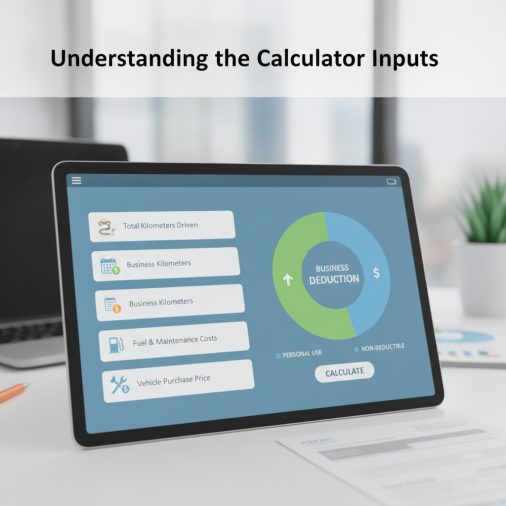
Business Kilometres Driven (per year): This is the total number of kilometres you drove specifically for work-related purposes during the financial year. Include travel to client sites, work-related errands, inter-office travel, and site visits. Do not include your regular commute from home to your usual place of work, as this is classified as private travel in most jurisdictions.
Per-Kilometre Rate (cents per km): This is the flat rate approved by your tax authority for the relevant tax year. In Australia, the ATO sets this rate annually (85 cents/km as of 2024–25). In the USA, the IRS publishes a standard mileage rate. In the UK, HMRC uses Approved Mileage Allowance Payments (AMAPs). Always use the rate that applies to your country and the specific tax year you are calculating for.
Total Kilometres Driven (per year): Enter the grand total of all kilometres driven in the vehicle during the year — both business and personal. This figure is used to calculate your business-use percentage, which is the foundation of the logbook method. If you drive multiple vehicles, calculate each separately.
Annual Fuel Cost: Enter your total spending on petrol, diesel, or electricity for the vehicle over the year. Keep fuel receipts or use bank statements to arrive at an accurate figure. This is typically the largest single running cost.
Annual Vehicle Depreciation: Depreciation represents the loss in value of your vehicle over time. Your tax authority will specify an approved method — such as diminishing value or prime cost (straight-line) — and an effective life for the vehicle. Use the depreciation amount calculated under that approved method for the year.
Annual Insurance Cost: Include comprehensive, third-party, and any other vehicle insurance premiums paid during the year. If your policy covers a period that spans two financial years, apportion the cost accordingly.
Annual Registration and Licensing Fees: Include vehicle registration, compulsory third-party insurance (where it is a separate charge), and any licensing fees directly related to the vehicle.
Annual Maintenance and Repairs: Include servicing, tyres, oil changes, mechanical repairs, and any other costs incurred to keep the vehicle roadworthy. Keep all receipts as supporting documentation.
Marginal Tax Rate: Select the income tax bracket that applies to your taxable income for the year. This is used to convert your deduction into an estimated real-dollar tax saving. If you are unsure of your bracket, consult your tax authority’s published rate schedule or a registered tax adviser.
Understanding Your Results
Standard Per-KM Deduction: This is the dollar amount you can claim using the flat-rate method. It is calculated by multiplying your business kilometres by the per-kilometre rate. No receipts for individual expenses are required under this method — only a record of your business kilometres. Many jurisdictions cap the number of kilometres claimable under this method (for example, Australia caps it at 5,000 km per vehicle per year under the cents-per-km method).
Business-Use Percentage: This percentage shows what proportion of your total driving was for business. For example, if you drove 10,000 km for business out of 20,000 km total, your business-use percentage is 50%. This figure is applied to your total vehicle costs under the logbook method to determine the deductible portion.
Calculated Total Vehicle Costs: This is the sum of all the individual cost fields you entered. Compare this figure to your own records to confirm accuracy before relying on the logbook method result. If the figure looks too high or too low, revisit each cost category.
Logbook Method Deduction: This is the deductible amount under the logbook (actual cost) method — your total vehicle costs multiplied by your business-use percentage. This method typically produces a larger deduction for high-cost vehicles or high business-use percentages, but it requires a valid logbook and receipts for all expenses.
Estimated Tax Saving (Per-KM Method): This converts your per-km deduction into an estimated reduction in tax payable, based on your marginal tax rate. For example, a $8,500 deduction at a 32.5% marginal rate saves approximately $2,763 in tax.
Estimated Tax Saving (Logbook Method): This shows the estimated tax saving if you use the logbook method deduction. Compare this to the per-km method tax saving to identify which approach is more beneficial for your situation before discussing with a tax professional.
Calculation Formulas Explained
Standard Per-KM Deduction: business_km × (rate_per_km ÷ 100). The rate is entered in cents per kilometre, so dividing by 100 converts it to dollars. Multiplying by business kilometres gives the total deductible amount in dollars.
Business-Use Percentage: (business_km ÷ total_km) × 100. This expresses business kilometres as a percentage of all kilometres driven. The result is a number between 0 and 100.
Calculated Total Vehicle Costs: fuel_cost_annual + depreciation_annual + insurance_annual + registration_annual + maintenance_annual. A straightforward sum of all entered annual vehicle expenses in dollars.
Logbook Method Deduction: total_vehicle_costs × (business_km ÷ total_km). The total costs are multiplied by the business-use fraction (not the percentage) to give the deductible portion in dollars.
Estimated Tax Saving (Per-KM Method): per_km_deduction × (tax_rate ÷ 100). The deduction is multiplied by the marginal tax rate (converted from a percentage to a decimal) to estimate the reduction in tax payable.
Estimated Tax Saving (Logbook Method): logbook_deduction × (tax_rate ÷ 100). The same tax-rate conversion is applied to the logbook method deduction to estimate the tax saving in dollars.
All formulas assume a simple proportional relationship between deductions and tax savings, which holds true for taxpayers whose income falls entirely within a single marginal bracket. If your deduction pushes you into a lower bracket, the actual saving may differ slightly.
Worked Example
Scenario: Sarah is a self-employed consultant who drove 12,000 km for business out of 25,000 km total during the financial year. Her per-kilometre rate is 85 cents/km. Her annual vehicle costs are: fuel $3,000, depreciation $2,500, insurance $1,400, registration $900, and maintenance $700. Her marginal tax rate is 32.5%.
Step 1 — Per-KM Deduction: 12,000 × (85 ÷ 100) = 12,000 × 0.85 = $10,200. Note: if Sarah’s jurisdiction caps this method at 5,000 km, her actual claimable amount would be 5,000 × 0.85 = $4,250. She should check her local rules.
Step 2 — Business-Use Percentage: (12,000 ÷ 25,000) × 100 = 48.0%.
Step 3 — Total Vehicle Costs: $3,000 + $2,500 + $1,400 + $900 + $700 = $8,500.
Step 4 — Logbook Method Deduction: $8,500 × (12,000 ÷ 25,000) = $8,500 × 0.48 = $4,080.
Step 5 — Tax Saving (Per-KM, uncapped): $10,200 × (32.5 ÷ 100) = $3,315.
Step 6 — Tax Saving (Logbook Method): $4,080 × (32.5 ÷ 100) = $1,326.
Conclusion: In this example, the per-km method (if uncapped) produces a significantly higher deduction. However, Sarah should verify whether her jurisdiction imposes a kilometre cap on the per-km method, in which case the logbook method may be more advantageous. She should retain her logbook and all receipts regardless of which method she chooses.
How to Interpret the Results
Once you have both deduction figures, compare them directly. The higher deduction will generally produce the greater tax saving, but the method you choose must be supported by the records you actually hold. If you have a valid logbook and all receipts, you can choose whichever method gives the better outcome. If you only have a kilometre log, you are limited to the per-km method.
A business-use percentage below 20% suggests that most of your driving is personal, and your deductible amount will be modest regardless of method. A percentage above 70% indicates heavy business use, and the logbook method is likely to produce a substantially larger deduction — especially if your vehicle has high running costs or significant depreciation.
The estimated tax saving figures translate your deduction into a real-dollar benefit. Use these to assess whether the administrative effort of maintaining a logbook is worthwhile for your situation. For high-cost vehicles with high business use, the logbook method can save thousands of dollars more than the per-km method.
Remember that these are estimates. Your actual deduction may be affected by jurisdiction-specific caps, the approved depreciation method, GST or VAT adjustments, and other factors that a registered tax professional can advise on.
Common Mistakes to Avoid
- Including commuting kilometres: Travel from your home to your regular workplace is private travel in most jurisdictions and cannot be claimed. Only include kilometres driven for genuine work purposes beyond your normal commute.
- Using an outdated per-kilometre rate: Tax authorities update the rate annually. Using last year’s rate — even if only slightly different — can result in an incorrect claim. Always verify the current rate with your tax authority before lodging.
- Forgetting to apportion mixed-use costs: Under the logbook method, you must apply the business-use percentage to all costs, including depreciation. Claiming 100% of any cost when the vehicle has personal use is incorrect and may trigger an audit.
- Not keeping a contemporaneous logbook: Reconstructing a logbook from memory after the fact is not acceptable in most jurisdictions. Records must be kept at or near the time of each trip.
- Double-counting expenses: If your employer reimburses you for vehicle costs, you cannot also claim those same costs as a deduction. Only unreimbursed expenses are deductible.
- Claiming the wrong vehicle: The vehicle must be used for income-producing purposes. Claiming deductions for a vehicle used solely for personal travel — even if it is registered in a business name — is not permitted.
- Ignoring GST or VAT adjustments: In some jurisdictions, if you are registered for GST or VAT and claim input tax credits on vehicle costs, you must use the GST-exclusive amount in your income tax deduction calculation, not the gross amount.
Limitations and Important Notes
This calculator provides general planning estimates only and does not constitute tax advice. Results are based solely on the figures you enter and the formulas described above. The calculator does not account for jurisdiction-specific kilometre caps (such as Australia’s 5,000 km cap on the cents-per-km method), luxury car depreciation limits, GST or VAT adjustments, employer reimbursements, or any other jurisdiction-specific rules that may affect your actual deductible amount.
The marginal tax rate brackets shown are indicative examples based on common rate structures and do not represent the official rates of any specific country. Your actual marginal rate may differ. The tax saving estimate assumes your entire deduction falls within a single marginal bracket, which may not be the case if the deduction reduces your income across a bracket boundary.
Depreciation figures must be calculated using the method approved by your local tax authority and applied to the correct effective life for your vehicle type. This calculator does not perform depreciation calculations — you must enter a pre-calculated depreciation figure.
Always verify your deduction with a registered tax professional or your national tax authority before lodging your return. Tax laws change frequently, and the rules that apply to your specific situation — including your employment status, vehicle type, and jurisdiction — may differ materially from the general assumptions used here.
Frequently Asked Questions
Can I claim kilometres driven from home to work?
In most jurisdictions, travel between your home and your regular place of work is classified as private travel and is not tax-deductible. However, there are exceptions: if your home is your principal place of business, if you are required to carry bulky tools or equipment that cannot be stored at your workplace, or if you travel between two separate workplaces on the same day. The rules vary by country, so check the specific guidance from your tax authority — such as the ATO, IRS, or HMRC — before including any home-to-work kilometres in your claim.
Do I need receipts to use the per-kilometre method?
Generally, no. The per-kilometre (or cents-per-km) method is designed to be a simplified option that does not require you to keep receipts for individual vehicle expenses such as fuel, insurance, or servicing. However, you do need to keep a record of your business kilometres — including the date, destination, purpose, and distance of each trip. Some tax authorities also require you to be able to demonstrate how you calculated your total business kilometres if asked. The logbook method, by contrast, requires receipts for all claimed expenses.
How long does my logbook need to cover?
In most jurisdictions that use a logbook method, the logbook must cover a continuous period of at least 12 weeks and must be representative of your typical business travel pattern throughout the year. In Australia, for example, a valid ATO logbook must cover at least 12 continuous weeks. Once established, the logbook is generally valid for five years, provided your business-use pattern does not change significantly. If your circumstances change — such as a new job role or a different vehicle — you should start a new logbook to ensure your business-use percentage remains accurate.
Can I claim a leased vehicle using the logbook method?
Yes, in most jurisdictions you can claim lease payments as part of your vehicle running costs under the logbook method, subject to any luxury car lease cost limits set by your tax authority. The deductible portion of the lease payment is calculated by applying your business-use percentage to the total lease payments made during the year. You should also check whether your jurisdiction treats operating leases and finance leases differently for tax purposes, as the treatment of depreciation and interest components may vary. Consult a tax professional to ensure the correct treatment for your specific lease arrangement.
Can employees claim vehicle expenses, or only self-employed people?
Both employees and self-employed individuals can potentially claim vehicle expenses, but the rules differ. Self-employed people generally have broader access to vehicle deductions and can use either the per-km or logbook method. Employees can typically only claim vehicle expenses if they are required to use their own vehicle for work and are not reimbursed by their employer. In some countries, employees must meet additional conditions — such as the travel being a requirement of their employment contract — and may need to obtain a declaration from their employer. Check the specific rules for employees in your jurisdiction before making a claim.
Is depreciation already included in the per-kilometre rate?
Yes. In jurisdictions that use a government-set flat per-kilometre rate, that rate is designed to cover all vehicle running costs, including depreciation, fuel, insurance, registration, and maintenance. This means you cannot claim depreciation or any other individual vehicle expense separately if you are using the per-km method — the rate is intended to be an all-inclusive figure. This is one reason why the logbook method can produce a higher deduction for expensive vehicles: it allows you to claim the actual depreciation amount, which may be significantly higher than the depreciation component embedded in the flat rate.
Can I switch between the per-km and logbook methods each year?
In many jurisdictions, you are permitted to choose the most advantageous method each year, provided you meet the record-keeping requirements for whichever method you select. However, some countries impose restrictions — for example, in the USA, if you use the standard mileage rate in the first year you own a vehicle, you may switch to actual expenses in a later year, but the reverse is not always permitted. In Australia, you can generally choose between the cents-per-km and logbook methods each year. Always check the current rules with your tax authority or adviser before switching methods, as the choice can have implications for depreciation calculations in subsequent years.
What records do I need to keep to support my vehicle tax claim?
For the per-kilometre method, you need a kilometre log recording the date, starting and ending odometer readings (or distance), destination, and business purpose of each trip. For the logbook method, you need all of the above plus a valid logbook covering at least 12 continuous weeks, receipts or invoices for all vehicle expenses (fuel, insurance, registration, servicing, repairs), and documentation supporting your depreciation calculation (purchase price, date of acquisition, and the depreciation method used). Retaining these records for at least five years after lodging your return is recommended in most jurisdictions, as tax authorities can audit claims for prior years.