Whether you’re relocating across the country or purchasing a vehicle online, understanding your car moving costs upfront can save you hundreds of dollars. This car moving cost calculator estimates your total auto transport expense based on distance, vehicle type, shipping method, and seasonal demand. Enter your details below to get an instant breakdown of base shipping fees, fuel surcharges, insurance, and terminal or door-to-door service premiums—so you can budget confidently before requesting a carrier quote.
Car Moving Cost Calculator: Instant Auto Transport Estimate
Estimate the total cost of shipping your vehicle based on distance, vehicle size, transport type, service level, and seasonal demand.
How to Use This Calculator

Follow these steps to get your instant car shipping estimate:
- Enter the shipping distance in miles between your origin and destination.
- Select your vehicle size from motorcycle to oversized, as larger vehicles occupy more carrier space.
- Choose your transport type—open carriers are standard and affordable; enclosed carriers protect high-value vehicles.
- Select your pickup and delivery service—door-to-door is more convenient while terminal-to-terminal is more economical.
- Indicate vehicle condition—non-running vehicles require special loading equipment and cost more.
- Pick your shipping season to account for demand-driven price fluctuations.
- Choose standard or expedited pickup if you need a guaranteed narrow pickup window.
- Enter additional vehicles if shipping more than one car simultaneously to apply a multi-vehicle discount.
- Review your results including base cost, adjustments, fuel surcharge, insurance estimate, and total.
Understanding the Calculator Inputs
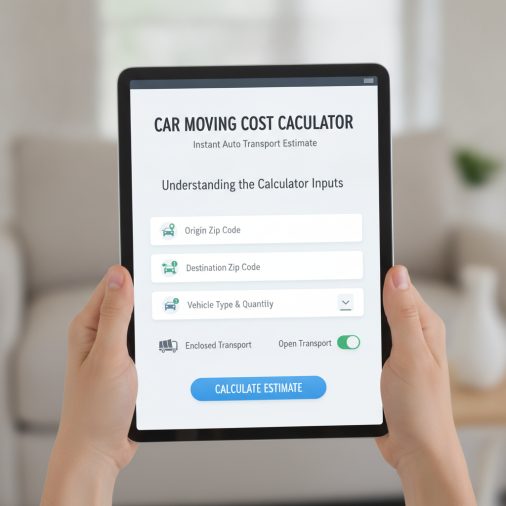
Shipping Distance (miles): Enter the approximate road distance between your pickup and delivery locations. You can use a mapping tool to find this figure. The minimum accepted distance is 50 miles; the calculator supports routes up to 3,500 miles, covering coast-to-coast US shipments. Distance is the single largest cost driver in auto transport pricing.
Vehicle Size: Select the category that best matches your vehicle. Motorcycles are the smallest and cheapest to ship. Sedans and coupes represent the standard baseline. SUVs and minivans are moderately larger. Standard pickup trucks are slightly bigger still. Large trucks and full-size vans occupy significantly more carrier space. Oversized or exotic vehicles—including lifted trucks, wide-body cars, and low-clearance exotics—carry the highest size multiplier because they may require special positioning or dedicated carriers.
Transport Type: Open transport is the industry standard. Your vehicle rides on an open multi-car trailer exposed to weather and road debris, but this method is safe for the vast majority of vehicles and is the most affordable option. Enclosed transport places your vehicle inside a covered trailer, protecting it from the elements. It is strongly recommended for classic cars, luxury vehicles, and exotics where paint and finish preservation is a priority. Expect to pay roughly 60% more for enclosed service.
Pickup / Delivery Service: Terminal-to-terminal service requires you to drop off and pick up your vehicle at designated carrier depots. It is cheaper but less convenient and may add days to your timeline. Door-to-door service has the carrier pick up and deliver directly at addresses you specify, adding a convenience premium of approximately 15%.
Vehicle Condition: A vehicle that runs and drives under its own power can be driven onto and off the carrier trailer normally. A non-running or inoperable vehicle requires a winch or forklift for loading and unloading, which adds specialized labor costs. Select the correct condition to avoid underestimating your quote.
Shipping Season: Auto transport demand peaks in summer and during snowbird migration periods (typically October–November and March–April). Shipping during off-peak fall and winter months can reduce your cost by roughly 10%. Peak summer demand can add 15% or more to standard rates.
Expedited Pickup: Standard booking gives carriers a 3–7 day window to assign a driver and pick up your vehicle. If you need pickup within 1–2 days, carriers charge a premium of approximately 20% to prioritize your load over standard bookings.
Number of Additional Vehicles: If you are shipping more than one vehicle on the same carrier at the same time—common for military relocations, dealership transfers, or households with multiple cars—enter the number of additional vehicles beyond the first. A 7% discount per extra vehicle is applied, capped at five additional units.
Understanding Your Results
Base Shipping Cost: This is the foundational estimate before any service upgrades or surcharges. It reflects a distance-scaled rate adjusted for your vehicle’s size. Longer routes benefit from lower per-mile rates due to carrier efficiency on long hauls, which is why the formula uses a sub-linear distance exponent.
Service & Condition Adjustments: This line shows the combined dollar premium added by your choices of transport type, service level, vehicle condition, season, and pickup speed above the open-transport baseline. A higher number here means you have selected several premium options simultaneously.
Multi-Vehicle Discount: If you entered one or more additional vehicles, this negative value shows the total savings applied. The discount is calculated as 7% of the base cost per additional vehicle, up to five extra units. If you entered zero additional vehicles, this result will show $0.00.
Estimated Fuel Surcharge: Carriers pass diesel fuel costs to shippers as a percentage surcharge. This estimate uses 8% of the base cost as a mid-range assumption. In periods of high diesel prices, actual surcharges may be higher; in low-price periods, they may be lower.
Carrier Insurance Estimate: All licensed US auto transport carriers are required to carry cargo liability insurance. This estimate represents approximately 3% of the base cost with a $100 minimum floor. It reflects the cost of standard carrier liability coverage, not supplemental declared-value or gap insurance.
Total Estimated Moving Cost: This is your all-in budgeting figure. It combines the base rate with all service multipliers applied simultaneously, adds the fuel surcharge and insurance estimate, and subtracts any multi-vehicle discount. Use this number as a realistic benchmark when comparing carrier quotes—not as a guaranteed price.
Calculation Formulas Explained
The core of every result is the base rate formula:
Base Cost = (( distance_miles ^ 0.92 ) * 0.65 + 150) * vehicle_size
The exponent of 0.92 models the well-documented industry pattern that per-mile rates decrease on longer routes because carriers spread fixed costs (driver wages, fuel deadhead, insurance) over more miles. The coefficient 0.65 is a calibrated rate factor reflecting typical US open-carrier market pricing as of 2024. The constant 150 represents a minimum booking fee that applies regardless of distance. The result is then multiplied by the vehicle size factor, which ranges from 0.6 for a motorcycle to 1.8 for an oversized vehicle.
The Service & Condition Adjustments formula sums all five option multipliers (transport type, service type, vehicle condition, season, and expedited) and subtracts 4—the sum of all baseline values of 1—so that the result represents only the incremental premium above the standard open-transport, terminal-to-terminal, running-vehicle, standard-season, standard-pickup baseline.
The Multi-Vehicle Discount multiplies the base cost by the number of additional vehicles (capped at 5 using the min() function) and by 0.07, representing a 7% per-vehicle discount.
The Fuel Surcharge is simply 8% of the base cost (base * 0.08).
The Insurance Estimate uses the max() function to enforce a $100 floor: max(100, base * 0.03). This ensures the estimate is never unrealistically low for very short or very small shipments.
The Total Estimated Moving Cost multiplies the base cost by all five service multipliers simultaneously (not additively), which correctly compounds the premiums as carriers do in practice, then adds fuel surcharge and insurance and subtracts the multi-vehicle discount.
Worked Example
Scenario: A family in Chicago is relocating to Dallas and needs to ship their SUV (runs and drives) via open transport, door-to-door, in July (peak season), with standard pickup. They are shipping one vehicle only.
- Distance: 920 miles
- Vehicle Size: SUV / Minivan → factor 1.2
- Transport Type: Open → factor 1.0
- Service Type: Door to Door → factor 1.15
- Vehicle Condition: Runs and Drives → factor 1.0
- Season: Peak (Summer) → factor 1.15
- Expedited: Standard → factor 1.0
- Additional Vehicles: 0
Step 1 – Base Cost: 920 ^ 0.92 = approximately 598.7. Then (598.7 * 0.65) + 150 = 389.2 + 150 = 539.2. Multiply by vehicle size: 539.2 * 1.2 = $647.04.
Step 2 – Service & Condition Adjustments: Sum of multipliers minus 4 = (1.0 + 1.15 + 1.0 + 1.15 + 1.0) − 4 = 5.30 − 4 = 1.30. Adjustment = 647.04 * 1.30 = $841.15.
Step 3 – Multi-Vehicle Discount: 0 additional vehicles → $0.00.
Step 4 – Fuel Surcharge: 647.04 * 0.08 = $51.76.
Step 5 – Insurance Estimate: max(100, 647.04 * 0.03) = max(100, 19.41) = $100.00 (floor applies).
Step 6 – Total: Base (647.04) * all multipliers simultaneously (1.0 * 1.15 * 1.0 * 1.15 * 1.0) = 647.04 * 1.3225 = 855.71. Add fuel surcharge (51.76) and insurance (100.00), subtract discount (0): Total ≈ $1,007.47.
This estimate suggests budgeting approximately $1,000–$1,100 for this shipment before collecting actual carrier quotes.
How to Interpret the Results
Use the Total Estimated Moving Cost as your primary budgeting benchmark. It represents a realistic mid-market estimate for the options you selected. Here is how to interpret the range:
- Your total is below $500: Typical for short-distance motorcycle or sedan shipments under 300 miles via open transport in off-peak season.
- $500–$900: Common range for mid-distance sedan or SUV shipments (400–1,000 miles) via open transport, standard service.
- $900–$1,400: Expected for cross-regional shipments (1,000–2,000 miles) or any shipment with one or two premium options selected.
- $1,400–$2,500: Typical for coast-to-coast open transport or mid-distance enclosed transport of a standard vehicle.
- Above $2,500: Expected for coast-to-coast enclosed transport, oversized vehicles, or combinations of multiple premium options.
When you receive actual carrier quotes, compare them against your estimate. Quotes significantly below your estimate may indicate a low-ball offer that could result in delays or hidden fees. Quotes significantly above it may mean the carrier is pricing in route-specific demand or limited availability—both legitimate reasons to shop around.
Remember that this calculator provides a planning estimate. Actual prices depend on real-time carrier availability, fuel index prices, and route-specific demand at the time of booking.
Common Mistakes to Avoid
- Using straight-line distance instead of road distance: Always use the actual driving distance between your origin and destination, not the geographic straight-line distance. Road distance is typically 15–25% longer and is what carriers use to price shipments.
- Forgetting seasonal timing: Many people book auto transport without considering that summer rates can be 15–20% higher than fall rates. If your schedule is flexible, shifting your ship date by a few weeks can produce meaningful savings.
- Assuming door-to-door means curbside delivery anywhere: Door-to-door service delivers to your address, but carriers drive large multi-car trailers. If your street is narrow, has low-hanging trees, or is otherwise inaccessible, the driver may need to meet you at a nearby accessible location.
- Underestimating enclosed transport costs: Owners of luxury or classic vehicles sometimes expect enclosed transport to cost only slightly more than open. In practice, enclosed transport typically costs 50–70% more due to limited carrier availability and smaller trailer capacity.
- Not disclosing a non-running vehicle upfront: Failing to disclose that a vehicle is inoperable when booking can result in the carrier refusing pickup or charging a surprise surcharge on delivery day.
- Booking too late: Last-minute bookings (less than one week out) almost always cost more because carrier availability is limited. Booking 2–4 weeks in advance gives you the best combination of price and scheduling flexibility.
- Leaving personal items in the vehicle: Most carriers prohibit personal items in shipped vehicles, and carrier insurance does not cover personal belongings. Items left inside can also add weight and create liability issues.
Limitations and Important Notes
This calculator is a planning and budgeting tool only. It is not a binding quote, a carrier contract, or a guarantee of any specific price. Actual auto transport costs depend on real-time carrier availability, current diesel fuel index prices, route-specific demand, individual carrier pricing strategies, and factors not captured in this model.
The base rate formula is calibrated to typical US open-carrier market conditions as of 2024. Rates in your specific market corridor may be higher or lower. The calculator assumes road distance is entered correctly; it does not calculate distance from city names or ZIP codes.
The following costs are not included in this estimate: broker commissions (typically $100–$300 above carrier cost), state permit fees for oversized loads, storage fees if pickup or delivery is delayed, supplemental declared-value or gap insurance beyond standard carrier liability, and any fees for remote or rural pickup/delivery locations.
The multi-vehicle discount assumes all vehicles ship simultaneously on the same carrier. Discounts negotiated directly with carriers may differ. The fuel surcharge is held constant at 8%; actual surcharges fluctuate weekly with the US Energy Information Administration diesel index. Always obtain at least three quotes from licensed, FMCSA-registered carriers before committing to a shipment.
Frequently Asked Questions
How much does it cost to ship a car across the country?
A coast-to-coast car shipment in the United States—typically 2,500 to 3,000 miles—generally costs between $1,100 and $1,800 for a standard sedan via open transport with door-to-door service during a standard season. Enclosed transport for the same route typically runs $1,800 to $2,800 or more. Larger vehicles, peak-season timing, and expedited pickup all push costs toward the higher end of these ranges. Use the calculator above with your specific inputs to get a personalized estimate before collecting carrier quotes.
How long does car transport take from coast to coast?
A coast-to-coast auto transport shipment typically takes 7 to 14 days from pickup to delivery, depending on the specific route, carrier schedule, and number of stops along the way. The pickup window itself can add 1 to 7 days on top of transit time if you book standard service. Expedited pickup reduces the wait for a driver to be assigned but does not necessarily shorten the transit time once the vehicle is loaded. Always build buffer time into your planning, especially if you need the vehicle by a specific date.
Is open or enclosed transport better for a luxury or classic car?
For luxury vehicles, classic cars, exotics, and any vehicle where paint and finish preservation is a priority, enclosed transport is strongly recommended. Open carriers expose your vehicle to road debris, weather, and UV light during transit. While the vast majority of open-transport shipments arrive without incident, the risk of minor paint chips or weather exposure is real. Enclosed transport eliminates those risks and typically includes higher cargo liability limits. The 50–70% cost premium is generally considered worthwhile for vehicles valued above $50,000 or those with irreplaceable finishes. If you’re also thinking about protecting your vehicle’s appearance after delivery, resources on touch-up car paint costs can help you budget for any minor corrections needed post-transport.
Does my personal auto insurance cover damage during transport?
In most cases, standard personal auto insurance policies do not cover damage that occurs while your vehicle is in the custody of a carrier. Your policy typically covers damage you cause while driving, not damage caused by a third party during shipping. Carriers are required by federal law to carry cargo liability insurance, which covers damage they cause during transport. However, carrier liability limits vary, and some policies have exclusions. Before shipping, contact your auto insurer to confirm your coverage, ask the carrier for a copy of their cargo insurance certificate, and consider purchasing supplemental declared-value coverage if your vehicle is high in value.
Can I put personal items in my car during shipping?
Most auto transport carriers prohibit personal items inside shipped vehicles, and for good reason. Carrier cargo insurance covers the vehicle itself, not personal belongings—meaning anything left inside is shipped at your own risk with no recourse if it is lost or damaged. Additionally, extra weight from personal items can technically violate carrier weight limits and DOT regulations. Some carriers allow a small amount of items in the trunk (typically under 100 lbs) as an informal accommodation, but this is not guaranteed and should be confirmed in writing before booking. As a general rule, remove all personal belongings before handing your vehicle to the carrier.
How far in advance should I book auto transport?
Booking 2 to 4 weeks in advance is the sweet spot for most auto transport shipments. This window gives carriers enough lead time to assign a driver on your preferred dates while still allowing you to compare quotes from multiple companies. Booking less than one week out significantly limits carrier availability and almost always results in higher prices or longer wait times. During peak season (summer and snowbird periods), booking 4 to 6 weeks ahead is advisable. If you have a hard deadline—such as a military reporting date or a real estate closing—always book as early as possible and consider paying for expedited pickup to reduce scheduling risk.
Why do car shipping quotes vary so much between companies?
Auto transport pricing varies widely because the industry operates on a broker-carrier model where brokers post loads to a national load board and independent carriers bid on them. A broker quoting a very low price may be underbidding to win your business, then struggling to find a carrier willing to accept the load at that rate—leading to delays. Higher quotes may reflect a carrier with strong route coverage and reliable availability. Other factors driving variation include the broker’s commission margin, the carrier’s equipment type, their insurance limits, and current demand on your specific route corridor. Always verify that any company you use is registered with the FMCSA and has a valid MC number before paying a deposit.
What happens if my car is damaged during transport?
If your vehicle sustains damage during transport, the process for filing a claim begins at delivery. Before signing the delivery receipt, carefully inspect your vehicle against the condition report (also called a Bill of Lading) that was completed at pickup. Document any new damage with photographs immediately. Do not sign a clean delivery receipt if damage is present—note all damage on the form before signing. Then contact the carrier’s insurance company directly to file a cargo damage claim. Resolution timelines vary, but most legitimate claims are processed within 30 to 60 days. If the carrier disputes the claim or is unresponsive, you can file a complaint with the FMCSA.