Use this car monthly payment calculator to instantly estimate your auto loan payment before you step into a dealership. Enter your vehicle price, down payment, any trade-in value, your expected interest rate, and loan term to see your projected monthly payment, total interest paid, and overall loan cost. Understanding these numbers in advance puts you in a stronger negotiating position and helps you choose a loan that fits comfortably within your budget.
Car Monthly Payment Calculator: Estimate Your Auto Loan Cost
Calculate your estimated monthly car payment, total interest paid, and full loan cost based on vehicle price, down payment, trade-in, taxes, fees, and APR.
How to Use This Calculator
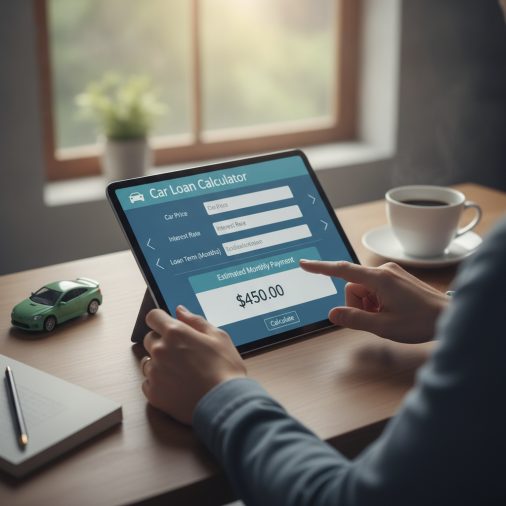
Follow these steps to get an accurate estimate from the calculator:
- Enter the vehicle price — use the sticker price or the negotiated purchase price you expect to pay.
- Enter your down payment — the cash you plan to pay upfront at signing.
- Enter your trade-in value — the estimated value of any vehicle you are trading in; leave at zero if not applicable.
- Set the sales tax rate — use your state or local rate; the slider defaults to 6%.
- Enter title, registration, and dealer fees — check your state DMV or ask the dealer for an estimate; $800 is a common baseline.
- Set the annual interest rate (APR) — use a rate you have been pre-approved for, or check current average rates for your credit tier.
- Select your loan term — choose from 24 to 84 months depending on the payment you can afford.
- Read your results — the calculator instantly shows your monthly payment, total interest, and complete out-of-pocket cost.
Understanding the Calculator Inputs
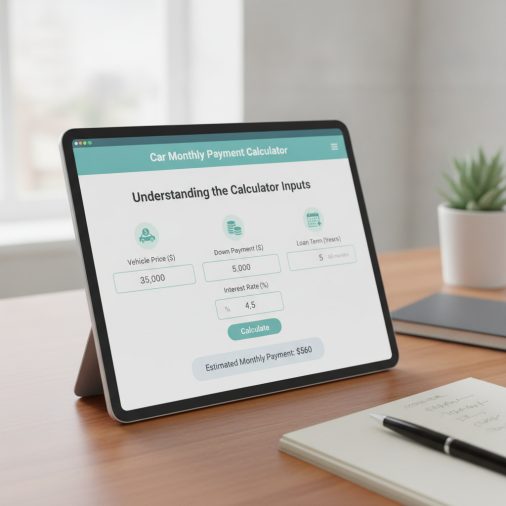
Vehicle Price ($): Enter the full purchase price of the car — either the manufacturer’s suggested retail price (MSRP) or the negotiated price you expect to agree on. This is the single largest driver of your loan amount, so even a few hundred dollars of negotiation can meaningfully reduce your payment.
Down Payment ($): This is the cash you hand over at signing. A larger down payment directly reduces the principal you borrow, which lowers both your monthly payment and the total interest you pay over the life of the loan. Most financial advisors recommend at least 10–20% down on a new vehicle.
Trade-In Value ($): If you are trading in a vehicle, enter its estimated value here. The dealer applies this credit against your purchase price, reducing the amount you need to finance. If your trade-in still has an outstanding loan balance, that balance is not accounted for in this calculator — only the equity (trade-in value) is used.
Sales Tax Rate (%): Most U.S. states charge sales tax on vehicle purchases. Use the slider to set your combined state and local rate. The calculator applies this tax to the vehicle price and rolls it into the financed amount, which is the most common dealer practice. Some states allow trade-in deductions from the taxable base; this calculator does not model that variation.
Title, Registration & Dealer Fees ($): These are the government and administrative fees charged at purchase — including title transfer, license plate registration, documentation fees, and any dealer processing charges. They vary widely by state and dealer. A reasonable estimate is $500–$1,500 for most U.S. buyers. These fees are assumed to be financed into the loan in this calculator.
Annual Interest Rate / APR (%): Enter the annual percentage rate you expect to receive. Your APR depends primarily on your credit score, the loan term, whether the vehicle is new or used, and the lender. Borrowers with excellent credit (720+) typically qualify for rates well below the national average, while subprime borrowers may see rates above 15%. Get pre-approved by a bank or credit union before visiting the dealership so you have a benchmark rate to compare against dealer financing offers.
Loan Term (months): Select the repayment period. Shorter terms (24–48 months) mean higher monthly payments but significantly less total interest. Longer terms (72–84 months) lower the monthly payment but increase total interest paid and raise the risk of being underwater on the loan (owing more than the car is worth).
Understanding Your Results
Amount Financed: This is the actual loan principal — the dollar amount the lender gives to the dealer on your behalf. It equals the vehicle price minus your down payment and trade-in credit, plus sales tax on the vehicle price and any fees rolled into the loan. This is the number that interest accrues on each month.
Monthly Interest Rate: This is your APR divided by 12. It is the periodic rate applied to your outstanding balance each month to calculate the interest portion of each payment. For example, a 6.5% APR produces a monthly rate of approximately 0.5417%. This figure is shown for transparency and is used internally in the amortization formula.
Monthly Payment: This is the fixed amount you owe the lender every month for the duration of the loan term. Each payment covers the month’s interest charge plus a portion of the principal. Early payments are weighted more toward interest; later payments pay down more principal — this is standard loan amortization.
Total Amount Paid: This is your monthly payment multiplied by the number of months in your loan term. It represents the gross cash you send to the lender over the life of the loan, not counting your down payment or trade-in.
Total Interest Paid: This is the total amount paid minus the amount financed. It is the true cost of borrowing — the premium you pay the lender for the privilege of spreading payments over time. Comparing this figure across different loan terms and rates is one of the most powerful ways to evaluate financing options.
Total Out-of-Pocket Cost: This is the most complete picture of what the vehicle actually costs you. It adds your down payment and trade-in equity to the total amount paid to the lender. Use this figure when comparing the true cost of different financing scenarios, including paying cash versus financing.
Calculation Formulas Explained
The calculator uses the standard amortizing loan payment formula, which is the same formula used by banks, credit unions, and auto lenders worldwide:
Monthly Payment = P × [r(1 + r)^n] / [(1 + r)^n − 1]
Where P is the principal (amount financed), r is the monthly interest rate (APR ÷ 12 ÷ 100), and n is the total number of monthly payments (loan term in months). This formula assumes a fixed interest rate and equal monthly payments throughout the loan — the definition of a fully amortizing fixed-rate loan.
The Amount Financed (P) is calculated as: vehicle price − down payment − trade-in value + (vehicle price × sales tax rate ÷ 100) + fees. Sales tax is applied only to the vehicle price, not to fees, which is the most common treatment.
The Total Amount Paid is simply the monthly payment multiplied by the number of months. The Total Interest Paid is the total amount paid minus the principal financed. The Total Out-of-Pocket Cost adds the down payment and trade-in value back in to reflect the complete financial outlay from the buyer’s perspective.
When the APR is zero (0%), the formula’s denominator approaches zero, which would cause a division error. In that case, the monthly payment simplifies to P ÷ n (principal divided by number of months), which the calculator handles automatically.
Worked Example
Scenario: You are buying a new SUV with a negotiated price of $38,000. You plan to put $6,000 down, trade in your current car for $4,000, finance at 7.0% APR over 60 months, with a 6% sales tax rate and $900 in fees.
- Sales tax on vehicle price: $38,000 × 6% = $2,280
- Amount Financed: ($38,000 − $6,000 − $4,000) + $2,280 + $900 = $28,000 + $2,280 + $900 = $31,180
- Monthly interest rate: 7.0% ÷ 12 = 0.5833% = 0.005833
- Monthly Payment: $31,180 × [0.005833 × (1.005833)^60] ÷ [(1.005833)^60 − 1]
(1.005833)^60 ≈ 1.4176
= $31,180 × [0.005833 × 1.4176] ÷ [1.4176 − 1]
= $31,180 × 0.008269 ÷ 0.4176
= $31,180 × 0.019800 ≈ $617.26/mo - Total Amount Paid: $617.26 × 60 = $37,035.60
- Total Interest Paid: $37,035.60 − $31,180 = $5,855.60
- Total Out-of-Pocket Cost: $6,000 + $4,000 + $37,035.60 = $47,035.60
This means the $38,000 SUV ultimately costs you about $47,036 when you account for your down payment, trade-in equity, and all loan payments — a useful reality check before signing.
How to Interpret the Results
When reviewing your results, focus on three key relationships:
- Monthly payment vs. your budget: A widely cited guideline suggests keeping total vehicle expenses (payment + insurance + fuel + maintenance) below 15–20% of your monthly take-home pay. If your monthly payment alone exceeds 10–12% of take-home pay, consider a larger down payment, a less expensive vehicle, or a longer term as a last resort.
- Total interest paid vs. vehicle value: If your total interest paid exceeds 15–20% of the vehicle’s purchase price, your APR or loan term may be too high. Shopping for a lower rate or shortening the term can dramatically reduce this figure.
- Total out-of-pocket cost vs. vehicle lifespan: Compare the total cost to how long you realistically plan to keep the vehicle. If you plan to sell or trade in after three years but are on a 72-month loan, you may owe more than the car is worth — a condition called being “underwater” or having negative equity.
- Amount financed vs. vehicle value: Lenders typically require the loan amount to not exceed the vehicle’s actual cash value. If your amount financed is very close to or exceeds the purchase price, gap insurance is worth considering to cover the difference in the event of a total loss.
Common Mistakes to Avoid
Focusing only on the monthly payment: Dealers are trained to negotiate around monthly payment rather than total price. A lower monthly payment achieved by extending the loan term to 84 months can cost thousands more in interest than a shorter loan at the same rate. Always compare total interest paid, not just the monthly figure.
Forgetting taxes and fees: Many buyers calculate their payment based on the sticker price alone and are surprised at signing when taxes and fees add $2,000–$4,000 to the financed amount. This calculator includes those costs so your estimate is realistic.
Using the dealer’s rate without shopping: Dealer financing is convenient but not always the cheapest option. Getting pre-approved by your bank or credit union before visiting the dealership gives you a rate benchmark and negotiating leverage. Even a 1% difference in APR on a $30,000 loan over 60 months saves roughly $800 in interest.
Not accounting for trade-in loan balance: If you still owe money on your trade-in vehicle, the outstanding balance is not automatically a credit — it may be rolled into your new loan, increasing the amount financed. This calculator assumes your trade-in is free and clear.
Ignoring the total out-of-pocket cost: The sticker price is not what you pay. Between taxes, fees, interest, and your down payment, the true cost of a vehicle is almost always significantly higher than the purchase price. Use the total out-of-pocket result to make an honest comparison between vehicles at different price points.
Limitations and Important Notes
This calculator provides estimates only and does not constitute a loan offer, pre-approval, or financial advice. Actual loan terms, rates, and fees will be determined by your lender based on your credit profile, the specific vehicle, and current market conditions.
The following assumptions are built into the calculations: (1) The interest rate is fixed for the entire loan term; variable-rate loans will produce different actual payments. (2) Sales tax is calculated on the vehicle price only and is fully financed; some states allow trade-in deductions from the taxable base or require tax to be paid upfront. (3) The trade-in vehicle is assumed to have no outstanding loan balance. (4) All fees are assumed to be financed into the loan; some buyers pay fees out of pocket at signing, which would reduce the amount financed. (5) No prepayment penalties are assumed. (6) If the calculated amount financed is zero or negative due to a very large down payment or trade-in, the results will not be meaningful. (7) This tool does not account for optional add-ons such as extended warranties, GAP insurance, or credit life insurance, which dealers often roll into the loan.
Frequently Asked Questions
What credit score do I need to get a good car loan rate?
Most lenders consider a credit score of 720 or above to be “prime” and will offer their most competitive auto loan rates to borrowers in this range. Scores between 660 and 719 are generally considered near-prime and will still qualify for reasonable rates, though not the lowest available. Borrowers with scores below 620 are typically classified as subprime and may face APRs that are 5–15 percentage points higher than prime rates, significantly increasing the total cost of the loan. Before applying, check your credit report for errors and consider waiting a few months to improve your score if you are near a tier boundary — even moving from 659 to 660 can meaningfully lower your rate.
Is it better to put more money down or choose a shorter loan term?
Both strategies reduce total interest paid, but they work differently. A larger down payment reduces the principal immediately, which lowers every payment and reduces the interest that accrues over the entire term. A shorter loan term reduces the number of months interest accrues, which also cuts total interest — but results in higher monthly payments. In general, if you have the cash available, a larger down payment is preferable because it also reduces the risk of negative equity (owing more than the car is worth). If cash is limited, choosing the shortest loan term your budget can comfortably support is the next best strategy. Use this calculator to compare both scenarios side by side.
Can I include taxes and fees in my car loan?
Yes, in most cases lenders will allow you to roll sales tax, title fees, registration fees, and dealer documentation fees into the financed amount. This is extremely common and is the default assumption in this calculator. The practical effect is that you pay interest on those costs over the life of the loan, making them slightly more expensive than if you paid them out of pocket at signing. If you have the cash available, paying fees upfront reduces your loan principal and saves a small amount of interest. However, for most buyers the convenience of financing fees outweighs the modest interest cost, especially when rates are low.
What is the difference between APR and interest rate on a car loan?
For most auto loans, the APR (Annual Percentage Rate) and the stated interest rate are the same number because auto loans typically do not carry the same origination fees that mortgage loans do. However, if a lender charges upfront fees that are included in the APR calculation, the APR will be slightly higher than the nominal interest rate. When comparing loan offers, always compare APRs rather than nominal rates to ensure you are making an apples-to-apples comparison. Dealer financing sometimes advertises a low interest rate while embedding profit in other fees, so reviewing the full loan disclosure document is essential before signing.
How does a trade-in reduce my monthly payment?
A trade-in reduces your monthly payment by lowering the amount you need to finance. For example, if you are buying a $30,000 car and your trade-in is worth $5,000, you only need to finance $25,000 (before taxes and fees), which directly reduces the principal on which interest accrues. The effect is mathematically identical to making a $5,000 cash down payment. To maximize your trade-in value, get independent appraisals from multiple sources before visiting the dealership, and negotiate the trade-in value separately from the purchase price of the new vehicle to avoid having the dealer offset a generous trade-in offer with a higher selling price.
What happens if I pay extra toward my car loan principal each month?
Making extra principal payments reduces your outstanding balance faster, which means less interest accrues in subsequent months. Over time, this can save a meaningful amount of interest and shorten the effective loan term. For example, paying an extra $50 per month on a $25,000 loan at 7% APR over 60 months would save approximately $400 in interest and pay off the loan about three months early. Most auto loans in the United States do not carry prepayment penalties, but it is worth confirming this in your loan agreement before making extra payments. This calculator assumes no prepayment and calculates the standard fully amortized schedule.
Is a 72-month or 84-month car loan a bad idea?
Long loan terms are not inherently bad, but they carry real risks that buyers should understand. The primary concern is negative equity: vehicles depreciate faster than long-term loans are paid down, meaning you may owe more than the car is worth for several years. If you need to sell or trade in the vehicle before the loan is paid off, you could face a shortfall. Additionally, 72- and 84-month loans typically carry higher interest rates than shorter terms, compounding the total interest cost. That said, if a longer term is the only way to keep the monthly payment within your budget, it may be preferable to buying a vehicle you genuinely cannot afford on a shorter term. GAP insurance is strongly recommended for long-term loans to cover the difference between the loan balance and the vehicle’s actual cash value in the event of a total loss.
Can I refinance my car loan to get a lower monthly payment?
Yes, refinancing an auto loan is a common and straightforward process. If interest rates have dropped since you took out your original loan, your credit score has improved, or you simply did not shop aggressively enough the first time, refinancing can lower your APR and reduce your monthly payment or total interest paid. The process involves applying for a new loan with a different lender, which pays off your existing loan. Most lenders do not charge prepayment penalties on auto loans, making refinancing relatively low-cost. The best time to refinance is typically within the first two years of the loan, before a significant portion of the interest has already been paid. Use this calculator with your current remaining balance as the “vehicle price” and zero for down payment and trade-in to estimate what a refinanced payment might look like.