Use this car loan payment calculator to instantly estimate your monthly payment and total interest before you visit the dealership. Enter your vehicle price, down payment, annual interest rate, and loan term to see a full cost breakdown. Understanding your financing costs upfront helps you negotiate better, avoid overpaying, and choose a loan term that fits your budget. Results update automatically so you can compare scenarios side by side and find the most affordable path to owning your next vehicle.
Car Loan Payment Calculator: Monthly Cost & Total Interest
Calculate your monthly car loan payment, total interest paid, and full vehicle financing cost using vehicle price, down payment, trade-in value, APR, loan term, and sales tax rate.
How to Use This Calculator
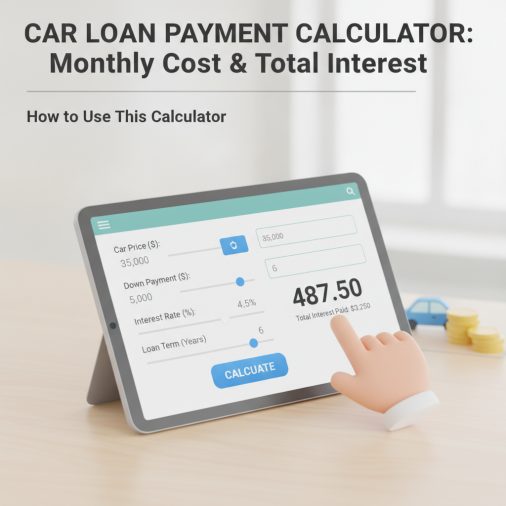
Follow these steps to get an accurate estimate of your car loan costs:
- Enter the vehicle price — type the sticker price or the negotiated purchase price of the car.
- Enter your down payment — include any cash you plan to pay upfront at signing.
- Enter your trade-in value — if you are trading in a vehicle, enter the net credit the dealer will apply. Leave at zero if not applicable.
- Enter the annual interest rate (APR) — use the rate quoted by your lender or dealer. Check your pre-approval letter or use a current average rate as a starting point.
- Select your loan term — choose the repayment period in months that best matches the offer you are considering.
- Enter the sales tax rate — use your state or local combined sales tax rate. If you are unsure, check your state revenue department website.
- Read your results — the calculator instantly shows your loan principal, monthly payment, total amount paid, total interest, full out-of-pocket cost, and interest as a percentage of the vehicle price.
Understanding the Calculator Inputs
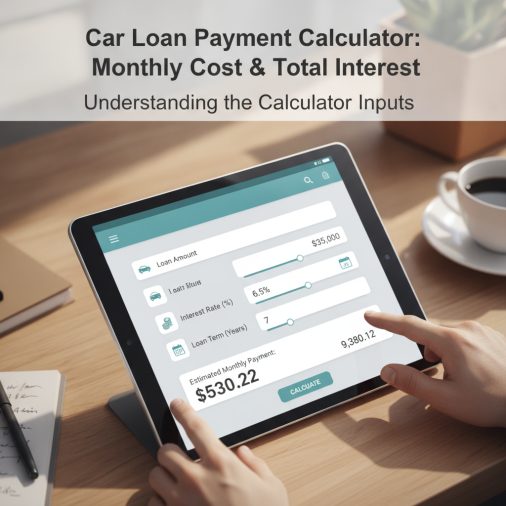
Vehicle Price ($): Enter the full purchase price of the vehicle before any credits are applied. This should be the negotiated out-the-door price before tax, or the sticker price if you have not yet negotiated. The calculator applies sales tax to this figure, so do not add tax yourself. Accepted range is $1,000 to $500,000, covering everything from economy used cars to high-end luxury vehicles.
Down Payment ($): Enter the cash amount you will pay at signing. A larger down payment directly reduces the amount you borrow, which lowers both your monthly payment and the total interest you pay over the life of the loan. If you plan to pay nothing upfront, enter zero.
Trade-In Value ($): If you are trading in a vehicle at the dealership, enter the net credit amount the dealer will apply toward your purchase. This should be the trade-in allowance after any existing loan payoff on the traded vehicle has been deducted. If you are not trading in a vehicle, leave this field at zero.
Annual Interest Rate — APR (%): Enter the annual percentage rate your lender has quoted or that you expect to qualify for. This is the nominal rate compounded monthly. You can find this on a pre-approval letter, a lender’s website, or by using a current average rate for your credit tier as a benchmark. Rates typically range from under 5% for excellent credit to over 15% for subprime borrowers.
Loan Term (months): Select the repayment period from the dropdown. Options range from 24 months (2 years) to 84 months (7 years). Shorter terms mean higher monthly payments but significantly less total interest. Longer terms reduce the monthly payment but increase the total cost of the loan.
Sales Tax Rate (%): Enter your combined state and local sales tax rate for vehicle purchases. In the United States this typically ranges from 0% in states with no sales tax to over 10% in some localities. Sales tax is applied to the full vehicle price before subtracting the down payment and trade-in, which is the standard method in most U.S. states. Check your state’s department of revenue for the exact rate in your area.
Understanding Your Results
Loan Principal (Amount Financed): This is the actual dollar amount you are borrowing from the lender. It equals the tax-inclusive vehicle price minus your down payment and trade-in credit. This is the balance on which all interest charges are calculated. A lower principal means less interest accrues each month.
Monthly Payment: This is the fixed amount you will owe the lender every month for the duration of the loan term. It is calculated using the standard amortization formula and remains constant throughout the loan. Use this figure to assess whether the loan fits comfortably within your monthly budget.
Total Amount Paid: This is the sum of every monthly payment you will make over the full loan term. It represents your total cash outflow to the lender, not counting the down payment or trade-in value you provided at signing.
Total Interest Paid: This is the difference between the total amount paid and the loan principal. It shows exactly how much extra money you pay the lender purely for the privilege of borrowing. Minimizing this figure — through a lower rate, shorter term, or larger down payment — is the primary goal of smart auto loan shopping.
Total Vehicle Cost (Out-of-Pocket): This is the most complete picture of what the vehicle actually costs you. It adds all loan payments to your down payment and trade-in value to show the true total expenditure. Comparing this figure across different loan scenarios reveals the real cost difference between financing options.
Interest as % of Vehicle Price: This expresses total interest paid as a percentage of the original vehicle price. It provides an intuitive benchmark — for example, a result of 12% means you paid an extra 12 cents in interest for every dollar of vehicle price. This metric is especially useful when comparing loans on vehicles at different price points.
Calculation Formulas Explained
The calculator uses the standard fixed-rate amortization formula to compute the monthly payment. The formula is:
Monthly Payment = P × [r × (1 + r)^n] / [(1 + r)^n − 1]
Where P is the loan principal (amount financed), r is the monthly interest rate (annual APR divided by 12), and n is the total number of monthly payments (the loan term in months).
The loan principal is derived as: vehicle price × (1 + sales tax rate / 100) − down payment − trade-in value. Sales tax is applied to the full vehicle price first, which is the most common U.S. method.
The total amount paid is simply the monthly payment multiplied by the number of months in the loan term.
The total interest paid is the total amount paid minus the loan principal. Because the principal is fully repaid through the amortizing payments, the remainder is pure interest cost.
The total out-of-pocket cost adds the down payment and trade-in value back to the total amount paid, because those funds also came from the buyer even though they were not financed.
The interest as a percentage of vehicle price divides total interest paid by the original vehicle price and multiplies by 100, giving a normalized ratio that is easy to compare across different purchase scenarios.
When the APR entered is zero, the amortization formula is mathematically undefined (division by zero). In that case the monthly payment simplifies to principal divided by the number of months, which the calculator handles automatically.
Worked Example
Scenario: You are buying a used SUV priced at $28,000. You have $4,000 cash for a down payment and a trade-in worth $2,500. Your lender has pre-approved you at 7.0% APR for 60 months. Your state sales tax rate is 6.5%.
Step 1 — Calculate the tax-inclusive price: $28,000 × (1 + 6.5 / 100) = $28,000 × 1.065 = $29,820.
Step 2 — Calculate the loan principal: $29,820 − $4,000 − $2,500 = $23,320.
Step 3 — Calculate the monthly interest rate: 7.0% / 12 = 0.5833% per month, or 0.005833 as a decimal.
Step 4 — Apply the amortization formula: Monthly Payment = $23,320 × [0.005833 × (1.005833)^60] / [(1.005833)^60 − 1]. First, (1.005833)^60 ≈ 1.4176. Numerator: 0.005833 × 1.4176 ≈ 0.008270. Denominator: 1.4176 − 1 = 0.4176. Payment = $23,320 × (0.008270 / 0.4176) ≈ $23,320 × 0.019806 ≈ $461.87 per month.
Step 5 — Total amount paid: $461.87 × 60 = $27,712.20.
Step 6 — Total interest paid: $27,712.20 − $23,320 = $4,392.20.
Step 7 — Total out-of-pocket cost: $27,712.20 + $4,000 + $2,500 = $34,212.20.
Step 8 — Interest as % of vehicle price: $4,392.20 / $28,000 × 100 ≈ 15.69%.
This means the financing adds roughly 15.7 cents of interest cost for every dollar of the vehicle’s purchase price over the five-year loan.
How to Interpret the Results
Monthly payment vs. your budget: A widely cited personal finance guideline suggests keeping total vehicle expenses — including payment, insurance, fuel, and maintenance — below 15–20% of your monthly take-home pay. If your monthly payment alone approaches that threshold, consider a larger down payment, a longer term, or a less expensive vehicle.
Total interest paid: A lower number is always better. If your total interest exceeds 10–15% of the vehicle price, it is worth shopping for a lower APR, increasing your down payment, or shortening the loan term. Even a 1% reduction in APR on a $25,000 loan over 60 months saves roughly $650–$700 in interest.
Loan term trade-offs: A 72- or 84-month loan lowers the monthly payment but can result in you owing more than the car is worth (being underwater or upside-down) for several years, because vehicles depreciate faster than long-term loans are paid down. If the interest as a percentage of vehicle price exceeds 20%, consider whether a shorter term or larger down payment is feasible.
Total out-of-pocket cost: Compare this figure across multiple scenarios — different terms, rates, or down payment amounts — to find the combination that minimizes your true total expenditure while keeping the monthly payment manageable.
Common Mistakes to Avoid
- Forgetting sales tax: Many buyers focus on the sticker price and forget that sales tax can add thousands of dollars to the financed amount. Always include your local tax rate for an accurate principal figure.
- Confusing APR with the interest rate: On auto loans, the APR and the stated interest rate are often the same, but if the lender charges origination fees, the effective APR will be higher than the nominal rate. Always ask for the APR, not just the interest rate.
- Overestimating trade-in value: Dealer trade-in offers are often lower than private-sale values. Using an inflated trade-in estimate will make your calculated payment lower than what you will actually be quoted.
- Ignoring fees: Documentation fees, dealer prep fees, and title and registration costs are not included in this calculator. These can add $500–$2,000 or more to the amount you need to finance or pay upfront.
- Focusing only on the monthly payment: Dealers sometimes extend the loan term to make a higher-priced vehicle seem affordable. Always check the total interest paid and total out-of-pocket cost, not just the monthly figure.
- Not accounting for an existing loan on the trade-in: If you owe money on the vehicle you are trading in, the payoff amount must be subtracted from the trade-in value before entering it into the calculator. Entering the gross trade-in value without deducting the payoff will understate your actual loan principal.
Limitations and Important Notes
This calculator assumes a fixed-rate, fully amortizing installment loan with equal monthly payments and end-of-period payment timing. It does not model variable-rate loans, balloon payment loans, or deferred-payment arrangements.
The calculator does not include dealer documentation fees, title and registration fees, extended warranty costs, GAP insurance premiums, or lender origination fees. Including these costs would increase the effective loan principal and total cost.
Sales tax is applied to the full vehicle price before subtracting the down payment and trade-in value. While this is the most common method in the United States, some states calculate tax differently — for example, applying tax only to the amount after the trade-in credit. Verify your state’s specific rules for the most accurate estimate.
The trade-in value entered should be the net credit after any existing loan payoff on the traded vehicle. The calculator does not separately model negative equity roll-over.
Results are estimates for planning and comparison purposes only. They do not constitute a loan offer, a guarantee of financing terms, or financial advice. Actual loan terms will depend on your credit profile, lender policies, and the specific vehicle transaction. Consult a qualified financial professional or lender for personalized guidance before making any financing decision.
Frequently Asked Questions
What credit score do I need to get a good car loan rate?
Most lenders tier their auto loan rates by credit score. Borrowers with scores above 720 typically qualify for the lowest advertised rates, often called prime or super-prime rates. Scores between 660 and 719 generally receive near-prime rates that are somewhat higher. Scores below 620 are usually classified as subprime, and lenders may charge significantly higher rates or require a larger down payment. Improving your credit score before applying — by paying down revolving balances and correcting any errors on your credit report — can meaningfully reduce your APR and save hundreds or thousands of dollars in interest over the life of the loan.
What is the difference between APR and interest rate on a car loan?
The interest rate is the base cost of borrowing expressed as an annual percentage of the loan balance. The APR, or annual percentage rate, is a broader measure that includes the interest rate plus any lender fees rolled into the cost of the loan, such as origination fees. On many auto loans, the APR and the stated interest rate are identical because lenders charge fees separately rather than rolling them in. However, if a lender does include fees in the APR calculation, the APR will be higher than the nominal interest rate. Always compare loans using the APR to get a true apples-to-apples comparison of total borrowing cost.
Is it better to make a larger down payment or choose a shorter loan term?
Both strategies reduce the total interest you pay, but they work differently. A larger down payment reduces the principal immediately, which lowers every monthly payment and reduces the total interest accrued over any term. A shorter loan term increases the monthly payment but eliminates months of interest accrual, often saving more in total interest than a modest down payment increase would. In practice, the best approach depends on your cash flow. If you have the cash available, a larger down payment also reduces the risk of being underwater on the loan — owing more than the car is worth — which is a common problem with long-term financing on depreciating assets.
How does a trade-in affect my car loan?
A trade-in reduces the amount you need to finance, similar to a down payment. The dealer applies the trade-in credit directly against the purchase price, lowering your loan principal. This reduces both your monthly payment and the total interest paid. However, if you still owe money on the vehicle you are trading in, the outstanding loan balance must be paid off first. If the payoff amount exceeds the trade-in value, the negative equity — sometimes called being upside-down — is typically rolled into the new loan, which increases your principal rather than reducing it. Always know your payoff balance before negotiating a trade-in.
Can I negotiate the interest rate on a car loan?
Yes, and doing so can save a significant amount of money. Dealers often mark up the interest rate above what the lender actually requires, pocketing the difference as profit. Getting pre-approved by your own bank or credit union before visiting the dealership gives you a competitive rate to use as leverage. You can then ask the dealer to beat that rate. Even a reduction of half a percentage point on a $25,000 loan over 60 months can save several hundred dollars in total interest. Shopping multiple lenders — including online lenders and credit unions — before committing to dealer financing is one of the most effective ways to reduce your borrowing cost.
What happens if I pay extra toward my car loan principal each month?
Making extra principal payments reduces your outstanding balance faster than the standard amortization schedule, which means less interest accrues in subsequent months. Over time, this can shorten the loan payoff date and reduce the total interest paid. When making extra payments, confirm with your lender that the additional amount is applied to the principal rather than to future scheduled payments. Some lenders apply overpayments to advance the next due date rather than reducing the principal, which does not save interest in the same way. Ask your lender for written confirmation of how extra payments are applied before adopting this strategy.
Does getting pre-approved for a car loan hurt my credit score?
A pre-approval application typically triggers a hard inquiry on your credit report, which can temporarily lower your score by a few points. However, credit scoring models such as FICO treat multiple auto loan inquiries made within a short window — typically 14 to 45 days depending on the scoring version — as a single inquiry for rate-shopping purposes. This means you can apply to several lenders within that window to compare rates without compounding the credit impact. The short-term dip from a hard inquiry is usually minor and recovers within a few months, making pre-approval a worthwhile step before visiting a dealership.
What is GAP insurance and do I need it with a car loan?
GAP insurance, which stands for Guaranteed Asset Protection, covers the difference between what you owe on your car loan and what your vehicle is worth if it is totaled or stolen. Because new vehicles depreciate quickly — sometimes losing 15–20% of their value in the first year — your insurance payout after a total loss may be less than your remaining loan balance. GAP insurance covers that shortfall so you are not left making payments on a car you no longer have. It is most valuable when you make a small down payment, choose a long loan term, or finance a vehicle that depreciates rapidly. GAP coverage is often available through your auto insurer at a lower cost than dealer-offered GAP products.