Use this car loan calculator to instantly estimate your monthly payment and total interest cost before you visit the dealership. Enter your vehicle price, down payment, trade-in value, sales tax rate, loan term, and annual interest rate to see a full breakdown of your financing. Understanding these numbers upfront helps you negotiate confidently, avoid overpaying, and choose a loan term that fits your budget. Results update automatically as you adjust any field.
Car Loan Calculator: Monthly Payment, Total Interest & True Cost
Calculate your monthly car loan payment, total interest paid, and full out-of-pocket vehicle cost based on price, down payment, trade-in, taxes, fees, and APR.
How to Use This Calculator

Follow these steps to get an accurate estimate of your car loan costs:
- Enter the vehicle price — use the agreed purchase price or the sticker price you are negotiating from.
- Enter your down payment — the cash you plan to pay upfront at signing.
- Enter your trade-in value — the amount your current vehicle will be credited toward the purchase; enter 0 if you have no trade-in.
- Enter your local sales tax rate — check your state or county rate; this is applied to the vehicle price and added to the financed amount.
- Enter other fees — include dealer documentation fees, title, and registration costs you expect to roll into the loan.
- Select your loan term — choose the repayment period in months that best matches your budget goals.
- Enter the APR — use a rate quoted by your lender or credit union, or a current market estimate for your credit tier.
- Review all six results — compare scenarios by adjusting the term or down payment to find the combination that minimizes total interest while keeping the monthly payment affordable.
Understanding the Calculator Inputs
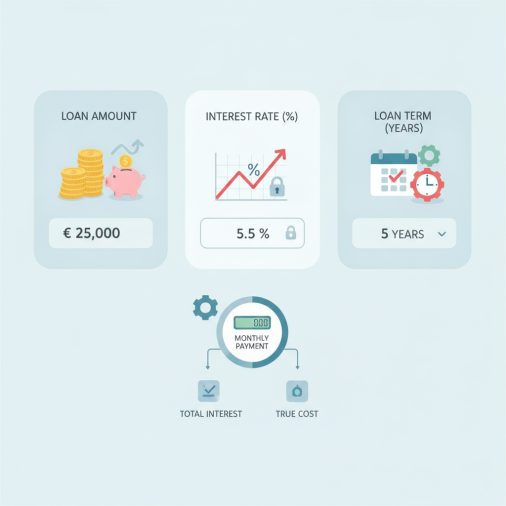
Vehicle Price ($): Enter the full purchase price of the car before any deductions. This is the number you negotiate with the dealer — the out-the-door price before tax, or the agreed sale price. For a used private-party purchase, use the agreed selling price. The default is $30,000, which is close to the median transaction price for used vehicles in the United States.
Down Payment ($): Enter the cash amount you will pay at signing. A larger down payment directly reduces the loan principal, lowering both your monthly payment and total interest. Financial planners commonly suggest putting down at least 10–20% of the vehicle price. The default is $3,000, representing a 10% down payment on the default vehicle price.
Trade-In Value ($): If you are trading in a current vehicle, enter the dealer’s offer or a fair-market estimate from a valuation service. This amount is subtracted from the amount you need to finance, similar to a down payment. If you have no trade-in, leave this at $0.
Sales Tax Rate (%): Enter your state or local combined sales tax rate for vehicle purchases. Rates vary widely — from 0% in states like Oregon and Montana to over 9% in some localities. The calculator applies this rate to the vehicle price and adds the resulting tax to the financed amount, which is the most common dealer practice. Check your state’s DMV or department of revenue website for the exact rate in your area.
Other Fees ($): Include any additional costs you expect to roll into the loan, such as dealer documentation fees, title fees, registration fees, and any add-on products financed at the point of sale. These vary by state and dealer. A reasonable estimate for most U.S. buyers is $300–$800, though documentation fees alone can reach $500–$1,000 at some dealerships.
Loan Term: Select the number of months over which you will repay the loan. Options range from 24 months (2 years) to 84 months (7 years). Shorter terms mean higher monthly payments but significantly less total interest. Longer terms reduce the monthly payment but increase the total cost of the loan and raise the risk of negative equity.
Annual Interest Rate / APR (%): Enter the annual percentage rate your lender has quoted or that you expect to qualify for based on your credit profile. The APR is the annualized cost of borrowing and is the standard figure used in loan disclosures. Do not enter 0% — if you have a 0% promotional offer, enter 0.01 to approximate it, as the standard amortization formula requires a non-zero rate. Rates as of recent years have ranged from roughly 5% for excellent-credit buyers to 15%+ for subprime borrowers.
Understanding Your Results
Loan Amount Financed: This is the actual principal you will borrow — the vehicle price minus your down payment and trade-in, plus sales tax on the vehicle price and any other fees rolled in. This is the number your lender uses to calculate your payment schedule. Keeping this number as low as possible minimizes every other cost in the calculation.
Monthly Payment: This is the fixed amount you will owe each month for the duration of the loan term. It is calculated using the standard amortizing loan formula, meaning each payment covers both interest accrued that month and a portion of the principal. Early payments are weighted more toward interest; later payments pay down more principal. This figure does not include car insurance, fuel, maintenance, or any other ownership costs.
Total Amount Paid: This is the sum of all monthly payments over the full loan term — your monthly payment multiplied by the number of months. It represents the total cash outflow from your loan payments alone and does not include the down payment or trade-in equity you contributed upfront.
Total Interest Paid: This is the total amount paid minus the original loan principal. It is the true cost of borrowing — the premium you pay the lender for financing the vehicle over time. Comparing this figure across different loan terms and rates is one of the most powerful ways to evaluate financing options.
Total Vehicle Cost (Out-of-Pocket): This is the grand total you will spend to own the vehicle, combining your upfront down payment, trade-in equity applied, and all monthly loan payments. It gives you the most complete picture of what the car actually costs you, which is always higher than the sticker price once financing is included.
Loan-to-Value Ratio (LTV): This expresses the loan amount as a percentage of the vehicle’s purchase price. An LTV above 100% means you are financing more than the car is worth from day one — a condition called being underwater or having negative equity. Most lenders prefer an LTV at or below 100%, and many cap financing at 110–125% of vehicle value. A lower LTV also typically qualifies you for better interest rates.
Calculation Formulas Explained
All calculations are based on the standard fixed-rate amortizing loan formula used by banks, credit unions, and auto lenders worldwide.
Loan Amount Financed (P):
P = (vehicle_price – down_payment – trade_in_value) + (vehicle_price * (sales_tax_rate / 100)) + other_fees
This sums the net vehicle cost after upfront credits, adds sales tax computed on the vehicle price, and adds any fees rolled into the loan.
Monthly Interest Rate (r):
r = annual_interest_rate / 1200
Dividing the APR by 1200 converts the annual percentage rate into a decimal monthly rate (dividing by 100 converts percent to decimal, then dividing by 12 converts annual to monthly).
Monthly Payment (M):
M = P * (r * pow(1 + r, n)) / (pow(1 + r, n) – 1)
Where n = loan_term_months. This is the standard amortization formula. The numerator computes the interest-adjusted payment factor; the denominator ensures the loan is fully paid off at the end of the term. Each monthly payment is identical, but the split between interest and principal shifts over time — early payments are mostly interest, later payments are mostly principal.
Total Amount Paid: M * loan_term_months — simply the monthly payment multiplied by the number of payments.
Total Interest Paid: (M * loan_term_months) – P — the total paid minus the principal borrowed equals the total interest cost.
Total Out-of-Pocket Cost: down_payment + trade_in_value + (M * loan_term_months) — adds your upfront contributions to all loan payments for the complete ownership cost picture.
Loan-to-Value Ratio: (P / vehicle_price) * 100 — expresses the financed amount as a percentage of the vehicle purchase price.
Worked Example
Scenario: You are buying a used SUV priced at $28,000. You have $4,000 cash for a down payment and a trade-in worth $2,500. Your state charges 7% sales tax. You expect $600 in title and registration fees. You qualify for a 60-month loan at 7.2% APR.
Step 1 — Loan Amount Financed:
Net vehicle cost after credits: $28,000 – $4,000 – $2,500 = $21,500
Sales tax: $28,000 * 0.07 = $1,960
Fees: $600
Loan principal (P): $21,500 + $1,960 + $600 = $24,060
Step 2 — Monthly Interest Rate:
r = 7.2 / 1200 = 0.006
Step 3 — Monthly Payment:
pow(1.006, 60) = approximately 1.4308
M = $24,060 * (0.006 * 1.4308) / (1.4308 – 1)
M = $24,060 * 0.008585 / 0.4308
M = $24,060 * 0.019929 ≈ $479.69/mo
Step 4 — Total Amount Paid:
$479.69 * 60 = $28,781.40
Step 5 — Total Interest Paid:
$28,781.40 – $24,060 = $4,721.40
Step 6 — Total Out-of-Pocket Cost:
$4,000 + $2,500 + $28,781.40 = $35,281.40
Step 7 — Loan-to-Value Ratio:
($24,060 / $28,000) * 100 = 85.9%
This LTV is comfortably below 100%, meaning you have positive equity from day one. The $4,721 in total interest represents about 16.9% of the vehicle’s purchase price — a meaningful cost that could be reduced by shortening the term or increasing the down payment.
How to Interpret the Results
Monthly Payment: A common budgeting guideline suggests keeping your total monthly car expenses (payment + insurance + fuel + maintenance) below 15–20% of your monthly take-home pay. If the monthly payment alone exceeds 15% of your net income, consider a larger down payment, a longer term as a temporary measure, or a less expensive vehicle.
Total Interest Paid: Compare this figure across scenarios. Dropping from a 72-month to a 60-month term on a $25,000 loan at 7% APR can save over $1,000 in interest. Improving your credit score by even one tier before applying can save thousands over the life of the loan.
Loan-to-Value Ratio: An LTV below 80% is considered strong and may qualify you for the best rates. An LTV between 80–100% is typical and generally acceptable to most lenders. An LTV above 100% means you owe more than the car is worth immediately after purchase — this is a financial risk because if the vehicle is totaled or you need to sell, you may owe more than you receive. Gap insurance is worth considering when LTV exceeds 100%.
Total Out-of-Pocket Cost: Use this number to compare the true cost of different vehicles. A car with a $2,000 lower sticker price but a higher interest rate or longer term may actually cost more in total. Always compare total out-of-pocket costs, not just monthly payments.
Common Mistakes to Avoid
- Focusing only on the monthly payment: Dealers often extend loan terms to make expensive vehicles seem affordable. A lower monthly payment achieved by stretching to 84 months can cost thousands more in interest than a 60-month loan on the same vehicle.
- Forgetting sales tax and fees: Many buyers calculate their loan based on the vehicle price alone and are surprised at closing. Always include tax, title, and registration in your estimate — these can add $2,000–$4,000 or more to the financed amount.
- Overestimating trade-in value: Online valuation tools give estimates; the actual dealer offer is often lower. Use a conservative trade-in estimate to avoid underestimating your loan amount.
- Accepting the dealer’s rate without shopping: Dealership financing is convenient but not always the best rate. Getting pre-approved through a bank or credit union before visiting the dealer gives you a benchmark and negotiating leverage.
- Not accounting for insurance and maintenance: This calculator estimates loan costs only. Budget separately for comprehensive and collision insurance (often required by lenders), fuel, and routine maintenance.
- Entering 0% APR: The amortization formula divides by zero when APR is exactly 0%. Enter 0.01% to approximate a 0% promotional offer. The resulting payment will be nearly identical to the loan amount divided by the number of months.
Limitations and Important Notes
This calculator provides planning estimates only and does not constitute a loan offer, financial advice, or guarantee of any specific rate or term. Results are based on a fixed-rate, fully amortizing loan model with the following assumptions:
- The APR entered is fixed for the entire loan term. Variable-rate auto loans are not modeled.
- Sales tax is calculated on the vehicle price only and is assumed to be fully financed. Some states offer a sales tax credit on trade-in value that reduces the taxable amount — this calculator does not model that credit. Consult your state’s DMV or a tax professional for precise figures.
- No prepayment penalties, origination fees beyond the other-fees field, gap insurance, extended warranties, or other add-on products are included in the calculation.
- The calculator does not enforce the constraint that down payment plus trade-in cannot exceed the vehicle price. If they do, the loan amount will be negative, which is not meaningful.
- Actual loan offers depend on your credit score, debt-to-income ratio, the lender’s policies, the vehicle’s age and mileage, and current market conditions. Always obtain a formal loan disclosure from your lender before signing.
Frequently Asked Questions
What credit score do I need to get a good car loan rate?
Most lenders tier their auto loan rates by credit score. Borrowers with scores of 720 or above (often called super-prime or prime) typically qualify for the lowest advertised rates. Scores between 660 and 719 (near-prime) usually receive rates a few percentage points higher. Scores below 620 (subprime) may still qualify for financing but at significantly higher rates — sometimes 12–20% APR or more — which dramatically increases total interest paid. Before applying, check your credit report for errors, pay down revolving balances if possible, and avoid opening new credit accounts in the months before your loan application. Even a modest improvement in your score can save hundreds or thousands of dollars over the life of a car loan.
Is it better to finance through a dealership or my own bank or credit union?
Both options have advantages. Dealer financing is convenient and sometimes includes manufacturer-subsidized promotional rates (such as 0% APR on new vehicles) that you cannot get elsewhere. However, dealers also earn a reserve — a markup on the rate the lender actually charges — which means the rate offered to you may be higher than what you qualify for. Financing through your own bank or credit union gives you a pre-approved rate to use as a benchmark, which strengthens your negotiating position at the dealership. Credit unions in particular often offer competitive rates to members. The best strategy is to get pre-approved before visiting the dealer, then compare that offer against any dealer financing incentives.
How does a larger down payment affect my monthly payment and total interest?
A larger down payment reduces the loan principal directly, which lowers both your monthly payment and the total interest you pay over the life of the loan. For example, increasing a down payment from $2,000 to $5,000 on a $28,000 vehicle at 7% APR over 60 months reduces the monthly payment by roughly $57 and saves approximately $430 in total interest. Beyond the math, a larger down payment also lowers your loan-to-value ratio, which can help you qualify for a better interest rate and reduces the risk of being underwater on the loan. If you have the cash available, putting more down is almost always financially beneficial.
Can I include taxes and fees in my car loan?
Yes, most lenders allow you to roll sales tax, title fees, registration fees, and dealer documentation fees into the financed amount. This is very common and is the default assumption in this calculator. The trade-off is that you pay interest on those costs over the life of the loan, increasing the total amount you pay. If you can afford to pay taxes and fees out of pocket at signing, you will reduce your loan principal and save on interest. Some buyers also choose to finance add-on products like extended warranties or gap insurance, which further increases the loan amount and total interest cost.
What is negative equity and how do I avoid it?
Negative equity — also called being underwater or upside-down on your loan — occurs when you owe more on your car loan than the vehicle is currently worth. This happens most often when buyers make a small or no down payment, choose a long loan term, or purchase a vehicle that depreciates quickly. It becomes a problem if you need to sell the car, trade it in, or if it is totaled in an accident, because you would owe more than you receive. To avoid negative equity, make a down payment of at least 10–20%, choose the shortest loan term your budget allows, and consider gap insurance if your LTV exceeds 100% at origination. Checking your loan-to-value ratio in this calculator before finalizing a purchase is a practical first step.
What happens if I pay off my car loan early?
Paying off your car loan early reduces the total interest you pay, because interest accrues on the outstanding principal balance each month. The sooner you reduce that balance, the less interest accumulates. Most auto loans in the United States do not carry prepayment penalties, meaning you can make extra payments or pay off the loan in full at any time without a fee — but always confirm this with your lender before signing. If your loan does have a prepayment penalty, calculate whether the interest savings outweigh the penalty before paying early. Making even one extra payment per year can meaningfully shorten your loan term and reduce total interest paid.
Should I lease or finance a vehicle?
Leasing and financing serve different needs. When you finance, you are building equity in the vehicle and will own it outright at the end of the loan term. When you lease, you are essentially renting the vehicle for a set period — typically 24 to 36 months — and return it at the end unless you choose to purchase it. Lease payments are generally lower than loan payments for the same vehicle because you are only paying for the depreciation during the lease term, not the full vehicle value. However, leases come with mileage limits, wear-and-tear charges, and no equity at the end. Financing is generally better for drivers who keep vehicles long-term, drive high mileage, or want to build an asset. Leasing may suit drivers who prefer a new vehicle every few years and drive predictable, moderate mileage.
How do I get the best interest rate on a car loan?
The most effective steps to secure a low auto loan rate are: improve your credit score before applying by paying down debt and correcting any errors on your credit report; shop multiple lenders including banks, credit unions, and online lenders rather than accepting the first offer; get pre-approved so you have a concrete rate to compare against dealer financing; consider a shorter loan term, as lenders often offer lower rates on 36- or 48-month loans than on 72- or 84-month loans; and make a larger down payment to lower your LTV, which reduces lender risk. Timing can also matter — manufacturer financing promotions on new vehicles occasionally offer rates well below market, particularly at the end of a model year.