Use this car loan calculator to instantly estimate your monthly payment and total interest before you sign anything at the dealership. Enter the vehicle price, your down payment, any trade-in value, the annual interest rate your lender quoted, and your preferred loan term. The calculator applies the standard amortization formula so every figure reflects real compounding math, not rough guesses. Understanding your true out-of-pocket cost upfront helps you negotiate smarter, choose the right term length, and avoid being surprised by how much interest adds up over time.
Car Loan Calculator: Monthly Payment & Total Cost Estimator
Calculate your monthly car loan payment, total interest paid, and all-in vehicle cost using the standard amortization formula. Supports down payment, trade-in value, sales tax, and fees.
How to Use This Calculator
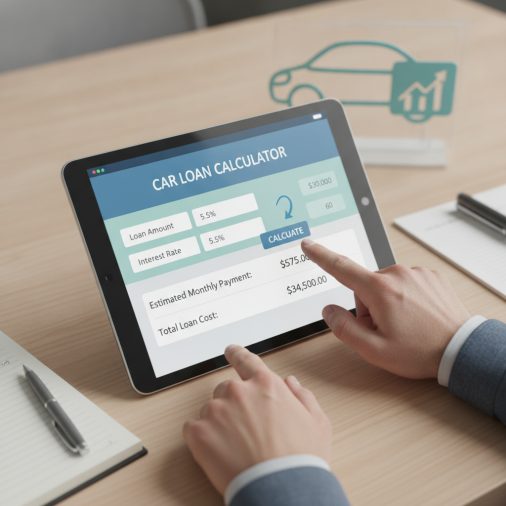
Follow these steps to get accurate results from the car loan calculator:
- Enter the vehicle price — use the agreed purchase price or sticker price before any credits.
- Enter your down payment — the cash amount you plan to pay upfront at signing.
- Enter your trade-in value — the dealer’s offer for your current vehicle; leave at zero if you have no trade-in.
- Set the sales tax rate — use your state and local combined rate; drag the slider to match your location.
- Enter title, registration, and dealer fees — include only fees you plan to roll into the loan, not ones you will pay in cash.
- Set the annual interest rate (APR) — use the rate your lender or dealer has quoted you, or a rate you are shopping for.
- Choose your loan term — select the number of months from the dropdown; longer terms lower monthly payments but raise total interest.
- Read the results — the calculator instantly shows your amount financed, monthly payment, total paid, total interest, all-in cost, and interest as a percentage of the vehicle price.
Understanding the Calculator Inputs
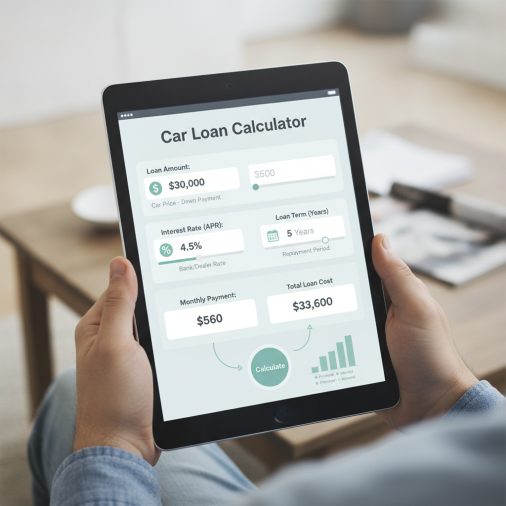
Vehicle Price ($): Enter the full agreed purchase price of the car before any credits are applied. This is the number on the buyer’s order or the price you negotiated with the dealer. Do not subtract the down payment or trade-in here — those have their own fields. The calculator uses this figure as the base for computing sales tax as well.
Down Payment ($): Enter the cash amount you will hand over at signing. A larger down payment directly reduces the amount financed, which lowers both your monthly payment and the total interest you will pay over the life of the loan. If you are putting zero down, leave this field at 0.
Trade-In Value ($): If you are trading in a vehicle at the dealership, enter the agreed trade-in credit here. This amount is subtracted from the vehicle price before calculating the loan principal. The calculator assumes your trade-in has no outstanding loan balance (no negative equity). If you still owe money on your trade-in, subtract that balance from the trade-in value before entering it.
Sales Tax Rate (%): Drag the slider to your combined state and local sales tax rate. In most U.S. states, sales tax is calculated on the full vehicle price before the trade-in credit is applied. A few states (such as Virginia and New Jersey) tax only the difference after the trade-in, so check your state’s rules. If you are unsure, your state’s DMV website lists the current rate.
Title, Registration & Fees ($): Include only the fees you plan to roll into the loan — dealer documentation fees, title fees, and registration costs are common examples. Do not include fees you plan to pay in cash at signing, as those would not be part of the financed amount.
Annual Interest Rate / APR (%): Enter the annual percentage rate your lender has quoted or that you are researching. This is the single biggest lever on your total interest cost. Even a 1% difference in APR on a $25,000 loan over 60 months adds up to several hundred dollars. Use the rate from a pre-approval letter or the dealer’s financing offer for the most accurate result.
Loan Term (months): Select the repayment period from the dropdown. Common terms range from 36 months (3 years) to 84 months (7 years). Shorter terms mean higher monthly payments but significantly less total interest. Longer terms reduce the monthly burden but increase the total cost of the loan and raise the risk of becoming upside-down on the vehicle.
Understanding Your Results
Amount Financed: This is the actual loan principal — the dollar amount the lender will fund on your behalf. It equals the vehicle price minus your down payment and trade-in credit, plus the sales tax on the vehicle price and any fees you are rolling in. This is the number your interest charges are calculated against.
Monthly Payment: The fixed amount you will owe every month for the duration of the loan term. This figure is calculated using the standard amortizing payment formula and will not change month to month (assuming a fixed-rate loan). Budget this amount alongside insurance, fuel, and maintenance when evaluating affordability.
Total Amount Paid: The sum of every monthly payment you will make over the full loan term. This does not include your down payment or trade-in equity — it represents only the cash that flows out of your bank account to the lender from month one through the final payment.
Total Interest Paid: The difference between the total amount paid and the amount financed. This is the pure cost of borrowing — money that goes to the lender and does not reduce what you owe on the car. Comparing this figure across different APRs and loan terms is one of the most powerful ways to evaluate financing options.
Total Vehicle Cost (All-In): The most complete picture of what the vehicle actually costs you. It adds your down payment and trade-in equity to all monthly payments made. Use this number when comparing the true cost of buying versus leasing, or when deciding between two vehicles at different price points.
Interest as % of Vehicle Price: Total interest expressed as a percentage of the original vehicle price. A low percentage (under 5%) suggests efficient financing; a high percentage (15% or more) signals that the loan term is too long, the APR is too high, or both. This metric makes it easy to compare financing costs across vehicles of different prices.
Calculation Formulas Explained
The calculator uses two core formulas. All other results are derived from these two.
Amount Financed (Principal, P):
P = (Vehicle Price − Down Payment − Trade-In Value) + (Vehicle Price × Sales Tax Rate / 100) + Fees
This assembles the loan principal by starting with the net vehicle cost after credits, then adding the sales tax owed on the full vehicle price and any financed fees.
Monthly Payment (M) — Standard Amortization Formula:
M = P × r × (1 + r)^n / ((1 + r)^n − 1)
Where r is the monthly periodic rate (APR ÷ 12 ÷ 100) and n is the number of monthly payments (loan term in months). This formula distributes the principal and all interest charges into equal monthly installments. Early payments are mostly interest; later payments are mostly principal — that is the nature of amortization.
Total Amount Paid: M × n — simply the monthly payment multiplied by the number of payments.
Total Interest Paid: (M × n) − P — total paid minus the original principal borrowed.
Total Vehicle Cost (All-In): Down Payment + Trade-In Value + (M × n) — adds the upfront equity contributions back to the total financed payments.
Interest as % of Vehicle Price: Total Interest Paid ÷ Vehicle Price × 100 — normalizes the interest cost against the car’s purchase price for easy comparison.
Note: When APR is exactly 0%, the formula produces a division by zero. In that edge case, the monthly payment is simply P ÷ n. The calculator sets the minimum APR to 0.01% to avoid this issue while remaining practically equivalent to a zero-rate loan.
Worked Example
Suppose you are buying a used SUV priced at $28,000. You plan to put $4,000 down, trade in your current car for $5,000, your state sales tax rate is 7%, dealer fees are $600, the lender quoted you 6.9% APR, and you choose a 60-month term.
Step 1 — Amount Financed:
Net vehicle cost after credits: $28,000 − $4,000 − $5,000 = $19,000
Sales tax: $28,000 × 0.07 = $1,960
Fees: $600
Amount Financed = $19,000 + $1,960 + $600 = $21,560
Step 2 — Monthly Periodic Rate:
r = 6.9% ÷ 12 ÷ 100 = 0.00575
Step 3 — Monthly Payment:
(1 + r)^60 = (1.00575)^60 ≈ 1.4083
M = $21,560 × 0.00575 × 1.4083 / (1.4083 − 1)
M = $21,560 × 0.008098 / 0.4083
M ≈ $174.59 / 0.4083 ≈ $427.60/mo
Step 4 — Total Amount Paid:
$427.60 × 60 = $25,656
Step 5 — Total Interest Paid:
$25,656 − $21,560 = $4,096
Step 6 — Total Vehicle Cost (All-In):
$4,000 + $5,000 + $25,656 = $34,656
Step 7 — Interest as % of Vehicle Price:
$4,096 ÷ $28,000 × 100 ≈ 14.63%
This tells you that financing adds roughly 14.6 cents of interest for every dollar of the car’s sticker price — a useful benchmark when comparing loan offers.
How to Interpret the Results
Monthly Payment: A common rule of thumb is to keep total vehicle expenses (payment + insurance + fuel) below 15–20% of your monthly take-home pay. If the monthly payment alone exceeds 15% of your net income, consider a larger down payment, a shorter vehicle price target, or a longer term only as a last resort.
Total Interest Paid: On a well-structured loan, total interest should ideally be less than 10% of the vehicle price. If your total interest exceeds 20% of the vehicle price, the combination of APR and term length is working against you significantly. Reducing the term by 12–24 months or improving your APR by even 1–2 points can cut this figure substantially.
Interest as % of Vehicle Price: Under 5% is excellent (short term or very low APR). 5–12% is typical for mid-range financing. Above 15% warrants a serious review of whether the loan terms are competitive or whether a larger down payment would help.
Total Vehicle Cost (All-In): Compare this number to the vehicle’s expected resale value at the end of the loan term. If the all-in cost significantly exceeds the projected resale value, you are paying a premium that may not be justified — especially relevant for rapidly depreciating vehicles.
Comparing scenarios: Run the calculator twice — once with your current offer and once with a 12-month shorter term or a 1% lower APR. The difference in total interest paid between those two scenarios is the dollar value of negotiating harder or improving your credit score before applying.
Common Mistakes to Avoid
- Focusing only on the monthly payment: Dealers often extend loan terms to make high-priced vehicles seem affordable month to month. A $450/month payment on an 84-month loan can cost thousands more in interest than a $530/month payment on a 60-month loan. Always compare total interest paid, not just the monthly figure.
- Forgetting sales tax and fees: Many buyers calculate affordability based on the sticker price alone. Sales tax, documentation fees, title, and registration can add $1,500–$4,000 or more to the financed amount, meaningfully increasing both the monthly payment and total interest.
- Overestimating trade-in value: Online valuation tools give estimates; the dealer’s actual offer may be lower. Using an inflated trade-in value in the calculator will make your results look better than reality. Get a firm written offer before running your final numbers.
- Not accounting for a trade-in lien: If you still owe money on the vehicle you are trading in, that balance is typically rolled into the new loan, increasing the amount financed. Subtract any remaining balance from your trade-in value before entering it.
- Ignoring the APR vs. interest rate distinction: The APR includes certain lender fees and is the legally required disclosure rate in the U.S. Always use the APR, not the base interest rate, for the most accurate payment estimate.
- Choosing the longest term to maximize affordability: An 84- or 96-month loan dramatically increases the risk of negative equity — owing more than the car is worth — because vehicles depreciate faster than long-term loan balances decrease.
Limitations and Important Notes
This calculator assumes a fixed-rate, fully amortizing loan with equal monthly payments. It does not model adjustable-rate loans, balloon-payment structures, or loans with deferred interest periods.
Sales tax is calculated on the full vehicle price before trade-in credit, which is the rule in most U.S. states. Some states (including Virginia and New Jersey) tax only the net price after the trade-in deduction. Verify your state’s specific rule for precise results.
The calculator does not include prepayment penalties, loan origination fees expressed outside of APR, gap insurance, extended warranty costs, or dealer add-ons. These can meaningfully affect the true cost of a loan.
Ongoing ownership costs — depreciation, insurance premiums, fuel, routine maintenance, and repairs — are outside the scope of this tool. A complete affordability analysis should account for all of these.
The trade-in is assumed to carry no outstanding lien. If your trade-in has a remaining loan balance, adjust the trade-in value accordingly before entering it.
Disclaimer: This calculator is provided for general planning and educational purposes only. Results are estimates based on the inputs you provide and the assumptions described above. They do not constitute a loan offer, financial advice, or a guarantee of any specific rate or payment. Always confirm final terms with a licensed lender before making any financial commitment.
Frequently Asked Questions
What credit score do I need to get a good car loan rate?
Lenders generally reserve their lowest APRs — often called prime or super-prime rates — for borrowers with credit scores of 720 or higher. Scores between 660 and 719 typically qualify for competitive but not top-tier rates. Borrowers with scores below 620 are usually classified as subprime and may face APRs that are 5–15 percentage points higher than prime rates, which can add thousands of dollars in interest over the life of the loan. Before applying, check your credit report for errors, pay down revolving balances if possible, and avoid opening new credit accounts in the months leading up to your application. Even a modest improvement in your score can shift you into a lower rate tier.
Is it better to put more money down on a car loan?
In almost every scenario, a larger down payment reduces your total cost of borrowing. It lowers the principal, which directly reduces both the monthly payment and the total interest paid. A down payment of 20% or more also helps you avoid negative equity — the situation where you owe more on the loan than the car is worth — because vehicles typically depreciate 15–25% in the first year. If you cannot put 20% down, even an additional $1,000–$2,000 upfront can meaningfully reduce your interest charges over a 60- or 72-month term. Use the calculator to compare scenarios: enter your current down payment, then increase it by $2,000 and observe the change in total interest paid.
What is the difference between APR and interest rate on a car loan?
The interest rate is the base cost of borrowing expressed as an annual percentage of the loan principal. The APR (Annual Percentage Rate) is a broader measure that includes the interest rate plus certain lender fees — such as origination fees — expressed as a single annualized figure. Under U.S. federal law (the Truth in Lending Act), lenders must disclose the APR so consumers can make apples-to-apples comparisons between loan offers. For most auto loans, the APR and the stated interest rate are very close or identical because auto loan fees are often minimal, but you should always use the APR when comparing offers or entering a rate into this calculator to ensure accuracy.
How does a trade-in affect my car loan?
A trade-in reduces the amount you need to finance, which lowers your monthly payment and the total interest you pay. For example, a $5,000 trade-in credit on a 6.9% APR, 60-month loan saves you roughly $580 in interest compared to financing that extra $5,000. However, the benefit only materializes if the dealer gives you fair market value for your trade-in. It is worth getting independent valuations from multiple sources before visiting the dealership. Also remember that if you still owe money on your trade-in vehicle, that negative equity is typically rolled into the new loan, which increases — not decreases — the amount financed.
Should I choose a shorter or longer loan term?
The right loan term depends on your cash flow needs and your total cost tolerance. A shorter term (36–48 months) means higher monthly payments but significantly less total interest and faster equity building in the vehicle. A longer term (72–84 months) lowers the monthly payment, making a more expensive vehicle seem affordable, but you will pay substantially more interest and risk being upside-down on the loan for several years. As a general guideline, financial planners often recommend keeping auto loan terms at 60 months or fewer. If you can only afford a vehicle with an 84-month loan, it may be a signal to consider a less expensive vehicle rather than extending the term.
Can I include sales tax and fees in my car loan?
Yes, most lenders allow you to roll sales tax, title fees, registration costs, and dealer documentation fees into the financed amount. This is common practice and is reflected in this calculator’s fees field. The trade-off is that you pay interest on those amounts for the full loan term. For example, financing $1,500 in taxes and fees at 7% APR over 60 months adds roughly $275 in interest. If you have the cash available, paying taxes and fees out of pocket at signing reduces your loan principal and saves that interest cost. If cash is tight, rolling them in is a reasonable choice — just be aware of the added interest.
Can I refinance my car loan to get a lower rate?
Yes, refinancing an auto loan is a straightforward process that can save meaningful money if your credit score has improved since you took out the original loan, or if market interest rates have fallen. To refinance, you apply for a new loan with a different lender, who pays off your existing loan and issues a new one at the new rate and term. The savings depend on how much principal remains, the rate difference, and the new term length. Refinancing is generally most beneficial in the first half of the loan term, when the outstanding balance is highest. Use this calculator to compare your current remaining balance at your current APR against the same balance at a lower APR to estimate potential savings.
What is negative equity and how do I avoid it?
Negative equity — sometimes called being upside-down or underwater on a loan — occurs when you owe more on your car loan than the vehicle is currently worth. It is most common with long loan terms (72–96 months), small or no down payments, and vehicles that depreciate quickly. If you need to sell or trade in the vehicle while in negative equity, you must cover the difference out of pocket or roll it into a new loan, compounding the problem. To avoid it, put at least 10–20% down, choose the shortest loan term your budget allows, and consider gap insurance if you must finance a high percentage of the vehicle’s value. Checking your loan balance against the vehicle’s current market value periodically helps you track your equity position.