Use this car loan payment calculator to instantly estimate your monthly payment, total interest, and the true cost of financing your next vehicle. Enter the vehicle price, your down payment, any trade-in value, the annual interest rate, and your preferred loan term to see a full breakdown. Whether you are buying new or used, comparing dealer financing versus a bank offer, or simply budgeting for a future purchase, this tool gives you the clear numbers you need before you sign.
Car Loan Payment Calculator: Monthly Cost & Total Interest
Calculate your monthly car loan payment, total interest paid, and true vehicle cost using vehicle price, down payment, trade-in value, sales tax, fees, APR, and loan term.
How to Use This Calculator
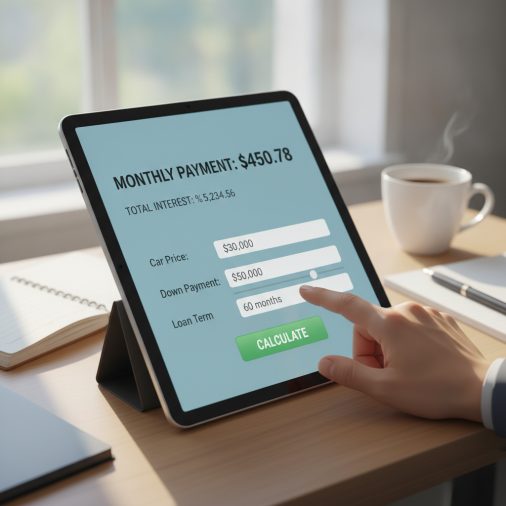
Follow these steps to get an accurate estimate of your car loan costs:
- Enter the vehicle price — use the agreed purchase price or sticker price before any discounts are applied at the lender level.
- Add your down payment — enter the cash amount you plan to pay upfront at signing.
- Enter trade-in value — if you are trading in a vehicle, enter its estimated value; leave at zero if not applicable.
- Set the sales tax rate — drag the slider to match your state and local combined sales tax rate on vehicle purchases.
- Enter title, registration, and fees — include dealer doc fees, title fees, and registration costs you expect to finance.
- Set the APR — enter the annual percentage rate quoted by your lender or dealer; check pre-approval offers from your bank or credit union first.
- Choose your loan term — select the number of months you want to repay the loan; shorter terms cost less in interest but raise the monthly payment.
- Review all six results — compare monthly payment, total interest, and total vehicle cost across different scenarios by adjusting any input.
Understanding the Calculator Inputs
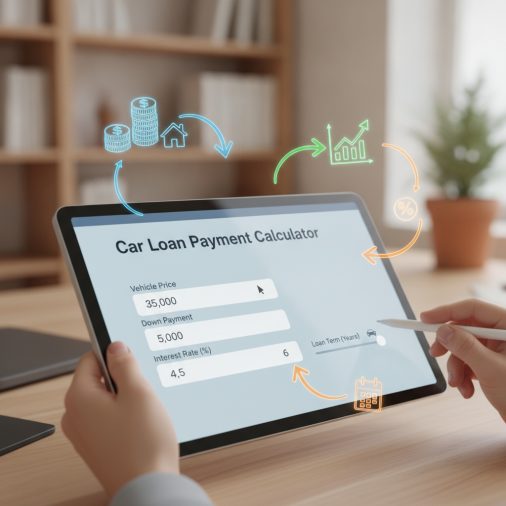
Vehicle Price ($): Enter the full agreed purchase price of the car before any financing adjustments. This is the number on the window sticker or the price you negotiated with the dealer. Do not subtract your down payment here — that is handled separately. For used vehicles, use the agreed sale price from the dealer or private seller.
Down Payment ($): Enter the cash amount you will pay at signing. A larger down payment directly reduces the amount you need to borrow, which lowers both your monthly payment and total interest. Most lenders recommend at least 10–20% down on a new vehicle and 10% on a used vehicle to avoid being underwater on the loan.
Trade-In Value ($): If you are trading in your current vehicle at the dealership, enter its estimated value here. This amount is applied as a direct reduction to the financed balance, similar to a down payment. Use a third-party valuation tool to get a realistic estimate before visiting the dealer. Leave this field at zero if you are not trading in a vehicle.
Sales Tax Rate (%): Drag the slider to your combined state and local sales tax rate on vehicle purchases. In most states, sales tax is calculated on the vehicle price and added to the amount financed. Rates vary widely — from 0% in states like Oregon and Montana to over 10% in some localities. Check your state’s department of motor vehicles or revenue website for the exact rate in your area.
Title, Registration & Fees ($): Enter the total of all fees you expect to finance, including dealer documentation fees, title transfer fees, and vehicle registration costs. These vary by state and dealer. A reasonable estimate for most buyers is $300–$1,200, though documentation fees alone can reach $500–$900 at some dealerships. If you plan to pay these out of pocket at signing, enter zero here.
Annual Interest Rate / APR (%): Enter the annual percentage rate offered by your lender. This is the single most important driver of your total interest cost. Even a 1% difference in APR on a $30,000 loan over 60 months can mean hundreds of dollars in extra interest. Always get pre-approved by your bank or credit union before visiting a dealer so you have a benchmark rate to compare against dealer financing offers.
Loan Term: Select the number of months over which you will repay the loan. Common terms are 36, 48, 60, 72, and 84 months. Shorter terms mean higher monthly payments but significantly less total interest. Longer terms reduce the monthly payment but increase the total cost of the loan and the risk of negative equity — owing more than the car is worth.
Understanding Your Results
Amount Financed: This is the net loan principal — the actual dollar amount the lender will advance to the dealer on your behalf. It equals the vehicle price plus sales tax and fees, minus your down payment and trade-in value. This is the number that earns interest over the life of the loan, so reducing it through a larger down payment or trade-in has a compounding benefit on every other result.
Monthly Payment: This is the fixed amount you will owe the lender every month for the duration of the loan term. It is calculated using the standard amortizing loan formula and assumes equal payments each month. Your first payments are weighted more heavily toward interest; later payments shift toward principal. Use this number to assess whether the loan fits comfortably within your monthly budget — most financial planners suggest keeping total vehicle expenses (payment, insurance, fuel, maintenance) below 15–20% of your take-home pay.
Total Amount Paid: This is the sum of all monthly payments over the full loan term. It represents the total cash you will send to the lender, not counting your down payment or trade-in. Comparing this figure across different loan terms and APRs is one of the clearest ways to see the true cost of financing choices.
Total Interest Paid: This is the difference between the total amount paid and the amount financed — the pure cost of borrowing. It is the number most buyers overlook when focusing only on the monthly payment. A lower monthly payment achieved by extending the loan term often means paying thousands more in total interest over the life of the loan.
Total Vehicle Cost (Out-of-Pocket): This is the most complete picture of what the vehicle actually costs you. It adds your down payment and trade-in equity to the total of all loan payments. Use this figure when comparing the true cost of different financing scenarios or when deciding between buying and leasing.
Interest as % of Vehicle Price: This metric expresses total interest paid as a percentage of the original vehicle price. It gives you a quick, intuitive sense of how expensive your financing is relative to the asset. For example, a result of 15% means you are paying an extra 15 cents in interest for every dollar of vehicle price. Lower is better, and this number rises sharply with longer loan terms and higher APRs.
Calculation Formulas Explained
The calculator uses the standard amortizing loan payment formula, which is the same method used by banks, credit unions, and auto lenders worldwide:
Monthly Payment = P × [r(1+r)^n] / [(1+r)^n − 1]
Where P is the loan principal (amount financed), r is the monthly interest rate (annual APR divided by 12, then divided by 100 to convert from percentage to decimal), and n is the total number of monthly payments (loan term in months).
The Amount Financed (P) is calculated as: vehicle price + (vehicle price × sales tax rate / 100) + fees − down payment − trade-in value. Sales tax is applied only to the vehicle price, not to fees, which reflects the most common state tax treatment.
The Total Amount Paid is simply the monthly payment multiplied by the number of months in the loan term.
The Total Interest Paid is the total amount paid minus the amount financed. This isolates the pure borrowing cost from the principal repayment.
The Total Vehicle Cost (Out-of-Pocket) adds the down payment and trade-in value back to the total amount paid, because those funds represent real money spent on the vehicle even though they were not borrowed.
The Interest as % of Vehicle Price divides total interest paid by the original vehicle price and multiplies by 100 to express the result as a percentage. This is a planning metric, not a lender-defined rate.
Note: The monthly interest rate r is a nominal rate compounded monthly. It is not an effective annual rate (EAR). Most auto loan APRs in the United States are quoted as nominal rates, so this treatment is standard and correct for typical auto loan disclosures.
Worked Example
Scenario: You are buying a used SUV priced at $28,000. You have $4,000 cash for a down payment and a trade-in vehicle worth $3,500. Your state charges 8% sales tax on vehicle purchases. The dealer charges $650 in documentation and registration fees. Your credit union has pre-approved you at 5.9% APR for 60 months.
- Sales tax on vehicle price: $28,000 × 0.08 = $2,240
- Gross financed amount before credits: $28,000 + $2,240 + $650 = $30,890
- Amount Financed (P): $30,890 − $4,000 (down) − $3,500 (trade-in) = $23,390
- Monthly interest rate (r): 5.9% / 12 / 100 = 0.004917
- Number of payments (n): 60
- (1 + r)^n: (1.004917)^60 ≈ 1.34227
- Monthly Payment: $23,390 × (0.004917 × 1.34227) / (1.34227 − 1) = $23,390 × 0.006601 / 0.34227 ≈ $451.08/mo
- Total Amount Paid: $451.08 × 60 = $27,064.80
- Total Interest Paid: $27,064.80 − $23,390 = $3,674.80
- Total Vehicle Cost (Out-of-Pocket): $4,000 + $3,500 + $27,064.80 = $34,564.80
- Interest as % of Vehicle Price: $3,674.80 / $28,000 × 100 ≈ 13.12%
This means you will pay roughly $3,675 in interest over five years, and the vehicle will cost you about $34,565 in total out-of-pocket spending when all payments and upfront costs are combined.
How to Interpret the Results
When reviewing your results, focus on three key relationships rather than any single number in isolation.
Monthly payment vs. your budget: A payment that stretches your budget leaves no room for insurance, fuel, maintenance, or unexpected repairs. A common guideline is to keep your total monthly vehicle costs — payment, insurance, and fuel — below 15% of your monthly take-home pay. If the monthly payment result exceeds that threshold, try increasing the down payment, choosing a shorter vehicle price target, or extending the term by one step and comparing the total interest cost.
Total interest vs. loan term: Compare the total interest paid result across two or three loan term options. Moving from a 72-month to a 60-month term on a $25,000 loan at 7% APR typically saves over $1,000 in interest while adding only $50–$80 to the monthly payment. The interest as % of vehicle price metric makes this trade-off immediately visible.
Amount financed vs. vehicle depreciation: New vehicles lose 15–25% of their value in the first year. If your amount financed is close to or exceeds the vehicle price, you are at high risk of negative equity — owing more than the car is worth — especially in the first two years of a long-term loan. A larger down payment or shorter term reduces this risk significantly.
Common Mistakes to Avoid
- Focusing only on the monthly payment: Dealers often extend loan terms to make an expensive vehicle seem affordable. Always check total interest paid alongside the monthly payment before agreeing to any financing terms.
- Forgetting sales tax and fees: Many buyers calculate affordability based on the sticker price alone. Sales tax and fees can add $2,000–$4,000 or more to the financed amount, meaningfully increasing both the monthly payment and total interest.
- Overestimating trade-in value: Dealer trade-in offers are often lower than private-sale values. Using an inflated trade-in estimate in the calculator will make results look more favorable than they will be in practice. Get a written appraisal before visiting the dealer.
- Ignoring the APR difference between lenders: A 1–2% APR difference on a $30,000 loan over 60 months can mean $900–$1,800 in extra interest. Always compare your bank or credit union’s pre-approval rate against the dealer’s financing offer.
- Rolling too many extras into the loan: GAP insurance, extended warranties, paint protection, and dealer add-ons are often financed at the loan APR for the full term. Adding $2,000 in extras at 7% APR over 60 months costs roughly $230 in additional interest on top of the product price.
- Assuming 0% APR deals are always best: Manufacturer 0% financing offers often require you to forgo a cash rebate. Calculate whether taking the rebate and financing at a normal rate costs less overall — sometimes the rebate wins.
Limitations and Important Notes
This calculator provides planning estimates based on standard amortization mathematics and the inputs you provide. It does not constitute a loan offer, pre-approval, or guarantee of any financing terms. Actual loan terms, APR, fees, and approval are determined solely by your lender based on your credit profile, income, debt-to-income ratio, and the vehicle being financed.
The following assumptions are built into the calculations: (1) Sales tax is applied to the vehicle price only, not to fees — some states tax fees differently. (2) The APR is treated as a nominal rate compounded monthly, which is standard for U.S. auto loans but may differ in other countries. (3) Trade-in value is applied as a straightforward reduction to the financed amount, assuming no negative equity on the trade-in vehicle. (4) No additional products such as GAP insurance, extended warranties, or dealer-installed accessories are included unless entered in the fees field. (5) The calculator does not model prepayment, balloon payments, or variable-rate loans. (6) Results may differ slightly from lender quotes due to rounding conventions and lender-specific fee structures. Always verify final numbers with your lender before signing any loan documents.
Frequently Asked Questions
What is a good interest rate for a car loan?
A good auto loan rate depends heavily on your credit score, the loan term, and whether you are buying new or used. As a general benchmark, borrowers with excellent credit (720 and above) typically qualify for rates in the 5–7% range on new vehicles and 6–9% on used vehicles in a normal rate environment, though market conditions shift these ranges. Borrowers with fair credit (580–669) may see rates of 10–15% or higher. The best way to know whether a rate is competitive is to get pre-approved by at least two lenders — your bank, a credit union, and the dealer — before committing. Credit unions in particular often offer rates 1–2 percentage points below dealer financing for the same borrower profile.
How much should I put down on a car?
Most financial experts recommend a down payment of at least 20% on a new vehicle and 10% on a used vehicle. These thresholds help you avoid negative equity — a situation where you owe more on the loan than the car is worth — which is especially common in the first two years of ownership when depreciation is steepest. A larger down payment also reduces the amount financed, which directly lowers both your monthly payment and total interest paid. If 20% is not feasible, even an additional $1,000–$2,000 upfront meaningfully reduces your borrowing cost over a 60- or 72-month term. Use the calculator to compare scenarios with different down payment amounts to see the exact dollar impact.
Does a longer loan term always mean a lower monthly payment?
Yes, a longer loan term always produces a lower monthly payment for the same loan amount and APR — but it also always increases the total interest you pay. For example, a $25,000 loan at 7% APR costs about $495/month over 48 months with roughly $1,760 in total interest, versus about $396/month over 72 months with approximately $2,530 in total interest. The 72-month option saves $99 per month but costs $770 more in interest overall. Longer terms also increase the risk of negative equity because the loan balance decreases more slowly than the vehicle depreciates. Use the loan term selector in this calculator to compare total interest across terms before deciding.
How does my credit score affect my auto loan rate?
Your credit score is the single largest factor lenders use to set your APR. Lenders group borrowers into risk tiers — often labeled super prime, prime, near prime, subprime, and deep subprime — and assign rate ranges to each tier. Moving from a subprime score (580–619) to a prime score (660–719) can reduce your APR by 4–8 percentage points, saving thousands of dollars in interest on a typical auto loan. If your score is below 660, it may be worth delaying the purchase by 6–12 months to pay down existing debt, correct any errors on your credit report, and avoid new credit inquiries. Even a modest score improvement before applying can meaningfully lower your rate.
What is the difference between APR and interest rate on a car loan?
On most auto loans, the terms APR (annual percentage rate) and interest rate are used interchangeably because auto loan APRs typically include only the interest cost and not additional fees, unlike mortgage APRs which must include closing costs under federal law. However, some lenders quote a base interest rate and then add origination fees or other charges that effectively raise the true cost of borrowing above the stated rate. Always ask your lender whether the quoted APR includes all fees, and compare the total amount paid — not just the monthly payment — across competing offers to identify the genuinely lower-cost option.
Is it better to finance through a dealership or a bank?
Neither option is universally better — the right choice depends on the specific rates and terms available to you at the time of purchase. Dealers have access to multiple lenders and can sometimes offer manufacturer-subsidized rates (such as 0% or 1.9% APR promotions) that banks cannot match. However, dealers also earn a finance reserve — a markup on the rate the lender actually charges — which means the rate they quote you may be higher than what you qualify for. Getting pre-approved by your bank or credit union before visiting the dealer gives you a concrete benchmark. You can then let the dealer try to beat it, and choose whichever offer results in the lower total interest paid over the full loan term.
What fees are typically rolled into a car loan?
The most common fees financed into an auto loan include the dealer documentation fee (doc fee), state title transfer fee, vehicle registration fee, and sometimes a loan origination fee charged by the lender. Some buyers also finance optional products such as GAP insurance, extended service contracts, paint and fabric protection, and tire-and-wheel coverage. It is important to understand that every dollar rolled into the loan earns interest at your APR for the full loan term. A $1,500 extended warranty financed at 7% APR over 60 months costs an additional $173 in interest on top of the warranty price. Paying fees and optional products out of pocket at signing — if you can afford to — is almost always the lower-cost approach.
What happens if I pay extra on my car loan each month?
Paying more than the required monthly payment reduces your principal balance faster, which means less interest accrues each month. Over time, this can save a meaningful amount in total interest and shorten the loan payoff date. For example, paying an extra $50 per month on a $20,000 loan at 6.5% APR over 60 months saves approximately $350 in interest and pays off the loan about three months early. Most auto loans do not carry prepayment penalties, but confirm this with your lender before making extra payments. When making additional payments, specify to your lender that the extra amount should be applied to principal, not to future payments, to maximize the interest savings.