Use this car finance calculator to instantly estimate your monthly payment, total interest, and the true cost of buying a vehicle on credit. Enter the vehicle price, your down payment, trade-in value, loan term, and annual interest rate to see a full breakdown. Whether you are comparing dealer financing, a bank loan, or a credit union offer, these results help you understand exactly what you will pay over the life of the loan before you sign anything.
Car Finance Calculator: Monthly Payment, Interest & True Cost
Calculate your monthly car loan payment, total interest paid, and complete out-of-pocket cost. Enter vehicle price, down payment, trade-in, APR, and loan term for a full breakdown.
How to Use This Calculator
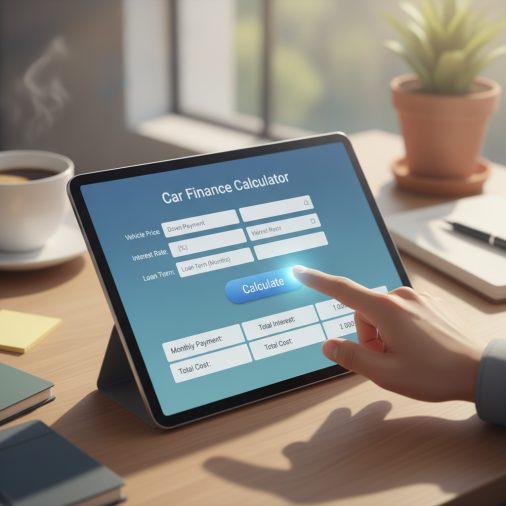
Follow these steps to get accurate results from the car finance calculator:
- Enter the vehicle price — use the agreed purchase price or sticker price before any discounts not already reflected.
- Add your down payment — the cash you plan to pay upfront at signing.
- Enter trade-in value and amount owed — if you have no trade-in, leave both at zero. If you owe more than the car is worth, the difference increases your new loan.
- Set your sales tax rate — check your state rate; the slider defaults to 7%.
- Add fees — include title, registration, documentation, and any dealer fees you expect to be rolled into the loan.
- Enter the APR — use the annual percentage rate quoted by your lender, not a monthly rate.
- Choose your loan term — select from 24 to 84 months.
- Add any rebate — manufacturer cash-back incentives reduce the financed amount directly.
- Review all six results instantly and adjust any input to compare scenarios.
Understanding the Calculator Inputs
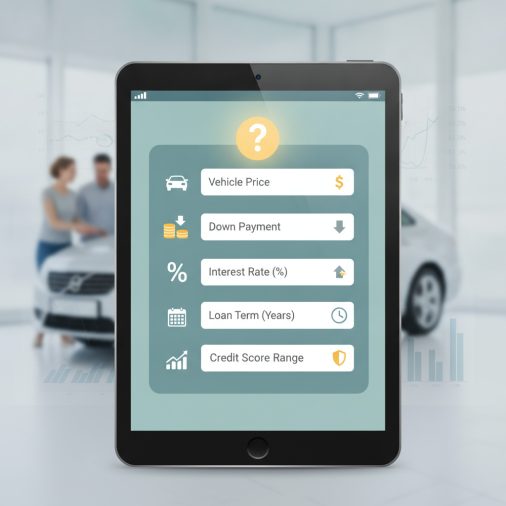
Vehicle Price ($): Enter the full agreed purchase price of the car, truck, or SUV. This is the number on the buyer’s order before tax, fees, or any deductions. Do not subtract your down payment here — there are dedicated fields for that.
Down Payment ($): Enter the cash amount you will pay at signing. A larger down payment directly reduces the loan principal, which lowers both your monthly payment and total interest. Most lenders recommend at least 10–20% down on a new vehicle.
Trade-In Value ($): If you are trading in a vehicle, enter its agreed value. This acts like an additional down payment and reduces the amount you need to finance. Get a written appraisal from at least two sources before accepting a dealer’s offer.
Amount Owed on Trade-In ($): If you still owe money on the vehicle you are trading in, enter that payoff balance here. This amount is added to your new loan principal. If you owe more than the trade-in is worth, you have negative equity, which increases what you borrow.
Sales Tax Rate (%): Use the slider to set your state or local sales tax rate. In most US states, sales tax is calculated on the full vehicle price before any down payment or trade-in credit. Check your state’s DMV or revenue department for the exact rate; combined state and local rates typically range from 0% to over 10%.
Title, Registration & Dealer Fees ($): Include all government fees (title, registration, plates) and dealer fees (documentation fee, dealer prep) that will be rolled into the loan. These vary widely by state and dealer. A typical range is $400–$1,500, but some states and dealers charge more.
Annual Interest Rate / APR (%): Enter the annual percentage rate your lender has quoted or that you expect to qualify for. The APR is the single biggest driver of your monthly payment and total interest cost. Even a 1% difference on a $25,000 loan over 60 months changes your total interest by several hundred dollars.
Loan Term: Select the number of months over which you will repay the loan. Common terms are 36, 48, 60, 72, and 84 months. Shorter terms mean higher monthly payments but significantly less total interest. Longer terms lower the monthly payment but increase the total cost of the loan.
Manufacturer Rebate / Incentive ($): If the manufacturer is offering a cash-back rebate on the model you are buying, enter it here. Rebates reduce the effective purchase price and lower the amount financed. Note that some manufacturers offer a choice between a rebate and a special low APR — the calculator can help you compare both scenarios.
Understanding Your Results
Loan Principal (Amount Financed): This is the net dollar amount you are actually borrowing. It equals the vehicle price plus sales tax plus fees plus any trade-in balance owed, minus your down payment, trade-in value, and any rebate. This is the number your lender uses to calculate your payment schedule.
Monthly Payment: The fixed amount due each month for the full loan term, calculated using the standard amortizing loan formula. Early payments are weighted more heavily toward interest; later payments pay down more principal. This figure does not include insurance, fuel, maintenance, or any add-on products.
Total Amount Paid: Your monthly payment multiplied by the number of months in the loan term. This is the gross amount you will send to the lender over the life of the loan, not counting your upfront down payment or trade-in equity.
Total Interest Paid: The difference between the total amount paid and the original loan principal. This is the true cost of borrowing — the extra money you pay the lender in exchange for spreading the purchase over time. Comparing this figure across different APR and term combinations is one of the most powerful uses of this calculator.
Total Out-of-Pocket Cost: The most complete picture of what the vehicle costs you financially. It adds your loan payments to your upfront down payment and the trade-in equity you contributed. Use this figure when comparing the true cost of different financing structures, not just the monthly payment.
Effective Vehicle Cost Per Month: The total out-of-pocket cost divided by the loan term in months. This normalizes the full cost — including your down payment and trade-in — into a single monthly figure, making it easier to compare a 48-month deal against a 72-month deal on an apples-to-apples basis.
Calculation Formulas Explained
All calculations use the standard amortizing loan payment formula, which is the same method used by banks, credit unions, and auto lenders in the United States under Regulation Z:
Monthly Payment = P × r × (1 + r)^n / ((1 + r)^n − 1)
Where P is the loan principal (amount financed), r is the monthly interest rate (APR divided by 12, expressed as a decimal), and n is the total number of monthly payments (loan term in months).
The loan principal is derived as: Vehicle Price + (Vehicle Price × Sales Tax Rate) + Fees + Trade-In Balance Owed − Down Payment − Trade-In Value − Rebate. This captures every common factor that affects how much you actually borrow.
The total amount paid is simply Monthly Payment × Loan Term Months. The total interest paid is Total Amount Paid − Loan Principal. The total out-of-pocket cost adds the down payment and trade-in value back in, because those are real dollars you spent. The effective cost per month divides total out-of-pocket cost by the loan term.
The APR is treated as a nominal annual rate compounded monthly, consistent with how US auto lenders disclose rates. The minimum APR is set to 0.01% to avoid a mathematical division-by-zero error; for true 0% promotional financing, divide the loan principal by the number of months manually.
Worked Example
Scenario: You are buying a used SUV with a sticker price of $28,000. You put $4,000 down in cash and trade in your old car, which is worth $6,000 but you still owe $2,500 on it. Your state sales tax is 8%, dealer fees are $900, the lender quotes you 7.5% APR, and you choose a 60-month term. There is no manufacturer rebate.
Step 1 — Calculate the loan principal:
- Vehicle price: $28,000
- Sales tax: $28,000 × 0.08 = $2,240
- Fees: $900
- Trade-in balance owed: $2,500
- Subtotal before deductions: $28,000 + $2,240 + $900 + $2,500 = $33,640
- Minus down payment: −$4,000
- Minus trade-in value: −$6,000
- Minus rebate: −$0
- Loan Principal = $23,640
Step 2 — Calculate the monthly interest rate: 7.5% ÷ 12 = 0.625% = 0.00625 per month.
Step 3 — Apply the amortization formula: Monthly Payment = $23,640 × 0.00625 × (1.00625)^60 / ((1.00625)^60 − 1). (1.00625)^60 ≈ 1.4536. Numerator: $23,640 × 0.00625 × 1.4536 ≈ $214.77. Denominator: 1.4536 − 1 = 0.4536. Monthly Payment ≈ $473.48.
Step 4 — Total amount paid: $473.48 × 60 = $28,408.80.
Step 5 — Total interest paid: $28,408.80 − $23,640 = $4,768.80.
Step 6 — Total out-of-pocket cost: $28,408.80 + $4,000 (down) + $6,000 (trade-in equity used) = $38,408.80.
Step 7 — Effective cost per month: $38,408.80 ÷ 60 = $640.15/mo.
Notice how the effective monthly cost ($640) is significantly higher than the loan payment alone ($473), because it accounts for the upfront capital you deployed. This is the figure to use when comparing this deal against leasing or a different loan structure.
How to Interpret the Results
Monthly Payment: A common rule of thumb is to keep your total monthly vehicle costs (payment + insurance + fuel + maintenance) below 15–20% of your gross monthly income. If the monthly payment alone exceeds 15% of your income, consider a larger down payment, a shorter vehicle price target, or a longer term as a last resort.
Total Interest Paid: On a well-priced loan, total interest should ideally be less than 10–15% of the vehicle’s purchase price. If total interest exceeds 20% of the vehicle price, the APR or term is likely too high. Reducing the APR by even 1–2 percentage points or shortening the term by 12 months can save hundreds to thousands of dollars.
Loan Principal vs. Vehicle Price: If your loan principal is significantly higher than the vehicle price, review your tax rate, fees, and trade-in balance owed. Rolling large fees or negative equity into a loan means you start underwater — owing more than the car is worth — which creates risk if you need to sell or the vehicle is totaled.
Effective Cost Per Month: Use this figure to compare financing scenarios fairly. A 72-month loan may show a lower monthly payment than a 48-month loan, but the effective monthly cost (which spreads your down payment over more months) often reveals the longer loan is more expensive overall.
Comparing offers: Run the calculator twice — once with the dealer’s financing offer and once with your bank or credit union’s rate. Even a 0.5% APR difference on a $25,000 loan over 60 months saves roughly $350 in total interest. The total interest paid figure makes this comparison immediate and concrete.
Common Mistakes to Avoid
- Focusing only on the monthly payment: Dealers often extend the loan term to make a higher-priced vehicle seem affordable. Always compare total interest paid and total out-of-pocket cost, not just the monthly figure.
- Forgetting sales tax and fees: Many buyers calculate payments based on the vehicle price alone and are surprised at signing. Tax and fees can add $2,000–$4,000 or more to the financed amount.
- Ignoring negative equity on a trade-in: Rolling a trade-in balance that exceeds the car’s value into a new loan immediately puts you underwater. The calculator shows this clearly in the loan principal result.
- Confusing APR with the interest rate: On a simple auto loan, APR and the stated interest rate are often the same. However, if a lender charges origination fees, the APR will be slightly higher than the nominal rate. Always use the APR for accurate comparisons.
- Choosing the rebate without comparing the low-APR option: Manufacturer promotions sometimes offer either a cash rebate or a special low APR. Run the calculator with each scenario to see which saves more money over your specific loan term.
- Not accounting for the down payment in total cost: The monthly payment does not reflect the cash you paid upfront. The effective cost per month result corrects for this and gives a truer picture of the deal’s value.
- Assuming a longer term is always better: An 84-month loan on a vehicle that depreciates quickly can leave you owing more than the car is worth for years, increasing financial risk and limiting your ability to trade in or sell.
Limitations and Important Notes
This calculator uses the standard equal-payment amortization formula and is designed for conventional installment auto loans. It does not model balloon loans, deferred-interest financing, graduated payment structures, or lease agreements. Results are estimates for planning and comparison purposes only.
Sales tax is applied to the full vehicle price in this calculator, which is the rule in most US states. A minority of states (such as Virginia and some others) tax only the difference between the vehicle price and the trade-in value. Check your state’s exact rule for precise figures.
The calculator does not include ongoing ownership costs such as auto insurance, fuel, routine maintenance, extended warranties, GAP insurance, or add-on dealer products. These can add hundreds of dollars per month to the true cost of ownership.
The minimum APR is set to 0.01% to prevent a division-by-zero error. For true 0% promotional financing, divide the loan principal by the number of months to find the flat monthly payment.
Results produced by this calculator do not constitute a loan offer, pre-approval, or guarantee of any financing terms. Actual loan amounts, rates, and payments are determined by your lender based on your credit profile, the vehicle, and applicable laws. Always review the full loan disclosure documents before signing.
Frequently Asked Questions
What is a good APR for a car loan right now?
A good APR depends heavily on your credit score, the loan term, and whether the vehicle is new or used. As a general benchmark, borrowers with excellent credit (720+) typically qualify for new-car APRs in the 5–7% range in a normal rate environment, while used-car loans run 1–3 percentage points higher due to greater lender risk. Borrowers with fair credit (620–679) may see rates of 10–15% or more. The best way to know if you are getting a competitive rate is to get pre-approved by your bank or credit union before visiting the dealership, so you have a baseline to compare against the dealer’s financing offer.
How much should I put down on a car to avoid being underwater?
Most financial advisors recommend a down payment of at least 20% on a new vehicle and 10% on a used vehicle. New cars depreciate roughly 15–25% in the first year, so a smaller down payment can leave you owing more than the car is worth almost immediately. A 20% down payment on a $30,000 vehicle is $6,000, which keeps your loan principal close to the car’s actual market value after initial depreciation. If 20% is not feasible, consider a shorter loan term (48 months instead of 72) to build equity faster, or choose a less expensive vehicle.
Does a longer loan term always mean lower monthly payments?
Yes, a longer term always produces a lower monthly payment for the same principal and APR — but it also means you pay significantly more total interest over the life of the loan. For example, a $25,000 loan at 7% APR costs about $495/month over 48 months with roughly $1,760 in total interest, versus about $346/month over 84 months with roughly $4,064 in total interest. The 84-month loan saves $149 per month but costs an extra $2,300 in interest. Use the total interest paid result in this calculator to make that trade-off visible before you decide.
How does my credit score affect my car loan interest rate?
Your credit score is the primary factor lenders use to set your APR. Lenders typically group borrowers into tiers — super prime (750+), prime (700–749), near prime (650–699), subprime (600–649), and deep subprime (below 600) — with each tier carrying a different rate range. The difference between a super-prime rate and a subprime rate on the same loan can be 10 percentage points or more, which translates to thousands of dollars in extra interest over a 60-month term. Checking your credit report for errors and paying down revolving balances before applying can meaningfully improve your tier and your rate.
Should I take the manufacturer rebate or the low-APR financing deal?
This is one of the most common car-buying dilemmas, and the answer depends on the loan amount, the term, and the rate difference. As a rule of thumb, a larger rebate is more valuable on shorter loan terms, while a very low APR (such as 0% or 1.9%) becomes more valuable on longer terms and larger loan amounts. The best approach is to run this calculator twice: once with the rebate applied and the standard market APR, and once with the promotional APR and no rebate. Compare the total interest paid in each scenario. The option with the lower total out-of-pocket cost is the better deal for your specific situation.
What fees can I negotiate or avoid when financing a car?
Not all fees are negotiable, but many are. Government fees — title, registration, and license plates — are set by the state and cannot be waived. However, dealer fees such as the documentation fee (doc fee), dealer prep fee, advertising fee, and nitrogen tire inflation fee are often negotiable or can be removed entirely. Doc fees vary widely by state; some states cap them while others do not. Before signing, ask the dealer to itemize every fee and explain each one. Any fee that is not a government charge is potentially negotiable. Reducing fees by $500–$1,000 directly lowers your loan principal and saves additional interest over the loan term.
Can I pay off my car loan early and save on interest?
In most cases, yes. Standard auto loans in the United States use simple interest amortization, meaning interest accrues daily on the outstanding balance. Paying extra toward principal — whether through larger monthly payments or a lump-sum payment — reduces the balance faster, which reduces the interest that accrues in subsequent months. Before making extra payments, confirm with your lender that there is no prepayment penalty (most US auto loans do not have one, but some subprime lenders include them). Even paying one extra payment per year can shorten a 60-month loan by several months and save a meaningful amount in interest.
Is it better to finance through a dealer or my own bank or credit union?
Getting pre-approved through your own bank or credit union before visiting the dealership is almost always the smarter starting position. Credit unions in particular tend to offer lower APRs than dealer-arranged financing because they are not-for-profit institutions. Dealer financing can be competitive — especially when manufacturers subsidize low promotional rates — but dealers also earn a reserve (a markup on the rate) when they arrange financing through a third-party lender, which means the rate they quote you may be higher than what you actually qualify for. Arriving with a pre-approval in hand gives you a concrete benchmark and negotiating leverage, and you can always accept the dealer’s offer if it genuinely beats your pre-approval rate.