Your factory car stereo sounds flat, quiet, or distorted at higher volumes — and you’re wondering whether an amplifier is the solution. It almost always is.
An amplifier in a car stereo system increases the power of the audio signal before it reaches the speakers. Factory head units typically output 15–20 watts RMS per channel, which is too weak to drive most aftermarket speakers cleanly. An amp delivers more power — often 50–300+ watts RMS per channel — which translates to louder, cleaner sound with less distortion, better bass response, and improved overall audio clarity.
The Core Job of a Car Amplifier
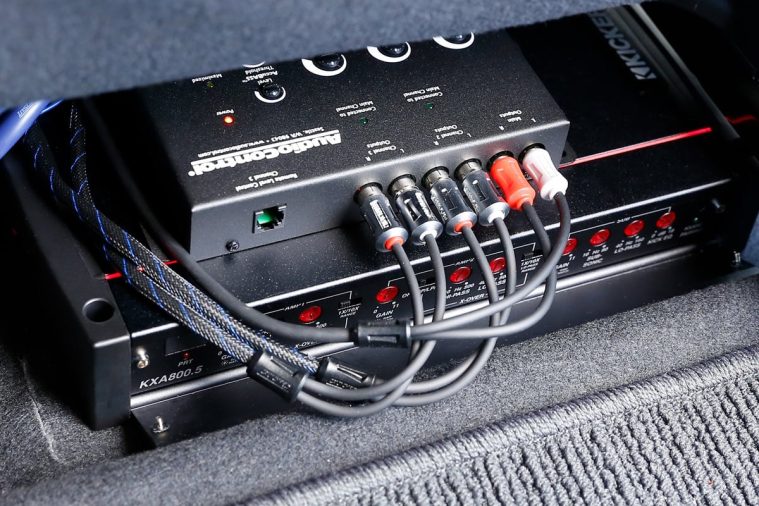
Every audio signal starts as a low-power electrical signal. Your head unit processes that signal — adjusting tone, volume, source input — but it doesn’t have enough power on its own to drive speakers loudly and cleanly.
That’s where the amplifier steps in. It takes the weak signal from the head unit, boosts it using power drawn directly from the vehicle’s electrical system, and sends that amplified signal to the speakers or subwoofer. The result is more headroom, better dynamic range, and sound that stays clean even at high volume levels.
Without an amp, factory speakers often produce a compressed, thin sound that distorts when pushed past moderate volume. With one, those same speakers — or upgraded aftermarket ones — can perform significantly closer to their potential.
How an Amp Connects to Your Car Audio System
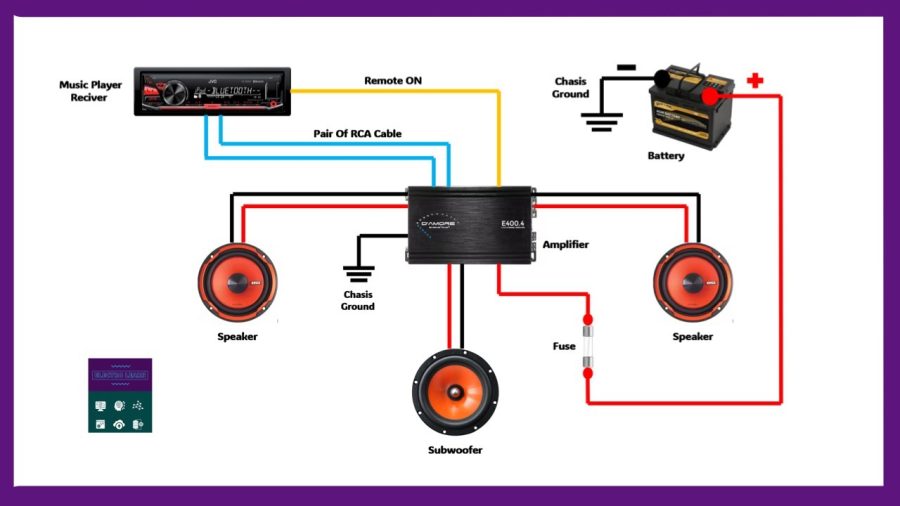
The signal path in a typical car audio setup with an amplifier looks like this:
- Head unit processes audio from radio, Bluetooth, USB, or other sources
- Preamp output (RCA) sends a low-voltage signal from the head unit to the amp’s input
- Amplifier boosts that signal using power from the battery and alternator
- Speakers or subwoofer receive the amplified signal and convert it to sound
Most aftermarket head units include RCA preamp outputs specifically for this connection. Factory radios without RCA outputs can still be used with an amp, but typically require a line output converter (LOC) to properly interface with the amplifier’s input.
Power wiring runs separately. The amp connects directly to the battery through a fused power cable, with a ground wire to the vehicle’s chassis. This dedicated connection is what allows the amp to deliver large amounts of power without straining the head unit’s internal circuits.
Types of Car Amplifiers and What Each Does
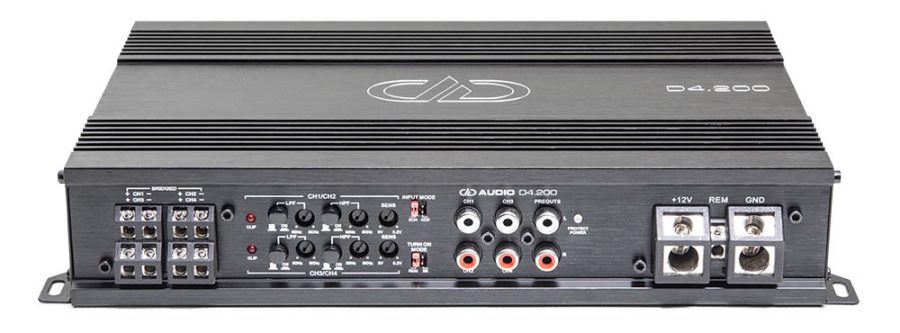
Not all amplifiers work the same way. The right type depends on what you’re powering.
| Amp Type | Channels | Best Used For |
|---|---|---|
| Monoblock (Class D) | 1 | Subwoofers only |
| 2-Channel | 2 | Front or rear speakers, or bridged to a sub |
| 4-Channel | 4 | Full speaker set (front + rear) |
| 5-Channel | 5 | Full speaker set + subwoofer in one unit |
| Multi-Channel (6+) | 6 or more | Complex systems with component speakers |
A monoblock amplifier is purpose-built for bass. It handles the high-current demands of subwoofers efficiently. A 4-channel amp powers your door and rear deck speakers for a more complete system upgrade. A 5-channel amp is popular for straightforward full-system builds because it handles everything in a single unit, simplifying wiring and saving space.
RMS Power vs. Peak Power — What Actually Matters
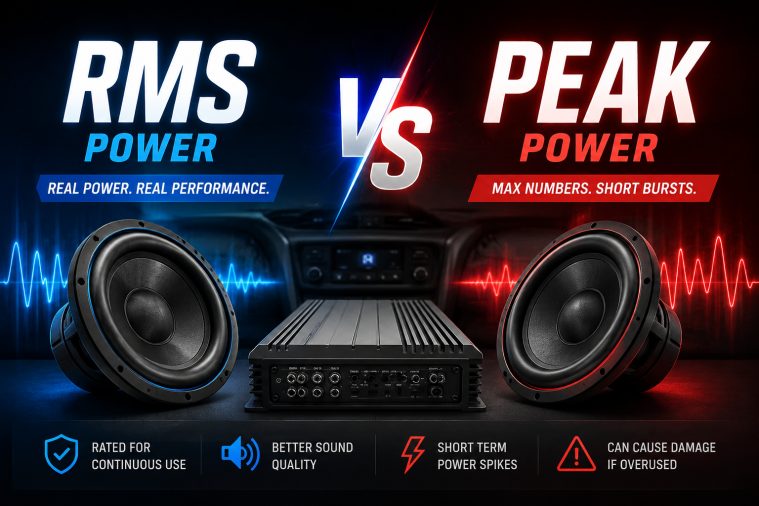
Amplifier specs can be misleading if you focus on the wrong numbers. Peak power is the maximum output for a fraction of a second — it’s largely a marketing figure. RMS power is the continuous, real-world output the amp can sustain, and it’s the only number that matters when matching an amp to your speakers.
As a general guideline:
- Match the amp’s RMS output to the speaker’s RMS power handling
- Going slightly over (within 50%) gives headroom without risking damage
- Severely underpowering speakers causes clipping — a distorted signal that damages tweeters and voice coils more than overpowering does
Many owners make the mistake of buying an amp based on peak wattage claims. A reputable amplifier rated at 75 watts RMS per channel will sound better and last longer than a cheap unit claiming 400 watts peak.
Sound Quality Improvements You’ll Actually Notice
Adding an amp isn’t just about volume. The improvements are practical and noticeable even at moderate listening levels.
Reduced distortion is often the first thing people notice. Factory head units clip (distort) their signal when pushed hard. An amp with proper gain settings never has to work near its limits for everyday listening volumes.
Tighter bass is another clear benefit, especially when pairing an amp with a dedicated subwoofer. Factory speakers try to reproduce bass frequencies they weren’t designed to handle, which wastes power and muddies the midrange. An amp and sub combination handles bass duty separately, freeing your other speakers to focus on mids and highs.
Better staging and imaging — the sense of where instruments and vocals are positioned — also improves when speakers are properly powered. Underpowered speakers struggle to reproduce transient sounds accurately.
Gain Setting: The Most Misunderstood Amplifier Control
The gain knob on an amplifier is not a volume control. This is one of the most commonly misunderstood aspects of amp setup.
Gain matches the input sensitivity of the amp to the output level of the head unit. Setting gain too high introduces clipping and distortion into the signal before it even gets amplified. Setting it too low wastes the amp’s available power.
- Proper gain setting is done by:
- Playing a test tone or your loudest typical listening track
- Turning the head unit to about 75–80% of max volume
- Slowly increasing the amp’s gain until distortion is barely audible
- Backing off slightly from that point
A multimeter or oscilloscope gives more precise results, but the above method works reasonably well for most owners. The Rockford Fosgate Punch series amplifiers, for example, include clearly labeled gain controls that make this process more straightforward than some budget alternatives.
Does Every Car Need an Amp?
Not necessarily, but most vehicles benefit from one. Factory audio systems in mainstream vehicles — sedans, SUVs, trucks, crossovers — are engineered to a price point, not an audio quality target. The internal amplification in factory head units typically delivers 15–22 watts RMS per channel under ideal conditions.
Premium factory audio packages from brands like Bose, Harman Kardon, Bang & Olufsen, and Meridian already include external amplifiers. These systems are more capable from the factory, though they’re also more complex to integrate with aftermarket components due to proprietary signal processing and impedance matching.
If your vehicle has a premium factory audio system, adding a new amp requires more research into signal processing compatibility — often needing a DSP adapter like the AudioControl LC2i Pro to properly extract and clean the signal before sending it to a new amplifier.
Common Signs Your Car Would Benefit From an Amplifier
- Sound becomes distorted or harsh when you push the volume past 60–70%
- Bass sounds weak or flabby even with factory subwoofers
- Music loses detail and sounds flat or compressed at any volume
- You’ve installed aftermarket speakers but haven’t noticed much improvement
- You want to add a subwoofer for proper bass response
In practice, aftermarket speakers often show only modest improvement over factory units when running off a factory head unit’s built-in power. Adding an amp is often where the real upgrade happens.
Installation Safety and Electrical Considerations
Car amplifier installation involves working with your vehicle’s electrical system. Done correctly, it’s a safe and rewarding DIY project. Done incorrectly, it can blow fuses, damage the head unit, or in worst cases start an electrical fire.
A few important points:
- Always fuse the power wire near the battery — within 18 inches of the positive terminal. This protects the entire power cable run if there’s a short.
- Never run signal cables parallel to power cables — this introduces noise (alternator whine or engine noise) into the audio signal.
- Ground the amp to bare metal — a properly sanded chassis ground point, not a painted surface or existing ground screw shared with other accessories.
- Size your power wire to the amp’s current draw — undersized wire causes voltage drop, heat, and poor performance.
If you’re uncomfortable working around vehicle electrical systems, a professional car audio shop can handle installation. Improper wiring is a legitimate safety concern, particularly for the fusing requirement.
FAQ
What is the difference between a car amp and a head unit’s built-in amplifier?
A head unit’s built-in amp is a small integrated circuit that typically outputs 15–22 watts RMS per channel. It’s convenient but limited in power and sound quality. A dedicated external amplifier draws power directly from the vehicle’s battery and can cleanly output 50–500+ watts RMS per channel, providing noticeably better dynamics, lower distortion, and more headroom.
Will adding an amp drain my car’s battery?
An amplifier draws power when the audio system is in use, not when the vehicle is parked and the ignition is off. However, a large or inefficient amp running at high volume for extended periods can stress a weak or older battery and alternator. Most street-use systems pair a healthy stock electrical system with a reasonably sized amp without issues. High-output competition systems may require an upgraded alternator or secondary battery.
Can I add an amp to a factory head unit without RCA outputs?
Yes. A line output converter (LOC) taps into the factory speaker wires and converts that signal to a preamp-level RCA output that connects to the amp. Quality varies among LOC units, so choosing a reputable one matters for signal cleanliness. Some amplifiers also include a high-level (speaker-level) input that accepts the signal directly, eliminating the need for a separate LOC.
How many watts do I need for a car amplifier?
It depends entirely on what you’re powering and how loud you want your system. For a basic speaker upgrade, 50–75 watts RMS per channel is typically sufficient. For a subwoofer, 200–500 watts RMS is a common range for street use. Match the amp’s RMS output to the speaker’s or subwoofer’s RMS power handling — not the peak rating — for the best results.
Does a car amplifier improve sound quality or just make it louder?
Both, but quality improvement is often the bigger benefit. A properly installed and calibrated amplifier reduces clipping, lowers distortion at moderate volumes, tightens bass response, and gives the system more dynamic headroom. Many audiophile-focused car audio enthusiasts run amps at moderate volumes specifically for the cleaner signal, not for maximum loudness.
Will an amp fix distorted sound at high volume?
In most cases, yes. Distortion at high volume from a factory or underpowered system is typically caused by signal clipping — the head unit’s internal amp being pushed beyond its capability. An external amp with proper gain settings handles those volume levels cleanly. If distortion persists after adding an amp, the cause may be incorrect gain settings, a clipping signal from the head unit, or damaged speakers.
Do I need an amp if I’m only adding a subwoofer?
Yes. Subwoofers require significantly more power than a head unit can supply. Even modest 10-inch or 12-inch subwoofers typically need 150–300 watts RMS to perform properly. Running a sub off a factory head unit without an amp produces weak, distorted bass that barely justifies the installation effort. A dedicated monoblock amplifier is the correct pairing for any subwoofer.
An amplifier is the foundation of any serious car audio upgrade. It doesn’t just add volume — it gives your entire system the electrical headroom to perform the way well-designed speakers actually can. Whether you’re powering a subwoofer, upgrading door speakers, or building a full custom system, matching the right amp to your components and setting the gain correctly makes the difference between a mediocre result and genuinely impressive sound.