Use this car loan balance calculator to find out exactly how much you still owe on your auto loan at any point in the repayment schedule. Enter your original loan amount, annual interest rate, loan term, and the number of payments you have already made to instantly see your remaining balance, total interest paid so far, and the interest still to come. Whether you are planning an early payoff, considering refinancing, or simply tracking your progress, this tool gives you a clear financial picture in seconds.
Car Loan Balance Calculator: Remaining Balance & Payoff Progress
Calculate your current auto loan remaining balance, total interest paid so far, remaining interest, and payoff percentage at any point in your loan term.
How to Use This Calculator
Follow these four steps to get your results:
- Enter your original loan amount — the total amount you borrowed when you first took out the auto loan, before any payments.
- Enter your annual interest rate — find this on your loan agreement or monthly statement; enter it as a percentage (for example, 6.5 for 6.5%).
- Select your loan term — choose the total number of months your loan was originally scheduled to run.
- Enter payments already made — count the number of monthly payments you have completed so far, including your most recent payment.
The calculator instantly displays your fixed monthly payment, current remaining balance, interest paid to date, remaining interest, payments left, and the percentage of your loan that has been paid down.
Understanding the Calculator Inputs
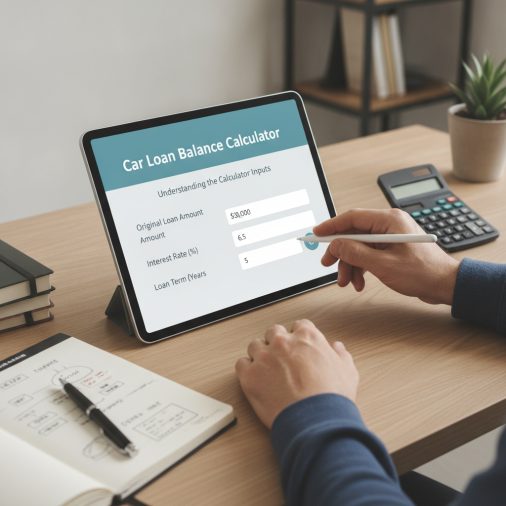
Original Loan Amount ($): This is the total principal you borrowed at the start of the loan — the amount shown on your original loan agreement, not the vehicle’s purchase price. If you rolled in taxes, fees, or a negative trade-in equity, those amounts are included here. The default is $25,000, which is close to the average used-car loan in the United States. Enter any value between $500 and $500,000.
Annual Interest Rate (%): Enter the annual percentage rate (APR) exactly as it appears on your loan contract or monthly statement. This is the yearly cost of borrowing expressed as a percentage. Do not confuse APR with the money factor used in leases. A typical new-car loan rate ranges from roughly 5% to 10% depending on credit score and lender; used-car loans are often higher. Enter the number only — for example, type 6.5 for a 6.5% rate.
Loan Term (months): Select the total number of monthly payments your loan was originally scheduled to have. Common terms are 36, 48, 60, 72, and 84 months. This is fixed at origination and does not change unless you formally refinance. Longer terms lower your monthly payment but increase total interest paid.
Number of Payments Already Made: Enter how many monthly payments you have successfully completed, counting from your very first payment through your most recent one. If you just made your 12th payment, enter 12. If you have not yet made any payments, enter 0 to see your starting balance (which will equal your original loan amount). This field accepts values from 0 up to your selected loan term.
Understanding Your Results
Fixed Monthly Payment: This is the constant amount due each month under your original amortization schedule. It does not change over the life of the loan unless you refinance. It covers both the interest accrued during that month and a portion of the principal. Early in the loan, most of this payment is interest; later, most is principal.
Remaining Loan Balance: This is the outstanding principal you still owe after the number of payments you entered. This is the core output of the calculator. If you were to pay off the loan today with no additional interest accrual, this is the amount you would need. Note that your lender’s official payoff quote may be slightly higher because lenders typically calculate interest on a daily basis up to the exact payoff date.
Total Interest Paid So Far: This is the cumulative interest portion of all the payments you have made to date. It equals your total payments made minus the reduction in principal. Early in the loan this number grows quickly because a large share of each payment is interest.
Remaining Interest to Be Paid: If you continue making every remaining scheduled payment without any extra contributions, this is the additional interest you will pay before the loan reaches zero. Comparing this figure to your remaining balance helps you evaluate whether early payoff or refinancing makes financial sense.
Payments Remaining: A simple count of how many monthly payments are left under the original schedule. Multiply this by your fixed monthly payment to find the total cash outflow remaining.
Loan Paid Off Percentage: This shows what fraction of your original principal has been eliminated. Because of front-loaded interest, this percentage grows slowly at first and accelerates toward the end of the loan. It is a useful proxy for your equity position in the vehicle financing, though actual vehicle equity also depends on the car’s current market value.
Calculation Formulas Explained
All calculations use the standard fixed-rate fully amortizing loan formulas, which assume equal monthly payments, monthly compounding, and no extra payments.
Monthly periodic rate: The annual rate is divided by 1200 to convert it from an annual percentage to a monthly decimal. For example, 6.5% becomes 6.5 / 1200 = 0.005417.
Fixed monthly payment (M): M = P * r * (1 + r)^n / ((1 + r)^n – 1), where P is the original principal, r is the monthly rate, and n is the total number of months. This is the standard annuity payment formula.
Remaining balance after k payments (B): B = P * (1 + r)^k – M * ((1 + r)^k – 1) / r. This formula compounds the original principal forward by k periods and then subtracts the future value of all payments made. It is mathematically equivalent to summing the remaining payment present values.
Total interest paid so far: Equal to (M * k) minus the principal reduction, where principal reduction is P minus B. In other words, it is the total cash paid minus the amount that actually reduced the debt.
Remaining interest: Equal to (M * (n – k)) minus B. This is the total future cash outflow minus the remaining principal, representing the pure interest cost of completing the loan on schedule.
Loan paid off percentage: (1 – B / P) * 100. This expresses the remaining balance as a fraction of the original principal and converts it to a percentage of principal eliminated.
Worked Example
Example: $25,000 loan at 6.5% APR for 60 months, 12 payments made.
Step 1 — Monthly rate: r = 6.5 / 1200 = 0.0054167
Step 2 — Fixed monthly payment: M = 25000 * 0.0054167 * (1.0054167)^60 / ((1.0054167)^60 – 1). First, (1.0054167)^60 = 1.38237. Then M = 25000 * 0.0054167 * 1.38237 / (1.38237 – 1) = 25000 * 0.007488 / 0.38237 = 187.20 / 0.38237 = $489.46 per month.
Step 3 — Remaining balance after 12 payments: B = 25000 * (1.0054167)^12 – 489.46 * ((1.0054167)^12 – 1) / 0.0054167. (1.0054167)^12 = 1.06716. B = 25000 * 1.06716 – 489.46 * (0.06716 / 0.0054167) = 26679 – 489.46 * 12.398 = 26679 – 6067.5 = $20,611.50.
Step 4 — Total interest paid so far: Total payments = 489.46 * 12 = $5,873.52. Principal reduction = 25000 – 20611.50 = $4,388.50. Interest paid = 5873.52 – 4388.50 = $1,485.02.
Step 5 — Remaining interest: Remaining payments cash = 489.46 * 48 = $23,494.08. Remaining interest = 23494.08 – 20611.50 = $2,882.58.
Step 6 — Paid off percentage: (1 – 20611.50 / 25000) * 100 = (1 – 0.8245) * 100 = 17.6%.
After one year of a five-year loan, you have paid down only about 17.6% of the principal despite making 20% of your payments — a clear illustration of front-loaded interest amortization.
How to Interpret the Results
Is your remaining balance higher than expected? This is normal, especially in the first half of the loan. Because interest is charged on the outstanding balance each month, early payments are mostly interest. The principal reduction accelerates over time. If your remaining balance feels uncomfortably high relative to the car’s current market value, you may be in a negative equity position — meaning you owe more than the vehicle is worth. This is sometimes called being underwater on the loan.
Evaluating early payoff: Look at the Remaining Interest to Be Paid figure. That is the maximum interest you can save by paying off the loan immediately. Compare it to any prepayment penalty (if applicable) and to the opportunity cost of using that cash elsewhere. If the remaining interest is substantial and you have the funds, early payoff is often a strong financial move.
Evaluating refinancing: If interest rates have dropped since you took out your loan, refinancing your remaining balance at a lower rate can reduce both your monthly payment and total interest. Use the remaining balance from this calculator as the new principal in a refinance comparison. Keep in mind that extending the term while lowering the rate may reduce monthly payments but increase total interest paid.
Tracking equity: The Loan Paid Off Percentage tells you how much of the original principal is gone, but vehicle equity also depends on depreciation. A car that has lost significant value may still leave you with negative equity even if you have paid down 30% of the loan. Checking your remaining balance against a current vehicle valuation gives you the full picture.
Common Mistakes to Avoid
- Using the purchase price instead of the loan amount: If you made a down payment, the loan amount is lower than the vehicle price. Always use the amount you actually borrowed.
- Confusing APR with the money factor: Leases use a money factor, not an APR. This calculator is for purchase loans only. If you have a lease, the math is entirely different.
- Counting payments incorrectly: Count only completed payments. If your next payment is due in two weeks, do not count it yet. Counting an extra payment will understate your true remaining balance.
- Assuming the calculator result equals the lender’s payoff quote: Lenders typically accrue interest daily. If you request a payoff quote mid-month, the lender will add daily interest from your last payment date to the payoff date. The calculator result is the balance at the end of your last payment cycle, not a same-day payoff figure.
- Ignoring extra payments already made: If you have made any lump-sum payments or paid extra principal at any point, this calculator will overstate your remaining balance because it assumes only regular scheduled payments. Contact your lender for an exact balance in that case.
- Selecting the wrong loan term: Some borrowers confuse a 60-month and 72-month loan. Double-check your original loan documents to confirm the term before entering it.
Limitations and Important Notes
This calculator assumes a standard fixed-rate fully amortizing loan with equal monthly payments and monthly compounding. It does not account for the following situations: variable-rate loans where the interest rate changes over time; loans with balloon payments at the end of the term; loans where payments have been deferred, skipped, or modified; any extra principal payments made beyond the regular schedule; daily interest accrual used by many lenders for official payoff quotes; origination fees, prepayment penalties, or other loan costs not reflected in the principal balance; and currency differences for loans denominated outside the United States dollar.
The results are estimates intended for financial planning and educational purposes. For an official payoff amount, always contact your lender directly and request a formal payoff statement with a specific payoff date. Payoff amounts are legally binding only when provided in writing by your lender. This calculator does not constitute financial advice.
Frequently Asked Questions
What is the difference between my remaining balance and my payoff amount?
Your remaining balance, as calculated here, is the outstanding principal at the end of your most recent payment cycle. Your lender’s official payoff amount is typically higher because most auto lenders accrue interest on a daily basis. From the day after your last payment was applied, interest continues to accumulate at the daily rate (annual rate divided by 365) until the exact date your lender receives the payoff funds. If you request a payoff quote, your lender will specify a payoff date and the exact amount due on that date, which includes those additional days of interest. Always use your lender’s written payoff quote when actually paying off the loan.
Why does so little of my early payments go toward principal?
Auto loans use a standard amortizing schedule in which each monthly payment first covers the interest that accrued on the outstanding balance during that month, and the remainder reduces the principal. Early in the loan the balance is at its highest, so the interest charge is also at its highest, leaving only a small portion of each payment for principal reduction. As the balance falls, the monthly interest charge shrinks and more of each fixed payment goes toward principal. This front-loading of interest is a mathematical property of the amortization formula, not a lender policy. It is one reason why the Loan Paid Off Percentage grows slowly at first and accelerates toward the end of the term.
Can I use this calculator if I have made extra payments?
Not accurately. This calculator assumes you have made only the regular scheduled monthly payments with no additional principal contributions. If you have ever paid extra — whether as a lump sum or by adding to your regular payment — your actual remaining balance will be lower than what this calculator shows. In that case, the most reliable source for your true balance is your lender’s online account portal or a recent monthly statement. You can also call your lender and ask for a current balance or a payoff quote. Once you have the actual current balance, you could use it as a new starting principal in a fresh calculation to project future interest savings.
How does refinancing affect my remaining balance?
Refinancing does not directly change your remaining balance — it replaces your existing loan with a new one. When you refinance, your new lender pays off your old loan using the payoff amount, and you then owe that same amount (plus any rolled-in fees) to the new lender under new terms. The benefit of refinancing comes from a lower interest rate, a shorter term, or both, which reduces the total interest you pay going forward. Use the Remaining Loan Balance from this calculator as the approximate new principal when comparing refinance offers. Keep in mind that restarting a longer term, even at a lower rate, can sometimes increase total interest paid over the life of the new loan.
What happens to my balance if I miss a payment?
If you miss a scheduled payment, your lender will typically charge a late fee and continue accruing interest on the full outstanding balance. Because no principal reduction occurred that month, your balance will be higher than the amortization schedule predicts, and all subsequent balance calculations will be off. Some lenders may also report the missed payment to credit bureaus after a grace period, which can affect your credit score. If you have missed any payments, this calculator will understate your true remaining balance. Contact your lender immediately if you have missed or expect to miss a payment, as many lenders offer hardship programs or deferral options that can help you avoid additional penalties.
Is the remaining balance the same as the car's trade-in value?
No — these are two completely different figures. Your remaining loan balance is what you owe the lender; it is a liability. Your car’s trade-in or market value is what a dealer or private buyer would pay for the vehicle; it is an asset. If your remaining balance is higher than the car’s current market value, you have negative equity, sometimes called being underwater or upside-down on the loan. This situation is common in the first two to three years of a long-term loan because vehicles depreciate quickly while loan balances fall slowly due to front-loaded interest. If you trade in a car with negative equity, the shortfall is often rolled into the new loan, which can compound the problem.
How do I find my original loan details if I have lost my paperwork?
There are several reliable ways to recover your original loan details. First, check your lender’s online account portal or mobile app — most lenders display your original loan amount, interest rate, term, and payment history in your account dashboard. Second, look at your most recent monthly statement, which usually shows the original loan amount and APR. Third, call your lender’s customer service line and ask for your loan origination details; you will need to verify your identity. Finally, if the loan was arranged through a dealership, the finance and insurance office may have copies of your original contract. Your original loan agreement is a legally required document that lenders must retain, so a copy is always available upon request.
Does a lower interest rate always mean a lower remaining balance at any given point?
Yes, all else being equal. A lower interest rate means less interest accrues each month, so more of each fixed payment goes toward reducing the principal. As a result, the remaining balance falls faster with a lower rate than with a higher rate, assuming the same original principal and loan term. However, if a lower rate is paired with a longer loan term, the monthly payment may be lower and the balance may actually fall more slowly in the early months despite the lower rate. The interaction between rate and term is why it is important to compare both the monthly payment and the total interest cost — not just the rate — when evaluating loan offers or refinancing options.