Use this car amortization calculator to instantly see your estimated monthly payment, total interest charges, and the full cost of your auto loan. Enter your vehicle price, down payment, trade-in value, loan term, and annual interest rate to get a complete payment breakdown. Whether you are financing a new or used car, understanding how your loan amortizes over time helps you negotiate better terms, choose the right loan length, and avoid paying more interest than necessary.
Car Amortization Calculator: Monthly Payment & Total Cost
Calculate your monthly car loan payment, total interest paid, and full out-of-pocket cost with this auto loan amortization calculator. Enter vehicle price, down payment, trade-in, tax, fees, and APR to get a complete financing breakdown.
How to Use This Calculator
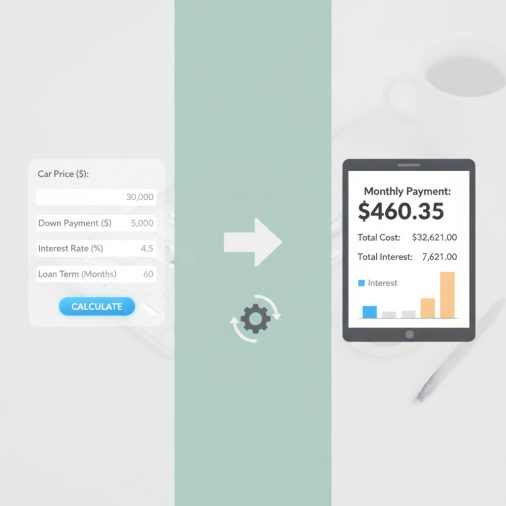
Follow these steps to get an accurate auto loan estimate:
- Enter the vehicle price — use the agreed purchase price or sticker price before any credits.
- Add your down payment — any cash you plan to pay upfront at signing.
- Enter trade-in value — the dealer credit for your current vehicle, if applicable.
- Set the sales tax rate — use your state or local rate; the slider defaults to 6%.
- Enter fees — include title, registration, documentation, and dealer fees you expect to finance.
- Choose your loan term — select the number of months from the dropdown.
- Set the APR — use the rate quoted by your lender or a rate you are shopping for.
- Enter any manufacturer rebate — factory cash incentives reduce the taxable price before financing.
- Review all six results — compare scenarios by adjusting the term or APR to find the best fit for your budget.
Understanding the Calculator Inputs
Vehicle Price ($): Enter the full agreed purchase price of the car before any credits are applied. For a new car this is typically the negotiated out-the-door price before tax; for a used car it is the dealer or private-sale asking price you have agreed to pay.
Down Payment ($): Enter the cash amount you will pay at signing. A larger down payment directly reduces the loan principal, which lowers both your monthly payment and total interest. Most financial planners suggest putting down at least 10–20% of the vehicle price.
Trade-In Value ($): If you are trading in a vehicle, enter the dealer credit amount. Like a down payment, this equity is applied against the purchase price and reduces the amount you need to finance. If you are not trading in a vehicle, leave this at $0.
Sales Tax Rate (%): Use the slider to set your state or local combined sales tax rate. In most US states, sales tax is calculated on the vehicle price after the rebate is subtracted but before fees are added. Rates vary widely — from 0% in states like Oregon and Montana to over 10% in some localities. Check your state DMV or tax authority for the exact rate.
Title, Registration & Dealer Fees ($): Enter the total of all government and dealer fees you expect to finance, including title fees, registration fees, documentation fees, and any dealer processing charges. These are rolled into the loan principal in this calculator. If you plan to pay any fees in cash at signing, exclude them from this field.
Loan Term: Select the number of months for your loan from the dropdown. Common terms range from 36 to 72 months. Shorter terms mean higher monthly payments but significantly less total interest. Longer terms lower the monthly payment but increase total interest cost substantially.
Annual Interest Rate / APR (%): Enter the annual percentage rate quoted by your lender. This is the single most important driver of your total interest cost. Even a 1% difference in APR on a $25,000 loan over 60 months can mean hundreds of dollars in extra interest. Use the rate from a pre-approval letter or lender quote for the most accurate result.
Manufacturer Rebate / Incentive ($): If the manufacturer is offering a cash rebate on the vehicle, enter it here. The rebate is subtracted from the vehicle price before sales tax is calculated, which is the standard treatment in most states. If you are choosing between a rebate and a special low-APR financing offer, you can compare both scenarios using this calculator.
Understanding Your Results
Loan Principal (Amount Financed): This is the actual dollar amount you are borrowing — the balance on which interest accrues every month. It equals the vehicle price minus the rebate, plus sales tax and fees, minus your down payment and trade-in credit. Reducing this number through a larger down payment or trade-in is the most direct way to lower your total interest cost.
Monthly Payment: This is the fixed amount due each month for the life of the loan, calculated using the standard amortization formula. Early payments are weighted heavily toward interest; later payments shift toward principal repayment. Your actual payment from a lender may differ slightly due to rounding conventions or additional products financed.
Total Amount Paid: The monthly payment multiplied by the number of months. This represents the total cash outflow for the financed portion of the vehicle. It does not include the down payment or trade-in equity you applied at purchase.
Total Interest Paid: The total amount paid minus the original loan principal. This is the true cost of borrowing — the extra money paid to the lender beyond what you originally financed. Comparing this figure across different loan terms and APRs is one of the most useful exercises this calculator enables.
Total Out-of-Pocket Cost: The complete acquisition cost of the vehicle including your down payment, trade-in equity applied, and all loan payments over the full term. This gives you the most complete picture of what the vehicle actually costs you in total cash terms, excluding ongoing ownership costs like insurance and fuel.
Interest as % of Principal: Total interest expressed as a percentage of the loan principal. This ratio makes it easy to compare the relative cost of different loan scenarios regardless of vehicle price. A 60-month loan at 6.5% APR typically produces an interest-to-principal ratio of roughly 17–18%. Ratios above 25% are a signal that the term is too long or the rate is too high.
Calculation Formulas Explained
All results are derived from the standard fixed-rate amortization formula, which is the same method used by banks and credit unions to calculate auto loan payments:
Monthly Payment = P × [r(1+r)^n] / [(1+r)^n − 1]
Where: P is the loan principal (amount financed), r is the monthly interest rate (APR divided by 12, divided by 100), and n is the total number of monthly payments (loan term in months).
The loan principal is calculated as: (Vehicle Price − Rebate) × (1 + Sales Tax Rate / 100) + Fees − Down Payment − Trade-In Value. The result is floored at zero using the max() function to prevent negative loan amounts when credits exceed the financed price.
The total amount paid is simply the monthly payment multiplied by the number of months (n). The total interest paid is the total amount paid minus the principal. The total out-of-pocket cost adds the down payment and trade-in value back to the total amount paid, because those funds were also spent acquiring the vehicle.
The interest as % of principal divides total interest by the principal and multiplies by 100. The max(1, principal) guard in the denominator prevents a division-by-zero error when the principal is zero.
This calculator assumes a fixed interest rate for the entire loan term with equal monthly payments. It does not model variable-rate loans, balloon payments, or loans with irregular payment schedules.
Worked Example
Scenario: You are buying a used car with a negotiated price of $28,000. You have a $2,500 down payment, a trade-in worth $1,500, and a $1,000 manufacturer rebate. Your state sales tax is 7%, dealer and title fees total $750, and your credit union has pre-approved you at 5.9% APR for 60 months.
- Taxable price after rebate: $28,000 − $1,000 = $27,000
- Sales tax: $27,000 × 0.07 = $1,890
- Subtotal before credits: $27,000 + $1,890 + $750 (fees) = $29,640
- Loan principal: $29,640 − $2,500 (down) − $1,500 (trade-in) = $25,640
- Monthly rate (r): 5.9 / 1200 = 0.004917
- (1 + r)^n: (1.004917)^60 ≈ 1.3404
- Monthly payment: $25,640 × (0.004917 × 1.3404) / (1.3404 − 1) = $25,640 × 0.006593 / 0.3404 ≈ $494.87/mo
- Total amount paid: $494.87 × 60 = $29,692.20
- Total interest paid: $29,692.20 − $25,640 = $4,052.20
- Total out-of-pocket cost: $29,692.20 + $2,500 + $1,500 = $33,692.20
- Interest as % of principal: $4,052.20 / $25,640 × 100 ≈ 15.8%
This means the financing adds about $4,052 to the cost of the vehicle over five years — a reasonable outcome at a competitive APR with a meaningful down payment and trade-in applied.
How to Interpret the Results
Monthly Payment: A common rule of thumb is to keep your total monthly vehicle costs (payment + insurance + fuel) below 15–20% of your monthly take-home pay. If the monthly payment alone exceeds 15% of your net income, consider a larger down payment, a longer term, or a less expensive vehicle.
Total Interest Paid: Compare this figure across different loan terms. Extending from 60 to 72 months might save $50/month but add $1,500–$2,500 in total interest on a typical loan. The interest savings from a shorter term are often more valuable than the monthly cash flow relief of a longer term.
Interest as % of Principal: Use this as a quick benchmark. Under 10% is excellent (short term or very low rate). 10–20% is typical for 48–60 month loans at moderate rates. Above 25% suggests a long term, a high rate, or both — and is worth reconsidering. Above 35% is a strong signal to shop for a better rate or shorten the term.
Total Out-of-Pocket Cost: This is the most honest measure of what the vehicle costs you. Compare it to the vehicle’s expected useful life and residual value. If you are financing a $30,000 car but the total out-of-pocket cost is $38,000 over 72 months, ask whether the vehicle will still be worth driving — and worth the cost — at the end of the loan.
Comparing scenarios: Run the calculator at least three times — once with your target term, once with a term 12 months shorter, and once with a term 12 months longer. The difference in total interest between these scenarios is often the most persuasive argument for choosing a shorter loan.
Common Mistakes to Avoid
- Forgetting sales tax and fees: Many buyers focus on the vehicle price and monthly payment but forget that tax and fees can add $1,500–$4,000 or more to the financed amount. Always include these in your planning calculation.
- Comparing monthly payments instead of total cost: A dealer may offer a lower monthly payment by extending the loan term, but the total interest paid can be thousands of dollars higher. Always compare total interest paid, not just the monthly figure.
- Using the dealer’s APR without shopping: Dealer-arranged financing often carries a markup above the lender’s buy rate. Getting a pre-approval from your bank or credit union before visiting the dealership gives you a benchmark rate to negotiate against.
- Treating the trade-in and rebate as equivalent: A manufacturer rebate reduces the taxable price of the vehicle in most states, which saves you sales tax on top of the rebate amount. A trade-in credit does not reduce the taxable price in most states. The rebate is often more valuable than it appears.
- Ignoring the impact of a small APR difference: A 1% APR difference on a $25,000 loan over 60 months adds roughly $650 in total interest. On a $40,000 loan it adds over $1,000. Small rate improvements are worth pursuing.
- Financing add-on products: Extended warranties, gap insurance, and paint protection packages are often rolled into the loan, increasing the principal and the interest paid on those products over the full term. Evaluate these separately before agreeing to finance them.
- Not accounting for negative equity on a trade-in: If you owe more on your current vehicle than it is worth, the negative equity is typically rolled into the new loan, increasing your principal significantly. This calculator assumes your trade-in value is positive equity only.
Limitations and Important Notes
This calculator uses the standard fixed-rate amortization formula and is designed for planning and comparison purposes. It assumes a fixed interest rate for the entire loan term with equal monthly payments — it does not model variable-rate loans, balloon payment structures, or loans with deferred interest periods.
Sales tax treatment varies by state. This calculator applies tax to the vehicle price after the rebate is subtracted, which reflects the most common US state treatment. Some states apply tax differently — for example, some states tax the full price before rebates, and some states offer a sales tax credit on trade-ins that reduces the taxable amount. Check your state’s DMV or department of revenue for the exact rules in your jurisdiction.
Fees entered are assumed to be financed into the loan. If you plan to pay any fees in cash at signing, exclude them from the fees field to avoid overstating your loan principal.
This calculator does not account for gap insurance, extended warranties, prepayment penalties, or other add-on products. It also does not model the ongoing costs of vehicle ownership such as insurance, fuel, maintenance, or depreciation.
Results are estimates for financial planning purposes only and do not constitute a loan offer, commitment to lend, or financial advice. Actual loan terms, payments, and costs will be determined by your lender based on your credit profile, the vehicle, and applicable laws. Consult a qualified financial advisor or lender for personalized guidance.
Frequently Asked Questions
What is an amortization schedule for a car loan?
An amortization schedule is a complete table showing every payment over the life of your loan, broken down into the portion that goes toward interest and the portion that reduces your principal balance. In the early months of a car loan, most of each payment covers interest because the outstanding balance is high. As the balance decreases, the interest portion shrinks and more of each payment goes toward principal. By the final payment, almost the entire amount is principal. Understanding this schedule helps you see how much equity you are building at any point in the loan and how much you would save by making extra payments early in the term when the interest portion is largest.
How is my monthly car payment calculated?
Your monthly car payment is calculated using the standard amortization formula: Monthly Payment = P × [r(1+r)^n] / [(1+r)^n − 1], where P is the loan principal (the amount you are financing), r is the monthly interest rate (your APR divided by 12 and then divided by 100), and n is the total number of monthly payments. This formula ensures that each equal monthly payment covers the interest accrued that month plus a portion of the remaining principal, so the loan is fully paid off at the end of the term. The calculator above performs this calculation automatically as you adjust your inputs.
Does a longer loan term always mean lower monthly payments?
Yes, a longer loan term always produces a lower monthly payment for the same principal and APR — but it also means you pay significantly more total interest over the life of the loan. For example, a $25,000 loan at 6.5% APR has a monthly payment of about $489 over 60 months but only $381 over 84 months. However, the 84-month loan costs roughly $2,000 more in total interest. There is also a practical risk: longer loan terms increase the likelihood of becoming upside-down on the loan (owing more than the car is worth), which creates problems if you need to sell or trade in the vehicle before the loan is paid off.
What is a good APR for a car loan?
A good APR for a car loan depends on your credit score, the loan term, whether the vehicle is new or used, and current market interest rate conditions. As a general benchmark, borrowers with excellent credit (720+) typically qualify for the lowest rates, which for new cars have historically ranged from roughly 4–7% depending on the economic environment. Used car loans generally carry higher rates than new car loans because the collateral depreciates faster and lenders perceive slightly more risk. Borrowers with fair or poor credit may see rates of 10–20% or higher. The best way to find a competitive rate is to get pre-approved by at least two or three lenders — including your bank or credit union — before visiting a dealership.
How much should I put down on a car?
Most financial advisors recommend a down payment of at least 20% for a new car and at least 10% for a used car. A larger down payment reduces your loan principal, lowers your monthly payment, reduces total interest paid, and helps you avoid being upside-down on the loan as the vehicle depreciates. New cars can lose 15–25% of their value in the first year, so a small down payment on a new car can quickly result in owing more than the car is worth. If you cannot put down 20%, consider a shorter loan term to build equity faster, or look at a less expensive vehicle that fits your budget more comfortably.
Is it better to take the manufacturer rebate or the low-APR financing deal?
This is one of the most common auto financing decisions, and the answer depends on the size of the rebate, the difference between the special APR and the rate you could get elsewhere, the loan amount, and the loan term. In general, if you have good credit and can qualify for a competitive rate from your own bank or credit union, the cash rebate is often more valuable because it reduces the principal on which interest accrues for the entire loan term. If the special APR offer is significantly below market rates — for example, 0% or 1.9% when market rates are 6–7% — the low-rate financing may save more money. Use this calculator to model both scenarios: enter the rebate amount with your bank’s rate in one scenario, then enter $0 rebate with the special APR in another, and compare total interest paid.
How does my credit score affect my auto loan rate?
Your credit score is the primary factor lenders use to determine your auto loan APR. Borrowers with scores above 750 typically receive the best available rates, while those with scores below 600 may face rates two to four times higher. Even a modest improvement in your credit score before applying for a loan can translate into meaningful savings. For example, moving from a 650 to a 700 score might reduce your APR by 1–2 percentage points, saving hundreds or even thousands of dollars in interest over a 60-month loan. Before shopping for a car, it is worth checking your credit report for errors, paying down revolving balances, and avoiding new credit applications, all of which can improve your score in the months before you apply.
Should I finance through the dealer or my bank or credit union?
Getting a pre-approval from your bank or credit union before visiting the dealership is almost always a smart strategy. It gives you a known rate to use as a baseline and puts you in a stronger negotiating position. Dealers can sometimes beat bank rates because they have access to multiple lenders and may receive manufacturer-subsidized financing offers, but dealer financing also sometimes includes a markup above the lender’s actual rate — a practice called the dealer reserve — which increases your APR without your knowledge. By arriving with a pre-approval in hand, you can compare the dealer’s offer directly against your pre-approved rate and choose whichever is lower. Credit unions in particular often offer competitive auto loan rates to their members and are worth contacting early in the process.