Transporting a child safely in Washington DC isn’t just about choosing the right car seat — it’s also about understanding the legal requirements that govern how and where that seat must be used. The rules cover age, weight, height, and seating position, and getting them wrong can mean both fines and, more importantly, unnecessary risk to your child.
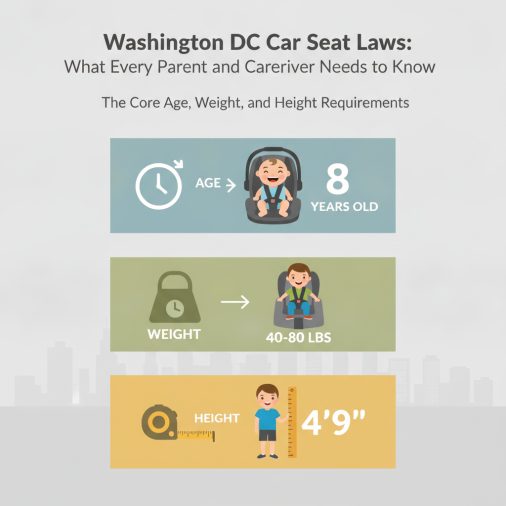
Washington DC law requires all children to ride in an appropriate child restraint system based on their age, weight, and height. Children under age 8 must use a federally approved car seat or booster seat unless they are at least 4 feet 9 inches tall. All children under age 16 must be buckled, and children under age 3 must ride in a rear-facing car seat when size permits.
The Core Age, Weight, and Height Requirements
DC’s child passenger safety law follows a stage-based approach that aligns closely with guidance from the American Academy of Pediatrics and National Highway Traffic Safety Administration recommendations.
Rear-facing seats are required for children under age 3 when their height and weight allow it. Most convertible car seats support rear-facing up to 40–50 pounds, so many children can remain rear-facing well past their second birthday. Keeping a child rear-facing as long as the seat allows is widely considered the safest position because it distributes crash forces across the back, neck, and head.
Forward-facing seats with a harness become appropriate once a child exceeds the rear-facing weight or height limit of their seat. DC law recommends keeping children in a harnessed forward-facing seat for as long as the seat’s limits allow — typically up to 40–65 pounds depending on the specific model.
Booster seats are required after a child outgrows their harnessed forward-facing seat and until the vehicle’s seat belt fits correctly. That usually means the lap belt lies flat across the upper thighs (not the stomach) and the shoulder belt crosses the chest and shoulder (not the neck). DC law sets the exit point from booster requirements at either age 8 or 4 feet 9 inches in height — whichever comes first.
Seat belts alone are appropriate once a child passes those thresholds, but all passengers under age 16 must be buckled regardless.
Specific DC Legal Requirements at a Glance
Child Age / Size
Required Restraint
Under age 3 (if size allows)
Rear-facing car seat
Age 3 and up (outgrown rear-facing)
Forward-facing seat with harness
Outgrown harness, under age 8 or under 4'9"
Belt-positioning booster seat
Age 8+ OR 4'9"+
Seat belt (still required under age 16)
Ages 8–15
Seat belt mandatory
All car seats used in DC must meet federal safety standards set by NHTSA. Seats manufactured after January 1, 1981, are generally required to carry a federal certification label. Using an expired, recalled, or previously crash-involved car seat does not meet this standard even if the seat appears undamaged.
Where Children Must Sit
DC law strongly encourages children to ride in the rear seat, and for children under age 13, the back seat is the consistently safer option in virtually all vehicle types. Front airbags deploy with significant force and can seriously injure a rear-facing child placed in the front passenger seat.
A rear-facing car seat should never be placed in a front seat with an active front passenger airbag. This applies regardless of seat size, child age, or vehicle type.
Forward-facing children can ride in the rear seat with appropriate installation, and that remains the recommended position even after a child transitions to a booster. Many parents make the common mistake of moving children to the front seat too early simply because the back seat feels less convenient.
DC Penalties for Non-Compliance
Violations of DC’s child passenger safety law can result in fines. Officers can issue citations during routine traffic stops if a child is observed without a proper restraint or in an incorrect restraint for their size.
Beyond the legal consequence, the practical risk is far more significant. Improperly installed or incorrectly sized restraints dramatically reduce their protective effectiveness in a crash. An unrestrained or improperly restrained child is at serious risk of serious injury even in moderate-speed collisions.
Installation, LATCH, and Seat Belt Compatibility
A correctly chosen seat that is improperly installed offers much less protection than a properly installed one. DC — like all US jurisdictions — recognizes federally approved seats, which means the seat must be installed following both the vehicle owner’s manual and the car seat manufacturer’s instructions.
Most modern vehicles include the LATCH system (Lower Anchors and Tethers for Children), which allows car seats to attach directly to anchor points built into the vehicle rather than routing around the seat belt. LATCH is not universally better than seat belt installation — both methods are equally safe when done correctly. However, LATCH anchors have combined weight limits (typically 65 pounds including the seat itself), so larger children in forward-facing seats may need to switch to a seat belt installation.
Always use the top tether anchor for forward-facing seats when one is available. Many parents overlook this step, but the top tether significantly reduces how far a child’s head moves forward in a frontal crash.
If you’re installing a child seat in a vehicle with fabric or leather upholstery, car seat protectors for child seats can prevent the deep indentations and wear that harness anchors and rigid seat bases often cause to upholstery over time.
Choosing a Federally Approved Car Seat
Not all car seats sold in the United States meet the same standards. Look for seats that carry the federal safety certification label, which indicates compliance with Federal Motor Vehicle Safety Standard 213.
The seat must also be appropriate for the child’s current weight and height — not just their age. A child who weighs 22 pounds and is in the 95th percentile for height may outgrow a rear-facing infant seat well before a child of the same age who is lighter and shorter.
Regularly verify that your car seat has not been subject to a recall. NHTSA maintains a searchable recall database at nhtsa.gov where you can check using the seat’s model name or manufacturer.
When it comes to keeping newborns comfortable and properly positioned within their seat, products like the Boppy Preferred Head and Neck Support provide gentle positioning — though any aftermarket insert should only be used if explicitly approved by the car seat manufacturer, since unauthorized accessories can interfere with harness function. Parents looking for manufacturer-approved options can also explore newborn car seat inserts designed for proper infant support.
Free Car Seat Inspection Resources in DC
Washington DC offers free child passenger safety inspection events and permanent inspection stations where certified Child Passenger Safety Technicians (CPSTs) can check seat installation at no cost. These are available through Safe Kids DC and through certain fire stations and health centers in the District.
Many parents discover at these inspections that a seat they believed was correctly installed had critical errors — a loose harness, an incorrect recline angle, or an incorrectly routed belt path. The NHTSA website and Safe Kids Worldwide both maintain searchable directories of inspection stations and upcoming check-up events.
Frequently Asked Questions
At what age can a child sit in the front seat in Washington DC?
DC law does not set a specific minimum age for front seat placement, but it strongly recommends keeping children in the rear seat, particularly those under age 13. Front passenger airbags pose a serious injury risk to younger children. A rear-facing seat should never be placed in the front seat when an active airbag is present. Even once a child is large enough for a seat belt, the rear seat remains statistically safer in frontal crashes.
Is it legal to use an expired car seat in Washington DC?
No. DC law requires the use of federally approved child restraint systems, and an expired car seat no longer qualifies. Car seat manufacturers set expiration dates — typically 6 to 10 years from the manufacture date — because plastic and foam materials degrade over time and may not perform as intended in a crash. The expiration date is usually printed on a label on the base or shell of the seat.
Can a child ride in a booster seat without a back in DC?
High-back and backless booster seats are both legal in DC when used appropriately. A backless booster is generally considered safe for older children whose heads are adequately supported by the vehicle seat back. For younger children, a high-back booster provides better head and neck support, particularly in vehicles with low seat backs. The child’s size and the vehicle’s seat geometry both matter.
Does DC’s car seat law apply to rideshares and taxis?
DC exempts for-hire vehicles including taxis and rideshares from its car seat law when the vehicle does not have a child restraint available. However, this does not mean it is safe to transport a young child without a proper seat — it simply means the driver is not held legally responsible. Parents and caregivers are encouraged to bring their own portable car seat when using rideshares with young children. Travel-friendly options include the Cosco Scenera Next, which is lightweight and easy to use in rideshare situations.
What happens if a child outgrows their car seat before age 8?
If a child outgrows the harness limits of their forward-facing seat but is still under 4 feet 9 inches tall and under age 8, they must transition to an appropriate booster seat — not ride with just a seat belt. Booster seats are designed to raise the child so the vehicle’s existing seat belt fits correctly across the chest and thighs rather than the neck and abdomen.
Does DC’s law apply to children visiting from other states?
Yes. Any child being transported in a vehicle operating within DC must comply with DC child passenger safety law regardless of the state where the vehicle is registered or where the family resides.
Are there car seat requirements for children with disabilities or medical conditions?
DC follows federal guidance on this. Children with certain medical conditions or physical disabilities may require specialized restraint systems that differ from standard car seats. A physician or certified CPST familiar with special needs transportation can help identify appropriate options. The National Center for the Safe Transportation of Children with Special Health Care Needs is a reliable resource for families navigating these situations.
Final Thoughts
Washington DC’s car seat laws reflect the same stage-based approach recommended by child safety experts nationwide: rear-facing as long as possible, then a harnessed forward-facing seat, then a booster, then a seat belt alone. The legal thresholds represent minimums — not targets. A child who meets the age requirement to exit booster use but hasn’t yet reached 4 feet 9 inches still legally and practically needs that booster. When in doubt about correct installation or seat selection for your child’s current size, a free inspection from a certified CPST is the most reliable next step available to DC-area families.