Traveling to Mexico with young children raises an important question that many families overlook until the last minute. Child passenger safety laws vary significantly between countries, and what applies in the United States or Canada does not automatically apply south of the border.
Mexico does have child car seat laws, but enforcement, specific requirements, and penalties vary considerably by state. Federal law in Mexico generally requires children under 12 to use appropriate restraints, and several major states including Mexico City, Jalisco, and Nuevo León have enacted stricter regulations. However, inconsistent enforcement means many families mistakenly assume car seats are optional — a dangerous assumption that puts children at real risk.
What Mexican Law Actually Says About Child Restraints
Mexico’s federal highway traffic law (Ley de Caminos, Puentes y Autotransporte Federal) establishes baseline requirements for child passenger safety. Children riding in passenger vehicles are generally required to use age-appropriate restraints, with children under 12 typically prohibited from riding in the front seat.
Beyond federal minimums, individual Mexican states have their own traffic codes. Some states have passed specific car seat legislation with defined age, weight, and height thresholds. Others rely on broader language about “appropriate restraints” without specifying seat type or installation method.
The practical takeaway is that Mexico’s child restraint laws exist, but they are not as uniformly codified at the state level as laws in the United States or Canada. Families should research the specific states they plan to visit or drive through.
State-by-State Differences: Where Laws Are Stricter
Certain Mexican states have taken child passenger safety more seriously at the legislative level.
Mexico City (CDMX) has enacted specific regulations requiring car seats for infants and young children, with fines for violations. Jalisco and Nuevo León, which include the major cities of Guadalajara and Monterrey, have also passed child restraint legislation with defined requirements.
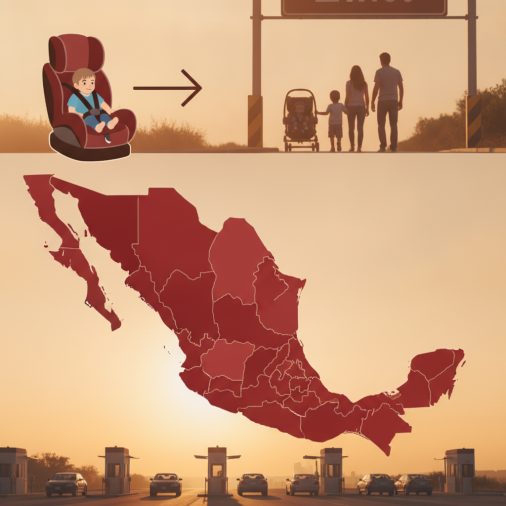
Baja California, a popular destination for American and Canadian families driving across the border, generally follows federal guidelines. Border states tend to see more traffic enforcement activity partly because of the volume of international travelers.
Even in states with written laws, enforcement at traffic stops can be inconsistent. That inconsistency does not mean the risk disappears — it simply means the consequences are sometimes unevenly applied. Local police do have authority to issue fines, and in some areas enforcement campaigns are periodic and unpredictable.
The Real Safety Argument: Why You Should Use a Car Seat Regardless of Local Enforcement
Road conditions in Mexico vary dramatically. Major toll highways (cuotas) are generally well-maintained and comparable to US interstate standards. Secondary roads, however, can involve unexpected hazards including potholes, speed bumps (topes), livestock, and inconsistent signage.
Traffic fatality rates in Mexico are statistically higher than in the United States or Canada. The physical protection a properly installed car seat provides does not change based on which side of a border you are traveling on. Crash forces are the same regardless of local law.
Families crossing into Mexico by car should treat their existing home-country car seat practices as the baseline, not the ceiling. If your child uses a rear-facing infant seat, a convertible seat, or a toddler booster seat that positions the seat belt correctly, continue using it exactly as you would at home.
Renting a Car in Mexico: What to Expect from Rental Agencies
If you are flying into Mexico and renting a vehicle, child seat availability from rental agencies is inconsistent. Major international rental chains operating in Mexico — Hertz, Avis, Budget, and National — typically offer car seat rentals, but availability cannot be guaranteed without advance reservation.
Car seat quality and condition from rental agencies in Mexico can vary significantly. Many experienced traveling families bring their own seat to ensure proper fit, familiar installation, and known crash history. If the seat has been in a previous collision, it should not be used regardless of where you are traveling.
When bringing your own seat, confirm that the vehicle you are renting or borrowing in Mexico has a functioning LATCH system or compatible seat belt routing for your specific seat model. Most vehicles sold in Mexico in recent years include LATCH anchors, but older vehicles or certain body styles may require a seat-belt-only installation.
For families frequently traveling with children in compact vehicles or rentals with tighter rear seats, lightweight travel car seats designed for portability can make cross-border trips significantly more manageable.
Age, Weight, and Height Guidelines to Use in Mexico
Because Mexico’s laws use varying language across states, applying the more protective US guidelines is a practical default. These are not Mexican legal requirements, but they represent widely accepted child passenger safety standards:
Child Stage
Recommended Restraint
Approximate Age/Size
Infant
Rear-facing infant or convertible seat
Birth to 2+ years or max rear-facing weight
Toddler
Rear-facing convertible (preferred) or forward-facing with harness
Typically 2–4 years, up to seat's forward-facing limit
Young child
Forward-facing seat with harness
Until reaching the seat's harness height/weight maximum
Older child
High-back or backless booster with seat belt
Until adult seat belt fits correctly, often around 4'9"
Near-adult
Adult seat belt
When shoulder belt crosses the chest and shoulder correctly
Children under 12 should ride in the rear seat whenever possible. This recommendation is consistent with both Mexican federal guidelines and international road safety standards.
Crossing the Border by Car: Practical Considerations
If you are driving your own vehicle from the United States or Canada into Mexico, your existing car seat remains in place and fully legal. US-certified seats (those meeting FMVSS 213) are not invalidated at the Mexican border, and Mexican authorities do not require seats certified to a specific Mexican standard.
Bring your car seat’s original manual. In the unlikely event of an inspection or question, documentation of the seat’s installation requirements and weight limits can be helpful.
Keep in mind that some border crossing points, particularly in Baja California, see high volumes of family travelers. Customs inspections occasionally involve checking vehicle interiors, and having a properly installed car seat demonstrates responsible travel.
What Happens If You Are Stopped Without a Car Seat
Mexican traffic fines for child restraint violations vary by state and municipality. In states with specific car seat laws, fines can be issued on the spot. In practice, enforcement is less consistent than in the United States, but that uncertainty does not eliminate legal or financial risk.
More importantly, if an accident occurs without proper child restraints, the consequences extend well beyond a traffic fine. Mexican emergency medical response times and trauma care infrastructure vary considerably by region. A preventable injury is the worst possible outcome of choosing convenience over safety.
Choosing the Right Seat If You Are Purchasing One for Mexico Travel
Some families purchase a dedicated travel seat rather than risk damage or loss of their primary seat during air travel. For this purpose, a seat that installs reliably with a seat belt alone — without requiring LATCH — is often the most flexible choice for unfamiliar rental vehicles.
The Cosco Scenera NEXT is a commonly referenced option for travel because of its light weight, simple seat-belt-only installation, and low price. It meets US safety standards and installs predictably in most rear-seat configurations. For families needing a seat that covers the toddler-to-booster range, budget-friendly convertible car seats that maintain solid safety credentials are worth considering when a dedicated travel seat makes sense.
Frequently Asked Questions
Is it illegal to drive without a car seat in Mexico?
Mexico’s federal law and several state laws require child restraints for young passengers, so technically yes — driving without appropriate restraints can be illegal depending on the state. However, enforcement is inconsistent. The more important point is that unrestrained children face serious injury risk regardless of whether local police are actively checking. Treat Mexico the same way you would treat driving at home.
Do I need a Mexican-certified car seat, or can I use my US or Canadian seat?
You can use your US or Canadian car seat in Mexico without any recertification requirement. Mexican authorities do not require seats certified to a specific Mexican standard. A seat meeting US FMVSS 213 or Canadian CMVSS 213 standards is acceptable for travel in Mexico. Bring the original manual in case questions arise during a border or traffic stop.
Can I rent a car seat from a Mexican rental agency?
Major international rental chains operating in Mexico generally offer car seat rentals, but availability varies by location and must be reserved in advance. Seat condition and age cannot always be confirmed before pickup. Many families traveling with young children bring their own seat to ensure proper fit, known crash history, and reliable installation in an unfamiliar vehicle.
What age can a child sit in the front seat in Mexico?
Mexican federal guidelines generally prohibit children under 12 from riding in the front seat. State laws may vary slightly, but the rear seat is significantly safer for children of any age due to airbag deployment forces. Keeping children in the rear seat regardless of local law is the recommended practice.
Are the car seat rules different for taxis and ride-shares in Mexico?
Car seat requirements typically apply to private passenger vehicles. Enforcement in taxis and ride-share vehicles is extremely inconsistent in Mexico, and most services do not provide child seats. Families using taxis or apps like Uber in Mexican cities are generally responsible for providing their own seat or making their own safety decisions. For short urban trips, some families use a portable travel seat that folds or stores easily. For longer journeys, bringing a proper seat is the safer choice.
Do buses or vans in Mexico require car seats for children?
Mexican intercity buses and passenger vans generally do not provide or require child car seats. This is consistent with common practice in many countries and reflects the practical challenges of installing personal seats in commercial vehicles. For road trips within Mexico, a private vehicle with a properly installed car seat remains the safest option for families with young children.
What if my child has outgrown an infant seat but still needs a booster? What should I bring?
A forward-facing harness seat or a high-back booster appropriate for your child’s size and weight is the right choice for Mexico travel, just as it would be at home. If vehicle space is tight — as it often is in smaller rental cars — narrow convertible seats designed for tight back seats or compact booster models can help with fitment. Always confirm the seat installs securely with the available belt path before driving.
Final Thoughts
Mexico does require child restraints, and several states enforce those requirements actively. But the real reason to use a car seat in Mexico has nothing to do with local enforcement — road conditions, traffic patterns, and emergency infrastructure make proper child restraint at least as important as it is at home, arguably more so. Bring your own seat if possible, confirm it installs correctly in any rented or borrowed vehicle, and keep children under 12 in the rear seat. Those three habits cover the most important ground regardless of which Mexican state you are driving through.