Traveling by air with a young child raises a lot of practical questions, and one of the most common is whether a car seat is actually required on the plane. The answer matters both for safety and for how you pack and plan.
Car seats are not legally required on airplanes in the United States. The FAA does not mandate them for children under two, who may legally fly as lap infants at no extra charge. However, the FAA and pediatric safety organizations strongly recommend using an approved child restraint system (CRS) for any child who weighs under 40 pounds, because a seat belt alone does not adequately restrain a small child during severe turbulence or an emergency.
What the FAA Actually Says About Child Restraints
The Federal Aviation Administration permits children under 24 months to fly as lap children, meaning they sit on a parent’s lap without an assigned seat. This is legal but not without risk.
The FAA’s official position is that the safest place for a young child on an aircraft is in an approved child restraint device secured in their own seat. The agency has repeatedly encouraged parents to purchase a separate ticket and use an approved CRS, even though it stops short of requiring it.
For children weighing 40 pounds or more, aircraft seat belts are generally considered adequate. For smaller children, the dynamics of turbulence, abrupt deceleration, and emergency stops create forces that a lap cannot safely absorb.
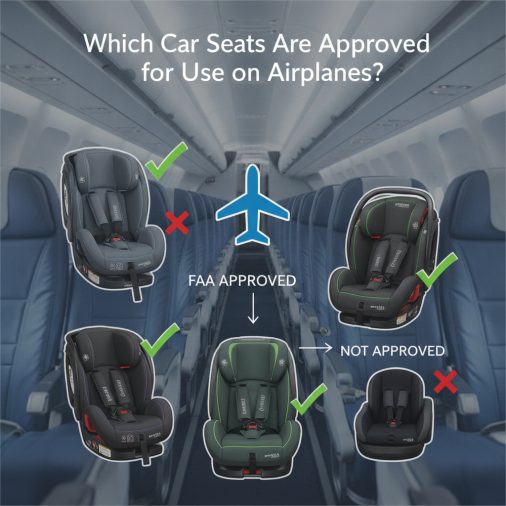
Which Car Seats Are Approved for Use on Airplanes?
Not every car seat qualifies for aircraft use. The FAA requires that any child restraint used on an airplane display one of two labels:
– “This restraint is certified for use in motor vehicles and aircraft” — this is the standard FAA-approved label found on most hard-shell convertible and infant car seats
– FAA approval label for aircraft-specific restraints, such as the CARES harness for children over 22 pounds
Booster seats — both backless and high-back models — are not approved for aircraft use. They require a lap-and-shoulder belt to function correctly, and airplane seats only provide a lap belt. Inflatable seat belts and vest-style harnesses not bearing the FAA label are also prohibited.
If you’re already researching travel car seats specifically approved for airplane use, look for the FAA certification label printed directly on the seat’s shell before purchasing.
The CARES Harness: A Lightweight Alternative
For parents who prefer not to haul a bulky car seat through an airport, the Kids Fly Safe CARES Aviation Safety Harness offers an FAA-approved alternative. It weighs under one pound, fits children between 22 and 44 pounds, and wraps around the aircraft seat back to provide a four-point harness.
It is worth noting that the CARES harness is only appropriate for children in that specific weight range. Infants and very small toddlers still require a rear-facing infant or convertible seat.
Airline Policies vs. FAA Rules
The FAA sets the minimum federal safety standard, but individual airlines can impose additional rules. In practice, most major U.S. carriers follow FAA guidelines closely. A few things to keep in mind:
– The car seat must fit within the aircraft seat without the armrests being forced upward, which typically means a seat no wider than 16 inches
– Many airlines require the car seat to be placed in a window seat to avoid blocking other passengers during an evacuation
– Some carriers have specific documentation requirements or boarding procedures for passengers traveling with child restraints
– International airlines and routes may follow different regulations set by their own civil aviation authority
Always confirm the airline’s current child restraint policy when booking, especially on international flights.
Rear-Facing vs. Forward-Facing on an Aircraft
Rear-facing installation is preferred for infants and young toddlers, just as it is in a vehicle. On an aircraft, a rear-facing seat should face the window or toward the seat back, not toward the aisle.
Some parents find that rear-facing installations on narrow aircraft seats require careful positioning to ensure the seat does not press against the seat back in front of it. Forward-facing seats with a five-point harness are generally easier to install on aircraft seats, but rear-facing remains the recommended orientation for children who have not yet outgrown the weight and height limits of their rear-facing seat.
Parents traveling with infants under 12 months should pay particular attention to travel-friendly car seats designed for one-year-olds, as these seats need to accommodate rear-facing use while still fitting in a standard aircraft seat.
Why Lap-Infant Travel Carries Real Risk
Turbulence is the most common cause of in-flight injuries to passengers. During severe turbulence, unsecured objects and unrestrained passengers can be thrown with significant force. A parent physically cannot maintain a grip on a child when subjected to sudden vertical acceleration.
The NTSB has documented cases where lap infants were injured during turbulence events that caused no injuries to seat-belt-wearing passengers. This is the core reason safety organizations consistently advise against lap-infant travel even though it is legally permitted.
Checking Whether Your Car Seat Fits in an Aircraft Seat
A common frustration for traveling parents is discovering that a car seat they already own does not physically fit in the aircraft seat, even if it carries FAA approval.
Practical checks before your trip:
1. Measure the car seat’s base width — most economy aircraft seats are approximately 17–18 inches wide
2. Confirm the seat is no wider than the aircraft seat cushion so armrests can lower normally
3. Check that the harness buckle does not interfere with the aircraft seat belt buckle
4. Verify the FAA approval label is still legible — a worn or missing label may cause problems at boarding
Seats with a narrower profile tend to fit more easily. Narrow convertible car seats designed for tight vehicle back seats often translate well to aircraft use because of their slimmer footprint.
What Happens at Security and Gate Check
The TSA does not require car seats to be screened in the X-ray machine, though they can be. Most parents find it faster to simply carry the seat through security rather than placing it on the belt.
If you choose not to use the car seat on the plane, most airlines allow it to be gate-checked at no charge. Gate checking allows you to use the seat in the terminal and retrieve it at the jet bridge upon arrival, reducing the chance of damage that sometimes occurs with checked baggage.
A padded car seat travel bag can help protect the seat during gate checking. For parents who frequently fly with young children, investing in a seat-specific travel bag is a practical consideration.
FAQ
Is it safer to use a car seat on an airplane than to hold a child on your lap?
Yes, according to the FAA and the American Academy of Pediatrics. An approved child restraint system significantly reduces injury risk during severe turbulence and emergency stops. Lap-infant travel is legal and common, but it leaves a small child with no protection against sudden g-forces. Purchasing a separate seat and using an approved CRS is the safest option for children under 40 pounds.
Can I use any car seat on an airplane, or does it have to be a special one?
It must carry the FAA certification label, which states the seat is certified for use in both motor vehicles and aircraft. Most hard-shell infant seats and convertible car seats carry this label. Booster seats — backless or high-back — are not approved for aircraft use because they require a shoulder belt to function safely, which aircraft lap belts do not provide.
What is the age limit for a lap infant on an airplane?
In the U.S., children under 24 months may fly as lap infants without a purchased seat. Once a child turns two, airlines require a purchased ticket and a seat. At that point, parents must either bring an approved car seat or rely on the aircraft seat belt, which is only appropriate for children over approximately 40 pounds.
Does a car seat count as a carry-on bag on airlines?
Most U.S. airlines do not count an approved child restraint as a carry-on bag when the child has a purchased ticket and the seat is being used in an assigned seat. Policies vary by carrier, so it is worth confirming before travel. A car seat carried on without a ticket for the child may be counted against your carry-on allowance.
Can I use a car seat on an international flight?
Many international carriers permit FAA-approved child restraints, but aviation regulations vary by country and airline. Some foreign carriers have their own approved restraint standards, and an FAA label alone may not satisfy their requirements. Always check the specific airline’s policy when booking international travel. The CARES harness is approved for use on many international carriers but should be verified before the trip.
Do car seats with a no-rethread harness work well for air travel?
A no-rethread harness simplifies harness height adjustments, which can be helpful during travel when clothing layers change between the car and the airport. However, the harness type alone does not determine aircraft suitability. The FAA certification label and the seat’s physical dimensions relative to the aircraft seat are what matter most for in-flight use.
What is the lightest FAA-approved car seat for air travel?
Several convertible and infant seats are designed with travel portability in mind, balancing lighter weight with FAA certification. The CARES harness is the lightest option at under one pound but only works for children between 22 and 44 pounds. For infants, a lightweight FAA-approved infant seat is the appropriate choice, and many parents specifically seek out safety-rated infant car seats that balance protection with portability.
Final Thoughts
Car seats are not required on airplanes by law, but the safety case for using one is clear. The FAA certification label is the key detail that determines whether a seat you already own can legally be used in-flight. Booster seats and non-certified harnesses are not permitted. If you frequently travel by air with a young child, choosing a seat that is both FAA-approved and sized for aircraft use from the start will make every trip significantly less complicated.