If you’re a parent trying to stretch your healthcare dollars, it’s natural to wonder whether a child car seat qualifies as an HSA-eligible expense. Car seats are expensive, safety-critical, and something every parent with young children needs — so it makes sense to explore every possible way to offset the cost.
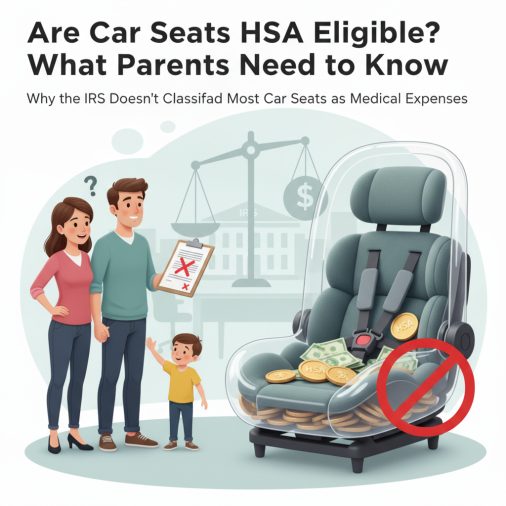
Child car seats are generally not eligible for reimbursement through a Health Savings Account (HSA) or Flexible Spending Account (FSA). The IRS considers car seats a general safety and transportation item rather than a medical necessity, which means they typically do not meet the qualifying criteria for medical expense deductions under IRS Publication 502. However, there are narrow exceptions where a car seat or specialized positioning device may qualify — primarily when prescribed by a licensed physician to manage a diagnosed medical condition.
Why the IRS Doesn’t Classify Most Car Seats as Medical Expenses
The IRS defines eligible HSA expenses as costs paid primarily for the diagnosis, cure, mitigation, treatment, or prevention of a disease or medical condition. A standard child car seat — even a high-quality, crash tested car seat designed to the highest safety standards — serves a general child safety purpose rather than a specific medical one.
Because virtually all children require a car seat for vehicle travel, the IRS views the expense as a personal or family cost rather than a medical one. The same logic applies to items like strollers, baby monitors, or bicycle helmets. Widely used safety products don’t automatically become medical expenses simply because they protect health.
Your HSA administrator follows IRS guidelines closely. If you attempt to use HSA funds for a standard car seat, the expense can be flagged as an ineligible withdrawal, which may result in taxes owed on the amount plus a 20% penalty if you’re under age 65.
The Exception: Medically Necessary Specialized Seating
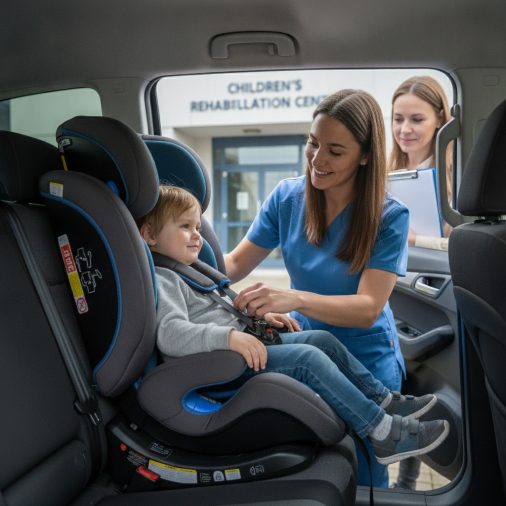
The situation changes when a child has a diagnosed medical condition that requires specialized positioning, orthopedic support, or adaptive restraint equipment that goes beyond what a standard retail car seat provides.
Examples of conditions that might justify a medical exception include:
– Spinal muscular atrophy or other neuromuscular conditions
– Severe hypotonia (low muscle tone)
– Spina bifida or similar spinal conditions
– Post-surgical positioning requirements
– Conditions requiring harness modifications or custom orthopedic support
In these cases, a physician-prescribed adaptive car seat or specialized medical restraint device — distinct from a standard consumer car seat — may qualify as an HSA-eligible expense. The prescription documentation is critical. Without written physician documentation linking the device to a specific medical condition and treatment plan, HSA reimbursement is unlikely to hold up under scrutiny.
Always contact your HSA or FSA plan administrator before purchasing to confirm eligibility. Plan administrators can vary in how they interpret borderline cases, and getting written confirmation protects you.
What About Convertible or Booster Seats?
The same general rule applies across all standard car seat categories. Whether you’re purchasing an infant seat, a convertible seat, or a toddler booster seat, the HSA eligibility question comes back to the same IRS standard: is this item primarily for medical care, or is it a general safety product?
Standard convertible seats and booster seats — even well-known safety-rated models — don’t meet that threshold for most families. They’re purchased because children need them for safe vehicle travel, which is a universal need rather than a condition-specific one.
If your child is transitioning through seat stages, consider other strategies to manage costs, such as manufacturer rebates, retailer trade-in programs, or state child passenger safety programs that sometimes offer subsidized seats to qualifying families.
HSA-Eligible Items That Are Relevant to Child Travel Safety
While the car seat itself typically doesn’t qualify, some related items connected to child health may be HSA-eligible depending on your plan and circumstances.
Item
Generally HSA Eligible?
Notes
Standard child car seat
No
General safety item, not medical
Medically prescribed adaptive restraint
Possibly yes
Requires physician prescription and medical necessity documentation
Orthopedic seat insert (prescribed)
Possibly yes
Must be physician-prescribed for a specific condition
Over-the-counter medications
Yes (post-2020 CARES Act)
For routine illnesses during travel
Sunscreen SPF 15+
Yes
Qualifies as a preventive product
Baby formula (standard)
No
General nutrition, not medical
Prescription eyeglasses for a child
Yes
Qualifies as vision care
The CARES Act of 2020 expanded HSA eligibility for many over-the-counter health products, but car seats were not part of that expansion.
How to Check Before You Buy
Before assuming any product qualifies, follow these steps to avoid a costly mistake:
1. Review IRS Publication 502 — This document lists qualifying medical and dental expenses. Car seats are not listed as eligible items.
2. Contact your HSA or FSA administrator directly — Ask them to confirm in writing whether a specific product qualifies, especially for adaptive or specialized equipment.
3. Get a letter of medical necessity — If a physician recommends a specialized restraint for your child’s condition, request written documentation on official letterhead specifying the diagnosis and the medical need for the device.
4. Keep all receipts and documentation — If you submit a borderline claim, thorough documentation is your best protection during an audit or review.
5. Ask the manufacturer — Some adaptive seating manufacturers are familiar with HSA and Medicaid documentation requirements and can help you navigate the process.
Car Seat Costs Without HSA: Practical Ways to Save
Since standard car seats don’t qualify for HSA reimbursement, it’s worth knowing that cost-effective options exist without sacrificing safety.
Many families are surprised to find that budget-friendly convertible car seats perform comparably to premium models in federally required crash tests. The most expensive seat is not necessarily the safest for your specific vehicle and child.
Some retailers offer seasonal trade-in events where used car seats can be exchanged for discount coupons on new ones. Manufacturer rebates are another underused option, particularly for premium brands. State and local traffic safety offices sometimes operate car seat loan or subsidy programs for families who qualify based on income.
If you’re purchasing for a vehicle with a tight rear seat — such as a truck or compact car — confirming proper fit before buying saves money on returns. Families dealing with cramped back seats often benefit from researching space-saving car seats designed for extended cab trucks or similarly constrained vehicles before committing to a purchase.
FSA vs. HSA: Does the Account Type Change Anything?
Both Flexible Spending Accounts and Health Savings Accounts follow the same IRS eligibility rules for medical expenses. A standard car seat is ineligible under both account types for the same reasons.
The key practical difference between FSA and HSA for this purpose is that FSA funds typically have a use-it-or-lose-it deadline, while HSA funds roll over year to year. Neither account type changes whether a standard car seat qualifies — only the underlying medical necessity determination does that.
If your employer offers a Dependent Care FSA, it’s worth clarifying that this account covers qualifying childcare and dependent care expenses, not child health safety equipment. A standard car seat would not qualify under a Dependent Care FSA either.
Frequently Asked Questions
Can I use my FSA card to pay for a car seat at checkout?
Most FSA cards will decline at the point of sale for car seats because major retailers code car seats under general merchandise rather than medical products. Even if a transaction processes, it may be flagged during plan review. It’s safest to confirm eligibility with your FSA administrator before attempting to use FSA funds for a car seat purchase.
Does a doctor’s recommendation make a standard car seat HSA eligible?
A general recommendation to use a car seat does not create HSA eligibility. For a car seat or positioning device to potentially qualify, a physician must document a specific diagnosed medical condition and prescribe the device as a medically necessary treatment — not simply advise safe driving habits. The device itself also typically needs to be a specialized adaptive product rather than a standard retail seat.
Are car seat accessories like seat protectors covered by HSA?
No. Car seat accessories such as seat protectors designed to shield vehicle upholstery from child seats are clearly general maintenance products with no medical purpose. They would not qualify as HSA or FSA eligible expenses under any standard interpretation.
What happens if I accidentally use HSA funds for an ineligible car seat purchase?
If you use HSA funds for an ineligible expense, the distribution is treated as taxable income. Additionally, if you are under age 65, a 20% penalty tax applies to the ineligible amount. You may be able to correct the mistake by redepositing the funds before your tax filing deadline, but this depends on your HSA custodian’s policies.
Are car seats for children with disabilities ever covered by insurance instead of HSA?
Possibly. Some private health insurance plans, Medicaid, and early intervention programs may cover adaptive car seats or specialized positioning devices for children with qualifying disabilities or medical conditions. Coverage varies significantly by state, insurance carrier, and diagnosis. Contacting your insurance provider and your child’s medical team together is the most effective approach for pursuing coverage through this route.
Can I deduct a car seat as a medical expense on my tax return?
Standard car seats generally don’t qualify as itemized medical deductions for the same reasons they don’t qualify for HSA reimbursement. A prescribed adaptive device for a specific medical condition might qualify under Schedule A medical expense deductions, but only to the extent that total medical expenses exceed 7.5% of your adjusted gross income. Consult a qualified tax professional for guidance specific to your situation.
Do any states have programs that help cover car seat costs?
Yes. Many states operate child passenger safety programs through their highway safety offices or public health departments. Some programs provide free or subsidized car seats to low-income families, foster families, or families of children with special needs. The National Highway Traffic Safety Administration (NHTSA) website maintains state-level resources that can help connect families to local programs.
Final Thoughts
Standard child car seats don’t meet the IRS definition of a medical expense, so HSA and FSA reimbursement is off the table for most families. The exception is narrow: adaptive or physician-prescribed specialized restraint devices tied to a diagnosed medical condition may qualify, but that requires proper documentation and administrator confirmation before purchase. If you believe your child’s situation might fall into that category, start with your child’s physician and your HSA plan administrator — not the checkout line.