Traveling with young children raises an immediate practical question the moment you step into a taxi or rideshare vehicle: does your child need to be in a car seat, and whose responsibility is it to provide one?
In most U.S. states, taxis and rideshare vehicles are legally exempt from standard child passenger restraint laws, meaning the driver is not required to provide a car seat. However, this exemption does not mean riding without one is safe. The exemption simply shifts legal responsibility — it does not eliminate crash risk. Most child safety experts and pediatric organizations strongly recommend bringing your own car seat whenever possible, regardless of what local law requires.
Why Taxi Exemptions Exist and What They Actually Mean
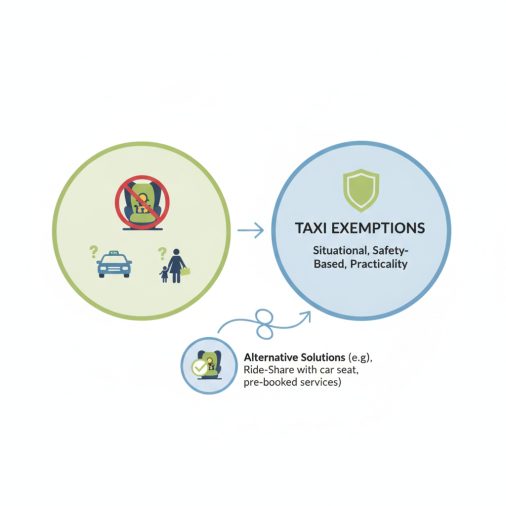
Child restraint laws in the United States are primarily written around private passenger vehicles. When those laws were drafted, taxis were considered common carriers — similar to buses — and exempted from car seat requirements because installing and removing child seats between every fare was considered impractical.
That legal logic has carried forward into the rideshare era, though some states and cities have revisited the question. The exemption is not a safety endorsement. It is a practical carve-out that reflects the operational difficulty of requiring a rotating fleet of drivers to carry appropriately sized seats for every possible child passenger.
What this means for parents is straightforward: the law in most jurisdictions will not require the driver to provide a seat, but no law prevents you from bringing and installing your own.
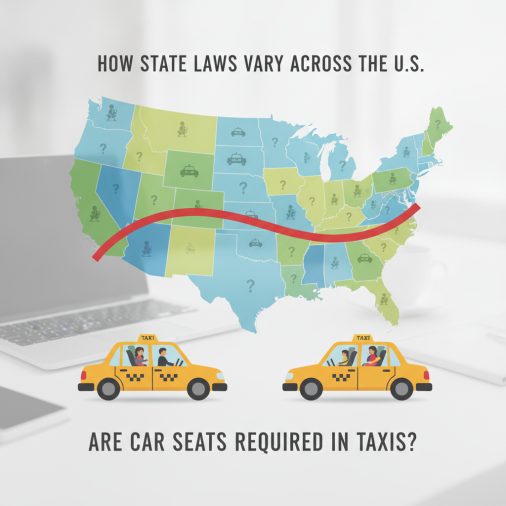
How State Laws Vary Across the U.S.
There is no single national standard governing car seats in taxis. Rules vary significantly by state, and in some cases, by city or municipality.
State Example
Taxi/Rideshare Car Seat Law
New York
Taxis generally exempt; rideshares like Uber and Lyft exempt in NYC
California
Taxis exempt from child restraint law; drivers not required to carry seats
Florida
Taxis exempt from the child restraint requirement
Illinois
Taxis exempt, though Chicago has specific considerations
Texas
Taxis and TNCs generally exempt under state law
A handful of states have no explicit taxi exemption, which can create ambiguity. New York City is worth noting specifically: Uber offers a designated “Uber Car Seat” option in NYC that pairs riders with a driver carrying a forward-facing seat for children roughly 1 to 4 years old. This is a voluntary service, not a legal mandate.
Because state and local laws change, confirming the current rule in your specific location through your state’s DMV or transportation authority is always the safest approach.
Rideshare Apps and Child Seat Policies
Uber and Lyft have both addressed the car seat question in their policies, though neither app universally requires drivers to carry child seats.
Uber Car Seat is a dedicated service option available in select cities — currently concentrated in New York City — that matches families with drivers who carry an installed, forward-facing Graco car seat. Outside of those specific markets, standard Uber and Lyft rides do not guarantee any child restraint equipment.
Lyft has no equivalent child seat service in most markets. Both platforms state that children must comply with local laws, but since most local laws exempt rideshares from providing seats, the practical burden falls on the parent.
If you plan to use a rideshare regularly with a young child, portable booster car seats designed for travel are worth exploring — many are lightweight, FAA-compliant, and compact enough to carry in a backpack or stroller bag.
What Actually Happens in a Crash Without a Car Seat
The legal exemption does not change the physics of a collision. An unrestrained child in a taxi or rideshare vehicle faces the same crash forces as an unrestrained child in any other car.
In a 30 mph frontal crash, an unrestrained child effectively becomes a projectile inside the vehicle cabin. The adult seat belt is not designed for small children and can cause serious internal injuries if worn incorrectly — especially for children under 4 feet 9 inches tall who have not yet reached booster-seat graduation requirements.
The American Academy of Pediatrics (AAP) is direct on this point: no car ride is safe enough to skip restraint, regardless of distance or trip duration. A short taxi ride across town carries meaningful crash exposure, particularly in urban traffic.
When Bringing Your Own Seat Is the Practical Answer
For frequent travelers with young children, carrying a dedicated travel seat is the most reliable solution. Several convertible and booster seats are specifically engineered to be lighter, narrower, and easier to install than full-size home seats.
When selecting a seat for taxi and rideshare use, consider these practical factors:
– Weight — A seat you can carry through an airport or city street should ideally weigh under 10–12 pounds
– LATCH compatibility — Some taxis lack accessible lower LATCH anchors; look for seats that install securely with the vehicle belt alone
– Install speed — Seats with single-click or simplified belt-path installation reduce friction on busy street corners
– FAA approval — If the seat will also travel on aircraft, FAA approval expands its usefulness significantly
The CARES Child Aviation Restraint System is one example of a FAA-approved harness often used on flights, though it is not designed for car use. For combined air-and-road travel, travel car seats designed specifically for toddlers offer a more complete solution.
For older children who have outgrown harnessed seats but still require belt positioning, a compact high-back or backless booster can fold flat and fit inside a large tote bag. Many parents also use a BubbleBum Inflatable Booster Seat for taxi and rideshare trips — it inflates quickly, weighs about one pound, and positions the adult lap-and-shoulder belt correctly for children who meet its weight and height requirements.
Age and Weight Thresholds That Define the Need
Understanding when a child actually requires a dedicated restraint helps clarify the stakes for different trip scenarios.
– Infants and toddlers under 2 years: Should remain rear-facing in an infant or convertible car seat. No adult belt configuration safely restrains a child this young.
– Children 2–4 years (approximately): Should be in a forward-facing harness seat once they exceed rear-facing weight or height limits.
– Children 4–8 years (approximately): Typically transition to a high-back or backless booster once they outgrow harness weight limits, usually around 40–65 pounds depending on the seat.
– Children under 4 feet 9 inches tall: Should not use an adult belt alone, regardless of age. The shoulder belt typically crosses the neck rather than the chest, and the lap belt sits on the abdomen rather than the hip bones.
For children in the booster stage, booster seats appropriate for 8-year-olds can offer guidance on whether a child is truly ready to graduate to an adult belt.
Practical Steps Before Your Next Taxi or Rideshare Trip
Taking a few minutes to plan ahead reduces stress significantly on the day of travel.
1. Check local law — Search your state’s child restraint statute and confirm whether taxis or TNCs are explicitly exempt.
2. Check the app — If using Uber, search for the “Uber Car Seat” option in your city before assuming it is unavailable.
3. Bring your own seat when possible — This is the most reliable way to ensure your child is properly restrained.
4. Practice the install at home — Run through the belt installation at home before you need to do it quickly on a city sidewalk.
5. Verify the seat fits the taxi’s back seat — Some taxi vehicles have narrower rear seats or limited anchor access; extended-cab vehicles with limited rear-seat depth present similar fitment challenges.
FAQ
Are rideshare drivers required to provide car seats?
In most U.S. cities and states, no. Uber and Lyft drivers are not legally required to carry child car seats. The responsibility for providing appropriate child restraints typically falls on the parent or guardian. Only the Uber Car Seat option in select cities like New York City pairs riders with a driver who carries an installed seat, and this is a voluntary service offered for an additional fee.
Is it safe for a child to ride in a taxi without a car seat?
From a safety standpoint, no. An unrestrained child in a taxi faces the same crash forces as in any other vehicle. The legal exemption does not reduce physical risk. Pediatric safety organizations including the American Academy of Pediatrics consistently recommend using a properly installed car seat for every car trip, regardless of trip length or vehicle type.
What is the youngest age a child can legally ride in a taxi without a car seat?
This varies by state and by whether the taxi exemption applies. In states with a taxi exemption, technically no minimum age is legally imposed on taxi passengers. However, no age makes it physically safe for a young child to ride unrestrained. Many safety advocates recommend treating any child under 8 years old or under 4 feet 9 inches as needing a restraint in every vehicle.
What is a good portable car seat option for frequent taxi and rideshare users?
Lightweight convertible seats, compact booster seats, and inflatable belt-positioning boosters are popular choices. The BubbleBum Inflatable Booster Seat is a commonly used option for children who meet its weight and height requirements. For harnessed children, look for seats under 10–12 pounds that install securely using the vehicle seat belt without requiring LATCH anchors.
Do New York City taxis have to provide car seats?
No. Standard NYC taxis are exempt from child restraint requirements under New York State law. Uber’s voluntary Car Seat option is available in NYC, but it requires selecting the specific service tier and carries an additional fee. Availability can vary by time of day and neighborhood.
Can I use a booster seat in a taxi if my child is old enough?
Yes. A belt-positioning booster seat, when used with a lap-and-shoulder belt, is an appropriate restraint for children who have outgrown a harness seat but have not yet reached the adult belt graduation criteria. Many parents carry compact or inflatable boosters specifically for taxi and rideshare use. Families who frequently travel should look into portable booster seats built for travel scenarios.
What if my child already outgrew a booster but is still small for their age?
The standard graduation criteria is 4 feet 9 inches tall, and fitting the adult belt properly across the chest and hips — not the neck or abdomen. If the belt does not fit correctly, the child still needs a booster regardless of age. Many children reach this point between ages 8 and 12, though it varies. A quick belt-fit check before assuming a child is ready is always worthwhile.
Final Thoughts
Taxis and rideshares are legally exempt from car seat requirements in most U.S. states, but that exemption reflects regulatory history rather than child safety standards. The practical answer for any parent traveling with a young child is to bring an appropriate restraint whenever possible. A compact travel seat or inflatable booster adds minimal bulk to a trip and eliminates the guesswork around what any particular driver may or may not carry. For trips where bringing a seat simply is not feasible, checking whether an app-specific child seat service is available in your city is a worthwhile first step before assuming you have no options.